LegCo committee meetings

The following is issued on behalf of the Legislative Council Secretariat:
 
     The Legislative Council (LegCo) House Committee will hold a special meeting at 2.30pm tomorrow (December 6) in Conference Room 1 of the LegCo Complex to continue the election of the Chairman and Deputy Chairman of the House‍ Committee for the 2019-2020 session.
 
     The meeting of the LegCo Finance Committee originally scheduled at 3pm tomorrow in Conference Room 1 of the LegCo Complex will be held at 4pm.
 
     Meanwhile, the LegCo Public Accounts Committee will hold a closed meeting at 9.30am tomorrow in Conference Room 4 of the LegCo Complex.


Effective Exchange Rate Index

     The effective exchange rate index for the Hong Kong dollar on Thursday, December 5, 2019 is 106.5 (down 0.1 against yesterday's index).


Initial results of enhanced land control and enforcement by Lands Department

     The Lands Department (LandsD) reported today (December 5) that since the establishment of the Special Duties Task Force to step up enforcement against unlawful occupation of sizeable government land and large-scale unauthorised structures on private agricultural land as announced in late July, the Task Force has conducted enforcement actions in phases with initial success.

     A spokesman for the LandsD said that the Task Force had earlier identified 100 black spots of unlawful occupation of sizeable government land which chiefly involve brownfield operation, and expected to complete clearance within 24 months. The first phase has cleared 15 pieces of unlawfully occupied government land (each with an area of over 3 000 square metres) in Yuen Long and Tuen Mun, involving approximately 40 operators. With the completion of clearance ahead of schedule in the first phase, the second phase has been advanced. Clearance operations are being conducted against 15 black spots (each with an area of 2 000 to 3 000 sq m), mainly in Yuen Long and North District, which likewise chiefly involve brownfield operation with approximately 25 operators. Up till now, over 70 per cent of the clearance operations in the second phase have been completed. As at the end of November, the Task Force had cleared a cumulative total of around 12 hectares of unlawfully occupied government land (roughly equivalent to the area of 16 standard soccer pitches).

     During the operations, the Task Force has found unauthorised structures erected on private land adjoining the black spots. Lease enforcement actions have been carried out in parallel by issuing warning letters to the landowners of 49 lots in breach of land leases, requiring rectification of the breaches before a specified date, or else follow-up action will be taken under the existing mechanism, including registration of a warning letter at the Land Registry or re-entry upon the land.

     Also during the operations, nine applications for short-term tenancy and five applications for short-term waiver have been received for regularisation of some of the unlawfully occupied government land or unauthorised structures on private land under the existing mechanism. The LandsD will examine the merits of each application and proceed with enforcement actions against confirmed cases of not meeting the relevant requirements.

     The spokesman said that the Task Force would continue to step up enforcement actions against unlawful occupation of sizeable government land and large-scale unauthorised structures on private agricultural land, and would endeavour to complete actions against all the 100 black spots as soon as practicable. Given the current progress, the Task Force expects to complete actions against all the black spots in less than 24 months. In addition to the 100 black spots, the Task Force has taken over 48 cases with serious land irregularities after liaising with the District Lands Offices, with a view to facilitating expeditious enforcement actions.

     The spokesperson reiterated that unlawful occupation of government land is a serious offence and members of the public should not occupy government land without authorisation. Unlawful occupation of government land in contravention of section 6(4) of the Land (Miscellaneous Provisions) Ordinance (Cap. 28) is a criminal offence. A person is liable to a maximum fine of $500,000 and to imprisonment for six months on the first occasion on which he or she is convicted of the offence and, in the case of a continuing offence where the unlawful occupation persists after the expiry of the notice requiring cessation of occupation, to a further fine of up to $50,000 for each day during which the offence continues. Since the amendment to the Ordinance in 2015, 85 successful prosecutions against unlawful occupation of government land have been made by the LandsD.

     Last but not least, the spokesman advised landowners to comply with the conditions stipulated in their land leases. Members of the public are urged to check whether their rented structures erected on agricultural land are in breach of land leases or in violation of the law, so as to avoid losses and liabilities arising from enforcement action taken by the Government against such structures in the future.


LRC issues report on Review of Substantive Sexual Offences (with photo)

The following is issued on behalf of the Law Reform Commission:
 
     The Law Reform Commission of Hong Kong (LRC) published a report on the Review of Substantive Sexual Offences today (December 5), making final recommendations for the reform of substantive sexual offences in the Crimes Ordinance (Cap 200). These recommendations include the creation of a range of non-consensual sexual offences such as a new offence of sexual penetration without consent, a uniform age of consent of 16 years old in Hong Kong, the creation of a range of new sexual offences involving children and persons with mental impairment (PMIs) which are gender neutral, and the reform of a series of miscellaneous sexual offences such as incest, exposure, bestiality, necrophilia and homosexual-related buggery and gross indecency offences.
 
     The report follows a study on the overall review of substantive sexual offences by the LRC's Review of Sexual Offences Sub-committee, chaired by Mr Peter Duncan, SC, which issued three consultation papers in September 2012, November 2016 and May 2018. In April 2019, the LRC expeditiously published a report recommending the introduction of a new offence of voyeurism and a new offence in respect of non-consensual upskirt photography. The responses to the consultation papers have been taken into account in formulating the final recommendations in the two reports published in April and December.
 
     Some of the main final recommendations contained in the report are:
 
(1) Discarding the term "rape" to name the offence "sexual penetration without consent", and the offence should cover penetration of the vagina or anus, and penile penetration of the mouth of another person;
 
(2) Abolition of the offence of "non-consensual buggery", so that the conduct which is the subject of such an offence would be covered in future by the gender-neutral offence of sexual penetration without consent;
 
(3) Substituting the offence of "indecent assault" with a new offence of "sexual assault" focusing on conduct which is "sexual" rather than "indecent", with a proposed definition of "sexual". It is considered that this would best accord with the principle of respecting one's sexual autonomy;
 
(4) There should be a uniform age of consent in Hong Kong of 16 years of age, which should be applicable irrespective of gender and sexual orientation;
 
(5) Offences involving children and young persons should be gender-neutral with two separate types of offences, one involving children under 13 and the other involving children under 16, and capable of being committed by either an adult or a child;
 
(6) Consensual sexual activity between persons who are aged between 13 and 16 should continue to be criminalised while recognising the existence of prosecutorial discretion;
 
(7) The creation of a new offence of sexual grooming to protect children against paedophiles who might groom them by communicating with them on a mobile phone or on the Internet to gain their trust and confidence with the intention of sexually abusing them;
 
(8) The proposed new offences involving PMIs should apply to a mentally disordered person or mentally handicapped person (as defined in the Mental Health Ordinance (Cap 136)) whose mental disorder or mental handicap, as the case may be, is of a nature or degree that the person is incapable of guarding himself or herself against sexual exploitation;
 
(9) The offence of incest should be reformed to become gender-neutral; to cover all penile penetration of the mouth, vagina and anus and other forms of penetration; and be extended to cover uncles (aunts) and nieces (nephews) who are blood relatives as well as adoptive parents;
 
(10) The proposed creation of a new offence of sexual exposure to cover exposure of one's genitals in private or public in a sexual manner targeting a specific victim;
 
(11) Replacing the existing offence of bestiality with an offence of sexual intercourse with an animal;
 
(12) The creation of a new offence of sexual activity on a dead person; and
 
(13) The abolition of a number of the existing homosexual-related offences.
 
     Copies of the report are available on request from the Secretariat of the LRC at 4/F, East Wing, Justice Place, 18 Lower Albert Road, Central, Hong Kong. The report can also be accessed on the website of the LRC at www.hkreform.gov.hk.

Photo  


Speech by CE at Business of IP Asia Forum (English only) (with photos/video)

     Following is the speech by the Chief Executive, Mrs Carrie Lam, at the Business of IP Asia Forum this morning (December 5):
 
Deputy Commissioner Gan (Deputy Commissioner of the National Intellectual Property Administration Mr Gan Shaoning), Peter (Chairman of the Hong Kong Trade Development Council (HKTDC), Dr Peter Lam), Margaret (Executive Director of the HKTDC, Ms Margaret Fong), Victor (Director of the Hong Kong Design Centre, Dr Victor Lo), Edmund (Executive Director of the Hong Kong Design Centre, Dr Edmund Lee), ladies and gentlemen,
 
     Good morning. This is the third year in a row I've had the honour of joining you for the opening ceremony of the Business of Intellectual Property Asia Forum. And I must say it's gratifying to be here, to have this opportunity to thank you, each and every one of you, for your clear and compelling commitment to Hong Kong. I understand the Forum has attracted more than 75 expert speakers who are intellectual property (IP) professionals and business and finance leaders from Hong Kong, the Mainland, throughout Asia and around the world. In the forum today and tomorrow, you will catch up on the latest developments in the IP world, and have the opportunity to network, share insights and experience and, of course, to explore business and partnership opportunities.
 
     IP is built on co-operation. Today's business world is characterised by sharply defined division of labour. Few companies or individuals can afford to make everything, to do everything, on their own. While comics' artists, for example, may have an abundance of creativity, most will need to partner with manufacturers through IP licensing to get their work out to the world, to expand their artistry from pure comics to expanded commercial opportunities, for example, in stationery, clothing, houseware and a wealth of other product and service inspirations. Similarly, for many scientific inventors, their value can be best realised by coupling with other technologies to make more advanced machinery and equipment.
 
     In short, despite the exclusive nature of IP rights, there is great incentive to pursue partnerships among individuals, companies and industries, even economies. Ideally, such collaboration heightens innovation and boosts business promise.
 
     Promoting innovation is a central priority of my Government. We encourage companies to invest in research and development (R&D), and we enable their efforts in numerous ways. The Government, for example, has amended the tax law, providing a two-tiered rate of tax deduction for expenditures incurred in R&D activities. The deduction works out to 300 per cent for the first HK$2 million invested in R&D – that's about US$260,000 – in qualifying R&D expenditures incurred by companies, and 200 per cent for the remainder, and what's more, without any upper limit.
 
     We place significant emphasis on nurturing local I&T (innovation and technology) talent, while expanding our efforts to attract technology talent from overseas as well as Mainland China. We are also trying to bring in world-renowned institutions through the establishment, at a cost of about US$1.3 billion, of two research clusters at the Hong Kong Science Park – one focused on healthcare, the other on artificial intelligence and robotics. To date, we've received more than 60 proposals from leading international universities and research institutions, all eager to establish a base in one of the clusters, collaborating with Hong Kong research institutions in mid- and downstream R&D projects. Indeed, we expect some of the institutions will begin operation in the next few months. With the experience gained from the first two clusters, we will actively explore the establishment of a third research cluster to promote global R&D collaboration in Hong Kong.
 
     In addition, Science Park is beginning the next phase of its expansion programme. The goal is clear: to expand support facilities and value-added services for Hong Kong's fast-growing I&T community.
 
     There's much more in the works. In partnership with the Shenzhen Government, we are developing a major innovation and technology park near the boundary with Shenzhen. The park will serve as a regional and international base for co-operation in scientific research. Companies establishing R&D centres in the park will, of course, find themselves with ready access to the Mainland. My Government has set aside US$2.6 billion for the initial development of the park, with the first batch of I&T buildings scheduled for completion by the year 2023.
 
     The concerted efforts and achievements of many others are helping to build our I&T sector, I'm pleased to say. GRST Holdings, for example, a Hong Kong-based green tech company, has developed Watmar3. The water-based technology is used to make and recycle high-efficiency lithium-ion batteries. The innovation was awarded top prize at the 47th International Exhibition of Inventions of Geneva in April. The new technology has been patented in a number of places and will have much to contribute to sustainable development.
 
     Creating innovative products and offerings would be extremely difficult without a strong and internationally respected IP regime. Hong Kong attaches great importance to intellectual property. And, I am pleased to note, our ranking has climbed from ninth place to fifth place, overall, in the Global Competitiveness Report's "IP Protection" section. The Report is produced annually by the World Economic Forum. About 140 economies were included in the Global Competitiveness Report, showcasing, once again, Hong Kong's IP regime and the high degree of confidence it enjoys with the international business community.
 
     That said, we are continuing to enhance our intellectual property regime, determined to ensure that it remains a leader in attracting global business. In February, my Government introduced a bill into the legislature. It will enable Hong Kong to implement the international registration system under the Protocol Relating to the Madrid Agreement Concerning the International Registration of Marks. The Madrid Protocol, in short. The Bills Committee has completed its scrutiny of the bill, and we look forward to its early enactment. Tomorrow, by the way, the Main Forum will focus on legal issues and the business of IP. The afternoon-long session will include a spotlight on the Madrid Protocol and its implementation in Hong Kong.
 
     Then in May, our Judiciary set up an IP specialist list, making it easier to assign specialist judges for IP cases, particularly those of a highly technical nature. This should reduce the costs and time needed for the resolution of disputes involving IP matters in our courts. And, two weeks from today, Hong Kong will launch an original grant patent system. This will offer an alternative route for patent applicants seeking standard patent protection here in Hong Kong. Applicants will have the option of filing standard patent applications directly here in Hong Kong, without having to make prior filing with a patent office outside Hong Kong, as is now required. I'm confident these and other measures will enhance Hong Kong's competitiveness and help enable our long-term development as the region's innovation and IP trading hub.
 
     Certainly, the Belt and Road Initiative and Guangdong-Hong Kong-Macao Greater Bay Area development will create wide-ranging, far-reaching opportunities for Hong Kong companies and the international companies that work with Hong Kong, in IP trading and business and investment generally. The Mainland, after all, was ranked second worldwide as a source of international patent applications filed via the World Intellectual Property Organization in 2017. And China was the only country to record a double-digit annual growth rate of 13.4 per cent that year. You can hear more about IP infrastructure and business opportunities in the Greater Bay Area later this morning, at Breakout Session ll.
 
     And, just a reminder, as Margaret has shared with us, this Forum is part of Innovation & IP Week. The event began in November and continues through much of this month, with a series of conferences, exhibitions and workshops, including DesignInspire. An exhibition focused on design and innovation, DesignInspire opens today and runs through Saturday, open both to the trade and the public.
 
     Ladies and gentlemen, I wish you the best of business at the BIP Asia Forum and a very rewarding year ahead. Thank you very much.
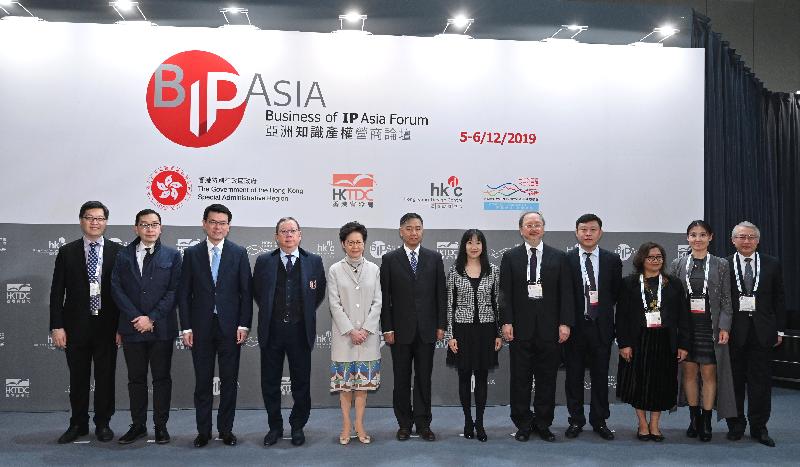
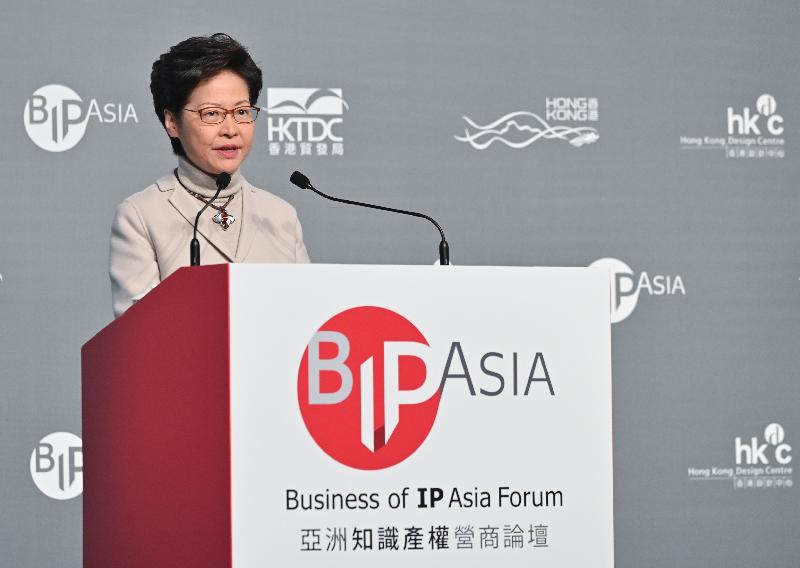
Photo  Photo