CS inspects prevention and control measures at airport (with photos)

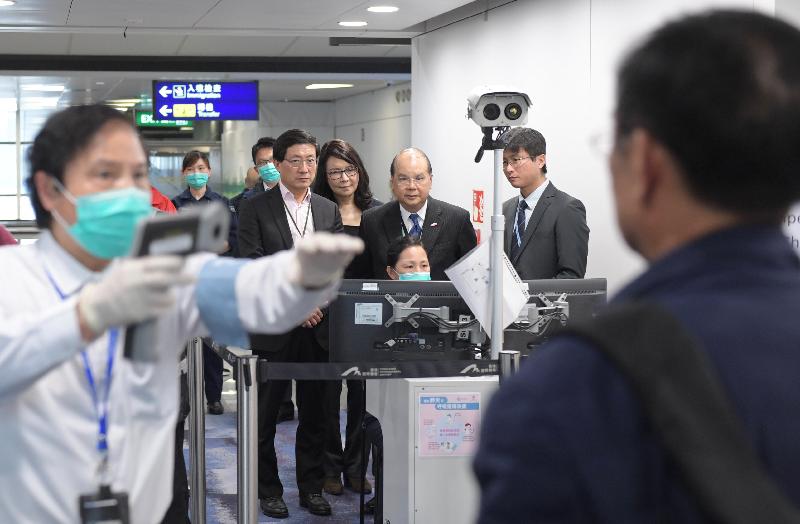
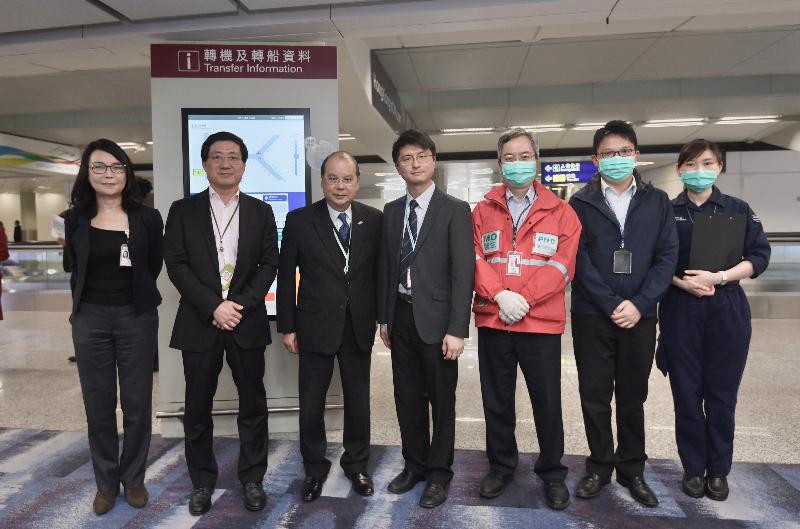
     The Chief Secretary for Administration, Mr Matthew Cheung Kin-chung, today (January 8) visited Hong Kong International Airport to inspect the prevention and control measures adopted in response to the cluster of pneumonia cases detected in Wuhan, Hubei Province. 

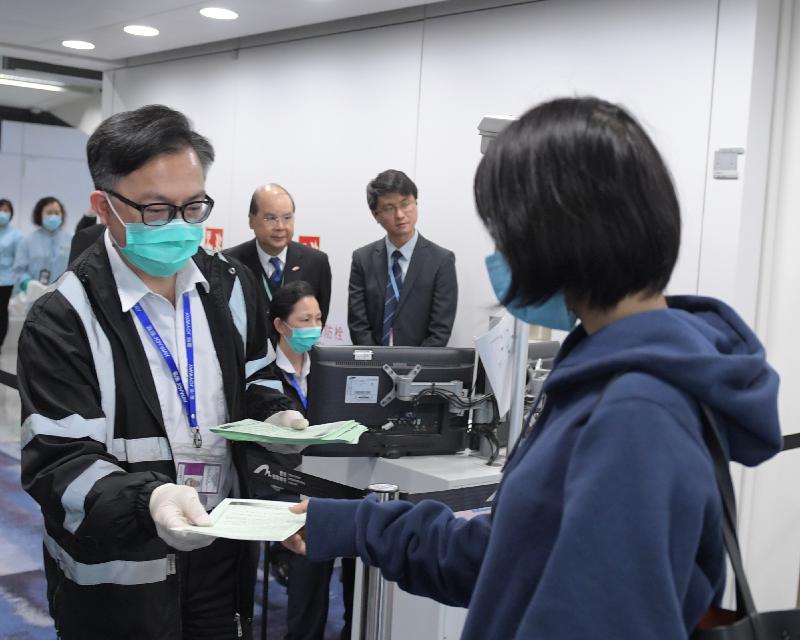
     At the gate of a flight from Wuhan, Mr Cheung, accompanied by the Chief Executive Officer of the Airport Authority Hong Kong, Mr Fred Lam; the Chief Port Health Officer of the Centre for Health Protection of the Department of Health, Dr Leung Yiu-hong; and the Executive Director, Airport Operations, of the Airport Authority Hong Kong, Mrs Vivian Cheung, observed officers of the Port Health Division of the Centre for Health Protection of the Department of Health inspecting temperatures of travellers concerned by using thermal imaging system.

     He was also briefed on the enforcement of prevention and control measures at the airport and expressed warmest gratitude to the officers for their dedication in safeguarding the health of the public and travellers.

     Mr Cheung stressed that whilst no serious pneumonia cases related to those in Wuhan have been detected in Hong Kong, the Hong Kong Special Administrative Region Government has strengthened prevention and control measures on all fronts including enhancing health surveillance measures at all boundary control points.

     He added that, at an earlier meeting of the inter-departmental action task force under his chairmanship, he instructed all relevant government departments to stay vigilant and step up cleaning efforts at public facilities under their purview.
     ã€€
     Mr Cheung also appealed to members of the public to maintain good personal and environmental hygiene. Those with symptoms of respiratory illness are advised to wear surgical masks, avoid going to crowded places and seek medical advice as soon as possible.
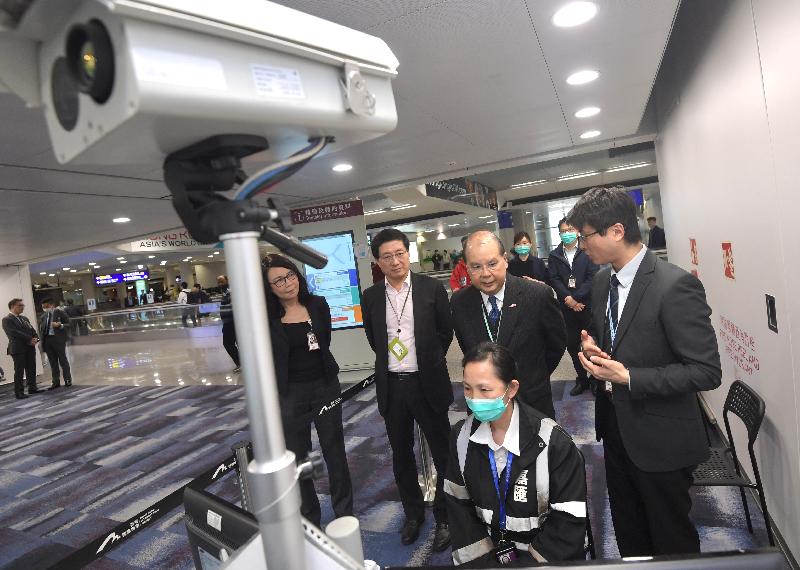
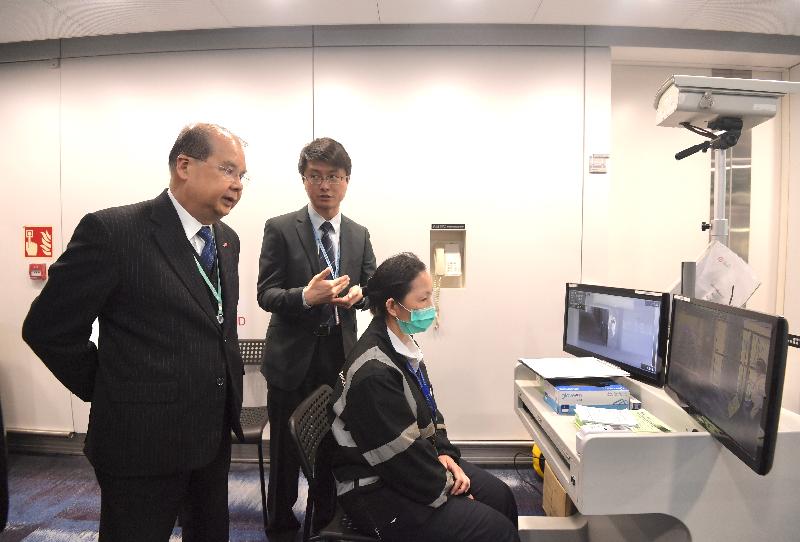
     

Photo  Photo  Photo  Photo  Photo  


LCQ19: Cleansing of police uniforms

     Following is a question by the Hon Joseph Lee and a written reply by the Secretary for Security, Mr John Lee, in the Legislative Council today (January 8):
 
Question:
 
     Since June last year, the Police have used a total of some 16 000 tear gas canisters during public meetings and processions. Some online rumours have claimed that some frontline police officers took their uniforms and other clothing (police clothing) worn at work to self-service laundries for washing. As such police clothing might have been stained with residues of chemicals from tear gas canisters, some members of the public are worried about their clothing washed at such laundries being contaminated. Regarding the washing of clothing which might have been contaminated by chemicals, will the Government inform this Council:
 
(1) whether the Police have formulated guidelines on the decontamination and washing procedure for police clothing which might have been contaminated by chemicals;
 
(2) whether the clothing of uniformed and plain-clothed police officers is required to be sent to designated laundries for washing; if so, of the locations of such laundries and their operation details; if not, the reasons for that;
 
(3) whether the Police have, since June 9 last year, outsourced laundry work; if so, of the details, including the decontamination and washing procedure to be followed by the service contractors, as well as whether it is provided in such procedure that police clothing which might have been contaminated by chemicals must be handled separately from other clothing; and
 
(4) given that on the evening of November 17 last year, the Police fired a number of tear gas canisters on Gascoigne Road adjacent to the Queen Elizabeth Hospital, whether the Police have liaised with the Hospital Authority afterwards for making special arrangements for washing the clothing in the hospital which might have been contaminated by chemicals?
 
Reply:
 
President,
 
     My reply to the question raised by Hon Joseph Lee is as follows:
 
     Since early June last year, more than 1 200 protests, processions and public assemblies have been staged in Hong Kong, many of which ended up in violent illegal acts. When illegal acts take place, the Police must take appropriate law enforcement actions to maintain public order, protect lives and properties of citizens, as well as preserve the public peace. The Police would not need to use any force if members of the public could express their views in a peaceful and lawful manner.
 
      The Police have strict guidelines on the use of force. Tear gas is used to create a safe distance between police officers and protesters, so as to avoid close confrontation and to reduce the chance of injury to either party as far as practicable, while dispersing the crowd and controlling the violent scenes.
 
      Tear gas contains 2-chlorobenzalmalononitrile, commonly known as CS, and is released into the air as particles. In general, post-exposure symptoms to tear gas may include burning sensation to the skin and eyes, coughing, sneezing and temporary breathing difficulty resulted from irritation to the nose and throat. These symptoms will usually subside after a short period of time.  On the health effects of tear gas, the Department of Health has uploaded health information on tear gas to the website of the Centre for Health Protection for the public’s reference. 
 
      As we understand from international literatures, similar to ordinary stains, CS will be washed into water during the washing process and will gradually dissolve in water. The dissolved CS will be hydrolysed rapidly. This is especially so when the temperature of the water will be increased during the normal washing process and the pH will also be increased by the alkaline additives used in the washing powder, as both processes will accelerate the CS hydrolysis process. Generally speaking, CS has a half-life of only one minute in water of 25 degrees Celsius and a pH value of 9 with general laundry detergents in the washing process. Therefore, ordinary laundry progress can already handle CS residuals that may be stained on clothes.
 
       As stipulated in the Police General Orders, officers should ensure that they are correctly dressed when in uniform at all times and that uniforms are kept clean and neatly pressed. Over the years, there have been arrangements in allowing police uniforms to be cleaned by laundries inside police stations which are operated by outsourced service contractors. Hence, according to the current arrangement, officers (both uniformed or plainclothes) participating in the operations may hand their uniforms or operational outfits to the laundries run by outsourced service contractors in police stations for washing, based on their operational needs. Police have not received any report of discomfort or health problems on the wearing of cleaned clothing all along.
 
      Regarding the incident occurred in the vicinity of Queen Elizabeth Hospital (QEH) on November 18, 2019, QEH has been closely monitoring the indoor air quality and made suitable arrangements, including temporarily suspending intake of fresh air to the ventilation system at specific areas, sealing off windows and turning on the indoor air curtains to reduce air infiltration. Portable air purifiers have been deployed to individual wards in need. In addition, QEH has arranged environmental cleansing and started replacing the air filters of ventilation system and medical compressed air system.
 
      QEH has maintained communication with its staff and provided necessary support regarding the incident. Staff Clinic has also provided support to staff who experienced discomfort under the influence of tear gas.


SCMA to visit Guangzhou

     The Secretary for Constitutional and Mainland Affairs, Mr Patrick Nip, will depart for Guangzhou tomorrow afternoon (January 9) to visit Hong Kong enterprises stationed at the Tianhe Hong Kong and Macau Youth Association entrepreneurship base. He will also officiate at the large-scale promotional event "Chic HK" organised by the Hong Kong Trade Development Council and address the event's dinner reception.     

     Mr Nip will return to Hong Kong in the evening on the same day.


Labour Department to hold briefing on employment of foreign domestic helpers

     The Labour Department (LD) will hold a briefing on the employment of foreign domestic helpers (FDHs) on February 8 (Saturday) at 2.30pm at the Lecture Theatre of the Hong Kong Central Library, 66 Causeway Road, Causeway Bay. Enrolment is now open.

     The employment rights and obligations of employers of FDHs will be introduced. Employers of FDHs, especially first-time employers, are welcome to attend.

     The briefing will be conducted in Cantonese and admission is free. Seats will be allocated on a first-come, first-served basis.  The enrolment deadline is February 5 (Wednesday). The enrolment form can be downloaded from the department's website (www.labour.gov.hk). For enquiries, please call the LD at 2852 4000.


LCQ21: Allocation of funding to District Councils

     Following is a question by the Hon Hui Chi-fung and a written reply by the Secretary for Home Affairs, Mr Lau Kong-wah, in the Legislative Council today (January 8):
 
Question:

     Regarding the allocation of funding by the Government to the various District Councils (DCs) for implementing district minor works projects and community involvement projects, will the Government inform this Council:

(1) of the respective amounts of funding allocated to each DC in respect of (i) district minor works projects and (ii) community involvement projects, in each of the past three financial years and in the current financial year (up to December 31, 2019);

(2) whether the amounts of funding for the current financial year received by the various DCs have been revised subsequent to the conclusion of the 2019 District Council Ordinary Election; and

(3) of the procedure and legal basis for determining and revising the amounts of funding receivable by the various DCs each year, the government departments involved in making the relevant decisions, and whether they are required to consult DCs and the Legislative Council prior to making such decisions?
 
Reply:

President,

     A consolidated reply to various parts of the question is as follows:

(i) District Minor Works (DMW) Programme

     Since 2008-09, the Government has been implementing the DMW programme in the 18 districts of Hong Kong, aiming to improve local facilities, living environment and hygiene conditions in the territory. The programme provides funding for District Councils (DCs) to initiate and carry out district-based minor works projects.

     The annual basic provision for block allocation Subhead 7016CX District Minor Works Programme under the Capital Works Reserve Fund is $340 million. The Home Affairs Department (HAD) may apply for additional funding to cater for special circumstances in individual years (such as reconstruction or repair works required due to natural disasters). Works projects of such nature requires DC endorsement, just as any other minor works projects. The annual funding proposal will be submitted to the Legislative Council Finance Committee for approval, upon which HAD will allocate funding to various districts according to population size, land area, socio-economic factors, etc.

     In 2019-20, the allocation for the DMW programme is $360 million, including the basic funding of $340 million and an additional one-off provision of $20 million for repairing some facilities damaged by typhoon Mangkhut. Allocation of funding to various DCs from 2016-17 to 2019-20 is at Annex 1. Funding allocated to various DCs for 2019-20 remains unchanged after completion of the 2019 District Council Ordinary Election.

(ii) Community Involvement (CI) Projects

     The Government provides annual funding to DCs for implementation of CI projects to meet the needs of their districts. These projects may include community building activities, district sports activities, arts and culture programmes, greening activities, volunteer activities, etc. DCs are responsible for identifying suitable projects for implementation or sponsorship and examining funding applications to ensure that the use of funds will meet the needs of the districts and benefit more people in the community.

     The allocation for CI projects in 2019-20 is $461.6 million. In allocating funding to the 18 DCs, HAD will take into account factors such as population size, socio-economic factors, land area and the past pattern of fund utilisation, and submit the proposed allocation for various districts to the Home Affairs Bureau for approval. Allocation of funding to various DCs for CI projects from 2016-17 to 2019-20 is at Annex 2. Funding allocated to various DCs for 2019-20 remains unchanged after completion of the 2019 District Council Ordinary Election.