Transcript of remarks by CS at media session (with video)

     Following is the transcript of remarks by the Chief Secretary for Administration, Mr Matthew Cheung Kin-chung, and the Secretary for Home Affairs, Mr Lau Kong-wah, at a media session after meeting with the new District Council members this afternoon (January 10):
 
Reporter: Mr Cheung, are you disappointed that so many pro-democracy councillors have boycotted this meeting? And how will you enhance the communication with them in the coming four years?
 
Chief Secretary for Administration: We were a bit disappointed, of course, that only 40 members turned up today. But these 40 members were very active. In fact, 20 of them had the chance to speak up and speak from their heart, speak their mind, and we did answer them fully and satisfactorily. We had a very good exchange this afternoon including two hours of Q&A. Only 20 minutes was spent on a very brief introduction for the work of the DCs. It’s a very useful, productive, I would say fertile, exchange in the first place. It’s an initial exchange. We will certainly continue our dialogue, our interaction with District Councils in the months to come. OK?

(Please also refer to the Chinese portion of the transcript.)


Import and sale of shellfishes harvested in production areas 35.11 and 35.06 in France suspended

     â€‹The Centre for Food Safety (CFS) of the Food and Environmental Hygiene Department announced today (January 10) that the import into and sale within Hong Kong of shellfishes harvested in production areas 35.11 and 35.06 in France have been suspended with immediate effect.
      ã€€ã€€
     A spokesman for the CFS said, "The CFS received a notification from the Rapid Alert System for Food and Feed (RASFF) of the European Commission that shellfishes harvested in the abovementioned areas which were suspected to be contaminated with norovirus were under recall. For the sake of prudence, the CFS has immediately suspended the import into and sale within Hong Kong of all shellfishes harvested in the two areas concerned."
      ã€€ã€€
     Upon learning of the incident, the CFS immediately followed up with major local importers and retailers. Preliminary investigation found that a local importer had imported not ready-to-eat mussels from the abovementioned areas into Hong Kong which were on sale in its supermarkets. For the sake of prudence, the importer concerned had already voluntarily stopped sale and removed from shelves of the affected product. The CFS is tracing the distribution of the affected product. The trade should also stop using or selling the affected product harvested in the abovementioned areas concerned immediately if they possess them.
      
     "Shellfish (including mussels) are filter feeders which ingest food and absorb nutrients through filtering sea water. The shellfish may be contaminated with viruses if nourished with contaminated water. One may be infected by norovirus or other pathogenic microorganism if consuming undercooked shellfish which is contaminated. So, shellfish should be thoroughly cooked before consumption. Young children, elderly people, pregnant women and others with weakened immune systems should pay special attention when consuming shellfish," the spokesman said. 
      
     The CFS has informed the French authorities of the import suspension and will also notify the local trade. It will continue to follow up on the incident and take appropriate action to safeguard food safety and public health. Investigation is ongoing.


Government issues Red Outbound Travel Alert on Iran

     In view of the latest situation in Iran, the Hong Kong Special Administrative Region Government today (January 10) issued a Red Outbound Travel Alert (OTA) on Iran.
 
     A Government spokesman said, "Residents who intend to visit the country should adjust their travel plans and avoid non-essential travel, including leisure travel. Those already there should monitor the situation, exercise caution, attend to personal safety and avoid large gatherings of people."
 
     The Security Bureau will closely monitor the situation there. Any update will be issued through the media and the bureau's Mobile App and OTA webpage www.sb.gov.hk/eng/ota.
 
     Residents in Iran who need assistance may call the 24-hour hotline of the Assistance to Hong Kong Residents Unit of the Immigration Department (ImmD) at (852) 1868 or contact the Chinese Embassy in Iran at the consular protection hotline: (98) 912-2176035.
   
     Hong Kong residents are encouraged to use the online Registration of the Outbound Travel Information service (www.gov.hk/roti) of the ImmD to register their contact details and itinerary when outside Hong Kong. The information provided allows the ImmD to disseminate practical information to them through appropriate means, including SMS on mobile phones, on a timely basis when necessary.


CHP investigates case of human infection of rat Hepatitis E virus

     The Centre for Health Protection (CHP) of the Department of Health is today (January 10) investigating a case of human infection of rat Hepatitis E virus (HEV) and urged members of the public to be vigilant against hepatitis E infection and to strictly observe good personal, food and environmental hygiene.
 
     The case involves a 17-year-old male. He was admitted to Hong Kong Children Hospital for management due to underlying illnesses in August last year and had passed away on December 27 in the same year due to his underlying illnesses. He was found to have liver function derangement during admission.
 
     The patient's previous blood specimens tested positive for rat HEV upon retrospective laboratory testing.
 
     The CHP's epidemiological investigations revealed that the patient resided in Kwai Tsing District.
 
     "Based on the available epidemiological information, the source and the route of infection could not be determined. The CHP's investigation is ongoing," a spokesman for the CHP said.
 
     "The CHP has already informed the Pest Control Advisory Section of the Food and Environmental Hygiene Department about the case to carry out rodent control measures and a survey as appropriate," the spokesman added.
 
     The exact mode of transmission of rat HEV to humans is unknown at the moment. Possible routes of transmission include ingestion of food or water contaminated by rodents or their excreta, exposure to environments or objects contaminated by rodents or their excreta and direct contact with rodents or their excreta. The usual HEV causing human infection is transmitted mainly through the faecal-oral route.
 
     To prevent hepatitis E infection, members of the public should maintain good personal, food and environmental hygiene. For example, they should wash hands thoroughly before eating, store food properly or in the refrigerator, not leave food at room temperature for a long time, and use 1:99 diluted household bleach for general household cleaning and disinfection as household detergent may not be able to kill HEV. High-risk individuals, such as elderly persons with a major underlying illness (especially those who have undergone organ transplantation), pregnant women, patients with chronic liver disease and patients with Glucose-6-Phosphate Dehydrogenase Deficiency (also known as G6PD Deficiency), who are infected with HEV may develop a serious illness, so they should exercise extra caution.
 
     The Five Keys to Food Safety should be adopted when handling food, i.e. Choose (choose safe raw materials), Clean (keep hands and utensils clean), Separate (separate raw and cooked food), Cook (cook thoroughly) and Safe Temperature (keep food at a safe temperature), to prevent food-borne diseases.
 

  • Drink only boiled water from the mains or bottled drinks from reliable sources.
  • Avoid drinks with ice of unknown origin.
  • Purchase fresh food from hygienic and reliable sources. Do not patronise illegal hawkers.
  • Clean and wash food thoroughly. Cook food, especially seafood (e.g. shellfish), pork and pig offal, thoroughly before consumption. Avoid raw food or undercooked food.
  • Slice raw meat and offal into thin strips to allow thorough cooking, especially during hotpot or congee cooking.
  • For sliced pig liver, depending on the thickness and quantity, boil at 100 degrees Celsius or stir-fry in hot skillet/wok for at least three to five minutes.
  • Heating to an internal temperature of 90 degrees Celsius for 90 seconds is required for cooking of molluscan shellfish. If possible, remove the shells before cooking as they impede heat penetration. Otherwise, boil at 100 degrees Celsius until their shells open; boil for a further three to five minutes afterwards. Discard any shellfish that do not open during cooking.
  • For meat and offal, make sure that juices are clear, not red, and blood is not visible when you cut the cooked meat and offal.
  • When having hotpot, use separate chopsticks and utensils for handling raw and cooked foods to prevent cross-contamination.

     In general, rodents (such as rats) can transmit multiple diseases to humans directly and indirectly. The public are advised to adopt the following measures:
 

  • Eliminate sources of food and nesting places for rodents in the living environment. Store food in covered containers and handle pet food properly to avoid it becoming food for rodents;
  • Store all refuse and food remnants in dustbins with well-fitted covers. Dustbins must be emptied at least once a day;
  • Keep premises, especially refuse rooms and stairways, clean. Avoid accumulation of articles;
  • Inspect all flower beds and pavements for rodent infestation regularly; and
  • Avoid the high-risk activities below to reduce rodent contact:

        – Avoid rodent contact and places dirtied with rodent excreta;
        – Avoid handling rodents with bare hands;
        – Wash hands with liquid soap and water immediately after handling animals, and disinfect contaminated areas; and
        – If a wound appears, clean the broken skin immediately and cover it properly with waterproof adhesive dressings.
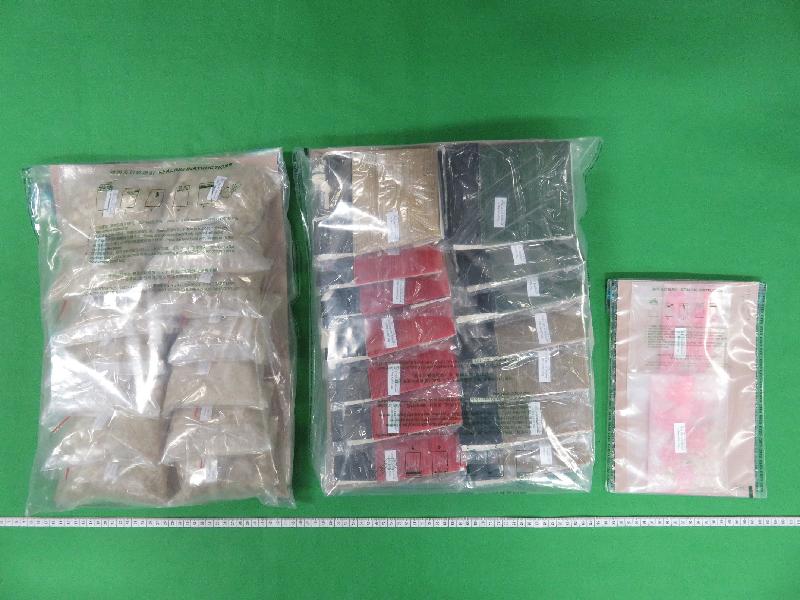


Hong Kong Customs seizes suspected dangerous drugs (with photo)

     Hong Kong Customs seized a total of about 4 kilograms of suspected 3,4-methylenedioxymethamphetamine (MDMA) with an estimated market value of about $600,000 at Hong Kong International Airport and Chai Wan on January 4 and yesterday (January 9).

     Customs officers inspected an air parcel arriving in Hong Kong from Germany on January 4 and found the batch of suspected dangerous drugs concealed in food packages inside 14 paper boxes.

     Upon follow-up investigation, Customs officers yesterday arrested a 41-year-old woman and a 42-year-old man suspected to be connected with the case in Chai Wan. A small amount of suspected MDMA was further seized at the woman's residential unit in the same district.

     The arrested woman has been charged with two counts of trafficking in a dangerous drug. She will appear at Eastern Magistrates' Courts tomorrow (January 11). The arrested man has been released on bail pending further investigation.

     Customs will maintain close contact with Hongkong Post and the logistics industries to step up action against drug trafficking through postal parcels and express courier channels.

     Under the Dangerous Drugs Ordinance, trafficking in a dangerous drug is a serious offence. The maximum penalty upon conviction is a fine of $5 million and life imprisonment.

     Members of the public may report any suspected drug trafficking activities to Customs' 24-hour hotline 2545 6182 or its dedicated crime-reporting email account (crimereport@customs.gov.hk).

Photo