Effective Exchange Rate Index

     The effective exchange rate index for the Hong Kong dollar on Monday, January 13, 2020 is 105.7 (down 0.2 against last Saturday's index).

     The effective exchange rate index for the Hong Kong dollar on Saturday, January 11, 2020 is 105.9 (down 0.2 against last Friday's index).


Speech by FS at Leadership Insights Session (English only)

     Following is the speech by the Financial Secretary, Mr Paul Chan, at Leadership Insights Session – “Opportunities for Hong Kong and Hong Kong’s Role in the Greater Bay Area” this morning (January 13):

Melissa (the President of the Law Society of Hong Kong, Ms Melissa Pang), Philip (the Chairman of the Hong Kong Bar Association, Mr Philip Dykes, SC), distinguished guests, ladies and gentlemen,
 
     Good morning. 

     It’s an honour to be here today, taking part for the first time in the Opening of the Legal Year in Hong Kong, and doing so through this morning’s “Leadership Insights Session.”     

     The Opening of the Legal Year is a vital annual occasion, as succinctly articulated by our first Chief Justice of the Court of Final Appeal, the Honourable Mr Andrew Li.

      Speaking at the opening of the Legal Year in January 1998, Chief Justice Li said of Legal Year, and I quote, “It provides an opportunity for us to speak about the challenges which we face. Above all, it enables the Judiciary, together with government lawyers, the Bar and the Law Society, to demonstrate to the public that they are united and can work together in achieving their common goal of serving the community and maintaining the rule of law.”
 
      Those words ring as true today as they did then, 22 years ago. The sanctity of the rule of law is absolutely essential to the stability, prosperity and future of Hong Kong.
 
      That future, in today’s competitive global economic landscape, is very much connected to the Guangdong-Hong Kong-Macao Greater Bay Area, the theme of this morning’s Session.
 
      The Greater Bay Area comprises Hong Kong, Macao and nine major cities in the Guangdong Province of the Mainland of China. Together, they count some 70 million people spread over more than 56 000 square kilometres, offering vast market potential.  Indeed, the combined GDP of the cluster city development exceeds US$1.6 trillion, comparable to that of Korea.
 
      From a market and division of labour perspective in this integrated development, the Greater Bay Area presents a unique opportunity for Hong Kong because of the “One country, Two systems” arrangement, which is Hong Kong’s great institutional advantage.  Our status as a special administrative region allows us to share in the long-term promise of the Greater Bay Area and other national policies and priorities, while maintaining a common law system entirely distinct from the rest of China, and the capitalist system of free enterprise, and free flow of factors of production – capital, information, talents and goods.  Our success as the world’s third international financial centre, just after New York and London, is a testimony of this unique institutional strength.    
 
      The Basic Law, our constitutional document, guarantees the “One country, Two systems” arrangement and ensures that Hong Kong exercises a high degree of autonomy, enjoying executive, legislative and independent judicial power. Under the Basic Law, the power of final adjudication is vested in the Court of Final Appeal of Hong Kong, with eminent judges from other common-law jurisdictions sitting as non-permanent judges.
 
      Thanks to the Basic Law, the backbone of our legal infrastructure, Hong Kong enjoys a world-wide reputation for its rule of law, its strong legal fraternity and its independent judiciary.
 
      In the World Bank’s latest Worldwide Governance Indicators, Hong Kong’s rule of law score rose from 69.85 in 1996 to 95.19 in 2018. That’s a leap from 70th place to top11 place in just over 20 years.
 
      Since 2003, Hong Kong’s rule of law score has remained consistently above 90.

     Our comprehensive body of legislation, case law, our tradition of respect for rule of law and our independent judiciary together, provides sound legal protection to businesses and other parties entering into transactions in the Greater Bay Area.
      
      Alongside its independence and impartiality, our judiciary is renowned for its support of arbitration and mediation. Our legal and dispute resolution professionals are highly regarded, their wide-ranging legal expertise covering finance, international trade and investment, infrastructure, maritime matters, intellectual property and more.
 
      That wealth of legal experience, and international cooperation, makes Hong Kong the natural hub for the provision of legal services to foreign investors in the Greater Bay Area.

     And we are, rest assured, taking full advantage of that. The first Guangdong-Hong Kong-Macao Bay Area Legal Departments Joint Conference was held here in Hong Kong last September. 
 
      At the Joint Conference, the three parties, the Department of Justice of Guangdong Province, the Office of the Secretary for Administration and Justice of the Macao Special Administrative Region and our own Department of Justice, agreed to study the feasibility of a Greater Bay Area mediation platform. That will work towards ensuring a unified system for the accreditation of mediators and mediation rules – an essential step in promoting mediation in the Greater Bay Area. 
 
     Beyond that, the Department of Justice is in discussions with Mainland authorities on more promising indeed, pioneering – proposals. 

     In April 2019, the Hong Kong Special Administrative Region (HKSAR) and the Mainland signed an agreement concerning mutual assistance in interim measures in aid of arbitration.  This arrangement allows parties in arbitration proceedings in Hong Kong to apply directly to Mainland court for interim relief, including property preservation, evidence preservation, and conduct preservation.  This arrangement, which is unique to Hong Kong, further enhances our attractiveness as a forum for resolving disputes. 
 
      I can tell you that, just over two months ago, the Central People’s Government announced a series of liberalisation measures to enable the development of legal services in the Greater Bay Area. 

     They include allowing eligible Hong Kong legal practitioners to obtain practice qualifications in the Greater Bay Area’s nine cities.  Hong Kong professionals will do so by passing an examination covering specific areas of Mainland law.  This measure has been included in an amendment to the Mainland and Hong Kong Closer Economic Partnership Arrangement (CEPA) Agreement on Trade in Services, signed in November. That, by the way, will be implemented in June this year.
 
      The capital input ratio requirement for partnership associations formed by Hong Kong and Mainland law firms was also removed. These are ground-breaking measures.  They enhance opportunities for Hong Kong legal professionals to participate in the Mainland market, particularly in the Greater Bay Area.
 
      It is important that legal sector in the Greater Bay Area’s three jurisdictions acquire a better understanding of their counterparts, so that they can maximise the wealth of opportunities the Greater Bay Area will present. In this regard, the Outline Development Plan for the Guangdong-Hong Kong-Macao Greater Bay Area (Outline Development Plan) encourages the strengthening of judicial and legal cooperation among Guangdong, Hong Kong and Macao. 
 
      I’m pleased to say that we are doing just that.  Last week, for example, the High People’s Court of Guangdong Province organised moot courts in Guangzhou for judges and legal practitioners from the Mainland, Hong Kong and Macao.  It proved a valuable opportunity to exchange views and deepen their understanding of the three legal systems.
 
      That’s imperative if the Greater Bay Area is to develop a legal framework that aligns with international standards. Doing so will greatly increase the Greater Bay Area’s attractiveness to international business. 
 
      Hong Kong’s legal and dispute-resolution services sector is certainly well positioned to contribute in this regard.  And the Government will continue with its efforts to develop Hong Kong as the capacity-building centre for the Greater Bay Area, while promoting legal exchange among the three jurisdictions.
 
      We will also continue to enhance Hong Kong’s development in international financial services, innovation and technology, transport, logistics and trade.
 
      The Greater Bay Area’s Outline Development Plan released last February, specified Hong Kong’s leadership role in those sectors, together with our international legal and dispute-resolution services. 
 
     That, ladies and gentlemen, offers Hong Kong extraordinary opportunity deep into this 21st century of outsized promise and, of course, significant challenges.

     Through it all, I look forward to the continuing support of the legal community, here in Hong Kong and around the world.

     I wish you a rewarding Session today and a year blessed with society-wide respect and support for the rule of law. With that, I am confident that peace, harmony and prosperity will surely follow.
 
      Thank you. 
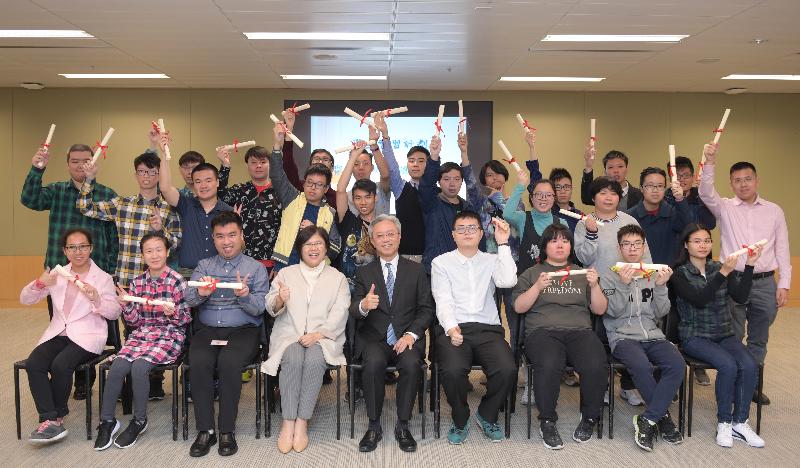


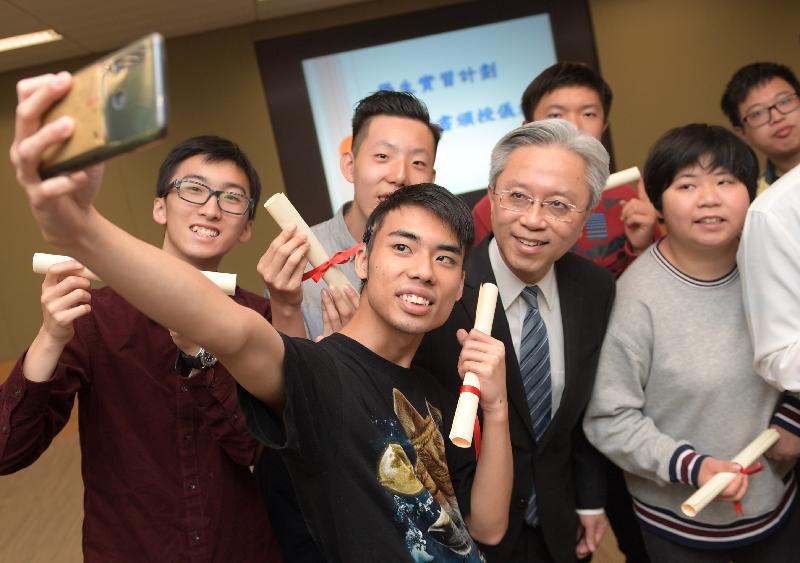
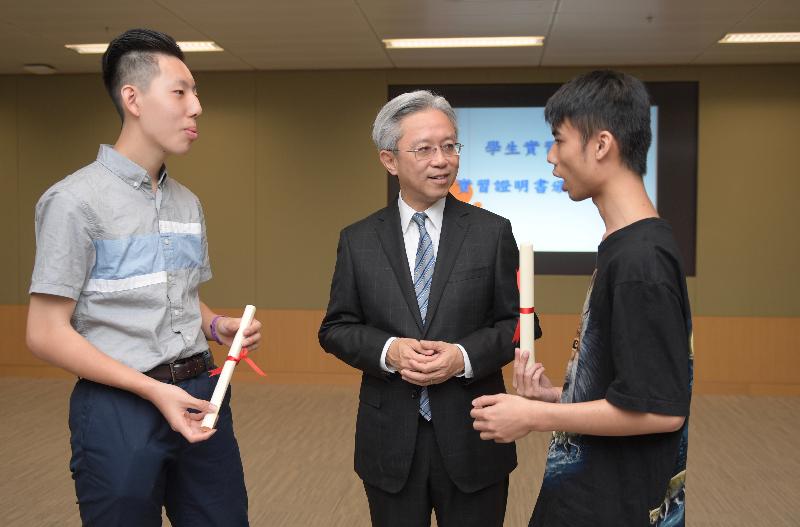
Student interns with disabilities equipping themselves to meet challenges ahead (with photos)

     The Secretary for the Civil Service, Mr Joshua Law, today (January 13) presented certificates to students of the Shine Skills Centre of the Vocational Training Council who participated in a government internship scheme. Mr Law commended their performance and efforts during the internship, and encouraged them to continue to equip themselves for meeting challenges ahead.

     At a tea gathering today with students of the Shine Skills Centre who have completed the internship, Mr Law said the Civil Service Bureau (CSB) has doubled the number of internship places for students with disabilities from an average of 50 a year to 100 since 2018 to provide opportunities for more young persons with disabilities to gain work experience in the Government, thereby strengthening their competitiveness before entering the workforce.

     Mr Law said that the student interns were given opportunities to take up diversified jobs having regard to their aptitude and interests, including graphic design, editing and processing databases, providing support for a sports ground and event co-ordination and support.

     A total of 35 students, who were assigned to 20 government bureaux and departments for internship in late 2019, received certificates today. 

     Two interns, Mr Hugo Choi and Mr Elvis Wong, were tasked to undertake clerical duties in the Electrical and Mechanical Services Department and the Environmental Protection Department (EPD) respectively.

     Mr Choi said the internship scheme not only provided him with valuable learning opportunities, but also allowed him to learn to communicate and get along with others, which helped boost his confidence. Expressing his gratitude to his colleagues for their guidance and support, he said the internship was truly enjoyable and practical.

     Mr Wong said the scheme, apart from providing him with an opportunity to acquire work skills, also brought him an unexpected experience. He pointed out that he was impressed by the recycling facilities in the EPD offices and the colleagues' commitment to separating waste, adding that his awareness of environmental protection was also raised.

     The performance of the student interns has been highly praised by colleagues of participating departments. Mentors also expressed appreciation for their efforts in gaining new knowledge and skills in their daily work.

     The CSB launched the internship scheme for students with disabilities in 2016 to enable them to gain work experience, and to give civil service colleagues more opportunities to better appreciate the talents and potential of persons with disabilities.

Photo  Photo  Photo  


Centre for Food Safety announces test results on Lunar New Year food (second phase)

     The Centre for Food Safety (CFS) of the Food and Environmental Hygiene Department today (January 13) announced the test results of a recently completed seasonal food surveillance project on Lunar New Year (LNY) food (second phase). The test results on 190 samples collected were all satisfactory.
 
     "The CFS announced the first-phase test results on LNY food last month. As the LNY is around the corner, the CFS has completed the second phase of the surveillance project. Different types of LNY food, including steamed puddings (e.g. turnip puddings and festive cakes), fried dumplings (e.g. sesame balls and crispy triangles), candies, glutinous rice balls, melon seeds and dried aquatic products, were collected from different retailers (including online retailers) for chemical and microbiological tests as well as nutrition content analysis," a spokesman for the CFS said.
 
     Chemical tests targeted preservatives (e.g. sulphur dioxide, benzoic acid and sorbic acid), colouring matters (e.g. Sudan dyes), antioxidants and metallic contaminants (e.g. cadmium, mercury and arsenic). Microbiological tests covered different food poisoning pathogens, such as Salmonella, Clostridium perfringens, Bacillus cereus and coagulase-positive staphylococci organisms. For nutrition content analysis, contents of energy, carbohydrates, protein, total fat, saturated fatty acids, trans fatty acids, sodium and sugars of the samples were tested to see if the test results comply with their declared values on the nutrition labels.
 
     The spokesman urged the food trade to observe the relevant laws and regulations in the preparation of food, follow Good Manufacturing Practice and use permitted food additives only in an appropriate manner. Retailers should source food from reliable suppliers, and conduct quality checks of incoming materials and end products to ensure that ingredients used are within legal standards. In addition, the food trade should maintain proper records in accordance with the requirements of the Food Safety Ordinance to allow source tracing if needed.
 
     He also advised consumers to buy LNY food from reliable retailers with good hygiene conditions; make sure the packaging of prepackaged cakes and snacks is intact and the products have not expired; refer to the nutrition labels on the sugar, salt (sodium) and fat content and more for healthier choices; and pay attention to the hygiene conditions of food containers and the personal hygiene of staff when buying loose-packed food (e.g. candied lotus seeds, nuts and melon seeds).
 
     "Consumers should choose food products with natural colours. Bright white pistachios may have been bleached and melon seeds with unnatural gloss may have had mineral oil added. Consumption of these food products can cause gastrointestinal discomfort," the spokesman said.
 
     "Festive cakes that are not for immediate consumption should be kept refrigerated or stored according to the instructions on the package, and should be eaten before they expire. Reheat hot-served festive cakes thoroughly before consumption, consume them as soon as possible, and avoid keeping them at room temperature for a long time. Foods like nuts and melon seeds should not be kept for a long time. Those with mould or an abnormal smell or taste should not be eaten," he added.
 
     The spokesman reminded the public to maintain a balanced diet and avoid foods that are high in energy, sugar, salt or fat during LNY. The CFS advises members of the public to share seasonal food with their friends and relatives while enjoying the festive season.
 
     Please visit the CFS website (www.cfs.gov.hk) for more food safety tips.


Parents reminded to choose primary schools

     Children who have joined the Primary One Admission (POA) System for 2020 but have not yet secured a discretionary place can take part in the Central Allocation process by making their choice of schools on either Saturday (January 18) or Sunday (January 19).

     "By participating in Central Allocation, these students will be allocated a government or aided primary school place," a spokesman for the Education Bureau said today (January 13).

     "The School Places Allocation Section of the bureau has sent letters to the parents concerned inviting them to make their choice of schools at a specified Central Allocation Centre. Each centre will operate from 9.30am to 12.30pm and from 1.30pm to 4.30pm on January 18 and January 19.

     "A completed Choice of Schools Form must be returned to the same centre on either of the two days," the spokesman said.

     "Parents who have not yet received the invitation letter should call the School Places Allocation Section at 2832 7700 as soon as possible."

     Parents who have recently moved or have plans to move in the near future are required to inform the School Places Allocation Section as soon as possible so that they can make school choices in the POA School Net where their new home is located. Parents should fill in the actual residential address of their child. If a false address is given by parents to secure a Primary One (P1) place for their child under the POA System, the application will be rendered void and the P1 place allocated will be withdrawn.

     The bureau has put in place a monitoring mechanism to verify the residential addresses of children as given by the parents. Random checks of applicant children's addresses are also being stepped up. The public are encouraged to report suspected cases of individuals using a false address to the School Places Allocation Section by calling the hotline at 2832 7700. As in previous years, the bureau will take appropriate action against false address cases.

     For enquiries about the procedures for Central Allocation, please call the bureau's 24-hour automatic telephone enquiry service at 2891 0088.

     Central Allocation is composed of two parts. Part A, which takes up 10 per cent of the P1 places earmarked for Central Allocation, is for unrestricted school choices. Parents can choose up to three government or aided primary schools in any school net. Part B takes up the remaining 90 per cent of the P1 places earmarked for Central Allocation. Parents of applicant children residing in the school net concerned are to select schools from the "Choice of Schools List for Central Allocation" of their school net, while parents of applicant children who intend to commute daily to schools in Hong Kong are to select schools from the "Choice of Schools List for Central Allocation (For Applicant Children who intend to commute daily to schools in Hong Kong)". Parents should fill in the Choice of Schools Form in the order of their preference.

     The computer-programmed Central Allocation will first process the school choices in Part A and then the school choices in Part B. For oversubscribed schools, the order of priority in allocating places will be determined by random numbers generated by the computer for individual applications. This is to ensure fairness to all applicant children.

     For applications for participation in POA 2020 after January 19, parents need to complete the necessary procedures with the School Places Allocation Section of the Education Bureau. The Education Bureau will separately arrange P1 places for the applicant children this June.

     In the event of adverse weather or other special conditions on any day during the period of making school choices, please pay heed to radio or television announcements on any special arrangements.

     The results of Central Allocation are scheduled for release on June 6.