January 2020 issue of “Hong Kong Monthly Digest of Statistics” now available

     The Census and Statistics Department (C&SD) published today (January 15) the January 2020 issue of the "Hong Kong Monthly Digest of Statistics" (HKMDS).

     Apart from providing up-to-date statistics, this issue also contains two feature articles entitled "Air Cargo Statistics" and "Use of Language in Hong Kong".

"Air Cargo Statistics"

     The Hong Kong International Airport is one of the busiest and most advanced airports. It consolidates Hong Kong's position as a hub of commerce and plays a very important role in the development of Hong Kong as a logistics centre. In terms of international air cargo throughput, the Hong Kong International Airport continued to rank first among all airports in the world in 2018. This feature article provides a detailed analysis of the air cargo statistics of Hong Kong from 2014 to 2018 and briefly highlights the more recent performance of the industry by making reference to the quarterly air cargo statistics from the first quarter of 2017 to the third quarter of 2019.

     For enquiries about this feature article, please contact the Trade Statistics Processing Section, C&SD (Tel: 2582 5039; email: tsp_1@censtatd.gov.hk).

"Use of Language in Hong Kong"

     The C&SD conducted a Thematic Household Survey on use of language in Hong Kong during March to June 2018 to collect information on Hong Kong persons aged 6 to 65 on the use of spoken and written Chinese and English. This feature article briefly describes the major findings of the survey.  

     For enquiries about this feature article, please contact the Social Surveys Section, C&SD (Tel: 2887 0416; email: thematic@censtatd.gov.hk).

     Published in bilingual form, the HKMDS is a compact volume of official statistics containing about 140 tables. It collects up-to-date statistical series on various aspects of the social and economic situation of Hong Kong. Topics include population; labour; external trade; National Income and Balance of Payments; prices; business performance; energy; housing and property; government accounts, finance and insurance; and transport, communications and tourism.  For selected key statistical items, over 20 charts depicting the annual trend in the past decade and quarterly or monthly trend in the recent two years are also available. Users can download the Digest free of charge at the website of C&SD (www.censtatd.gov.hk/hkstat/sub/sp460.jsp?productCode=B1010002).

     Enquiries about the contents of the Digest can be directed to the Statistical Information Dissemination Section of C&SD (Tel: 2582 4738; email: gen-enquiry@censtatd.gov.hk).


Effective Exchange Rate Index

     The effective exchange rate index for the Hong Kong dollar on Wednesday, January 15, 2020 is 105.6 (same as yesterday's index).


Employment agency’s application for licence renewal refused

     A spokesman for the Labour Department (LD) today (January 15) reminded licensees of employment agencies (EAs) to conduct their business in compliance with the law at all times.

     The LD refused to renew the licence of Berkah Employment Consultant Centre located in Tsuen Wan as the licensee of this EA had been convicted under the Theft Ordinance.
 
     Under section 53(1)(c)(ii) of the Employment Ordinance (EO), the Commissioner for Labour may refuse to issue or renew an EA licence if the licensee has, within the preceding five years, been convicted of an offence involving membership of a triad society, fraud, dishonesty or extortion.
 
     "Licensees and operators of EAs are reminded to conduct their business in compliance with the law, including the EO and the Employment Agency Regulations, as well as the Code of Practice for EAs, at all times. Otherwise their licences may be revoked or their applications for licence renewal may be refused," the spokesman said.
  
     This was the ninth revocation or refusal of renewal of an EA licence made by the LD in 2019.
    
     For enquiries about matters related to EAs or complaints about their malpractices, please call the Employment Agencies Administration of the LD at 2115 3667, or visit its office at Unit 906, 9/F, One Mong Kok Road Commercial Centre, 1 Mong Kok Road, Kowloon.


Speech by FS at Asia Private Equity Forum 2020 (English only) (with photo/video)

     Following is the speech by the Financial Secretary, Mr Paul Chan, at the Asia Private Equity Forum 2020 at the Hong Kong Convention and Exhibition Centre this morning (January 15):

Chin (Chairman of Hong Kong Venture Capital and Private Equity Association, Mr Chin Chou), Eric (Chairman of Asia Private Equity Forum 2020, Mr Eric Mason), distinguished guests, ladies and gentlemen,

     Good morning.
 
     It's a great pleasure to be here with you again for the Asia Private Equity Forum's 10th anniversary edition.
 
     I'm pleased, and grateful to see so many of you here today, to know that the Forum features more than 80 high-profile speakers – from Hong Kong, from the Mainland, throughout Asia and around the world.
 
     The early New Year scheduling of this annual financial highlight is a welcome opportunity to look to the past as well as the future.
 
     I'll do a little of both over the next few minutes, though I'll try to stay clear of predictions – especially about the future.
 
     That includes the United States-China trade conflict. While the upcoming signing of the Phase 1 trade deal is now cause for optimism, there may well yet be complications to contend with down the 2020 road to trade peace in our time.
 
     The global trade impasse has certainly blunted Hong Kong's 2019 economic performance. So, too, has the unprecedented social unrest that has shaken the Hong Kong community over the past six months.
 
     Final figures are not yet in, but the IMF (International Monetary Fund) and private sector analysts estimate our 2019 GDP at anywhere from -2.1 per cent to +0.7 per cent. Our own estimate is about -1.3 per cent.
 
     Let me add that, when it comes to finance, I'm not a fan of the minus sign.
 
     To counter our adverse economic conditions, I've unveiled four sets of relief measures since last August. Totalling some HK$25 billion, the funds are focused on supporting businesses and lightening the burden weighing on the people of Hong Kong.

     Meanwhile, we will continue to reach out to the community. Through wide-ranging dialogue communication and the pursuit of policies that address the deep-seated issues at the heart of our divide, I am hopeful that together we will find a path to peace and prosperity.
 
     From an economic perspective, there is reason for optimism. I am heartened by the confidence private equity investors have shown in us. In the third quarter of 2019, some 560 private equity companies here managed US$153 billion.
 
     We have nearly 50 more private equity (PE) firms based here when compared with the previous quarter. Among the world's top 10 PE fund managers, nine have a presence here in Hong Kong. That, ladies and gentlemen, underlines Hong Kong's formidable strengths in the Asian PE market. In that we trail only Mainland.
 
     By channelling capital into corporations and start-ups in the innovation and technology field, PE and VC (venture capital) funds may well become as important as banks and IPO markets one day. 
 
     This Government is determined to help unlock the vast potential of the asset and wealth management business, because we believe you are critical to ensuring Hong Kong's status as one of the world's leading financial centres. 
 
     That's why we have been stepping up efforts to sharpen Hong Kong's competitive edge on asset and wealth management through a multi-pronged approach including: (a) diversifying our fund structures and streamlining the licensing process to encourage fund formation; (b) adopting a more user-friendly approach to attract family offices; (c) providing a more facilitative tax environment for funds; and (d) expanding our fund distribution network through deepening our mutual access arrangements with other major financial markets.
 
     On fund structure, the long-awaited, limited-partnership fund regime is close to reality, thanks in part to your favourable feedback. Indeed, we are now developing the necessary legislation. Because of the current filibustering at the Legislative Council, the tabling of the legislation got a little delayed, but it remains our top policy priority for the rest of this year to put this forward.
 
     We are confident that the new regime will attract PE and VC funds, and we count on your support for that. With the new regime in place, we aim to bring in as many offshore funds as possible onshore to Hong Kong. We are well positioned to capture the opportunity arising from what happened on the international front over tax base erosion. This is mutually beneficial to Hong Kong as a fund hub and also the PE industry at large as you search for a new home for the funds you manage. My colleague, Chris Sun (Deputy Secretary for Financial Services and the Treasury (Financial Services)1), will have more to say on Hong Kong's promise as a private equity hub later this morning.
 
     PE and VC funds, whether onshore or offshore, have enjoyed a profits tax exemption since last April. A tax-exempt fund can invest in local and overseas private companies. Hong Kong, by now, has a tax regime at fund level that is competitive and caters to the needs of the PE industry. I fully understand that resolving the tax issues at fund level is not enough in itself. It is of even greater importance to tackle head-on the tax arrangement for investment managers. This is a hard nut to crack, but one that I am determined to look into and come up with solutions that will strengthen Hong Kong's position as a leading fund hub with one of the most competitive tax arrangements for investment managers in the PE industry.   
 
     The significance of the limited partnership fund regime in completing Hong Kong's fund manufacturing infrastructure is underpinned by its precursor – the open-ended fund company regime. Since its operation in July 2018, a number of open-ended fund companies have sprouted. The SFC (Securities and Futures Commission) is also looking into how to make the regime more business-friendly to facilitate the take-up.
 
     In short, the Government and our regulators are committed to developing Hong Kong into a full-fledged fund-service centre. 

     We're equally intent on expanding our fund-distribution network. We continue to expand our Mutual Recognition of Funds arrangements. Last year, Luxembourg and the Netherlands joined existing partners, the Mainland, Switzerland, France and the United Kingdom. More international partnerships will follow.

     Hong Kong is also an ideal location for the establishment of family offices, and we are boosting our promotional efforts in this regard.
 
     The Hong Kong Monetary Authority and InvestHK will provide comprehensive services to attract family offices to Hong Kong. The SFC has also recently issued licensing guidance for PE firms and family offices. This will enhance clarity and would help address the industry's concerns.

     Without a steady flow of talented professionals, of course, we won’t be able to cash in on all the opportunities there for us.  That's why the Government's Pilot Programme to Enhance Talent Training for the Asset and Wealth Management Sector has been supporting the industry since 2016.

     I encourage you to offer exposure, opportunity and jobs for our youth. To give them a stake in the society through the programme.

     Zooming out a bit, the Government will continue to boost Hong Kong's singular advantage as the business and financial bridge between international markets and investors and their counterparts on the Mainland. 
 
     To that end, we continue to emphasise the established channels – our Stock Connects, Bond Connect and the Mutual Recognition of Funds arrangements. We will also strengthen our position as the global offshore Renminbi business hub.
 
     Then there's the Guangdong-Hong Kong-Macao Greater Bay Area Development, and the extraordinary opportunity that it presents to Hong Kong.

     With a GDP in excess of US$1.6 trillion and more than 70 million prosperous consumers, the Greater Bay Area presents vast potential for the asset and wealth management sector. For each and every one of you. The establishment of a Greater Bay Area wealth-management connect scheme, which was, as you know, recently announced, will go a long way towards realising that promise.

     Our regulators are working out the details with their counterparts on the Mainland, and we will keep you posted and we are determined to push that forward as soon as possible. 

     For now, I wish you all a rewarding Forum and a healthy, harmonious and prosperous 2020. Thank you.
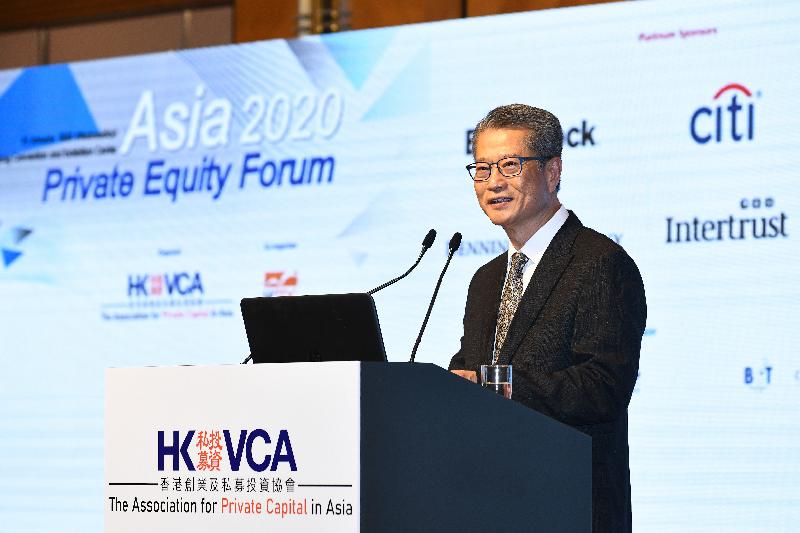
Photo  


LCQ16: Development of a “Sponge City”

     â€‹Following is a question by the Hon Elizabeth Quat and a written reply by the Acting Secretary for Development, Mr Liu Chun-san, in the Legislative Council today (January 15):
      
Question:
      
     It is learnt that "Sponge City" is a modern stormwater management approach which helps collect stormwater effectively, optimise the use of stormwater through the water recycling system and drain away stormwater timely to prevent the occurrence of flooding. At present, quite a number of countries and more than 30 Mainland cities have adopted the "Sponge City" concept, and Hong Kong has planned for many years to develop a "Sponge City". In this connection, will the Government inform this Council:

(1) of the works for stormwater harvesting and drainage systems carried out in the past three years which incorporated the concept of "Sponge City" at the design stage; the details of such type of works which are currently in progress;
 
(2) of the costs of "Sponge City"-related works in the past three years; whether it has evaluated the effectiveness of such works; if so, of the details; if not, the reasons for that;
 
(3) given that the Underground Stormwater Storage Scheme is a case that exemplifies the application of the "Sponge City" concept and the existing three underground stormwater storage tanks in Hong Kong are located at Tai Hang Tung, Sheung Wan and Happy Valley respectively, whether the authorities have plans to build underground stormwater storage tanks in other districts (e.g. the New Territories); if so, of the details; if not, the reasons for that;
 
(4) as the Drainage Services Department (DSD) indicated in its "Sustainability Report 2016-17" that it had, by making reference to the "Sponge City" concept, incorporated green roofs and vertical greening into its drainage facilities to reduce surface runoff, and would continue to build 4 000 additional square metres of such green facilities each year, of the additional square metres of green roofs and vertical greening built by the Government, as well as the costs of works incurred annually, since the financial year of 2016-2017;
 
(5) given that "Sponge City"-related works currently fall within the remit of different government departments (including the Water Supplies Department, DSD and Environmental Protection Department), while such type of works are overseen by one single department in Singapore (i.e. the Public Utilities Board), whether the authorities will follow such practice; if so, of the details; if not, the reasons for that; and
 
(6) as it is learnt that the Government is actively introducing design elements with "sponge" effects to new development projects, such as constructing the first flood retention lake in Hong Kong under the plan of the Development of Anderson Road Quarry Site and establishing the first river park in Hong Kong in the Tung Chung New Town Extension, how these two projects apply the concept of "Sponge City", and of their latest work progress and completion dates?

Reply:
 
President,
 
     Global climate change leads to sea level rise as well as more extreme rainstorm and storm surge events, resulting in the higher risk of flooding.  To combat climate change and improve the flood resilience of Hong Kong, the Drainage Services Department (DSD) strives hard to enhance its stormwater drainage system.  Among different measures, the DSD will proactively promote adopting the design elements of the "Sponge City" concept in the planning of drainage improvement works and new development projects.
      
     The "Sponge City" is a concept of modern stormwater management which simulates the natural water cycle based on the approach of "following the nature with resilience".  It follows the integral flood prevention management of six principles, "infiltration, detention, storage, purification, reuse and discharge", with a view to making a city function like a sponge such that that it can infiltrate, absorb, store and purify stormwater during rainy days, and release the stored water for utilisation as needed.  The design elements of the "Sponge City" concept include porous pavement, attenuation and treatment ponds, storage tanks, retention lakes and greening facilities.
      
     We provide response to the various parts of the question raised by the Hon Elizabeth Quat as follows:
 
(1 and 2) In the past three years, public works projects with the "Sponge City" design elements and their costs are listed below.
 

Item No. Project Title Project Cost*
(HK $)
Completed Projects
1 Happy Valley Underground Stormwater Storage Scheme Around $ 1.07B
2 Development at Anderson Road Around $ 3.47B
Projects under Construction
3 West Kowloon Drainage Improvement – Inter-reservoirs Transfer Scheme Around $ 1.22B
4 Development of Anderson Road Quarry Site – Site Formation and Associated Infrastructure Works Around $ 7.69B

*The figures shown above are approved project estimates of the projects.  As the “Sponge City” concept is generally adopted for flood prevention and is embodied in the design of the projects, detailed breakdown of the respective cost is not available.

     Application of the “Sponge City” concept can effectively reduce the risk of flooding. For example, the Happy Valley Underground Stormwater Storage Scheme, the tank with a volume reaching 60 000 cubic metres (equivalent to the total volume of 24 standard swimming pools) is capable of handling a heavy rainstorms with a 50-year return period. It can further increase the flood protection level of Happy Valley and the Wan Chai area. During the black rainstorm warning was in force on May 24, 2017, the Happy Valley Underground Stormwater Storage Tank drained and temporarily stored 12 000 cubic metres of rainwater (i.e. equivalent to the total volume of about five standard swimming pools), which greatly reduced the surface runoff to the downstream during the rainstorm and protected the citizens from the threat of flooding.
 
(3) Currently, there are four stormwater storage tanks in Hong Kong locating at Tai Hang Tung, Sheung Wan, Happy Valley and On Sau Road.  DSD will consider the need and feasibility of constructing underground stormwater storage tanks under its stormwater drainage improvement projects.
 
(4) In 2016-2018, the total area of greening works implemented on government buildings was about 100 000 square metres. As the relevant expenditure is generally merged in individual projects, detailed breakdown of the annual expenditure is not available.
 
(5) In Hong Kong, DSD is the responsible department taking the lead to promulgate the incorporation of the "Sponge City" elements in drainage-related works projects. In the "Stormwater Drainage Manual" updated in 2018, DSD encourages the industry to adopt the "Sponge City" concept in works projects. In vetting drainage impact assessment submitted under both public and private projects, DSD will demand the designers to consider adopting the "Sponge City" concept. In addition, the BEAM Plus issued by the Hong Kong Green Building Council has incorporated the "Sponge City" design elements as creditable items in accordance with DSD’s suggestions. Noting that the certification of BEAM Plus will render granting of Gross Floor Area concession to certain designated facilities of private development projects, this move can effectively foster the use of "Sponge City" design elements in private development projects.
 
(6) The Development of Anderson Road Quarry Site and the Tung Chung New Town Extension include a variety of design elements embodied with the "Sponge City" concept, as detailed below.
 
The Development of Anderson Road Quarry Site

     The development of the Anderson Road Quarry site has adopted a variety of the "Sponge City" design elements, including underground stormwater storage tank, green roof, porous pavement, etc. The underground stormwater storage tank can temporarily store rainwater, and the porous pavements can reduce the surface runoff generated during rainy days. The lake park in the project is Hong Kong's first park with both flood prevention and recreational functions. The artificial flood attenuation lake located in the park will be operated as a flood prevention facility and can temporarily store rainwater to reduce the burden of the downstream drainage system. In normal days, the artificial lake can be used by the public for recreation and it can also promote water-friendly culture. In addition, the rainwater collected in the artificial lake will be reused for irrigation to preserve water resources.  
      
     The project is currently in the construction stage and is anticipated to be completed in tandem with the population intake in 2023-2024.
 
The Tung Chung New Town Extension

     The Tung Chung New Town Extension has also adopted a number of the "Sponge City" design elements, including river revitalisation, attenuation and treatment ponds, and porous pavements.
      
     Under the Tung Chung New Town Extension, the drainage capacity of Tung Chung River, a major river channel in Tung Chung West, will be increased. Tung Chung River Park will be built on both sides of the river to protect the ecology of the Tung Chung River and to revitalise the engineered channel section of the Tung Chung River, so as to restore the ecological connection between its upstream and downstream. Further, the works could improve the environment, provide the public with more recreation and outing space, and promote water-friendly culture and ecological education. The revitalisation of Tung Chung River will simulate natural river courses and adopt natural river bed substrate to facilitate infiltration of river water. A series of attenuation and treatment ponds will be built along Tung Chung River to collect and filter surface runoff from adjacent roads and developments before discharging to Tung Chung River. Porous pavements will also be adopted in some new pavement sections to reduce surface runoff.
      
     Under severe weather such as heavy rainstorm, the future River Park will be closed and it will become part of the river channel to drain away stormwater.
      
     The Tung Chung New Town Extension will be constructed in phases. The project is now in the detailed design stage, and the timeline of the relevant works is now under review.