HAD steps up enforcement actions against unlicensed guesthouses during festive holidays (with photos)

     During the Christmas and New Year holidays, the Office of the Licensing Authority (OLA) of the Home Affairs Department (HAD) stepped up enforcement actions against unlicensed guesthouses by conducting day and night surprise inspections and decoy operations at tourist accommodation hotspots. The HAD also launched large-scale inter-departmental joint operations during the holidays to combat unlicensed guesthouses and ensure the safety of lodgers as well as the general public.
      
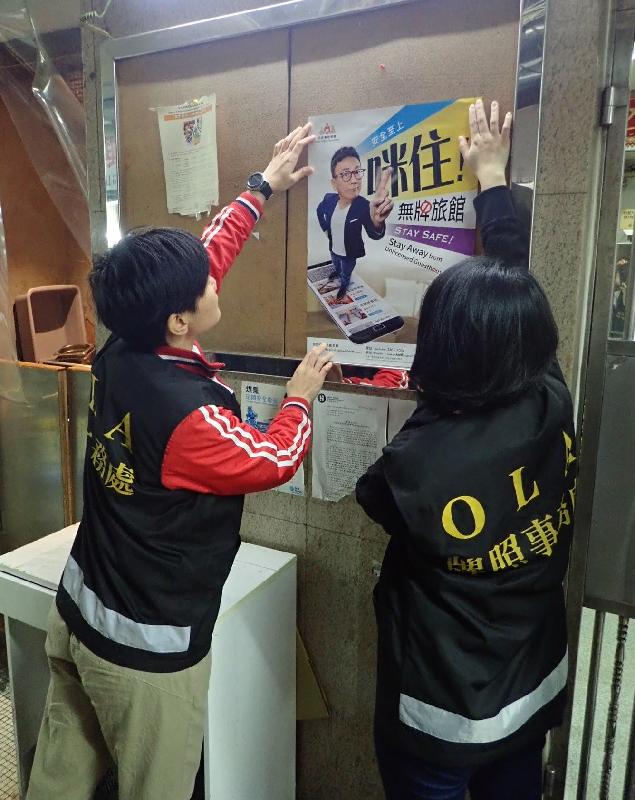
     A spokesman for the HAD today (January 21) said, "The OLA inspected a total of 224 premises in Hong Kong Island, Kowloon and the New Territories in the operations. Prosecution will be instituted by the OLA immediately if there is sufficient evidence that the premises concerned are involved in the operation of unlicensed guesthouses. OLA officers also visited a number of private residential estates and buildings, and posted advisory notices in the common areas of the buildings to alert visitors that there were no licensed guesthouses in those buildings. OLA officers also distributed leaflets to appeal to residents to provide information about suspected unlicensed guesthouses to the OLA."
      
     Having regard to unlicensed guesthouses soliciting lodgers via online platforms, the OLA has strengthened its intelligence collection by forming a dedicated team to browse web pages, mobile applications, social media, discussion fora, blogs, etc, to track down suspected unlicensed guesthouse activities. The OLA's law enforcement officers will initiate follow-up investigations when information on unlicensed guesthouses is found.
      
     The spokesman stressed, "Operating an unlicensed guesthouse is a criminal offence and it can lead to imprisonment as well as a criminal record. Upon conviction, an offender is liable to a maximum fine of $200,000, two years' imprisonment and a fine of $20,000 for each day during which the offence continues. In 2019, the OLA conducted over 16 950 inspections against unlicensed guesthouse activities and instigated 143 prosecutions, among which 103 were convicted so far, including 32 cases solicited via online platforms."
      
     Apart from conducting special operations during festive holidays, the OLA continues to combat unlicensed guesthouses advertised via online platforms through public education, such as broadcasting Announcements in the Public Interest on TV and radio. The OLA also conducts publicity through major Internet search engines on the Mainland and overseas to facilitate tourists' access to the information provided by the OLA in the course of planning their trips, so that they can make use of the search functions on OLA's website to distinguish whether the guesthouse reserved is licensed or not.
      
     Tourists and members of the public should report any suspected unlicensed guesthouses to the OLA by the hotline (Tel: 2881 7498), by email (hadlaenq@had.gov.hk), by fax (2504 5805), or through the mobile application "Hong Kong Licensed Hotels and Guesthouses".
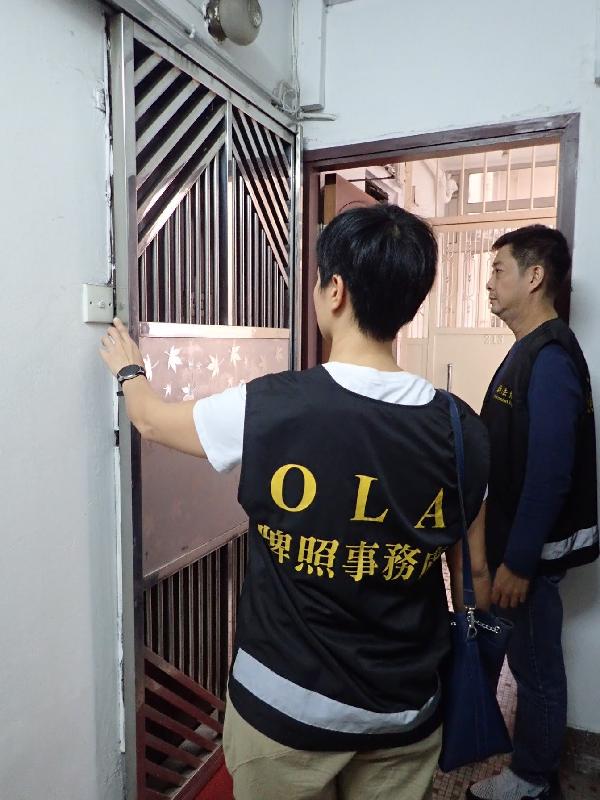
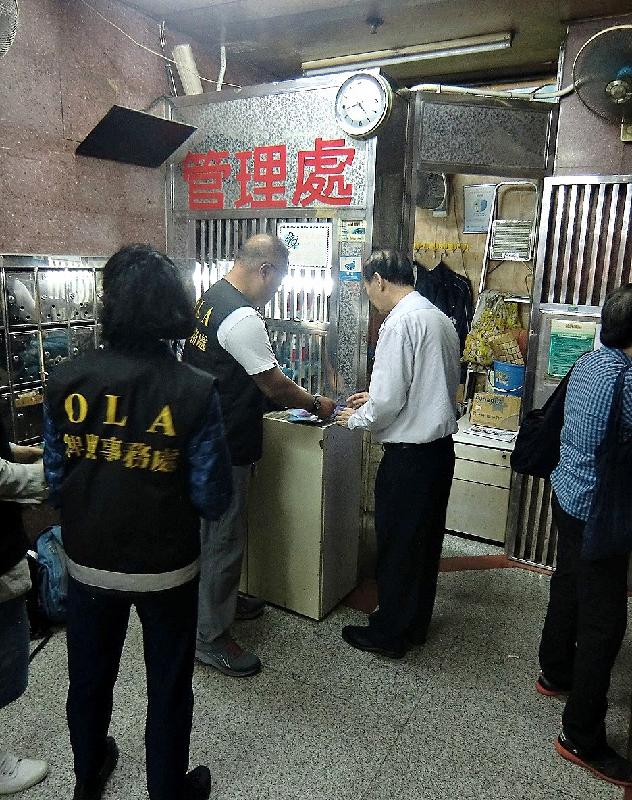
Photo  Photo  Photo  


Office of The Ombudsman announces direct investigation report on “Mechanisms for Verifying Travel Records of Comprehensive Social Security Assistance/Social Security Allowance Applicants and Recipients” (with photo)

The following is issued on behalf of the Office of The Ombudsman:
 
     The Ombudsman, Ms Winnie Chiu, today (January 21) announced the completion of a direct investigation, namely "Mechanisms for Verifying Travel Records of Comprehensive Social Security Assistance/Social Security Allowance Applicants and Recipients".
 
     To qualify for assistance or an allowance under the Comprehensive Social Security Assistance (CSSA) Scheme and the Social Security Allowance (SSA) Scheme, applicants must satisfy the prescribed eligibility criteria, including the residence requirements. After approval of applications, CSSA recipients and SSA recipients must reside in Hong Kong during receipt of the assistance/allowance, with their number of days away from Hong Kong not exceeding the permissible limits (absence limits). During its investigation of individual complaint cases, the Office of The Ombudsman found that there might be inadequacies in the relevant mechanism. Hence, The Ombudsman initiated a direct investigation against the Social Welfare Department (SWD).
 
     The Office's investigation has revealed that under the established mechanism, every month the SWD provides the Immigration Department (ImmD) with the Hong Kong identity card (HKIC) numbers of SSA applicants and CSSA/SSA recipients for the ImmD to conduct data matching (Regular Data Matching). After receiving from the ImmD the records of the persons concerned who travelled with their HKICs, the SWD uses those records to verify whether applicants and recipients satisfy the relevant residence requirement or absence limits. Nevertheless, since Regular Data Matching is conducted using only the HKIC numbers of the persons concerned, it is unable to obtain their accurate travel records through Regular Data Matching if those persons used travel documents other than the HKIC to exit and/or enter the territory. Consequently, it is unable to ascertain that the persons concerned indeed satisfy the residence requirement or absence limits.
 
     Upon the Office's pointing out that the existing procedures of Regular Data Matching should be improved, the SWD responded positively and has started enhancing Regular Data Matching since January 2020. The scope of Regular Data Matching is now extended to cover the travel documents issued by the ImmD. The scope will be further extended to cover the travel documents issued by other countries and territories.
 
     Moreover, the Office has noted that CSSA applicants are not subject to Regular Data Matching. After examination, the Office considers this practice appropriate. This is because most CSSA applicants can satisfy the residence requirement of having resided in Hong Kong for at least one year since acquiring Hong Kong resident status to the date prior to the date of application. Moreover, even after conducting Regular Data Matching on CSSA applicants, the ImmD may not be able to provide their complete travel records for confirming whether they satisfy the residence requirement, as the computerised database of the ImmD only retains travel records for 10 years. In addition to Regular Data Matching, the SWD has also established a mechanism with the ImmD under which the SWD can use where necessary a specific memorandum to obtain, for verification purposes, the detailed travel records of the persons concerned from the ImmD on a case-by-case basis. The Office considers that the current practice can largely strike a balance between verifying the eligibility of CSSA applicants in terms of the residence requirement and offering them timely assistance to meet basic needs.
 
     In the light of the above, The Ombudsman recommends that the SWD complete all the enhancements to Regular Data Matching as soon as possible, thereby improving the inadequacies in existing procedures.
 
     The full investigation report has been uploaded to the website of the Office of The Ombudsman at www.ombudsman.hk for public information.

Photo  


Illegal worker jailed

     A Vietnamese illegal worker holding a recognisance form was jailed by Shatin Magistrates' Courts on January 18.

     During operation "Greenlane" conducted on January 15, Immigration Department (ImmD) investigators raided a garbage room of a private housing estate in Tsueng Kwan O. A male Vietnamese, aged 30, was arrested while working as a garbage worker. Upon identity checking, he produced for inspection a recognisance form issued by the ImmD, which prohibits him from taking employment. A further investigation revealed that he was a non-refoulement claimant.

     The illegal worker was charged at Shatin Magistrates' Courts on January 18 with taking employment after landing in Hong Kong unlawfully and remaining in Hong Kong without the authority of the Director of Immigration or while being a person in respect of whom a removal order or deportation order was in force. He pleaded guilty to the charge and was sentenced to 15 months' imprisonment.

     The ImmD spokesman warned that, as stipulated in section 38AA of the Immigration Ordinance, illegal immigrants or people who are the subject of a removal order or a deportation order are prohibited from taking any employment, whether paid or unpaid, or establishing or joining in any business. Offenders are liable upon conviction to a maximum fine of $50,000 and up to three years' imprisonment. The Court of Appeal has issued a guideline ruling that a sentence of 15 months' imprisonment should be applied in such cases.

     The spokesman reiterated that it is a serious offence to employ people who are not lawfully employable. The maximum penalty is imprisonment for three years and a fine of $350,000. The High Court has laid down sentencing guidelines that the employer of an illegal worker should be given an immediate custodial sentence. According to the court sentencing, employers must take all practicable steps to determine whether a person is lawfully employable prior to employment. Apart from inspecting a prospective employee's identity card, the employer has the explicit duty to make enquiries regarding the person and ensure that the answers would not cast any reasonable doubt concerning the lawful employability of the person. The court will not accept failure to do so as a defence in proceedings. It is also an offence if an employer fails to inspect the job seeker's valid travel document if the job seeker does not have a Hong Kong permanent identity card. The maximum penalty for failing to inspect such a document is imprisonment for one year and a fine of $150,000.

     Under the existing mechanism, the ImmD will, as a standard procedure, conduct an initial screening of vulnerable persons, including illegal workers, illegal immigrants, sex workers and foreign domestic helpers, who are arrested during any operation with a view to ascertaining whether they are trafficking in persons (TIP) victims. When any TIP indicator is revealed in the initial screening, the officers will conduct a full debriefing and identification by using a standardised checklist to ascertain the presence of TIP elements, such as threat and coercion in the recruitment phase and the nature of exploitation. Identified TIP victims will be provided with various forms of support and assistance, including urgent intervention, medical services, counselling, shelter, temporary accommodation and other supporting services. The ImmD calls on TIP victims to report crimes to the relevant departments.


Red flag hoisted at Silverstrand Beach

Attention TV/radio announcers:

Please broadcast the following as soon as possible:

Here is an item of interest to swimmers.

     The Leisure and Cultural Services Department announced today (January 21) that due to big waves, red flag has been hoisted at Silverstrand Beach in Sai Kung District. Beach-goers are advised not to swim at the beach.


Key statistics on service demand of A&E Departments and occupancy rates in public hospitals

The following is issued on behalf of the Hospital Authority:

     During the winter surge, the Hospital Authority is closely monitoring the service demand of Accident and Emergency Departments and the occupancy rates in public hospitals. Key service statistics are being issued daily for public information. Details are in the appended table.