EDB clarification

     Regarding online circulation of a "press release" which stated that the Education Bureau (EDB) has already made an announcement on the extension of schools' Chinese New Year holidays, a spokesman for the EDB clarified that the so-called "press release" was entirely a fabrication.

     The EDB has already stated earlier today that in view of the latest development of the novel coronavirus infection cases, the bureau is actively discussing with different stakeholders on the implementation of the necessary control and preventive measures, including considering extending the Chinese New Year holidays for schools and other necessary arrangements. The EDB will announce the details as soon as possible and call on members of the public to pay attention to the formal announcement to be made by the bureau.


Suspected MERS case reported

     The Centre for Health Protection (CHP) of the Department of Health today (January 24) reported a suspected case of Middle East Respiratory Syndrome (MERS), and again urged the public to pay special attention to safety during travel, taking due consideration of the health risks in the places they visit. The case is detailed below:
 

Sex Male
Age 19
Affected area involved Dubai, United Arab Emirates
High-risk exposure Camel ride
Hospital Queen Elizabeth Hospital
Condition Stable
MERS-Coronavirus preliminary test result Pending

 
     "Travellers to the Middle East should avoid going to farms, barns or markets with camels; avoid contact with sick persons and animals, especially camels, birds or poultry; and avoid unnecessary visits to healthcare facilities. We strongly advise travel agents organising tours to the Middle East to abstain from arranging camel rides and activities involving direct contact with camels, which are known risk factors for acquiring MERS Coronavirus (MERS-CoV)," a spokesman for the CHP said.

     Locally, the CHP's surveillance with public and private hospitals, with practising doctors and at boundary control points is firmly in place. Inbound travellers and members of the public who recently visited the Middle East and developed relevant symptoms within 14 days will be classified as suspected MERS cases. They will be taken to public hospitals for isolation and management until their specimens test negative for MERS-CoV.

     Travellers to affected areas should maintain vigilance, adopt appropriate health precautions and take heed of personal, food and environmental hygiene. The public may visit the MERS pages of the CHP and its Travel Health Service, MERS statistics in affected areas, the CHP's Facebook Page and YouTube Channel, and the World Health Organization's latest news for more information and health advice. Tour leaders and tour guides operating overseas tours are advised to refer to the CHP's health advice on MERS.


Latest recommendations by Scientific Committee on Emerging and Zoonotic Diseases and the Scientific Committee on Infection Control after reviewing cases of novel coronavirus infection

     The Scientific Committee on Emerging and Zoonotic Diseases and the Scientific Committee on Infection Control under the Centre for Health Protection (CHP) of the Department of Health today (January 24) convened a joint meeting, during which members reviewed the epidemiological situation of the Mainland and Hong Kong cases of novel coronavirus infection, the risk assessment by the World Health Organization and made the latest recommendations.
      
     At the meeting, members discussed on the corresponding local response to this novel communicable disease in various aspects, including disease prevention and control, surveillance, emergency preparedness, port health measures and health promotion. The latest recommendation are as follows:
 

  1. The general public is strongly advised not to visit places with community transmission of novel coronavirus.
  2. The CHP should continue to uphold port health measures to detect possible imported cases into Hong Kong.
  3. The general public is advised to wear a surgical mask when taking public transport or staying in crowded places. It is important to wear a mask properly, including hand hygiene before wearing and after removing a mask.
  4. Proper infection prevention and control measures should be implemented and reinforced in all settings especially in hospitals.
  5. In view of the current available information, organisers of mass gathering events with mixing of people from areas with novel coronavirus transmission are advised to take into consideration of the increased risk arising from the event.
  6. Passengers who have stayed in an aircraft within two seats surrounding a confirmed case or on a train in the same row or two rows in front and behind of the case during the symptomatic phase are classified as close contacts for quarantine.
  7. Close contacts should be quarantined for 14 days.
  8. Confirmed cases can be released from isolation when their clinical conditions improve and afebrile, and with two clinical specimens tested negative for novel coronavirus taken at least 24 hours apart.

  
     To prevent pneumonia and respiratory tract infection, members of the public should always maintain good personal and environmental hygiene. They are advised to:
 
• Perform hand hygiene frequently, especially before touching the mouth, nose or eyes; after touching public installations such as handrails or door knobs; or when hands are contaminated by respiratory secretions after coughing or sneezing;
• Maintain drainage pipes properly and regularly (about once a week) pour about half a liter of water into each drain outlet (U-traps) to ensure environmental hygiene;
• Wash hands with liquid soap and water, and rub for at least 20 seconds. Then rinse with water and dry with a disposable paper towel. If hand washing facilities are not available, or when hands are not visibly soiled, performing hand hygiene with 70 to 80 per cent alcohol-based handrub is an effective alternative;
• Cover your mouth and nose with tissue paper when sneezing or coughing. Dispose of soiled tissues into a lidded rubbish bin, then wash hands thoroughly; and
• When having respiratory symptoms, wear a surgical mask, refrain from work or attending class at school, avoid going to crowded places and seek medical advice promptly.
 
     The public should take heed of the health advice below when travelling outside Hong Kong:
 
•Avoid unnecessary travel to Wuhan of Hubei Province. If it is unavoidable to travel to Wuhan, put on a surgical mask and continue to do so until 14 days after returning to Hong Kong;
•Avoid close contact with persons with fever or respiratory symptoms in countries/areas with possible community transmission of novel coronavirus infection. If it is unavoidable to come into contact with them, put on a surgical mask and continue to do so until 14 days after returning to Hong Kong;
• Avoid visiting hospitals. If it is necessary to visit a hospital, put on a surgical mask and observe strict personal and hand hygiene;
• Avoid touching animals (including game), poultry/birds or their droppings;
• Avoid visiting wet markets, live poultry markets or farms;
• Avoid making close contact with patients, especially those with symptoms of acute respiratory infections;
• Do not consume game meat and do not patronise food premises where game meat is served;
• Adhere to food safety and hygiene rules such as avoiding consuming raw or undercooked animal products, including milk, eggs and meat, or foods which may be contaminated by animal secretions, excretions (such as urine) or contaminated products, unless they have been properly cooked, washed or peeled;
• If feeling unwell when outside Hong Kong, especially if experiencing a fever or cough, wear a surgical mask, inform the hotel staff or tour escort and seek medical advice at once; and
• After returning to Hong Kong, consult a doctor promptly if experiencing a fever or other symptoms, take the initiative to inform the doctor of any recent travel history and any exposure to animals, and wear a surgical mask to help prevent spread of the disease.


Five Mainland Offices of HKSAR Government set up dedicated hotlines

    In view of the latest developments of the novel coronavirus infection, all five Mainland Offices of the Hong Kong Special Administrative Region (HKSAR) Government in the Mainland have set up dedicated hotlines to provide Hong Kong people in the Mainland with direct access for assistance when necessary during the Chinese New Year holiday.

Details of the dedicated hotlines are as below:

Wuhan Economic and Trade Office (ETO) Immigration Unit:
Service areas: Central region (Hubei, Hunan, Shanxi, Jiangxi and Henan)
Dedicated Hotline: (86)158 0277 5135

The Beijing Office Immigration Unit:
Service areas: Northern region (Beijing, Tianjin, Hebei, Liaoning, Jilin, Heilongjiang, Inner Mongolia, Xinjiang, Gansu and Ningxia)
Dedicated Hotline: (86) 139 1128 3314

Guangdong ETO Immigration Unit:
Service areas: Southern region (Fujian, Guangdong, Guangxi, Hainan and Yunnan)
Dedicated Hotline: (86) 139 2602 1772

Shanghai ETO Immigration Unit:
Service areas: Eastern region (Shanghai, Jiangsu, Zhejiang, Anhui and Shandong)
Dedicated Hotline: (86) 150 2126 0794

Chengdu ETO Immigration Unit:
Service areas: Western region (Sichuan, Chongqing, Guizhou, Shaanxi, Qinghai and Tibet)
Dedicated Hotline: (86) 185 0287 8350

     Since the emergence of the cluster of pneumonia cases in Wuhan, all ETOs in the Mainland have been liaising closely with  Hong Kong people in the Mainland and have uploaded relevant health information and latest updates on their websites and WeChat official accounts to keep them abreast of the latest situation. All ETOs in the Mainland will try their best to render practicable assistance to Hong Kong people in the Mainland when necessary.


SCED attends WTO Informal Ministerial Gathering in Davos (with photos)

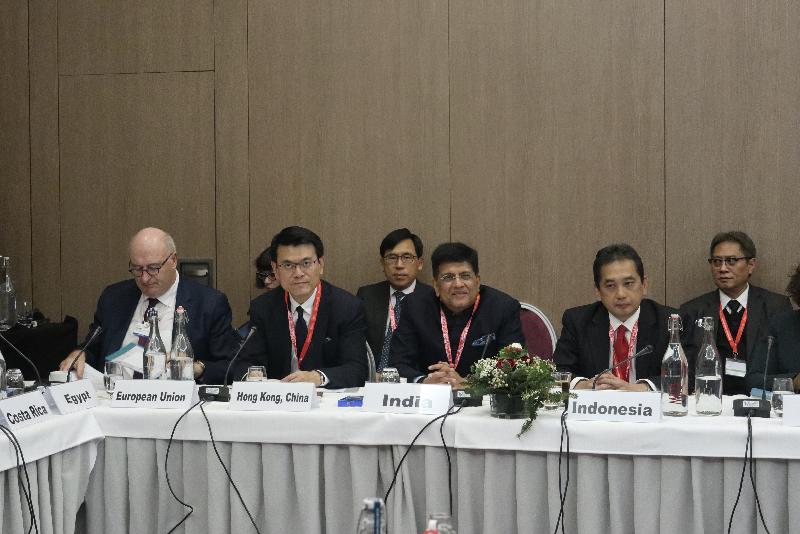
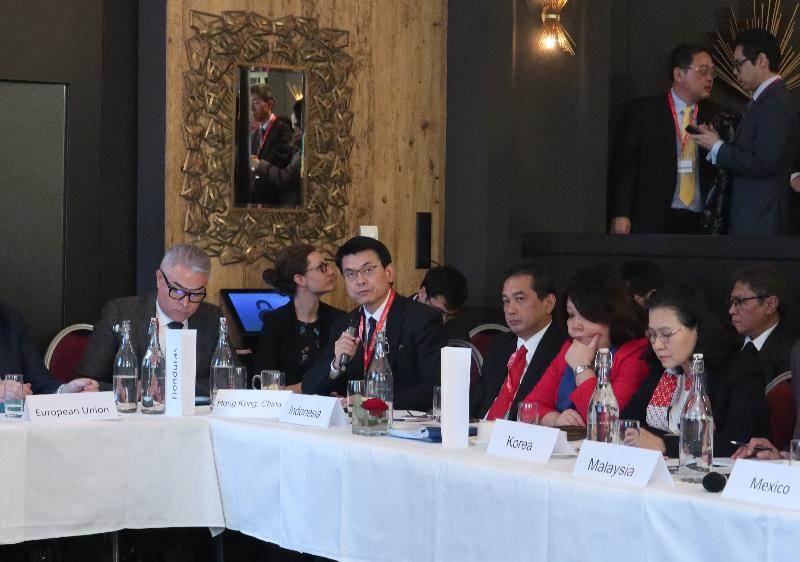
     The Secretary for Commerce and Economic Development, Mr Edward Yau, attended the World Trade Organization (WTO) Informal Ministerial Gathering in Davos, Switzerland, today (January 24, Davos time).

     Held on the margins of the World Economic Forum, the Informal Ministerial Gathering provided an opportunity for participating ministers to have candid exchanges on key priorities and actions to be taken towards MC12.

     Mr Yau said Hong Kong is committed to engaging actively and constructively in various initiatives under the WTO with a view to delivering concrete outcomes at the 12th WTO Ministerial Conference (MC12).

     This year marks the 25th anniversary of the WTO. Mr Yau said that in the past 25 years, the WTO has clearly achieved a great deal in liberalising and facilitating trade. He however remarked that there is much more to do in view of the changing global and economic situations. He urged WTO Members to redouble their efforts and remain constructively engaged for making a productive MC12.

     Mr Yau also reiterated Hong Kong's concerns about the continued blockage of the Appellate Body selection process. He appealed to WTO Members to explore pragmatic solutions to lift the blockage and to prioritise other reform efforts to ensure the rules-based multilateral trading system stays strong and effective.

     Earlier today, Mr Yau attended the Informal Meeting on the WTO Joint Statement Initiative on Electronic Commerce during which he reaffirmed Hong Kong's commitments in working closely with WTO Members to make further progress with regard to the Initiative.

     Mr Yau will return to Hong Kong tomorrow (January 25) evening.

Photo  Photo