CHP reminds public on precautions against cold weather

     The Centre for Health Protection (CHP) of the Department of Health (DH) today (February 1) reminded the public, particularly the elderly and people with chronic illnesses, to adopt appropriate measures to protect their health in view of the cold weather.

     A spokesman for the CHP said that cold weather can easily trigger or exacerbate diseases, especially among the elderly and persons suffering from heart disease, respiratory illness or other chronic illnesses.

     "Elderly people have less insulating fat beneath their skin to keep them warm and their body temperature control mechanism may be weaker. Their body may not be able to appropriately respond to the cold weather," the spokesman said.

     Some senior persons may have decreased mobility, which can in turn slow down their ability to generate and conserve body heat. Chronic illnesses, such as hypertension, diabetes and endocrine disorders, may undermine the health of elderly people and lower their metabolic rate, subsequently causing their body to generate less heat.

     The CHP reminds the public, in particular the elderly and persons with chronic illnesses, to adopt the following preventive measures:
 

  • Take note of the weather forecast. Wear warm clothing, including hats, scarves, gloves and socks accordingly;
  • Consume sufficient food to ensure adequate calorie intake;
  • Perform regular exercise to facilitate blood circulation and heat production;
  • Stay in a warm environment and avoid prolonged outdoor exposure;
  • Use heaters with care and maintain adequate indoor ventilation; and
  • Seek medical advice if feeling unwell.

     In addition, the public should avoid alcoholic beverages.

     "Drinking alcohol cannot keep you warm. Alcohol accelerates the loss of body heat through dilated blood vessels, resulting in chilling instead," the spokesman said.

     "Parents should ensure that babies are sufficiently warm, but it is also important to keep babies lightly clothed to avoid overheating them," the spokesman added.

     Parents should observe the following safety measures when putting their children to bed:
 

  • Keep the room well ventilated and with a comfortable temperature;
  • Always place babies on their back to sleep. Babies usually sleep well without a pillow;
  • Place babies on a firm and well-fitted mattress to sleep. Avoid soft objects and loose bedding;
  • Leave their head, face and arms uncovered during sleep; and
  • Let babies sleep in a cot placed in the parents' room and near their bed.

     Members of the public are advised to take heed of the following advice to reduce the risk of getting influenza and respiratory tract infections:
 

  • Maintain adequate rest, a balanced diet and regular physical activity, and avoid stress and do not smoke;
  • Maintain good personal and environmental hygiene;
  • Maintain good hand hygiene via proper handwashing or use of alcohol-based handrub;
  • Ensure good ventilation;
  • Wear a face mask in the event of influenza-like symptoms, while taking care of patients and when visiting hospitals or clinics;
  • Cover the nose and mouth while sneezing or coughing. Dispose of soiled tissue paper in a lidded rubbish bin and wash hands immediately afterwards;
  • Seek medical advice when feeling unwell, and stay at home;
  • Receive seasonal influenza vaccination, which is recommended for all persons aged 6 months or above except those with known contraindications; and
  • Persons at higher risk of getting influenza and its complications, including the elderly and persons aged 50 to 64, should receive seasonal influenza vaccination early. Please see details of the Vaccination Subsidy Scheme on the CHP's website.

     Food-borne diseases, particularly those linked to hot pot cuisine, are also common in cold weather. The following preventive measures should be taken:

  • Wash hands before handling and consuming food;
  • Do not patronise unlicensed vendors or those with poor hygienic standards while selecting food;
  • Wash and cook all food thoroughly;
  • Vegetables should be washed thoroughly in clean running water before cooking and consumption. When appropriate, scrub vegetables with hard surfaces with a clean brush to remove dirt and substances, including pesticide residues and contaminants, from the surface and crevices;
  • Shrimps should be fully cooked by cooking them until the shells turn red and the flesh turns white and opaque;
  • For shellfish like scallops and geoduck, scrub the shells thoroughly and remove internal organs;
  • Most hot pot ingredients should be stored in a refrigerator at 4 degrees Celsius or below, while frozen food should be stored in a freezer at -18 degrees C or below;
  • Never use raw eggs as a dipping sauce for hot pot; and
  • Use different sets of chopsticks to handle raw and cooked food to avoid cross-contamination.

     In addition, the public should not use charcoal as cooking fuel in poorly ventilated areas, especially indoors, to avoid harmful exposure to carbon monoxide (CO) and prevent CO poisoning. While using other kinds of fuel, the public should also ensure adequate ventilation.

     For more health information, the public may call the DH's Health Education Hotline (2833 0111) or visit the CHP's website and Facebook Fanpage.

     The public may also call Dial-a-Weather (1878 200) or visit the website of the Hong Kong Observatory for the latest weather information and forecast, or its page on Weather Information for Senior Citizens.


Employers and employees should take precautions during cold weather

Attention duty announcers, radio and TV stations:

     Please broadcast the following special announcement immediately, and repeat it at frequent intervals when the Cold Weather Warning is in force:

     The Labour Department reminds employers that as the Cold Weather Warning is in force, they should take appropriate precautions such as reminding employees who have to work outdoors or in remote areas to wear appropriately warm clothing, and make arrangements for employees to rotate from outdoor to indoor or sheltered work sites as far as possible. Employees should take note of the weather report, wear appropriately warm clothing and be mindful of their health conditions. They should notify their supervisors and seek medical help immediately if feeling unwell, such as having cold limbs and body shivering.


Regional flag-selling activities cancelled

     The Social Welfare Department (SWD) has been informed by the three flag day organisers that the regional flag-selling activities in public places scheduled to be held today (February 1) have been cancelled, a spokesman for the SWD said.
 
     The three charities are Saint Barnabas' Society and Home, the Hong Kong Down Syndrome Association and North District Hospital Charitable Foundation. They had been issued Public Subscription Permits to hold flag sales on Hong Kong Island, in Kowloon and in the New Territories respectively from 7am to 12.30pm today.
 
     For enquiries, please contact the individual organisations. Contact information for the above three organisations is as follows:
 

Region                    Name of Organisation                     Contact Person          Number           
Hong Kong Island Saint Barnabas' Society and Home Miss Hon 2548 9056
Kowloon The Hong Kong Down Syndrome Association Ms Tse 3427 8748
New Territories North District Hospital Charitable Foundation Ms Wong 2683 7984


Government enhances disease prevention and control measures with reference to WHO’s advice

     The World Health Organization (WHO) Director-General has declared that the outbreak of the novel coronavirus constitutes a Public Health Emergency of International Concern (PHEIC) and made a number of recommendations on disease prevention and control. A government spokesman said today (January 31) that the Government's disease prevention and control measures implemented so far are in line with the WHO’s suggestions. Taking into account the WHO’s recommendations, the Government has announced that measures will be extended or rolled out to further prevent and control the spread of the disease.
    
Extending class suspension and special work arrangements for government departments
 
     To reduce the flow of people and contacts among them in the community, the Government earlier extended the Chinese New Year holidays of secondary schools, primary schools, kindergartens, child care centres and special schools to February 27. Government departments have also made special work arrangements over the past week. Except for staff providing emergency services and essential public services, all other employees of the Government are not required to return to their offices but to work at home after the holidays. In light of the latest developments of the disease and the continued tight supply of surgical masks, the Government has announced the extension of the relevant measures. All secondary schools, primary schools, kindergartens, child care centres and special schools will continue to suspend classes. The date of class resumption will be decided later, but it will not be before March 2. Special work arrangements for government departments will be extended until February 9 and the Government will review the situation later. Taking into consideration the fact that the disease may persist for a period of time, other than providing emergency and essential public services, government departments have to provide basic and limited public services to members of the public starting from next week. On the details of class suspension arrangements and the provision of public services, the Education Bureau and individual government departments will make announcements as soon as possible. The Government appeals to employers to continue to make flexible work arrangements for employees in accordance with their operational needs.
 
Hong Kong residents returning from the Mainland
 
     To reduce the risk of spread of the disease in the community, all Hong Kong residents who have visited Hubei Province in the past 14 days should approach staff of the Department of Health’s Port Health Division for relevant assessment upon their arrival. Even those who are asymptomatic will be arranged to stay in quarantine centres for surveillance. The Government also appeals to Hong Kong residents returning from other places on the Mainland to stay home for 14 days upon their return as far as the circumstances permit. Those who need to go out should wear a surgical mask for 14 days upon their return.
 
Hubei residents in Hong Kong
 
     Hubei residents have been restricted from entering Hong Kong since January 27. For those Hubei residents who have already entered Hong Kong, they are only allowed to stay in Hong Kong for seven days in general, and it is believed that the number of these people in Hong Kong will gradually decrease. As at 1pm today, the Immigration Department had conducted inspections at 355 hotels and guesthouses and found 48 travellers from Hubei. Fifteen of them have left Hong Kong on their own while the Department of Health will arrange for the remaining travellers concerned to stay in quarantine centres or, for asymptomatic travellers, to leave Hong Kong as soon as possible.
 
Enhancing exit screening and health declaration
 
     Making reference to the WHO’s recommendations, the Government will enhance exit screening to facilitate early identification of passengers with symptoms. Starting from tomorrow (February 1), Hong Kong International Airport will implement body temperature checks for both departing and transit passengers. No boarding will be allowed for passengers with fever. On land-based control points, the Government will impose a requirement for health declaration at Lo Wu Control Point and the Shenzhen Bay Port tomorrow and extend it to other control points gradually.
 
All-out efforts to support front-line healthcare staff
 
     The Government will continue to fully support front-line healthcare staff. Although the supply of surgical masks remains tight, the Government will give priority to their needs. Starting from tomorrow, the seven hospital clusters of the Hospital Authority will have the capability to conduct rapid virus testing, which can help relieve the work pressure of healthcare staff.
 
Increasing supply of surgical masks through a multi-pronged approach
 
     The Government will continue to spare no effort in sourcing globally, increasing local production, liaising with mask suppliers in the Mainland and seeking assistance from relevant authorities to help supplies reach Hong Kong, with a view to meeting the needs of healthcare workers and other personnel providing services to the public, as well as stabilising the market supply. The Government also appeals to private and charitable organisations to donate surgical masks to the underprivileged, and will play a facilitation role with financial resources and co-ordination.
 
     The Government is also closely monitoring the effectiveness of the various measures implemented earlier:
 
Reducing the flow of people between the Mainland and Hong Kong
 
     Measures implemented earlier, including imposing restrictions on Hubei residents and those who have visited Hubei Province in the past 14 days from entering Hong Kong, the Mainland authorities suspending the issuance of endorsements under the Individual Visit Scheme as requested by the Hong Kong Special Administrative Region Government and reducing transport and border control point services, have significantly reduced the number of Mainland visitors coming to Hong Kong. The number of Mainland visitors who arrived in Hong Kong via control points (except the airport) yesterday accounted for only 9.7 per cent of the total number of passengers, and the number has dropped 91 per cent compared to the figure two weeks ago. It is believed that the number will further decrease. The Government will continue to liaise with the Mainland as appropriate to explore further consolidation and tightening the management of the control points.
 
Quarantine centre facilities
 
     To cope with future quarantine needs, the Government is preparing more quarantine centre facilities. If a large number of close contacts have to be quarantined within a short period of time, the Government may need to impose home isolation for the relevant persons. The Government has completed a study on the use of electronic tracking bracelets and positioning technology to help in surveillance. The relevant items will be available next week.
 
Assisting Hong Kong residents in Hubei
 
     As of yesterday (January 30), the Government had received about 600 requests for assistance in relation to the novel coronavirus, involving about 1 300 Hong Kong people located in over 30 cities in Hubei Province. Officers of the Wuhan Economic and Trade Office will stay connected with these people and render assistance to them. At the same time, the Government will communicate with the Central Authorities on ways to arrange for them to return to Hong Kong in a practical manner.
 
     The spokesman said that the current situation is critical. The Government is grateful to all front-line healthcare staff and other personnel participating in disease prevention and control for remaining steadfast at their posts, and urges all members of the public to join the Government and healthcare workers to do the best in disease prevention and control.


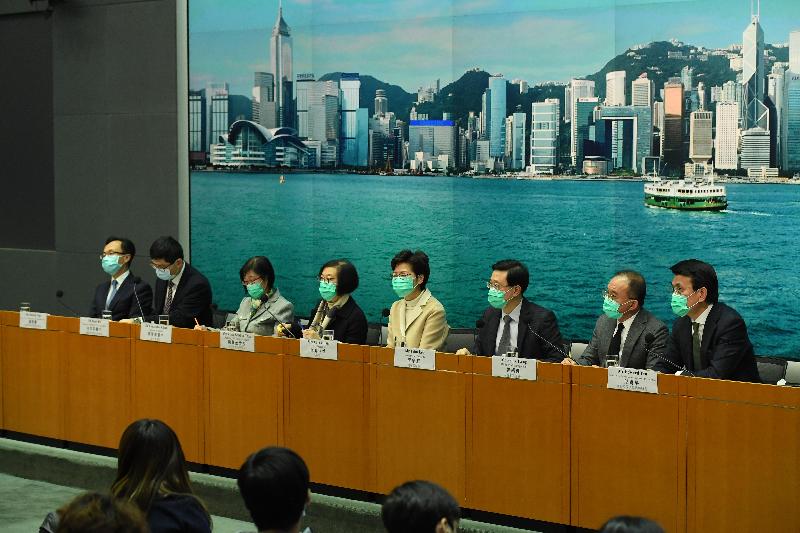
Transcript of remarks of press conference (with photo/video)

     The Chief Executive, Mrs Carrie Lam, held a press conference this afternoon (January 31). Also joining were the Secretary for Commerce and Economic Development, Mr Edward Yau; the Secretary for Security, Mr John Lee; the Secretary for Food and Health, Professor Sophia Chan; the Secretary for Constitutional and Mainland Affairs, Mr Patrick Nip; the Director of Immigration, Mr Tsang Kwok-wai; the Director of Health, Dr Constance Chan; and the Chief Executive of the Hospital Authority, Dr Tony Ko. Following is the transcript of remarks of the press conference.
 
Reporter: Mrs Lam, I’m sure you know that there is a vote tomorrow from some employees, hospital unions, talking about going on strike possibly if you didn’t close the border, sounds like you are not willing to do that. Are you willing to take that risk of thousands of employees going on strike as a result of sort of this emergency situation? Secondly, with the new sort of surveillance measures for Hubei visitors, would these measures have stopped visitors, for example, from jumping from hospital to hospital without authorities being able to do anything to force them to seek medical care? And thirdly, on face masks, I’m sure that Mr Yau, you have already sort of covered this but is this something where the Government could be taking more a centralised role in terms of distribution and also controlling prices so that we don’t see sort of price gouging and long lines around the neighborhoods waiting for face masks?
 
Chief Executive: Thank you for the three questions. I will answer the first question and then invite the Director of Health to talk about the medical surveillance and Mr Yau to comment on the question of pricing and distribution of surgical masks. I sincerely hope and appeal to our health staff in the Hospital Authority to consider very seriously any plan to have a strike because at the end of the day, those who suffer will be the patients as well as Hong Kong’s healthcare system. I said repeatedly that we treasure the contribution of our health staff throughout the years – it’s not just about this particular virus incident. I have been working very closely with Hong Kong’s medical staff throughout my public service career in my capacity as Assistant Director in the Health Department, as a member of the Hospital Authority Board, as the Director of Social Welfare. I have very high regard of the medical staff, medical nursing and allied health and also supporting staff in the public system, whether in the Department of Health or the Hospital Authority. I have no doubt that they have the best interests of Hong Kong people, as well as Hong Kong, in terms of our healthcare system, which is highly credible, professional, as well as Hong Kong’s overall interest. The Government has already taken a series of measures and they are effective measures as I have proven to you with some of the passenger statistics to significantly bring down the number of arrivals of visitors from the Mainland and other places so as to reduce the chance of infection and also to lessen the workload on the public hospitals.
 
     I have also pledged and have been working with the Secretary for Food and Health and the Hospital Authority to provide whatever assistance our health staff need, whether in terms of financial resources, in terms of supplies. I’ve been putting them on the first priority of the access to a very limited supply of protective equipment as well as masks despite there have been aspirations for us to share some of this limited supply with the community. I hope very much that they will also take into account these efforts made and seriously consider their plan. I really don’t think a complete closure of the border control points is the right answer to the situation that we are facing. It is at least not in line with the very scientific-based and knowledge-based advice given to us as recently as early this morning by the World Health Organization and its panel of experts. We should not contemplate restrictions of international travel or trade and we should not adopt a discriminatory approach in dealing with people flowing between different countries and places in trying to contain the spread of the disease. There are other measures which will help us to achieve that effect.
 
Director of Health: Under the Prevention and Control of Disease Ordinance, this new novel coronavirus infection is one of the notifiable diseases. So when the doctors suspect a person who fulfils the criteria of referring to us, the patient will be sent to a public hospital for investigation and under isolation. And under the law we will place an isolation order on this infected person. When the case is confirmed we will conduct epidemiological investigation and identify the patient’s close contact. And for the close contact we will impose a quarantine order and direct the close contact to be kept in the quarantine centre. So under either the isolation order or the quarantine order, this person is obliged to be kept in the place where he or she is directed to stay. And if he breaches it, it constitutes an offence.

Secretary for Commerce and Economic Development: On the question of protective materials, including masks, the Government has been trying to help in a number of ways. We are taking a three-pronged approach. In recognition of the shortage (of masks), which is not just local but global, we try to cast the net wider. The Government, as the major user, has to procure such materials for our frontline medical staff. We have been casting the net on a global basis, hoping that we can secure a longer term (of supply) and in greater quantity.
 
     In addition, we are also working with the retail and wholesale sectors, which are also in great demand for such materials. We talked to them and identified that there might be certain problems that they encountered, including custom clearances on some of these materials coming over from the Mainland. We have established channels to talk to the Mainland authorities, between customs authorities, to make sure that orders which have been placed are able to be delivered on time and in full. So through this process, we have been helping both procurement of government departments and procurement from the private sector. The third element is that, in recognition of this strong demand, there are also companies approaching us to see if we can help them in bringing back production lines (of protective materials to Hong Kong). We are lining up government departments to work (on this) together.
      
     In addition to all these, there are also people and companies who would like to donate certain (number of) masks to those in need. We helped them to channel these to charity groups or people in need. These are what we have been doing in the past couple of weeks.
      
     You mentioned about price control, I think we will leave no stone unturned (to address the issue) as the Chief Secretary (for Administration) mentioned yesterday. But in considering whichever ways to tackle the problem, we must find a way which is effective in ensuring supply. On price, if there are malpractices, (like) stocking up or whatever, this is a job for the Consumer Council (to deal with), and they have given advice. Customs (Customs and Excise Department) has also taken enforcement actions in the last few days by enforcing the Trade Descriptions Ordinance. These malpractices were brought before the law. But I think what we need to do at the moment is to try to enhance the global supply, to make sure that the orders we have placed will have a prompt delivery, and also to ensure that there will be a good distribution system. In this regard, we are talking to both the trade and within the (government) departments. At the same time, we also encourage the community to find various ways of sharing, like the gifts we have received and channelled to those in need. Thank you.
 
Reporter: I've got three questions. First, for Mrs Lam. You said that we shouldn't be discriminating against certain types of people, right? The Mainlanders. But the Labour Department yesterday issued a statement that FDHs, foreign domestic workers, he requests them to stay at home even on their days off and the foreign domestic workers feel that this is discriminatory because they have only one day off where they could, you know, do so many things and gather but in open-air areas as you know. They've done that during SARS, where I think just two Filipino or Indonesians were infected by SARS because they went to a grocery store, you know, at the early stage of the outbreak. That's one. Number two is, can you explain more about the electronic tracking device and GPS, that I think it was Professor Chan who said that you're planning to do, to track those people who are confirmed or suspected or should be brought into the quarantine because they came from Hubei Province, if I get it right? Number three is do we know much more about the coronavirus? Maybe Professor Chan or Dr Chan, Constance Chan, can tell us, because you said, I mean, breaking news now that there are two confirmed cases in the UK, so it is spreading, right, globally, and Hong Kong and Macao is lumped in China among the figures in China because you're SAR. So, what I'd like to ask you is do we know much? There are so many unknowns. Is it a full range of, you know, symptoms? Is it mild? Are you contagious when you don't have symptoms or when you develop fever or some other symptoms? So I just wanted to ask.
 
Chief Executive: I'll answer the first question and then leave Professor Chan and Dr Chan to address the latter two questions. First of all, let me just quote for you what is in the World Health Organization statement. It makes it very clear that the countries and governments are cautioned against actions that promote stigma or discrimination in line with the principles of article 3 of the International Health Regulations. This approach that we should not stigmatise or discriminate is well enshrined in an international health regulation, which means that it has very good basis from the protection of public health perspective and also the balancing, taking into account other considerations.
 
     I just heard what you told me about the Labour Department’s advice.  I have not seen it myself. But I suppose that advice was given really to protect our foreign domestic helpers by suggesting that they should stay at home. That was part of a strategy to reduce as much as possible social contacts or what we call social distancing. That also takes into account now the currently limited supply of face masks, because if they all go out and they enjoy their day as we have seen from time to time on Sundays in various parts of Hong Kong, they are no doubt in a crowd, which means that they will have to wear masks and protect themselves attending those events. In the same way that the Government has cancelled, and many associations have also cancelled, events of a particular scale, whether it's outdoor event or indoor event, I think the Labour Department’s advice is based on that very same consideration.
 
Secretary for Food and Health: Thank you for your question. Regarding active surveillance and contact tracing as well as isolating the close contacts of patients, there are a number of ways to do so. Of course, putting people into quarantine camps is one of the ways. Another way is home quarantine, that is, people staying at their home for 14 days. The idea of home quarantine is ensuring people to isolate themselves at home and not to come out into the community so that the risk of transmission in the community would be reduced. Way back many years ago, for example during SARS (Severe Acute Respiratory Syndrome) (outbreak in Hong Kong), there are people guarding at the entrances of the buildings or outside homes to make sure that the people (being quarantined) could not go out. But now, I think after so many years, there are lots of technology that can help doing the work in terms of tracing the contacts where they are, and to ensure that they are staying at home and not going out into the community. The development of these technology in terms of providing (devices) to these contacts is really to ensure that they stay at home, so that the entire quarantine procedures can be more efficient and probably to save manpower to check whether these people are at home. As for your question on the two confirmed cases, I would like to invite the Director of Health, Dr Constance Chan, to provide more information.
 
Director of Health: I do not have the details of the two confirmed cases that were reported in the United Kingdom. Nonetheless, referring to your question on the nature of the coronavirus, indeed this is a novel coronavirus and it has only been identified in the recent few weeks. So you will note in the statement by the World Health Organization (WHO) regarding declaring this disease as a public health emergency of international concern, it specifically suggested that one should collaborate with WHO and partners to conduct investigation to understand the epidemiology and evaluate the measures, and it also encouraged the sharing of data on human cases and it also suggests supporting research. So that is why I think the Mainland scientists are working very hard and they have also shared a lot of information with the international community and they will continue to do research in this regard, and a number of the experts in Hong Kong are actually contributing to research in this area.

Chief Executive: In case media friends have more interest on the electronic devices that we have developed for the home quarantine, I'm happy to ask my colleagues in the Innovation and Technology Bureau together with their partners to give a briefing next week.

(Please also refer to the Chinese portion of the transcript.)
Photo