UGC Secretary-General visits US and UK

The following is issued on behalf of the University Grants Committee:
 
     The Secretary-General of the University Grants Committee (UGC), Professor James Tang, led a delegation to visit the United States and the United Kingdom from May 25 (San Diego time) to June 6 (Birmingham time) as part of the effort to promote Hong Kong's development into an international hub for post-secondary education.
 
     Together with the delegation comprising all eight UGC-funded universities under the aegis of the Heads of Universities Committee's Standing Committee on Internationalisation (HUCOMSCI), Professor Tang attended the NAFSA Annual Conference and Expo 2025 held in San Diego, the United States, where he spoke at a dedicated session on the strengths of Hong Kong's higher education sector and the opportunities presented to students from around the world. With funding support from the UGC, the HUCOMSCI also set up a Hong Kong Pavilion to showcase Hong Kong's internationalised and diversified higher education environment that welcomes academics and students from around the world to realise their aspirations.
 
     "Over the years, with the substantial investment by the Government in higher education, the eight UGC-funded universities have continued to grow, with five ranked among the world's top 100, six within Asia's top 50, and four as the top most international universities in the world. Some 70 per cent of our research outputs are assessed as internationally excellent, while the most recent round of quality audits also reaffirms the quality of educational experience that our universities offer to students. Hong Kong is indeed the ideal destination for students to pursue their further studies and achieve greater success," said Professor Tang at the session at the NAFSA Conference and Expo.
 
     For the first time, the UGC also supported the Hong Kong Teaching Excellence Alliance and the HUCOMSCI to share with the international audience on how the UGC-funded universities have grasped the immense potential brought by artificial intelligence in enhancing students' learning experiences. This has once again demonstrated Hong Kong's leadership in quality education through investment and innovation.
 
     Professor Tang then attended the International Higher Education Forum 2025 held on June 4 (Birmingham time) in Birmingham, the United Kingdom, to share the factors underpinning Hong Kong's success as an international hub for post-secondary education. He stressed that academic freedom and institutional autonomy have been the cornerstones of Hong Kong's success, while highlighting the diversified composition of Hong Kong's academic staff. Hong Kong universities attract a strong pool of distinguished scholars with a rich repertoire of international experience, and indeed some 70 per cent of them come from outside Hong Kong.
 
     In the 2024 Policy Address, the Government announced its support for establishing the "Study in Hong Kong" brand in order to attract more meritorious students to pursue their studies in Hong Kong. Through participation in international conferences and exhibitions, Hong Kong has continued to expand its network for student mobility and research collaboration. As of November 2024, the eight UGC-funded universities have jointly signed 2 660 student exchange agreements with universities from around the world, and engaged in over 6 800 active research collaborations with other institutions. At present, around one out of four students in UGC-funded universities are from outside Hong Kong. The Government will continue to support universities to strive for further internationalisation, thereby reinforcing their global reputation and scaling new heights.
 
     During the visit, Professor Tang also met with senior management and prominent scholars from top-tier higher education institutions in the United States and the United Kingdom to exchange views on the latest developments in higher education. He also highlighted that Hong Kong's outstanding universities have been a welcoming academic home for top scholars and talented students from around the world. As an international hub for higher education, Hong Kong's doors are always open to all who want to realise their academic pursuits and explore the exciting opportunities offered by one of the world's most dynamic cities.
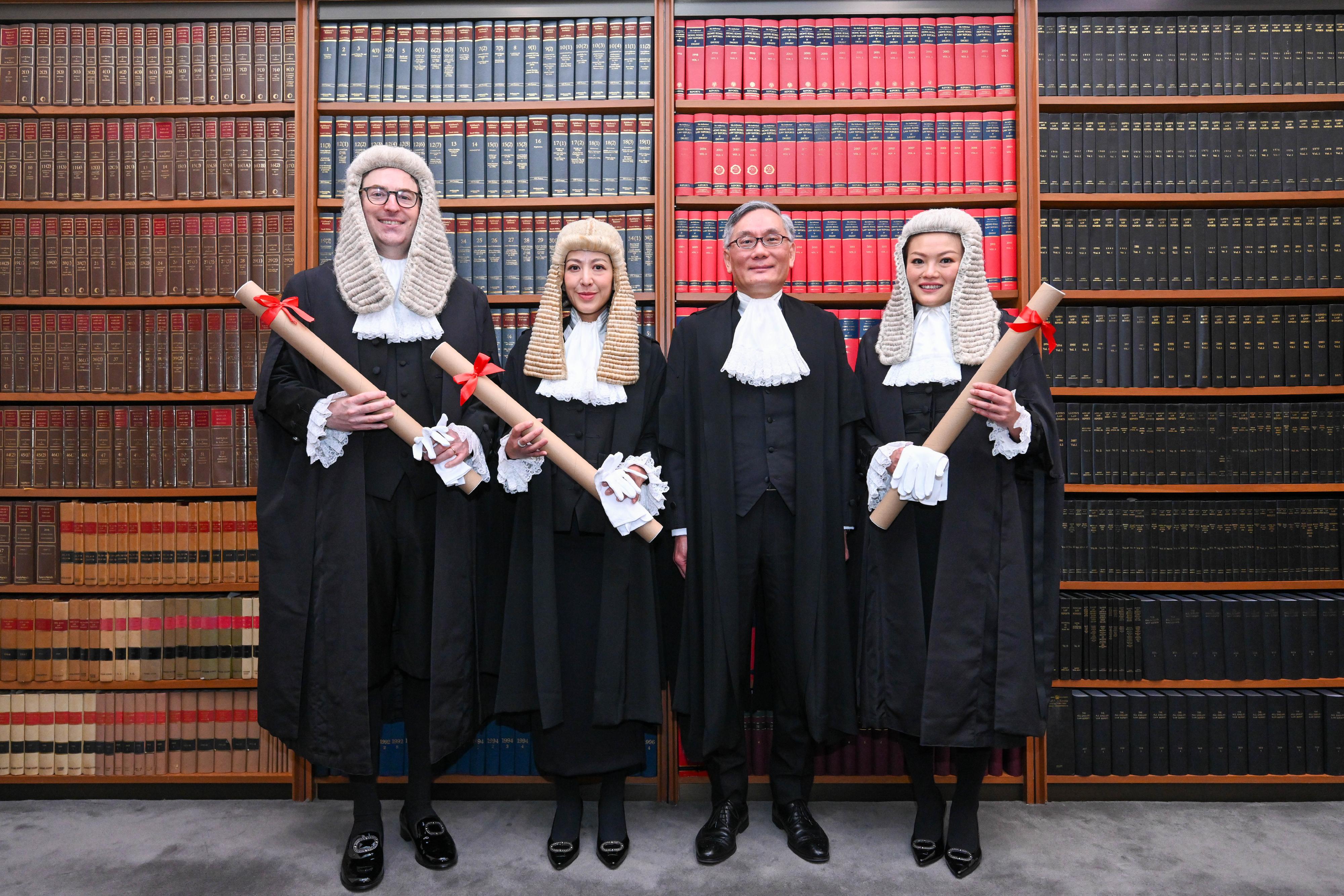
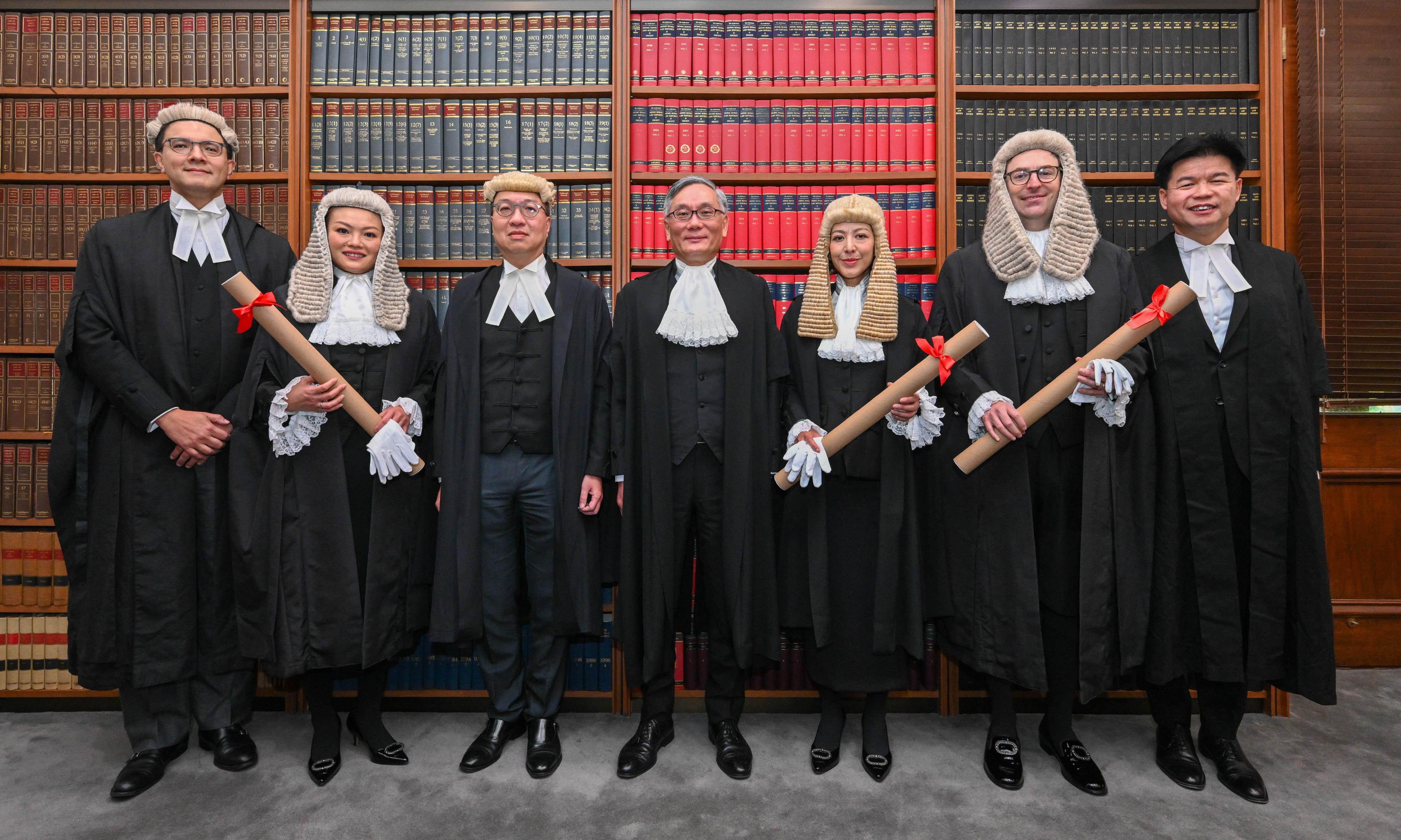


CJ’s address at Ceremony for the Admission of the New Senior Counsel (with photos)

The following is issued on behalf of the Judiciary:

     The following is the full text of an address by Chief Justice Andrew Cheung, Chief Justice of the Court of Final Appeal, at the Ceremony for the Admission of the New Senior Counsel today (June 7): 

     Secretary for Justice, Chairman of the Bar, President of the Law Society, fellow judges, ladies and gentlemen,

     It is a privilege and a pleasure to welcome you all to this important ceremony, marking the admission to the rank of Senior Counsel of Ms Catrina Lam, Ms Priscilia Lam and Mr Timothy Parker. 

     To each of our appointees, I extend my warmest congratulations. Today is the culmination of years of rigorous practice, professional growth, and steadfast dedication to the law. But while this moment may be viewed as a culmination, it is equally a commencement – a threshold to the responsibilities and expectations that come with the rank of Senior Counsel. 

     The conferment of silk is not merely an individual honour. It is a public recognition of excellence in advocacy, depth of legal learning, and the highest standards of integrity and conduct. In our common law tradition, which underpins the legal system in Hong Kong, the role of Senior Counsel carries great weight and significance. It is a rank that signifies leadership at the Bar, and a visible commitment to the values that sustain our system of justice. 

     The rank of Senior Counsel is, of course, grounded in the law. It is conferred by the Chief Justice under statute, following extensive consultation with the Chairman of the Bar, the President of the Law Society, and the senior Judiciary. The process is deliberate and exacting, as it must be, for it serves the public interest above all. The legal community and the wider society are entitled to know that those who bear the distinction of Senior Counsel do so not only on account of their technical ability, but also because they embody the finest traditions of the profession. 

     It is precisely because of these traditions that the responsibilities of Senior Counsel are so considerable. First and foremost among them is the duty to maintain the highest standards of advocacy, professional integrity, and independence. In an adversarial system, courts rely on the skill and honesty of counsel to present cases with clarity, fairness and a deep respect for the law. Senior Counsel, by their very presence in court, shape the tone and quality of proceedings and must serve as exemplars to the junior Bar. 

     Beyond the courtroom, Senior Counsel are expected to play an active and constructive role in the life of the Bar – mentoring junior members, contributing to legal education, and upholding the independence of the legal profession. They are also expected to serve the public, whether through public appointments, law reform initiatives, or, in due course, judicial service. 

     Indeed, our legal framework contemplates that some of those who ascend to the rank of Senior Counsel may in time be called to join the Bench. The qualities that make one a leader at the Bar – independence of mind, sound judgment, fairness, and intellectual rigour – are also those that form the foundation of good judging. In that sense, the appointment to silk is not merely about past achievement; it is an investment in the future strength of the Judiciary and the rule of law in Hong Kong. 

     As the best of our juniors take silk, they do so not only as individuals of great accomplishment, but as custodians of the finest traditions of the legal profession that are larger than themselves. The strength of any legal system depends not only on the soundness of its laws and institutions, but also on the quality and character of those who practise within it. Today's appointments strengthen our confidence in the future of the profession. 

     On this happy occasion, we must of course acknowledge the support given to our new silks by their families, friends, and colleagues. Their success is not achieved in isolation. It is fitting that their loved ones are present to celebrate this occasion, for they too have contributed in no small measure to the journeys culminating here this morning. 

     It would also be remiss not to acknowledge the important role played by instructing solicitors in the professional journeys of today's appointees. The trust and collaboration of those who have briefed our new Senior Counsel – often repeatedly and in the most demanding of cases – have enabled them to refine their advocacy, develop their legal thinking, and demonstrate the very qualities for which they are recognised today. The professional partnerships forged between counsel and those who instruct them are a vital part of the fabric of the legal profession, and today's appointments reflect that shared endeavour. 

     For any profession to continue to flourish, those entrusted with its guidance must possess a clear and forward-looking vision for its development, shaped by an appreciation of the needs and expectations of the society it exists to serve. They must be prepared to confront and overcome the strains and tensions that may arise from narrow or sectional interests, which are often preoccupied with short-term concerns. Senior Counsel, as the natural leaders of their branch of the legal profession, bear a particular responsibility to support this endeavour, so that the profession as a whole may continue to discharge its public function and command the respect of the community it serves.

     Now let me say a few words about our appointees. 

     Ms Catrina Lam is a highly regarded barrister with a broad commercial practice, encompassing complex disputes, domestic and international arbitration, competition law, and regulatory matters. She also has significant experience in administrative and constitutional law. Ms Lam is known for her clarity of thought, technical excellence, and strong courtroom advocacy.

     Ms Priscilia Lam is a highly respected criminal advocate, known for her diligent and fearless advocacy on both sides of the courtroom. She is recognised for her integrity, professionalism, and balanced judgment, whether acting for the prosecution or the defence. Her substantial contribution to the criminal Bar makes her elevation to silk richly deserved. 

     Mr Timothy Parker has long been regarded as one of the Bar's busiest juniors in the field of public and constitutional law. His sharp legal mind, calm authority, and principled approach have earned him the respect of judges and peers alike.

     To each of our new silks, I reiterate: the rank you now hold is not only a privilege, but also a solemn call to service. You are now leaders of the Bar. You bear a particular responsibility not only to serve as highly capable and dependable advocates in court, but also to uphold the rule of law and to safeguard the proper administration of justice. You are expected to speak with courage and conviction where the rule of law is threatened, to maintain the highest standards of professional conduct and integrity, both inside and outside the courtroom, and to uphold the traditions of discipline and courtesy which underpin the profession. No less importantly, you must be vigilant in defending the right of every individual to unimpeded access to the courts. These are not abstract ideals, but living principles that underpin the public's trust in our legal system, both within Hong Kong and beyond. 

     The courts, the legal profession, and the public will look to you for your expertise, your example, and your commitment to upholding the values that define the rule of law in our society. I have every confidence that you will rise to these challenges, as your predecessors have done, and that you will meet these expectations with the same commitment and excellence that have brought you to this day. 

     On behalf of the Judiciary and the wider legal community, I offer you my congratulations and wish you every success and fulfilment in your careers as Senior Counsel. 

     Thank you. 

Photo  Photo  


Remarks by SFST about company re-domiciliation at media session

     Following are the remarks made by the Secretary for Financial Services and the Treasury, Mr Christopher Hui, at a media session after attending a radio programme this morning (June 7):

Reporter: Mr Hui, can you talk about the Companies (Amendment) Ordinance because you mentioned that this can attract the enterprises and also investment? So how effective is this since the Ordinance came into effect?

Secretary for Financial Services and the Treasury: Since the enactment of the relevant company re-domiciliation regime legislation on May 23, we have got very positive response from the market, inquiring about how they can do that and at the same time the detailed procedures.

     So far, in terms of inquiries, we have got about 150 of them and in terms of downloads of the relevant information from our website regarding this new regime, the number is close to 10 000. So I think all these are something very positive in terms of how we have been drawing more companies to re-domicile to Hong Kong.

Reporter: What should the Government do to even attract them to use more of other services in Hong Kong?

Secretary for Financial Services and the Treasury: I think it is natural and also logical. If they decide to re-domicile to Hong Kong, there will be demand for relevant professional services. By that, it could be about accounting, could be about legal, and also other supporting financial and professional services. So once that decision is made, I am sure that the relevant professional sectors in Hong Kong will be able to benefit from that.

(Please also refer to the Chinese portion of the remarks.) 


Speech by CE at International Science, Technology and Innovation Forum of Boao Forum for Asia 2025 Hong Kong Conference (English only)

     â€‹Following is the speech by the Chief Executive, Mr John Lee, at the International Science, Technology and Innovation Forum of the Boao Forum for Asia 2025 Hong Kong Conference today (June 7):

Honourable Vice-Chairman Edmund Ho (Vice-Chairman of the National Committee of the Chinese People's Political Consultative Conference and President of the International Science, Technology and Innovation Forum of Boao Forum for Asia), Deputy Director Liu Guangyuan (Deputy Director of the Liaison Office of the Central People's Government in the Hong Kong Special Administrative Region (HKSAR)), Deputy Commissioner Li Yongsheng (Deputy Commissioner of the Office of the Commissioner of the Ministry of Foreign Affairs of the People's Republic of China in the HKSAR), Professor Frederick Ma (Chairman of the Hong Kong Trade Development Council), distinguished guests, ladies and gentlemen,

     Good morning. It is a great pleasure to join you, today, for the opening of the International Science, Technology and Innovation Forum of the Boao Forum for Asia 2025 Hong Kong Conference. It is an honour for the HKSAR Government to be hosting this Conference together with the Boao Forum for Asia – and for the first time. 

     I'm pleased to note that over 800 I&T (innovation and technology) professionals and scholars, government officials, economic leaders and high-profile representatives from some 20 countries and regions are taking part in this fourth Boao International Science, Technology and Innovation Forum. 

     Hong Kong participated in the first three editions of the conference – in Macao, Guangzhou and Zhuhai. Our co-organisation of this year's event continues the Forum's tradition of hosting the conference in the Guangdong-Hong Kong-Macao Greater Bay Area. 

     The Greater Bay Area – bringing together Hong Kong, Macao and nine major cities in Guangdong – is committed to becoming a leading international I&T hub. Ladies and gentlemen, we're well on our way now. 

     Shenzhen, Hong Kong and Guangzhou have ranked second, as a science and technology cluster, in the World Intellectual Property Organization's Global Innovation Index for the past five consecutive years – a testament both to the individual strengths we bring to our interconnected region, and our collective commitment to excellence. 

     Consider the I&T progress Hong Kong has made, under the unwavering support of our country. We are now ranked first in Asia, and seventh globally, in digital competitiveness, and third globally, as an emerging start-up centre.

     Our development is underpinned by the unique "one country, two systems" principle, which makes Hong Kong the only world city with both the China advantage and the global advantage. 

     We take full advantage, too, of the research and development (R&D) expertise of our world-class universities. After all, as a city with just 1 100 square kilometres in area, we boast five universities in the world's top 100. Add to that our established tradition of the rule of law, a common law regime that dovetails with many of the world's financial centres, and a robust intellectual property protection regime, Hong Kong is built to succeed as an international I&T centre. 

     Ladies and gentlemen, we stand at the consequential crossroads in human history – a moment where artificial intelligence and health technology converge not just as tools, but the architects of our evolution into the next era of development.

     Hong Kong is committed to the development of these frontier industries. Our InnoHK research clusters will help us get us there that much faster. InnoHK was created to drive Hong Kong's R&D collaboration with world-renowned universities and research institutions. 

     Our first two clusters focus on healthcare technology, artificial intelligence and robotics technologies. Our third cluster will specialise in four research areas: sustainable development, energy, advanced manufacturing and materials. And it is open now, through the 29th of August, for applications from international research institutions and universities eager to work with Hong Kong – and the Greater Bay Area.

     We're also making more land available for I&T development through the Hetao Shenzhen-Hong Kong Science and Technology Innovation Co-operation Zone, which straddles our boundary with Shenzhen. The Hong Kong Park in the Zone will become operational within this year, and bring together vital sources of new quality productive forces for the country. 

     For innovation to thrive, it must be rooted in international co-operation. The exchange of knowledge, talent and ideas should be open and free. Without borders. Without boundaries. Without tariffs. 

     A long-standing champion of multilateralism, and a rules-based global economy, Hong Kong is deeply committed to building collaboration among governments, businesses and academic institutions. Everywhere.

     And, rest assured, we will continue to advocate for free trade, economic openness and cross-border investment. That will ensure that technology serves as a bridge, rather than a barrier to co-operation, and the economic flourishing and societal well-being it can bring us all.

     I wish you all a rewarding Conference, a memorable stay in Hong Kong and the best of innovation and technology in the coming year. Thank you.


Food Safety Day 2025 highlights importance of preventing cross-contamination

     The Centre for Food Safety (CFS) of the Food and Environmental Hygiene Department launched its annual Food Safety Day 2025 campaign today (June 7), emphasising the importance of preventing cross-contamination in safeguarding food safety. It serves to remind food businesses and the public that adopting proper hygiene and food handling practices, such as handling raw and cooked food separately, can reduce the risk of foodborne illnesses.

     To echo World Food Safety Day, the CFS has chosen "preventing cross-contamination" as the theme for Food Safety Day 2025. Cross-contamination is one of the most common causes of food poisoning, occurring when harmful microorganisms are transferred directly or indirectly from raw food to cooked or ready-to-eat food via contaminated hands, utensils, cutting boards, or food contact surfaces. 

     "Food handlers and the public should remain vigilant in storing and handling raw and cooked foods separately, using designated utensils and storage containers, and maintaining good personal and environmental hygiene to prevent the spread of bacteria. If raw and cooked or ready-to-eat food must be handled in the same area, thorough disinfection between uses is essential," said a CFS spokesman.

     Food handlers and members of the public are also reminded that maintaining hand hygiene is essential for minimising the risk of cross-contamination and ensuring food safety. Hands should be washed thoroughly with liquid soap and clean running water for at least 20 seconds before and after handling food and wearing gloves, as well as after using the toilet, touching the face, or handling waste. Wearing gloves does not replace proper handwashing.

     To prevent foodborne diseases and curb the emergence of antimicrobial resistance, the CFS urges food businesses and the public to maintain proper personal and environmental hygiene and observe the "Five Keys to Food Safety" when preparing food, including choosing safe raw materials, keeping hands and utensils clean, separating raw and cooked food, cooking thoroughly, and keeping food at safe temperatures.

     â€‹For more information about Food Safety Day 2025 and related activities, please visit the CFS website (www.cfs.gov.hk).