Latest progress in follow up on novel coronavirus infection in Hong Mei House, Cheung Hong Estate

     The Centre for Health Protection (CHP) of the Department of Health (DH) is today (February 11) continuing to proactively follow up on the cases of novel coronavirus infection in Hong Mei House, Cheung Hong Estate in Tsing Yi. Questionnaires with the households at the A07 units of Hong Mei House had completed. Apart from the close contacts of the resident involved in the case confirmed yesterday (February 10), so far no additional case has been recorded from other households.
 
        Personnel from the CHP have successfully traced all 34 households of all the A07 units of Hong Mei House. Active case finding was conducted to identify if there are undiagnosed cases. Five residents who were symptomatic were sent to hospitals for isolation and treatment. All of the respiratory samples tested negative for novel coronavirus.
 
        Among the 34 households, two are from the confirmed cases, about 100 residents from 30 households are being arranged to be transferred to quarantine centres while the remaining two households currently do not reside in their units due to individual reasons.
 
        The CHP is continuing epidemiological investigations into the cases of novel coronavirus infection in Hong Mei House. Together with the Environment Bureau, and departments including Housing Department (HD), the Electrical and Mechanical Services Department and the Architectural Services Department, the CHP is investigating and examine if environmental factors were involved in the infection of the cases.
 
        According to the HD's information, the HD's Maintenance Surveyor and technical inspection team has conducted a detailed inspection at the unit A07 of Hong Mei House where the 62-year-old female patient resides. The vent pipe at the toilet which was altered without permission has been sealed up. The inspection team will inspect other 07 units in the building. If unauthorised alteration of vent pipes in the toilets are detected, immediate and proper follow up actions will be taken.
 
        As the investigations by relevant departments are ongoing, the CHP advised that, as a precautionary measure, the residents of Cheung Hong Estate at this stage should not open the window or turn on the ventilator when using the toilet.
 
        The Food and Environmental Hygiene Department and the HD will conduct thorough cleaning and disinfection for the building. The DH today organised a health talk for residents of Cheung Hong Estate to give health advice on the prevention of pneumonia and respiratory tract infection to residents.
 
        A spokesman for the CHP said, "The public is strongly urged to maintain at all times strict personal and environmental hygiene which is key to personal protection against infection and prevention of the spread of the disease in the community."
 
     The spokesman said, "On the personal level, members of the public should wear a surgical mask when having respiratory symptoms, taking public transport or staying in crowded places. They should also perform hand hygiene frequently, especially before touching the mouth, nose or eyes. The public should go out less and reduce social activities, and maintain appropriate social distance with other people as far as possible."
 
     "As for household environmental hygiene, members of the public are advised to maintain drainage pipes properly and regularly pour water into drain outlets (U-traps); after using the toilet, they should put the toilet lid down before flushing to avoid spreading germs."
 
        For other health advice and information, please visit the CHP's dedicated webpage (www.gov.hk/ncv) on novel coronavirus infection.
 
     The CHP has set up a hotline (2125 1122), which operates from 8am to midnight daily, for public enquiries.


Latest Arrangements on Postal Services

     Hongkong Post today (February 11) announced that the principle of according a top priority for the delivery of surgical masks has been strictly upheld and it has been a prime concern for Hongkong Post to handle Speedpost items containing surgical masks since after the Lunar New Year. Up to now, we have handled and delivered about 30 000 such items. The daily volume of inward mail received this week has surged by 80 per cent as per usual, and around 70 per cent of which are Speedpost items. It is estimated that about 10 000 Speedpost items containing surgical masks were received over the past few days.
      
     To speed up the delivery of mail items containing surgical masks to the public, the following measures will be introduced.  Thanks to the support of our colleagues who are committed to serving Hong Kong people together, starting from tomorrow (February 12), Hongkong Post will deploy additional manpower from other divisions/sections for the handling of Speedpost items and arrange for night-time delivery, except from maintaining normal posting and delivery services of Speedpost items from Monday to Saturday. In parallel, we will resume mail delivery services on a daily basis, so as to handle the upsurge in mail volume. It is estimated that delivery of this batch of surged mail items containing surgical masks could be completed within this week.
      
     Hongkong Post will continue to attach attention to the occupational health and safety of our staff. Measures have been taken to strengthen the disinfection of our workplace. Surgical masks, alcohol swabs and other gears have also been provided to our staff for their protection.
      
     Subject to the mail volume, we will again review the arrangements of our postal services.


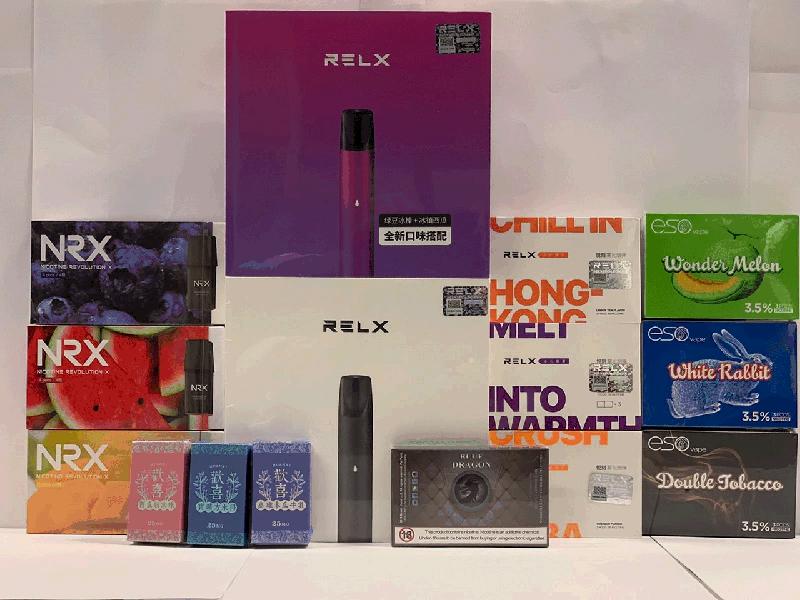
Man arrested for suspected illegal sale of nicotine-containing liquids for electronic cigarettes (with photo)

     The Department of Health (DH) and the Police yesterday (February 10) conducted a joint operation against the illegal sale of nicotine-containing liquids intended for use with electronic nicotine delivery systems, commonly known as electronic cigarettes. 
 
     Acting upon a public complaint, the DH found that a type of nicotine-containing liquid "RELX" was offered for sale in a retail store in Wan Chai. During the operation against the retail store in Wan Chai and its branch in Mong Kok yesterday, a number of other brands of nicotine-containing liquids, for use in electronic cigarette labelled with nicotine content were also found.
 
     A 38-year-old man was arrested by the Police for suspected illegal sale and possession of Part 1 poisons and unregistered pharmaceutical products. In addition, a 21-year-old man and a 19-year-old woman were also arrested by the Police for suspected possession of Part 1 poisons and unregistered pharmaceutical products.
 
     The DH's investigation is continuing.
 
     According to the Pharmacy and Poisons Ordinance (Cap 138), nicotine-containing electronic cigarette products are classified as pharmaceutical products requiring registration with the Pharmacy and Poisons Board of Hong Kong before they can be sold in Hong Kong. In addition, Part 1 poisons can only be sold at pharmacies under the supervision of a registered pharmacist. Illegal sale and possession of Part 1 poisons and unregistered pharmaceutical products are criminal offences. The maximum penalty for each offence is a fine of $100,000 and two years' imprisonment.
 
     Members of the public who have purchased the above products should stop using them immediately and consult healthcare professionals for advice if they are in doubt or feeling unwell after use. They may submit the products to the DH's Drug Office in Room 1801, Wu Chung House, 213 Queen's Road East, Wan Chai, during office hours for disposal.
 
     Smokers are advised to quit smoking for their own health and that of others. They are encouraged to make use of smoking cessation services through the DH's Integrated Smoking Cessation Hotline (1833 183). Information on smoking cessation can also be obtained from the DH's Tobacco and Alcohol Control Office website (www.taco.gov.hk).

Photo  


Government proactively assists students unable to return to Taiwan to attend school

     Taiwan authorities announced yesterday afternoon (February 10) that with effect from midnight today (February 11), the entry of Hong Kong and Macao residents to Taiwan would be temporarily suspended, and a number of Hong Kong students currently studying in Taiwan are unable to return to Taiwan in time. A spokesman for the Hong Kong Special Administrative Region (HKSAR) Government said today that the Government attaches high importance to the matter and immediately took a series of measures to assist the affected students.

     The spokesman said that the HKSAR Government and the Hong Kong Economic, Trade and Cultural Office (HKETCO) in Taipei took immediate action to contact an airline yesterday, requesting it to render assistance as far as possible to Hong Kong students who wished to return to Taiwan at that time to continue their studies. It is understood that the airline tried its best to allocate seats on its existing flights to cater for the needs of Hong Kong students.

     The spokesman said, "The Education Bureau has set up a hotline at 2891 0088 (press 1 and 7 after choosing the language) to provide assistance to the affected students. The hotline operates from 8.30am to 1pm and from 2pm to 6pm, Monday through Friday. They can also contact the bureau via email at edbinfo@edb.gov.hk. Students and parents can provide their case details and contact information to the bureau, which will render assistance to them as far as practicable.

     "We have also liaised with the Taiwan side through the platform of the Hong Kong-Taiwan Economic and Cultural Cooperation and Promotion Council and the Taiwan-Hong Kong Economic and Cultural Co-operation Council, and appealed to the Taiwan side to offer as much assistance to the affected Hong Kong students as possible."

     Furthermore, the HKETCO has contacted a number of Hong Kong students currently in Taiwan, as well as Hong Kong and Macao student bodies and non-governmental organisations serving Hong Kong and Macao students in Taiwan, and has set up a 24-hour hotline (+886 963 660 632) to proactively provide practicable assistance to students who are already in Taiwan and are undergoing the required quarantine at student quarters or at home.

     The HKSAR Government will continue to closely monitor and follow up on the issue. Hong Kong students studying in Taiwan are advised to pay attention to announcements made in Taiwan and to contact their respective schools to make necessary arrangements.


CHP investigates cluster of Legionnaires’ disease

     The Centre for Health Protection (CHP) of the Department of Health is today (February 11) investigating a cluster of Legionnaires' disease (LD) cases, involving 10 patients, and stressed the importance of using and maintaining properly designed man-made water systems and that susceptible groups should strictly observe relevant precautions.
 
     Further to the CHP's announcements on a cluster of LD cases on February 1, 3, 6, 7 and 10 involving seven male patients and two female patients aged 65 to 84, one additional LD case relevant to the cluster has been recorded today.
 
     The male patient, aged 72 with underlying illness, lives in Tsuen Shek House, Ping Shek Estate, Kwun Tong. The patient's sample tested positive for Legionella pneumophila.
 
     "Epidemiological investigations revealed that the patient had no travel history in the incubation period. Officers of the CHP have conducted site visits at Ping Shek Estate and have already collected environmental and water samples. Investigations are ongoing to identify potential sources of infection, if any," a spokesman for the CHP said.

     "Men, people aged over 50, smokers, alcoholics and persons with weakened immunity are more susceptible to LD. Some situations may also increase the risk of infection including poor maintenance of water systems leading to stagnant water; living in areas with old water systems, cooling towers or fountains; using electric water heaters, whirlpools and spas or hot water spring spas; and recent stays in hotels or vessels," the spokesman said.
 
     Legionellae are found in various environmental settings and grow well in warm water (20 to 45 degrees Celsius). They can be found in aqueous environments such as water tanks, hot and cold water systems, cooling towers, whirlpools and spas, water fountains and home apparatus which support breathing. People may become infected when they breathe in contaminated droplets (aerosols) and mist generated by artificial water systems, or when handling garden soil, compost and potting mixes.
 
     Immunocompromised persons should: 

• Use sterile or boiled water for drinking, tooth brushing and mouth rinsing;
• Avoid using humidifiers, or other mist- or aerosol-generating devices. A shower may also generate small aerosols; and
• If using humidifiers, or other mist- or aerosol-generating devices, fill the water tank with only sterile or cooled freshly boiled water, and not water directly from the tap. Also, clean and maintain humidifiers/devices regularly according to manufacturers' instructions. Never leave stagnant water in a humidifier/device. Empty the water tank, wipe all surfaces dry, and change the water daily.
 
     The public should observe the health advice below:
 
• Observe personal hygiene;
• Do not smoke and avoid alcohol consumption;
• Strainers in water taps and shower heads should be inspected, cleaned, descaled and disinfected regularly or at a frequency recommended by the manufacturer;
• If a fresh water plumbing system is properly maintained, it is not necessary to install domestic water filters. Use of water filters is not encouraged as clogging occurs easily, which can promote growth of micro-organisms. In case water filters are used, the pore size should be 0.2 micrometres (µm) and the filter needs to be changed periodically according to the manufacturer's recommendations;
• Drain and clean water tanks of buildings at least quarterly;
• Drain or purge for at least one minute infrequently used water outlets (e.g. water taps, shower heads and hot water outlets) and stagnant points of the pipework weekly or before use;
• Seek and follow doctors' professional advice regarding the use and maintenance of home respiratory devices and use only sterile water (not distilled or tap water) to clean and fill the reservoir. Clean and maintain the device regularly according to the manufacturer's instructions. After cleaning/disinfection, rinse the device with sterile water, cooled freshly boiled water or water filtered with 0.2 µm filters. Never leave stagnant water in the device. Empty the water tank, keep all surfaces dry, and change the water daily; and
• When handling garden soil, compost and potting mixes:
   1. Wear gloves and a face mask;
   2. Water gardens and compost gently using low pressure;
   3. Open composted potting mixes slowly and make sure the opening is directed away from the face;
   4. Wet the soil to reduce dust when potting plants; and
   5. Avoid working in poorly ventilated places such as enclosed greenhouses.

     The public may visit the CHP's LD page, the Code of Practice for Prevention of LD and the Housekeeping Guidelines for Cold and Hot Water Systems for Building Management of the Prevention of LD Committee, and the CHP's risk-based strategy for prevention and control of LD.