CE visits Centre for Health Protection and inspects quarantine centre at Chun Yeung Estate (with photos/video)

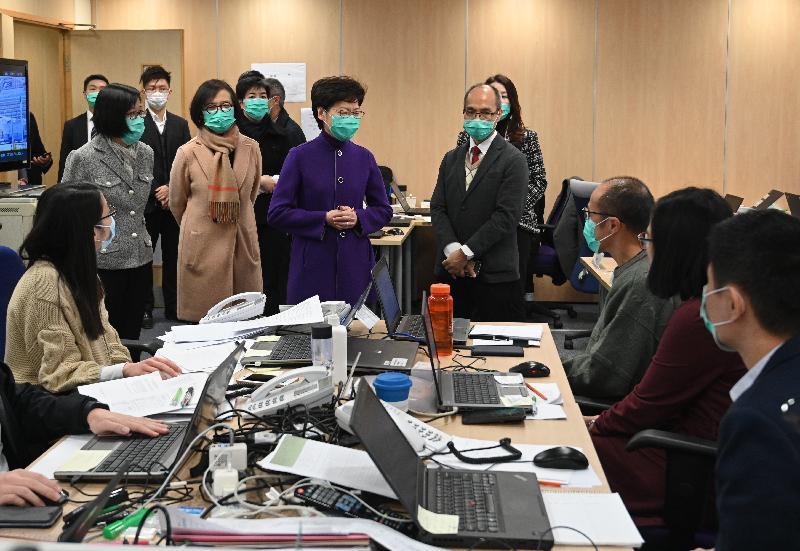
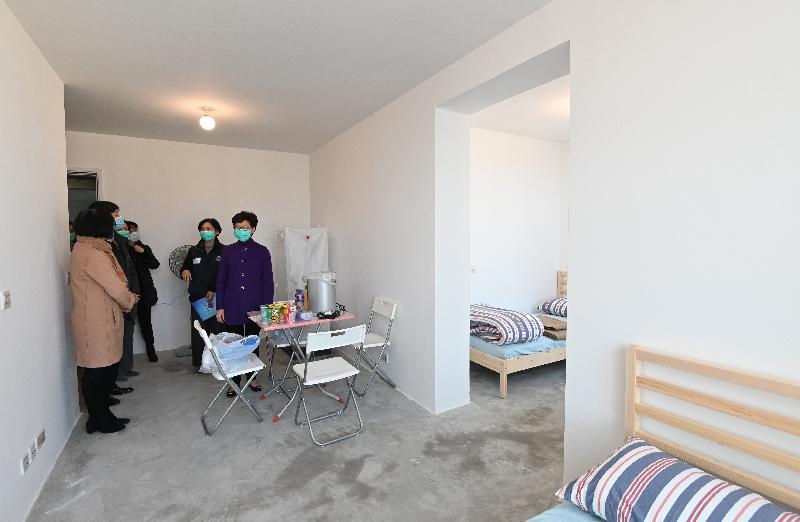
     The Chief Executive, Mrs Carrie Lam, visited the Centre for Health Protection (CHP) of the Department of Health this afternoon (February 19), expressing her heartfelt thanks to the staff's efforts in the prevention and control of the disease days and nights. She also inspected the Chun Yeung Estate in Fo Tan which will be used for quarantine centre to learn about the progress of its preparation.
      
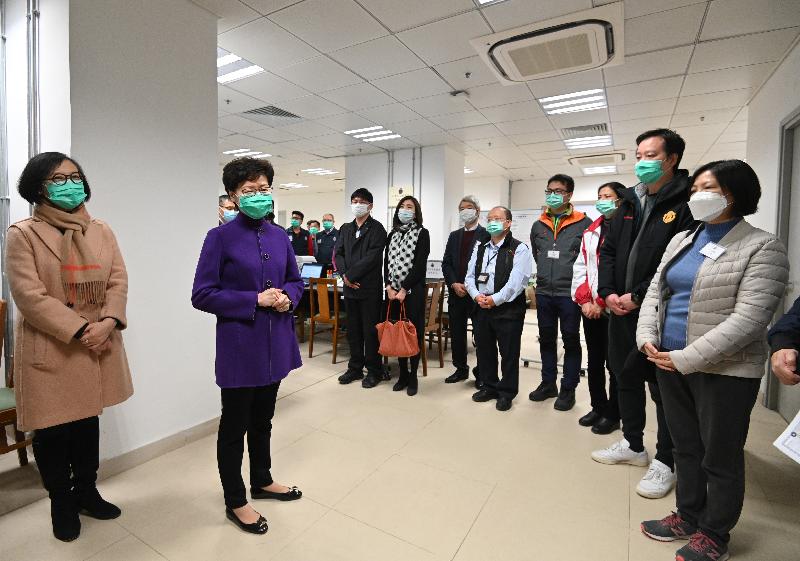
     Accompanied by the Secretary for Food and Health, Professor Sophia Chan, and the Director of Health, Dr Constance Chan, Mrs Lam visited various working units in the CHP including the home quarantine working group under the non-communicable disease branch, communicable disease branch, health promotion branch, emergency response and programme management branch, infection control branch, etc. She was briefed about the actions taken against the disease in the past month or so and exchanged views with the front-line officers there to learn more about their work.
      
     The Government set up the CHP in 2004 under the recommendation in the report by the Severe Acute Respiratory Syndrome Expert Committee to strength the Government's capability in the prevention and control of diseases.
      
     Mrs Lam said that the CHP has shouldered the duty to protect Hong Kong against diseases and has been standing at the front-line in the ongoing anti-epidemic work. She thanked the centre's staff for their dedicated work days and nights in carrying out various initiatives including health surveillance, compulsory quarantine, isolation treatment, health declaration, exit screening, etc. She also noted that they meet the media every day to brief the public on the latest development of the disease, and disseminate heath information. A lot of the information is provided in different languages to cater for the needs of the ethnic minorities. She praised the centre's staff for their professionalism and high efficiency, expressing confidence that they will continue to spare no effort in tackling the disease in accordance with the three principles namely making prompt responses, staying alert and working in an open and transparent manner. 
      
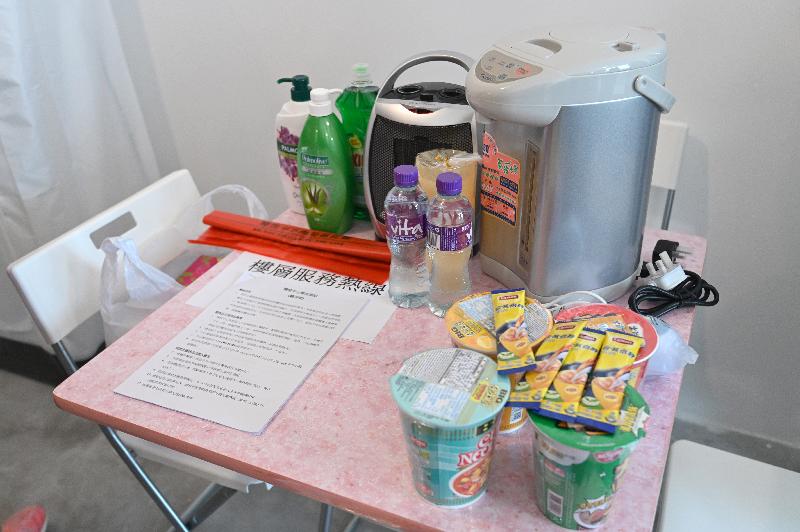
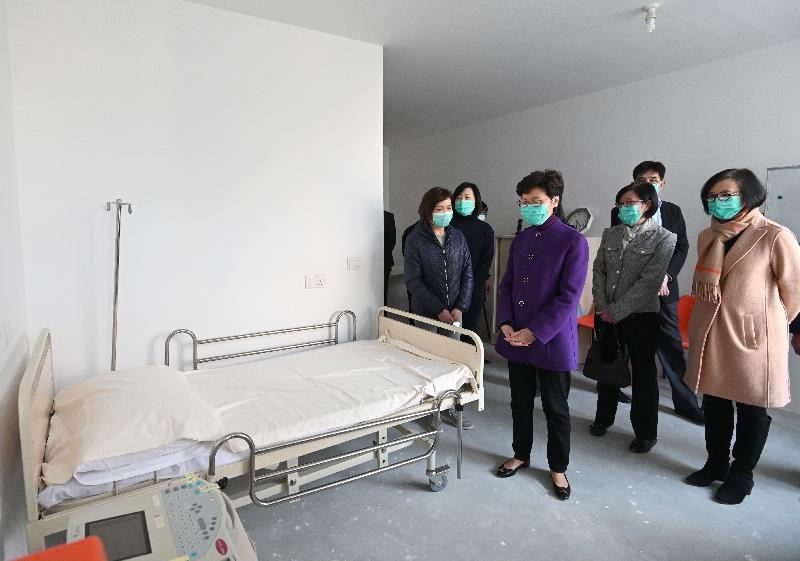
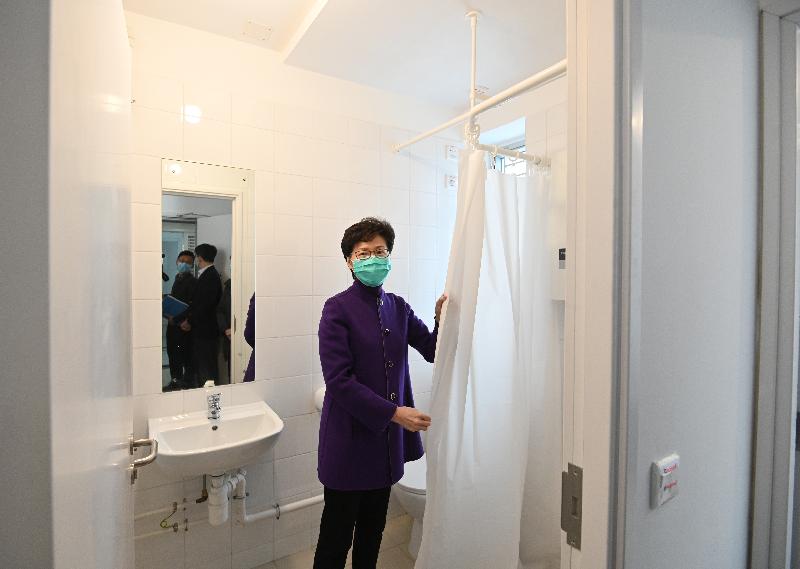
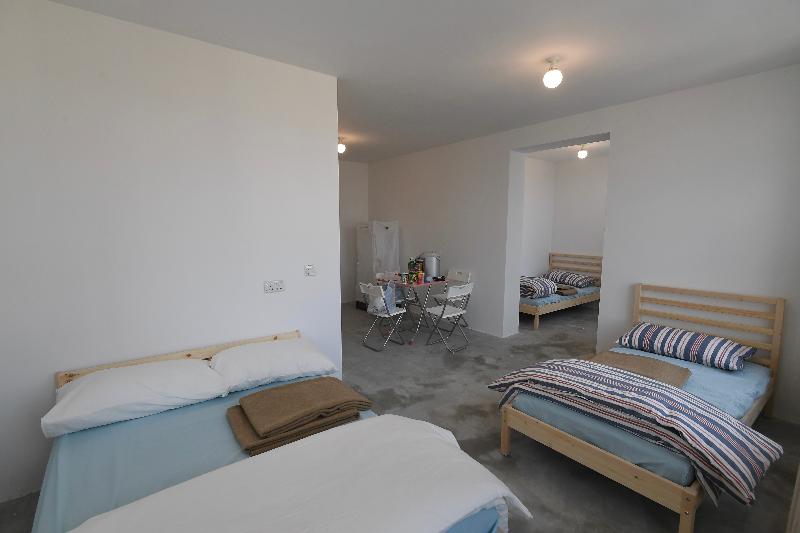
     Mrs Lam, Professor Chan and Dr Chan later visited Chun Yeung Estate, which will be used as quarantine centre, to learn about its preparatory work. She noted that the first batch of over 500 units is now available and ready for persons under quarantine to move in, including the Hong Kong residents on board the Diamond Princess cruise ship who will soon be returning to Hong Kong from Japan by Government's chartered flights. She expressed her gratitude to the Department of Health, the Police, the Civil Aid Service, the Home Affairs Department, the Housing Department, the Electrical and Mechanical Services Department, the Office of the Government Chief Information Officer and the Government Logistics Department for their efforts in making ready such a large number of units in a very short period time to meet the anti-epidemic need, contributing to the protection of public health.
      
     Mrs Lam stressed that all persons being arranged to stay at quarantine centres are not confirmed or suspected cases, and the operation of the quarantine centres must also meet the stringent requirements. Security and healthcare staff will be on duty round the clock in the quarantine centres. Transfer service for leaving and entering the centres will be provided to people under quarantine, therefore the impact on the community should be minor. She said she understood that the use of Chun Yeung Estate as a quarantine centre will affect the families who have been allocated with the units there earlier, but she hoped that they could appreciate the need to do so on public health grounds and support the Government's anti-epidemic work.
              
     The Government has announced earlier that the Anti-epidemic fund will provide a one-off special allowance of $6,000 to the families allocated with public housing units at Chun Yeung Estate in Fo Tan, and Fai Ming Estate in Fanling which was severely damaged by rioters earlier.
      
     Mrs Lam said the Anti-Epidemic Fund aims to strengthen the anti-epidemic work in Hong Kong and support the affected sectors and workers. As the Fund will benefit a large number of people and in view of the current emergency situation, she said she hoped that the funding application will be approved by the Legislative Council as soon as possible.
      
     The Legislative Council has decided to convene a special Finance Committee meeting on February 21 to consider the funding application of the Anti-epidemic Fund.
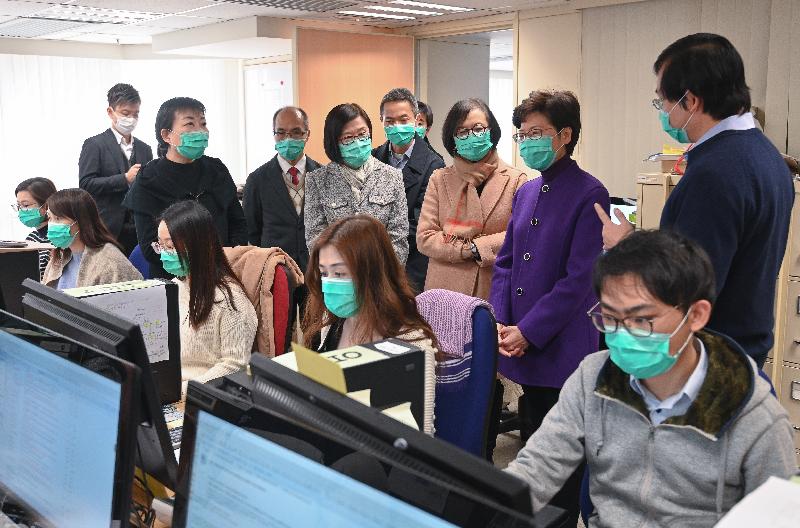
Photo  Photo  Photo  Photo  Photo  Photo  Photo  Photo  Photo  Photo  Photo  Photo  


CHP investigates three additional cases of COVID-19

     The Centre for Health Protection (CHP) of the Department of Health (DH) announced that as of 8pm today (February 19), the CHP is investigating three additional cases of COVID-19, taking to 65 the number of confirmed cases so far in Hong Kong.
 
     The first case involves an 83-year-old woman (the 63rd case) who is the mother-in-law of the 54-year-old male patient of the 57th case confirmed on February 16 and the mother of the 46-year-old female patient of the 60th case confirmed on February 17. The patient has underlying illnesses who lives in Block 1, Seaview Garden in Tuen Mun. She developed runny nose since February 14. She suffered from fractures caused by fall on February 15 and was admitted to the Orthopaedic ward of Tuen Mun Hospital (TMH) for treatment. She underwent surgery on February 16. Healthcare staff of TMH later acknowledged that the patient's daughter and son-in-law were confirmed cases of COVID-19. She was subsequently transferred to isolation ward of the hospital yesterday and received testing for COVID-19.
 
     Her respiratory sample was tested positive for novel coronavirus and is now in a stable condition. The patient had no travel history during the incubation period. Her husband who lived with her had cough since January 25 and had recovered. He is currently asymptomatic and has been admitted to TMH isolation ward for further examination.
 
     The patient visited the Hoi Tin Garden Restaurant on its first floor located on 5 Sam Shing Street, Tuen Mun from 9am to 11am on February 14 for a meal. Those who also visited the first floor of Hoi Tin Garden Restaurant during the above period and develop symptoms later are urged to call the CHP hotline.
 
     The second and third cases involve a couple who are a 68-year-old man (the 64th case) and a 70-year-old woman (the 65th case) with underlying illnesses. They live in Sui Moon House, Siu Sai Wan Estate. They developed cough since February 12 and consulted a private doctor for persistent cough on February 18, and sought medical attention at Pamela Youde Nethersole Eastern Hospital and were admitted for treatment. Their respiratory samples were tested positive for novel coronavirus and are now in stable condition. They had no travel history during the incubation period. Their daughter who live together is asymptomatic and will be arranged for quarantine.
 
     Relevant contract tracing by the CHP is ongoing.

     A spokesman for the CHP said, "According to our preliminary epidemiological investigations, some of the confirmed cases are locally infected. The CHP strongly urged the public to maintain at all times strict personal and environmental hygiene which is key to personal protection against infection and prevention of the spread of the disease in the community."

     The spokesman said, "On the personal level, members of the public should wear a surgical mask when having respiratory symptoms, taking public transport or staying in crowded places. They should also perform hand hygiene frequently, especially before touching the mouth, nose or eyes. The public should go out less and reduce social activities, and maintain appropriate social distance with other people as far as possible."

     "As for household environmental hygiene, members of the public are advised to maintain drainage pipes properly and regularly pour water into drain outlets (U-traps); after using the toilet, they should put the toilet lid down before flushing to avoid spreading germs."

     The CHP will report the cases to the World Health Organization, National Health Commission, Health Commission of Guangdong Province and the Hospital Authority.
       
     The CHP's epidemiological investigations and relevant contact tracing on the confirmed cases are ongoing. Quarantine will be arranged for close contacts while medical surveillance will be arranged for other contacts. For the progress on the contact tracing of the cases, please see annex.

     The CHP has set up a hotline (2125 1122) for public enquiries. The hotline operates from 8am to midnight daily. As at 4pm today, a total of 16 698 calls were received.

     A dedicated webpage (www.gov.hk/ncv) has been set up by the CHP. Information including the latest local situation, list of buildings and list of flights/trains/ships relevant to the confirmed cases, countries/areas with reported cases as well as health advice and a local situation interactive map dashboard are available on the webpage to help the public grasp the latest updates.

     To prevent pneumonia and respiratory tract infection, members of the public should always maintain good personal and environmental hygiene. They are advised to:

• Wear a surgical mask when taking public transport or staying in crowded places. It is important to wear a mask properly, including hand hygiene before wearing and after removing a mask;
• Perform hand hygiene frequently, especially before touching the mouth, nose or eyes; after touching public installations such as handrails or door knobs; or when hands are contaminated by respiratory secretions after coughing or sneezing;
• Maintain drainage pipes properly and regularly (about once a week) pour about half a liter of water into each drain outlet (U-traps) to ensure environmental hygiene;
• After using the toilet, put the toilet lid down before flushing to avoid spreading germs;
• Wash hands with liquid soap and water, and rub for at least 20 seconds. Then rinse with water and dry with a disposable paper towel. If hand washing facilities are not available, or when hands are not visibly soiled, performing hand hygiene with 70 to 80 per cent alcohol-based handrub is an effective alternative;
• Cover your mouth and nose with tissue paper when sneezing or coughing. Dispose of soiled tissues into a lidded rubbish bin, then wash hands thoroughly; and
• When having respiratory symptoms, wear a surgical mask, refrain from work or attending class at school, avoid going to crowded places and seek medical advice promptly.

     The public should take heed of the health advice below when travelling outside Hong Kong:

• Do not travel to Hubei Province where community transmission of COVID-19 is occurring;
• Avoid close contact with persons with fever or respiratory symptoms in countries/areas with possible community transmission of COVID-19. If it is unavoidable to come into contact with them, put on a surgical mask and continue to do so until 14 days after returning to Hong Kong;
• Avoid visiting hospitals. If it is necessary to visit a hospital, put on a surgical mask and observe strict personal and hand hygiene;
• Avoid touching animals (including game), poultry/birds or their droppings;
• Avoid visiting wet markets, live poultry markets or farms;
• Avoid making close contact with patients, especially those with symptoms of acute respiratory infections;
• Do not consume game meat and do not patronise food premises where game meat is served;
• Adhere to food safety and hygiene rules such as avoiding consuming raw or undercooked animal products, including milk, eggs and meat, or foods which may be contaminated by animal secretions, excretions (such as urine) or contaminated products, unless they have been properly cooked, washed or peeled;
• If feeling unwell when outside Hong Kong, especially if experiencing a fever or cough, wear a surgical mask, inform the hotel staff or tour escort and seek medical advice at once; and
• After returning to Hong Kong, consult a doctor promptly if experiencing a fever or other symptoms, take the initiative to inform the doctor of any recent travel history and any exposure to animals, and wear a surgical mask to help prevent spread of the disease. 


Government’s response to demonstration

     In response to the demonstration organised by the Union for New Civil Servants (the Union) outside the Central Government Offices today (February 19), a Government spokesman made the following response:
 
     The top priority of the Government now is to combat the novel coronavirus with all its means, and various policy initiatives have been put in place to step up anti-epidemic measures across the territory, including measures for minimising people flows and social contacts within Hong Kong.  Civil servants have strict responsibility to follow the Government's policies to combat the virus and to work in concert with other sectors of the community in this regard.   

     At this critical moment as we combat the virus, the act of the Union to organise a demonstration by calling upon civil servants and members of the public to gather together at the expense of their safety is totally irresponsible. This is clearly contrary to the Government's important guidelines on reducing social contacts in the fight against the virus.

     The Civil Service Bureau (CSB) has already provided a detailed reply in response to the concerns raised by the Union on the anti-epidemic protective equipment and special work arrangement for government employees in its letter last week.

     Regarding the special work arrangement for government employees, CSB has stated clearly in its reply that bureaux/departments will make appropriate manpower arrangements and take adequate anti-epidemic protective measures according to their actual operational needs.

     Regarding the Union's query on the protective equipment of the police officers on duty at Cheung Hong Estate, Tsing Yi, alleging that the protective equipment of the police officers was even better than that of the frontline medical staff, CSB has also stated clearly in its reply that the distribution of protective gear was based on the risks involved in the duties assigned. In addition, in order to allay public concerns and misunderstanding, the Government has repeatedly explained the standard of the Police's protective gear and the Government's criteria for distributing anti-epidemic protective equipment. 

     It is very disappointing that the Union appears to have not only ignored CSB's reply and the repeated responses given by the Government, but it has instead organised the demonstration on the pretext of the discontent about the special work arrangement and the criteria for allocating government resources. The Government deeply regrets such an attempt to divide and create conflicts among civil servants, and to undermine the morale of the civil service. Moreover, the shouting of slogan by some attending the demonstration in support of Hong Kong's independence is totally unacceptable.

     At this critical moment when Hong Kong is combating the virus, the Government hopes that the Union will adopt a positive attitude and work with the entire civil service to fight against the disease together.


Public hospitals daily update on COVID-19 cases

The following is issued on behalf of the Hospital Authority:
     
     As at noon today (February 19), public hospitals had reported to the Department of Health the admission of 31 patients (10 male and 21 female, aged 19 to 83) in the past 24 hours who met the reporting criteria of COVID-19. Appropriate tests have been arranged for the patients.
      
     There are 100 patients under isolation currently.  So far, five patients with COVID-19 infection have been discharged upon recovery.
      
     The Hospital Authority will maintain close contact with the Centre for Health Protection to monitor the latest developments and to inform the public and healthcare workers on the latest information in a timely manner.


Suspected theft of OGCIO mobile phones

     The Office of the Government Chief Information Officer (OGCIO) today (February 19) announced the suspected theft of two mobile phones used for monitoring persons under compulsory home quarantine. The OGCIO has reported the incident to the Police and the Office of the Privacy Commissioner for Personal Data. All those affected were also informed and reminded to remove contacts with the two mobile phones. They were also advised to inform the OGCIO and follow up with the Police if any suspicious calls were received.
      
     Staff of the OGCIO discovered the suspected theft of two mobile phones when they conducted inventory checking of all 170 phones last night. The two mobile phones were used at the temporary communication centre set up by the OGCIO at the Customs and Excise Department headquarters in North Point for monitoring whether persons under quarantine had been staying in their dwelling places. Persons under quarantine are requested to share their real-time locations and conduct video calls through mobile communication applications. A total of 122 persons had been contacted via the two mobile phones for monitoring purposes. Names, telephone numbers, shared locations and photos of these persons but no detailed addresses are stored in the phones. The mobile phones are password-protected with information encrypted. The OGCIO has already terminated the communication services of the two phones.
      
     The OGCIO expressed regret about the incident and offered its sincerest apologies to those affected. The OGCIO has immediately stepped up information security to avoid the recurrence of similar incidents.