Update on dengue fever

     The Centre for Health Protection (CHP) of the Department of Health today (February 21) reported the latest number of dengue fever (DF) cases, and strongly urged the public to maintain strict environmental hygiene, mosquito control and personal protective measures both locally and during travel.
 
     From February 7 to 20, the CHP confirmed one imported DF case. The patient had been to Indonesia during the incubation period.
 
     As of yesterday (February 20), a total of 14 cases of DF had been recorded in 2020, all of which were imported cases from countries comprising the Philippines (six), Malaysia (two), Thailand (two), Vietnam (two), Cambodia (one) and Indonesia (one).
  
     According to the Health Commission of Guangdong Province, a total of 6 042 cases had been recorded in Guangdong in 2019, which nearly doubled that in 2018 (3 315 cases). As of January 31, 11 cases had been recorded in Guangdong in 2020. In Taiwan, as of yesterday, 33 imported cases (none local) had been recorded in 2020.
 
     Detailed information on the latest DF situation in Hong Kong as well as neighbouring and overseas countries and areas has been uploaded to the CHP's website (www.chp.gov.hk/files/pdf/df_imported_cases_and_overseas_figures_eng.pdf). Members of the public should stay vigilant and carry out effective mosquito prevention and control measures.
 
     ​"Apart from general measures, travellers returning from areas affected by DF should apply insect repellent for 14 days upon arrival in Hong Kong. If feeling unwell, seek medical advice promptly and provide travel details to the doctor," a spokesman for the CHP said.
 
     The public should take heed of the following advice on mosquito control:
 

  • Thoroughly check all gully traps, roof gutters, surface channels and drains to prevent blockage;
  • Scrub and clean drains and surface channels with an alkaline detergent compound at least once a week to remove any deposited mosquito eggs;
  • Properly dispose of refuse, such as soft drink cans, empty bottles and boxes, in covered litter containers;
  • Completely change the water of flowers and plants at least once a week. The use of saucers should be avoided if possible;
  • Level irregular ground surfaces before the rainy season;
  • Avoid staying in shrubby areas; and
  • Take personal protective measures such as wearing light-coloured long-sleeved clothes and trousers and apply insect repellent containing DEET to clothing or uncovered areas of the body when doing outdoor activities.

 
     DEET-containing insect repellents are effective and the public should take heed of the tips below:
 

  • Read the label instructions carefully first;
  • Apply right before entering an area with risk of mosquito bites;
  • Apply on exposed skin and clothing;
  • Use DEET of up to 30 per cent for pregnant women and up to 10 per cent for children*;
  • Apply sunscreen first, then insect repellent; and
  • Re-apply only when needed and follow the instructions.

* For children who travel to countries or areas where mosquito-borne diseases are endemic or epidemic and where exposure is likely, those aged 2 months or above can use DEET-containing insect repellents with a DEET concentration of up to 30 per cent.
 
     The public should call 1823 in case of mosquito problems and may visit the following pages for more information: the DF page of the CHP and the Travel Health Service, the latest Travel Health Newstips for using insect repellents, and the CHP Facebook Page and YouTube Channel


Tender period for Central Kowloon Route – Buildings, Electrical and Mechanical Works further extended

     The Highways Department (HyD) announced today (February 21) that in response to requests from interested tenderers, the tender period for the contract for Central Kowloon Route – Buildings, Electrical and Mechanical Works (Contract No. HY/2019/13) has been further extended to noon on March 27.

     The HyD invited tenders for the contract on October 18, 2019. The original tender period had been extended from noon on February 7 to noon on February 28.

     The further extension of the tender period was gazetted today.

     The HyD has appointed Arup – Mott MacDonald Joint Venture as the consultant to design and supervise the construction works. For enquiries, please call the consultant at 2268 3560.


Toys and Children’s Products Safety Ordinance (Amendment of Schedules 1 and 2) Notice 2020 gazetted

     The Government today (February 21) published in the Gazette the Toys and Children's Products Safety Ordinance (Amendment of Schedules 1 and 2) Notice 2020. The Notice seeks to update the safety standards for toys and eight classes of children's products listed in Schedule 2 (Schedule 2 products) under the Toys and Children's Products Safety Ordinance (Cap. 424).

     The eight classes of Schedule 2 products are "babies' dummies", "baby walking frames", "child safety barriers for domestic use", "children's cots for domestic use", "children's high chairs and multi-purpose high chairs for domestic use", "children's paints", "playpens for domestic use" and "wheeled child conveyances". The Notice will come into operation on October 1, 2020.

     The Ordinance stipulates that a person must not manufacture, import or supply a toy or Schedule 2 product unless it complies with all the applicable requirements contained in any one set of the safety standards specified in Schedules 1 and 2 to the Ordinance. These standards are international standards or standards adopted by major economies. The Government keeps in view updates or amendments to the safety standards made by the standards institutions concerned and, as a regular exercise, applies up-to-date, operative versions to products supplied in Hong Kong. The last update commenced operation in October 2019.

     The standards institutions concerned have updated or amended the specified standards for toys and for eight classes of Schedule 2 products. The Notice seeks to apply the updated or amended standards.


Key statistics on service demand of A&E Departments and occupancy rates in public hospitals

The following is issued on behalf of the Hospital Authority:

     During the winter surge, the Hospital Authority is closely monitoring the service demand of Accident and Emergency Departments and the occupancy rates in public hospitals. Key service statistics are being issued daily for public information. Details are in the appended table.


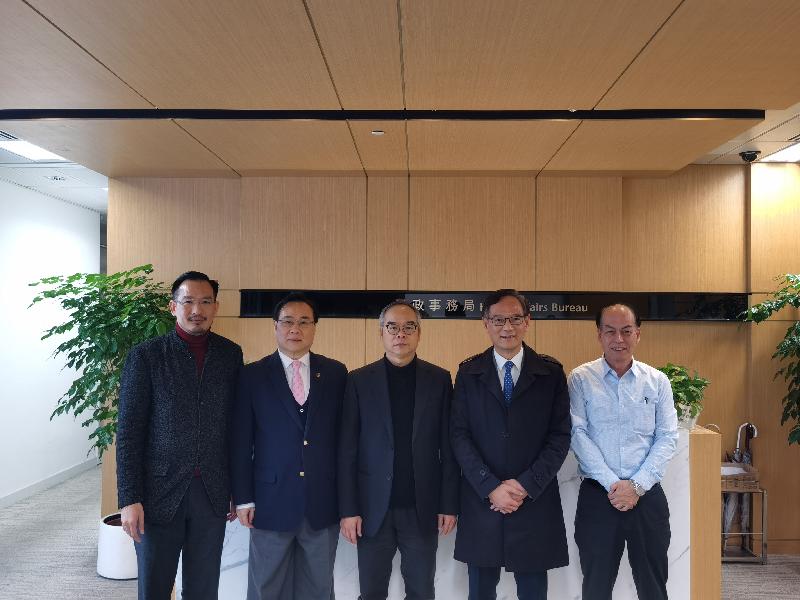
Secretary for Home Affairs meets representatives from property management, cleansing and security sector (with photo)

     The Secretary for Home Affairs, Mr Lau Kong-wah, yesterday (February 20) met the representatives from the property management ("PM"), cleansing and security sector to introduce relevant details of the "Property Management Sector Support Scheme" under the Anti-epidemic Fund.  Legislative Council Member for Architectural, Surveying, Planning and Landscape Constituency and the Chairman of the Property Management Services Authority, Mr Tony Tse; the President of the Hong Kong Association of Property Management Companies, Dr Johnnie Chan; the Convenor of the Hong Kong Services Trade Alliance, Dr Mickey Yan, and the President of the Hong Kong Institute of Registered Security Trainers, Mr Justin Wong, have attended the meeting.
 
     "Different sectors have been affected, in different extent, since the outbreak of the COVID-19. Urgent financial support to the frontline PM workers, in particular cleansing and security workers, is warranted so as to better cope with the present public health challenge.  Therefore, we have proposed to the Finance Committee of the Legislative Council to launch the 'Property Management Sector Support Scheme' to facilitate the anti-epidemic work," said Mr Lau.
 
     The Scheme aims to provide the frontline PM workers in private residential and composite buildings with financial support, so as to strengthen their capacity on personal protection and environmental hygiene, and give recognition to their committed services provided during this critical period. The Scheme also seeks to alleviate the additional costs arising from heightened cleansing efforts and procurement of cleansing products and protective kits, and to alleviate the burden on the residents.
 
     The Scheme will provide each eligible building block with the following support:
 

  • Each of the frontline PM workers (i.e. cleansing/security workers) will be given a monthly "anti-epidemic hardship allowance" of $1,000 per eligible worker for four months, subject to a cap of six headcounts, i.e. a maximum of $24,000 "anti-epidemic hardship allowance" per eligible building block (for a residential estate, the quota will be calculated based on the sum of that entitled by each of the eligible building blocks within the estate);
  • the PM company or owners/residents organisations will be given a lump sum "anti-epidemic cleansing subsidy" of $2,000 per building block, as a subsidy for stepping up anti-epidemic cleansing efforts (e.g. buying of cleansing products and protective kits, etc.) in the four-month period and as recognitions of their efforts in enhancing hygiene awareness.

 
     It is expected that over 200 000 frontline PM workers serving around 33 000 building blocks (around 800 PM companies and/or 10 000 owners or residents organisations) will be benefited. The total funding required will be about $1 billion. Upon the approval of the Finance Committee of the Legislative Council, the scheme should be open for application in March 2020. 
 
     Mr Lau expressed gratitude to Mr Tony Tse and the representatives of the sector attending the meeting for their efforts in appealing for the PM sectors' support in anti-epidemic work.  He expected the engagement of the PM sector in the formulation of the Scheme should be able to provide frontline cleansing and security workers with appropriate support for anti-epidemic work. The representatives of the sector concurred that it was necessary to launch the Scheme as soon as possible; and the application procedures should be simplified to facilitate early disbursement of funding. They fully support the launching of the Scheme and will work in corporation with the Government to fight against the epidemic.      

Photo