LCQ14: Issues relating to the novel coronavirus epidemic

     Following is a question by the Hon Wu Chi-wai and a written reply by the Secretary for Food and Health, Professor Sophia Chan, in the Legislative Council today (March 18):
 
Question:
 
     Since the outbreak of the novel coronavirus epidemic, demand for face masks in Hong Kong has remained high. Quite a number of members of the public and healthcare workers have demanded the Government to "close all border control points" to curb the spread of the epidemic to Hong Kong, but the Government has refused. In this connection, will the Government inform this Council:
 
(1) whether it knows, in the past six months:
(i) the respective weekly quantities of (a) import, (b) export, (c) re-export and (d) net import of face masks effective in filtering viruses, and
(ii) the respective monthly quantities of such face masks produced by the Correctional Services Department (CSD) and local private enterprises and, among such face masks, the respective quantities of those for local consumption and for export;
 
(2) as a healthcare team of the University of Hong Kong has projected that the epidemic in Hong Kong will reach its peak in May this year, of the Government's projections for the coming three months in respect of:
(i) the overall demand in Hong Kong for face masks effective in filtering viruses, and
(ii) the weekly quantities of such face masks which will be (a) imported into Hong Kong, and (b) produced respectively by CSD and local private enterprises;
 
(3) of the criteria currently adopted by the Government for determining the quantity of face masks effective in filtering viruses to be maintained in stock by the Government for internal use, and how many months' consumption that such quantity of face masks can meet;
 
(4) of the respective quantities of face masks that various government departments have (i) obtained from the Government Logistics Department, (ii) consumed, and (iii) stockpiled, since January this year; the respective projected quantities of face masks to be allocated to the various departments in the coming month;
 
(5) of the circumstances under which the Government will consider (i) distributing face masks free of charge to members of the public and those organisations in need (e.g. elderly centres or social welfare organisations), and (ii) amending the Reserved Commodities Ordinance (Cap. 296) to specify face masks as a reserved commodity, so as to stabilise the supply of face masks;
 
(6) of the number of quarantine residential units which will be needed in the coming three months, as projected by the Government; whether the Government has (i) discussed with the Central People's Government on borrowing parts of the barracks of the Chinese People's Liberation Army Hong Kong Garrison for use as isolation/quarantine facilities, and (ii) studied the construction of isolation/quarantine facilities on the site reserved for the Phase 2 development of the Hong Kong Disneyland; if so, of the details (including the costs and the commencement dates for works);
 
(7) given that although the Mainland authorities suspended on February 2 and 7 this year respectively the processing of applications by Mainland residents for travel endorsements and for business visit endorsements to visit Hong Kong, they will still approve applications for visiting Hong Kong with urgent purposes such as studying, seeking medical treatment and attending funerals, of (i) the weekly number of Mainland residents entering Hong Kong during the period from January 1 to February 1, this year, and (ii) the weekly number of Mainland residents entering Hong Kong since February 2, this year (with a tabulated breakdown by type of endorsements and specific reasons for visiting Hong Kong (e.g. seeking medical treatment and attending funeral)); and
 
(8) as the number of confirmed cases of the infection recorded in the Guangdong Province has been on the rise recently, whether the Government will consider further tightening the immigration arrangements to temporarily suspend the entry of all Mainlanders to Hong Kong; if not, of the reasons for that?
 
Reply:
 
President,
 
     In view of the serious outbreak of the coronavirus disease 2019 (COVID-19), it is the top priority of the Government and members of the community to step up our efforts in prevention and control of the disease. Since the outbreak, the Government has been adhering to the three key principles of "responding promptly", "staying alert to the situation" and "working in an open and transparent manner".  Based on science and experts' advice, we have continued to adopt the "containment" strategy and secured every line of defence with a view to achieving "early identification, early isolation and early treatment of the infected". The Government has introduced a host of specific and practicable measures in the areas of providing surgical masks and protective equipment, compulsory quarantine and reducing cross-boundary flow of people, etc.
      
     In consultation with the Commerce and Economic Development Bureau, Financial Services and the Treasury Bureau, Security Bureau, Home Affairs Bureau, Labour and Welfare Bureau and Hospital Authority (HA), my reply to the various parts of the question raised by the Hon Wu Chi-wai is as follows:
 
(1) and (2) In view of the latest development of the COVID-19 outbreak, both the Government and the market have been actively procuring masks globally and importing them from different places and through different channels into Hong Kong. The commodity classification list currently used for trade declarations is based on the Harmonized Commodity Description and Coding System commonly adopted by the international community. There is no separate classification in the list for face masks or masks which can meet certain specific requirements. As such, no official statistics on weekly imports, exports, re-exports and net imports are available in this regard. However, the Government estimates that, through Hongkong Post’s services alone, over 160 000 postal items containing masks have been delivered between the end of Lunar New Year and March 6. As senders are not required to declare the detailed quantity of contents in their postal items, the Government does not have the actual number of masks imported through this channel. The Government expects that local demand for masks will remain keen in the near future. The volume of mask imports into Hong Kong is expected to remain high, but it is also subject to global supply, the latest demand of other places for masks, as well as export control imposed by certain countries and regions for such items.
 
     As regards local production, as the Hong Kong manufacturing industry is not required to submit figures on its production output to the Government, we do not possess statistics on mask production by private enterprises. Under the Anti-epidemic Fund, the Government has launched the Local Mask Production Subsidy Scheme to facilitate the establishment of mask production lines in Hong Kong. The Subsidy Scheme will provide financial assistance to a maximum of 20 production lines, with each producing at least 500 000 masks per month. The Government will also procure up to 2 million masks from each production line each month for one year. Actual mask output under the Subsidy Scheme depends on the number of production lines, the timing they commence production, and their respective production capacities.
      
     In 2019, the Correctional Services Department (CSD) produced about 1.1 million filter masks per month on average, which were mainly supplied to the Government Logistics Department (GLD). As the outbreak of novel coronavirus, there is a rapid increase for demand of filter masks from government departments. As such, the mask production facilities in Lo Wu Correctional Institution gradually increased production since January 2020 and has reached 24-hour operation. CSD has also recruited over 1 200 off-duty or retired CSD officers as volunteers to participate in the production of masks, increasing the production to 2.5 million masks per month. Among them, 1.8 million masks are supplied to GLD, whereas the remaining 700 000 masks are set aside for distribution to cleansing workers engaged by outsourced cleaning service contractors through relevant departments (including the Food and Environmental Hygiene Department, Leisure and Cultural Services Department, Housing Department, Government Property Agency, Marine Department and Customs and Excise Department (in respect of the Shenzhen Bay Port Hong Kong Port Area).
      
     CSD is actively striving to increase the number of production lines so as to further increase the mask production as early as possible.
 
(3) In support of the Government's response plan for infectious diseases, GLD maintains a stock of 10 million masks to support the operational needs of relevant bureaux and departments.  With the development of the outbreak, the usage of masks by government departments has significantly increased.  Based on broad estimates, the current stock of masks kept by GLD can last for about two months for meeting the operational needs of government departments.
 
     The HA has established guidelines on the use of personal protective equipment (PPE) for medical procedures and workplaces of different risk levels with stringent infection control measures and training, allowing frontline healthcare staff of various positions to understand and get familiar with infection control measures required for different medical procedures, including on the use of suitable PPE. Based on HA's usage as of March 13, the stockpile of surgical mask in HA is adequate for about two months' consumption, while stockpile of N95 respirators is adequate for about one month's consumption. In view of the pandemic, HA expects the demand for PPE will continue to increase in the coming months. The HA will continue to monitor the situation and endeavour to expedite the procurement of PPE so as to ensure that adequate PPE is provided to frontline healthcare staff for patient care.
 
(4) All government departments have stepped up efforts to reduce their demand for masks. The masks are now predominantly used for discharge of duties related to preventing and controlling the outbreak, as well as essential and emergency services provided by other government departments. In light of the development of the outbreak, GLD will comply strictly with the Government's internal guidelines on distribution and accord priority to frontline staff participating in quarantine-related work and execution of quarantine orders, including medical and port health staff of the Department of Health, and those who maintain provision of essential public services.
 
(5) The Government has provided 1 million masks for the staff of subvented, contract, self-financing and private residential service units (including residential care homes for the elderly and residential care homes for persons with disabilities licensed by the Social Welfare Department) so as to assist them to provide continuous services. Also, the Government has received donations of masks and sanitising items from some groups and individuals for distribution to those in need. According to the wishes of donors, the Government will distribute these items to day care service units, high-risk patients (e.g. the elderly and pregnant women) and medical workers through HA, as well as elderly and needy households through the major charities and non-governmental organisations.
 
     As the supply of masks continues to be tight in the short run, the Government considers that it is more pragmatic and practicable to strive to increase the supply and manage the demand. The Government currently does not have any plans to mandatorily control the supply and prices of masks through legislation, because this could be counterproductive and possibly adversely affect supply, or lower our ability to procure masks from other places. To address the problem at source, we will continue to increase supply and appeal for donation of masks to those in need through various channels in order to meet the needs of society and address the problem of inadequate supply.
 
(6) Currently, there are three quarantine centres for close contacts who may have been exposed to the risk of contracting COVID-19 but are nonetheless asymptomatic, namely the Lei Yue Mun Park and Holiday Village in Chai Wan, the Heritage Lodge at the Jao Tsung-I Academy and Chun Yeung Estate, Fo Tan, providing about 1 250 units. We are also making preparations to make available more units in Chun Yeung Estate for quarantine purpose.  It is expected that an addition of nearly 400 units will be available soon.
 
     In view of the development of the outbreak, the Government has been actively looking for suitable sites and setting up more quarantine facilities as soon as possible since late January. It is estimated that 88 retrofitted units at the Junior Police Call Permanent Activity Centre (JPC Centre) at Pat Heung, Yuen Long can be put into use shortly. On the other hand, quarantine facilities are being constructed through the application of the modular integrated construction method at the Lei Yue Mun Park and Holiday Village in Chai Wan, the Sai Kung Outdoor Recreation Centre, the JPC Centre and a government site at Penny’s Bay, providing at least 1 000 units as quarantine facilities in total. It is expected that the units can be completed and put into use from March to July by phase. In addition, we are following up with the Walt Disney Company, which has agreed to explore using another site at Penny's Bay reserved for future tourism development for constructing quarantine facilities. As regards the barracks of the Chinese People's Liberation Army Hong Kong Garrison, they are used for defence purposes, and the HKSAR Government has no plan to seek any change. 
      
     In view of the rapid development of the COVID-19 outbreak, it is difficult to accurately estimate the demand for quarantine facilities. The Government will closely monitor the latest development and make corresponding deployment in view of the situation.
 
(7) The weekly numbers of arrivals of Mainland visitors from January 1 to February 1, 2020 are tabulated below:
 

Date
(Monday to Sunday)
Number of arrivals of Mainland visitors
January 1 – 5
(5 days in total)
414 291
January 6 – 12 693 689
January 13 – 19 788 072
January 20 – 26 506 607
January 27 – February 1
(6 days in total)
129 711

 
     The weekly numbers of arrivals of Mainland visitors with breakdown by type of endorsements / travel documents from February 2 to March 10, 2020 are tabulated below:
 

Date
(Mon to Sun)
Number of arrivals of Mainland visitors By type of Endorsements
and Other Travel Documents
Endorsement for Individual Visit Endorsement for Group Visit Endorsement for Business Visit Endorsement for Visiting Relatives Other Endorsement Chinese Passport Other Travel Documents
Feb 2 11 715 2 223 208 476 1 975 320 6 367 146
Feb
3 – 9
 
57 438 4 451 874 2 895 9 355 2 135 36 916 812
Feb
10 – 16
5 273 5 (Note 1) 0 3 (Note 2) 832 29 4 368 36
Feb
17 – 23
 
4 443 1 (Note 3) 0 0 964 30 3 392 56
Feb 24 –
Mar 1
5 423 0 0 2 (Note 4) 1 396 28 3 905 92
Mar 2 – 8 6 853 1 (Note 5) 0 7 (Note 6) 1 805 25 4 741 274
Mar 9 – 10
(2 days in total)
1 861 0 0 1 (Note 7) 496 9 1 308 47

Note 1: Including one Mainland visitor arriving from Macao via the control point at the Hong Kong-Zhuhai-Macao Bridge Hong Kong Port, and four Mainland private air crew members arriving from the Mainland and disembarking at the Hong Kong International Airport who were exempted from the 14-day compulsory quarantine arrangement.
Note 2: Including two Mainland visitors arriving from Macao via the control point at the Hong Kong-Zhuhai-Macao Bridge Hong Kong Port and one Mainland visitor arriving from abroad via the Hong Kong International Airport.
Note 3: Including one Mainland private air crew member arriving from the Mainland and disembarking at the Hong Kong International Airport who was exempted from the 14-day compulsory quarantine arrangement.
Note 4: Including two Mainland visitors arriving from Macao via the control point at the Hong Kong-Zhuhai-Macao Bridge Hong Kong Port.
Note 5: Including one Mainland visitor arriving from Macao via the control point at the Hong Kong-Zhuhai-Macao Bridge Hong Kong Port.
Note 6: Including three Mainland visitors arriving from Macao via the control point at the Hong Kong-Zhuhai-Macao Bridge Hong Kong Port, and four Mainland private air crew members arriving from the Mainland and disembarking at Hong Kong International Airport who were exempted from the 14-day compulsory quarantine arrangement.
Note 7: Including one Mainland visitor arriving from Macao via the control point at the Hong Kong-Zhuhai-Macao Bridge Hong Kong Port.
 
     The Immigration Department (ImmD) does not maintain other breakdown statistics mentioned in the question.
 
(8) Since late January, the Government has actively implemented various measures to reduce the flow of people between the Mainland and Hong Kong in the light of the latest situation.  The effect of these measures is remarkable.  These measures include – 
 
(a) With effect from midnight of January 27, non-Hong Kong residents from Hubei Province and persons who visited the Hubei Province in the past 14 days are not be permitted to enter Hong Kong until further notice. As at March 15, the ImmD had refused entry of over 2 412 visitors concerned at various control points;
 
(b) With effect from midnight of January 30, the passenger clearance services of six control points (namely the West Kowloon Station, Hung Hom Station, China Ferry Terminal, Tuen Mun Ferry Terminal, Sha Tau Kok and Man Kam To) were suspended until further notice;
 
(c) With effect from midnight of February 4, the passenger clearance services of four control points (namely Lo Wu, Lok Ma Chau Spur Line, Lok Ma Chau (Huanggang) and Hong Kong-Macau Ferry Terminal) were suspended until further notice;
 
(d) With immediate effect on February 5, the passenger clearance services of Kai Tak Cruise Terminal and the Ocean Terminal were suspended until further notice. The 10 control points which were suspended since January 30 and February 4 remain closed.  The passenger clearances services are maintained only at the Airport, Shenzhen Bay Control Point and Hong Kong-Zhuhai-Macao Bridge Hong Kong Port; 
 
(e) With effect from February 8, apart from exempted persons, the Department of Health (DH) issues quarantine orders to all people entering Hong Kong from the Mainland or those who have been to the Mainland in the past 14 days preceding arrival at Hong Kong (including Hong Kong residents, Mainland residents and visitors from other places). As the period of compulsory quarantine would be 14-day, arrivals holding a visa with validity of less than 14 days would be denied entry; and
 
(f) In the light of the latest development of the novel coronavirus infection, DH has progressively, from late February onwards, issued quarantine orders to people who have been to the affected areas (including Korea, Iran, Schengen Area and Hokkaido of Japan) in the past 14 days preceding arrival at Hong Kong. From midnight of March 19, DH will issue quarantine orders to people who have been to the United Kingdom, the United States, Ireland and Egypt in the past 14 days preceding arrival at Hong Kong. As the period of compulsory quarantine would be 14-day, arrivals holding a visa with validity of less than 14 days would be denied entry.
 
     In addition, since January 28, the National Immigration Administration (NIA) has suspended the application, approval and issuance of the group visit endorsements and the endorsements under the Individual Visit Scheme (including the "one trip per week" endorsements) for Mainland residents to travel to Hong Kong and Macao with immediate effect until further notice.  In view of the HKSAR Government's imposition of the mandatory quarantine on people entering Hong Kong from the Mainland, the NIA also suspended the processing of the business visit endorsements for Mainland residents to travel to Hong Kong with effect from February 7.
 
     From the passenger traffic figures, the number of daily passenger trips arriving Hong Kong was about 19 503 on average from February 8, 2020 (i.e. from which the measure for issuing quarantine orders to all people entering Hong Kong from the Mainland or those who have been to the Mainland in the past 14 days preceding arrival at Hong Kong has taken effect) to March 15, 2020, which has significantly reduced by 91 per cent in comparison with the figures prior to the implementation of the measures for managing control points and reducing the flow of people (i.e. 217 065 passenger trips on January 26). Among them, about 82 per cent were Hong Kong residents (16 045 passenger trips daily on average), whereas five per cent were Mainland residents (895 passenger trips daily on average). The HKSAR Government will continue to monitor the latest situation and make necessary adjustment having regard to the advice of the experts as well as the actual situation in Hong Kong.
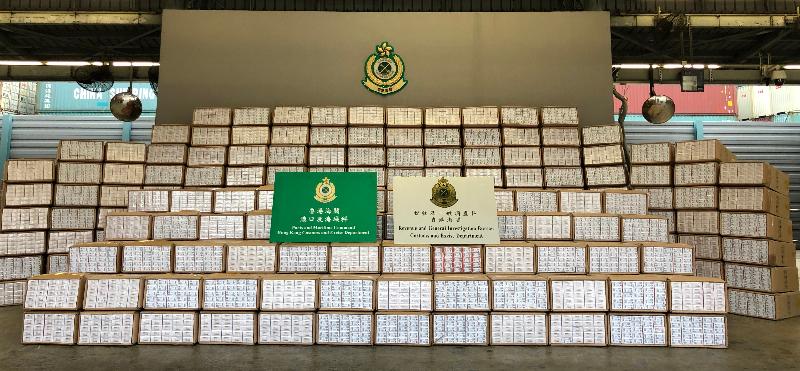


Hong Kong Customs seizes about 10.2 million suspected illicit cigarettes (with photo)

     â€‹Hong Kong Customs today (March 18) seized about 10.2 million suspected illicit cigarettes with an estimated market value of about $28 million and a duty potential of about $19 million at the Kwai Chung Customhouse Cargo Examination Compound.

     Through risk assessment, Customs officers selected a seaborne transshipment container from Cambodia heading for the Philippines via Hong Kong for inspection. The shipment manifest declared that it was a stationery consignment. Upon inspection, Customs officers found the batch of suspected illicit cigarettes in the container.

     Investigation is ongoing.

     Smuggling is a serious offence. Under the Import and Export Ordinance, any person found guilty of importing or exporting unmanifested cargo is liable to a maximum fine of $2 million and imprisonment for seven years.

     Members of the public may report any suspected illicit cigarette activities to Customs' 24-hour hotline 2545 6182 or its dedicated crime-reporting email account (crimereport@customs.gov.hk).

Photo  


LCQ15: Veterinary and pet shop services

     Following is a question by the Hon Chan Hak-kan and a written reply by the Secretary for Food and Health, Professor Sophia Chan, in the Legislative Council today (March 18):
 
Question:
 
     Regarding veterinary and pet shop services, will the Government inform this Council:
 
(1) of (i) the number of veterinary surgeons registered under the Veterinary Surgeons Registration Ordinance (Cap 529), (ii) the ratio of registered veterinary surgeons to pets, and (iii) the number of veterinary surgeons convicted of contravening Cap 529 and the punishments imposed on them, in the past five years;
 
(2) whether the authorities currently deploy officials to conduct inspections on veterinary clinics on a regular basis; if so, of the details; if not, the reasons for that; of the reasons why the authorities do not keep, on a routine basis, records on the number of veterinary clinics and related information; whether the authorities will change such practice; if so, of the details; if not, the reasons for that;
 
(3) whether it knows the following information in each of the past five years:
(i) the numbers of complaints against veterinary surgeons and veterinary clinics received by the Veterinary Surgeons Board (VSB), and the major subject matters of such complaints;
(ii) the respective numbers of complaints referred to the Preliminary Investigation Committee and the Inquiry Committee of the VSB for follow up actions;
(iii) regarding those complaints for which investigations were completed, of the average, longest and shortest time taken by the VSB to conclude the investigations; and
(iv) the number of veterinary surgeons found guilty of professional misconduct or neglect, and the punishments imposed on them;
 
(4) given that while some veterinary surgeons have been complained for several times and found guilty of professional misconduct or neglect, the VSB currently only publishes on its website the orders made within one year and the findings of disciplinary inquiries made within three years by the Inquiry Committee, whether the authorities will suggest VSB to modify such practice and publish on its website the names of all non-compliant veterinary surgeons and the veterinary clinics concerned for public inspection; if so, of the details; if not, the reasons for that;
 
(5) as some members of the public have pointed out that the complainants have to provide substantive supporting evidence when lodging complaints with the VSB, but the veterinary clinics do not provide the medical records and X-ray films of animals to their owners and, in some cases, even do not return the dead bodies of the animals to their owners, whether the authorities know if the VSB has required veterinary surgeons and veterinary clinics to provide the medical records of animals to their owners upon their requests; if the VSB has, of the details; if the VSB has not, the reasons for that; among the complaints received by VSB in the past three years, of the respective numbers of those (i) having problems of the provision of supporting evidence and (ii) which could not be followed up due to such problems;
 
(6) as some members of the public have relayed that the operation of veterinary clinics (including the procedures on operations, the care given to animals staying overnight at the clinics and treatment of the dead bodies of animals) lacks transparency, of the authorities' respective improvement measures;
 
(7) as many members of the public have relayed that the fees for veterinary services are high and not clearly set out, whether the authorities know if the VSB will require veterinary clinics to provide their customers with a schedule of fees and charges, so that animal owners can make informed choices in the selection of services; if the VSB will, of the details; if not, whether the VSB will consider making public the standard fees and charges for various types of medical consultation and treatments, laboratory tests and operations for reference of members of the public;
 
(8) as some members of the public have relayed that some animal owners cannot afford private veterinary services which are expensive, whether the authorities will consider afresh (i) offering subsidies to non-profiting-making bodies for the provision of inexpensive veterinary services, or (ii) introducing medical vouchers for animals; if so, of the details; if not, the reasons for that;
 
(9) given that this Council has passed amendments to Cap 529, one of which is to enlarge the membership of the VSB from 10 to 19 members (with six of the seats to be filled by registered veterinary surgeons elected by members of the profession), and that the authorities have made subsidiary legislation on the election of the six members, of the confirmed date of the election and, with the increase in the number of members, the anticipated reduction in the time taken on average by the VSB in handling a complaint; and
 
(10) as it has been reported that an incident occurred in Tai Po earlier on in which a groomer of a pet shop was alleged to have abused dogs, of the measures put in place by the authorities to step up the monitoring of such type of practitioners in the trade; the number of complaints against pet shops received by the Agriculture, Fisheries and Conservation Department in the past five years and the follow-up actions taken?
 
Reply:
 
President,
 
     My reply to the question is as follows:
 
(1) According to the information of the Veterinary Surgeons Board of Hong Kong (VSB), the number of registered veterinary surgeons in Hong Kong in the past five years (as at the end of each year) is as follows:
 

Year Number of registered
veterinary surgeons
2015  823
2016  861
2017  920
2018  988
2019 1,049

 
     According to the Thematic Household Survey Report No. 66 of the Census and Statistics Department, a total of around 221,100 dogs and 184,100 cats were being kept by households in Hong Kong in 2018. According to the VSB's number of registered veterinary surgeons in 2018, the veterinarian-to-pet (dog and cat) ratio of that year is around 1:410.
 
     According to section 16(1) of the Veterinary Surgeons Registration Ordinance (Cap. 529) (the Ordinance), no person shall practise veterinary surgery or provide a veterinary service in Hong Kong unless the person is registered with the VSB and a holder of a practising certificate which is currently in force. According to the VSB Secretariat's information, there were two convicted cases for contravening the relevant provision in the past five years, sentenced to 100 hours' community service order and six weeks of imprisonment respectively.
 
(2) The VSB is a statutory authority established under the Ordinance and is responsible for the regulation of the practice of veterinary surgery, the registration of veterinary surgeons, and the disciplinary control of the professional activities of registered veterinary surgeons in Hong Kong. All registered veterinary surgeons have received professional training before practising in Hong Kong, and obtained the qualifications for registration specified under the Ordinance, and are required to comply with the Ordinance and the Code of Practice for the Guidance of Registered Veterinary Surgeons (CoP) promulgated by the VSB. Although the VSB does not keep the number of veterinary clinics or inspect them regularly, the CoP includes operational requirements of the relevant clinics. For instance, Part E of the CoP stipulates the professional relationships between veterinary surgeons and clients, and paragraph 25 also sets out the requirements of professional premises and equipment, etc. The Ordinance and the Rules of the Veterinary Surgeons Board (Disciplinary Proceedings) (Rules) have also provided for the complaint mechanism and the disciplinary proceedings relating to the disciplinary offences of registered veterinary surgeons. Please refer to part (3) of the reply below for details.
 
     Moreover, in order to promote the message of responsible pet ownership, the Agriculture, Fisheries and Conservation Department (AFCD) also provides a list of veterinary clinics on its thematic website (pets.gov.hk) for public reference (See Note 1).
 
(3) All complaints received by the VSB will be referred to the Preliminary Investigation Committee (PIC) for investigation and decision on whether to advise the VSB to conduct disciplinary inquiries. The VSB will then consider whether to refer the complaints to the Inquiry Committee (IC) for conducting disciplinary inquiries.
 
     In the past five years, the numbers of complaints about registered veterinary surgeons received by the VSB, cases referred to the IC (as at end-February 2020), and cases found substantiated upon inquiry hearings are tabulated as follows:
 

Year Number of complaints received Number of cases referred to IC Number of inquiry hearings completed # Number of  cases found substantiated upon inquiry hearings #
2015 57 14 3 3
2016 54 13 12 12
2017 56 5 8 4
2018 51 0 8 7
2019 41 0 2 1

# The number includes those uncompleted cases in the past.
 
     Majority of the complaints received were against the result or process of diagnosis and treatment or surgery by registered veterinary surgeons. Amongst all the cases received and completed in the past five years, the shortest processing time was about one month, the longest one was about three years and the average processing time was around nine months.
 
     Over the past five years, a total of 27 complaint cases in relation to the conviction of disciplinary offences of misconduct or neglect in a professional respect of veterinary surgeons were found substantiated by the IC after conducting inquiry hearings with the following orders made:
 

Relevant Order Number of cases involved
Removal of name(s) of relevant veterinary surgeon(s) from the register for three months 2
Reprimand and compulsory participation in continuing professional development programme or professional seminar 23
Reprimand 1
Compulsory participation in continuing professional development programme 1
Total 27

 
(4) The relevant arrangement was decided by the VSB when reviewing the matter of publishing disciplinary orders in 2017.  Later on, the VSB discussed such arrangement again in 2019, and decided to add a hyperlink onto its website that links to the website of the Government Gazette, so as to facilitate members of public to search disciplinary orders made by the VSB.  The relevant hyperlink has already been added onto the webpage of "Disciplinary Inquiries of the VSB".
 
(5) The VSB has established the CoP as the general guidelines of conduct for the registered veterinary surgeons.  Members of the public could make complaints to VSB if there is suspected professional misconduct or neglect by veterinary surgeons.  Relevant requirements have been stipulated in the CoP (See Note 2) in regard to the matters of provision of medical records to owners.
 
     Over the past three years, a total of 14 complaints in relation to the refusal of registered veterinary surgeons to provide the complainants with medical records were received by the VSB. If complainants fail to obtain the medical records of the relevant animals for their cases, the VSB will request the relevant information from the veterinary surgeons or veterinary clinics concerned. If the veterinary surgeon concerned does not provide the relevant medical records as requested by VSB, thus adversely affecting the progress of processing the complaint case, VSB may issue charges against the veterinary surgeon concerned for failing to provide the relevant information to VSB in accordance with paragraph 18.2 of the CoP (See Note 3). Of the inquiry hearings conducted in the past three years, there was no registered veterinary surgeon being charged for refusal to provide medical records to VSB or owners.
 
(6) and (7) Paragraph 17.4 of the CoP has stipulated the guidelines on communication between veterinary surgeons and clients, the relevant details are as follows:
 
     "A client should always be offered the best option available for treatment or surgery, but lesser options may meet the client's needs. Anticipated outcomes of the various options available must always be fully discussed with the client before treatment, with cost estimates. It is essential that the client is kept fully briefed about changes to both prognosis and costs by regular communication with the attending veterinary surgeon."
 
     Furthermore, paragraph 17.5 of the CoP has stipulated the guidelines on providing a schedule of fees and charges by the veterinary clinics: "Veterinary surgeons shall make available to their clients or prospective clients a schedule of their normal fees and charges for consultations, routine tests and routine procedures, which may be done by way of a notice displayed at the veterinary surgeon's clinic containing the schedule or stating that the schedule is available on request."
 
(8) The number of registered veterinary surgeons continues to rise in recent years, currently there are more than 1,000 registered veterinary surgeons and over 140 veterinary clinics. As mentioned in part (1) of the reply above, the veterinarian-to-pet (dog and cat) ratio in Hong Kong is around 1:410 in 2018, which is far below the ratios of other places (i.e. Singapore (1:2 543), the United Kingdom (1:2 374) and the United States (1:3 072) ) included in the report of consultancy study on veterinary profession in Hong Kong published by the VSB in 2017. The veterinarian-to-pet ratio is a common indicator for assessing the overall situation of veterinary services: the lower the ratio, the greater the number of veterinary surgeons. As such, animal owners should be able to find suitable veterinary services in Hong Kong for their pets. Also, AFCD has been subventing Animal Welfare Organisations (such as the Society for Prevention of Cruelty to Animals) in support of their work on safeguarding animal welfare, including the provision of veterinary services.
 
(9) The Secretary for Food and Health has made the Veterinary Surgeons Board (Election of Members) Regulation (the Election Regulation) under section 28(1A) of the Ordinance as amended by the Veterinary Surgeons Registration (Amendment) Ordinance 2015 (the Amendment Ordinance). The Election Regulation was tabled at the Legislative Council on November 13, 2019 and the negative vetting process had been completed. According to the current timetable, we plan to commence the election procedures starting from the second quarter of this year, and expect that the newly constituted the VSB comprising appointed and elected members will come into operation in the fourth quarter; however, due to the current development of the COVID-19 situation, the relevant timetable might be affected.
 
     According to the amended Ordinance, the composition of the VSB will be expanded from 10 to 19 members, and an Assessment Panel will be formed by not more than 12 registered veterinary surgeons and not more than six other persons. The PIC and IC will be formed by members of VSB and Assessment Panel, therefore there will be more candidates to become members of the PIC and IC handling the complaints received. We will review the progress of complaint processing by VSB in due course after the commencement of the Ordinance.
 
(10) Although operating pet grooming business does not require any licence from AFCD, AFCD conducts regular inspections to relevant shops to monitor any illegal animal trading or suspected cases of cruelty to animals. Upon the receipt of relevant complaints or detection of the aforementioned situation during inspections, AFCD will conduct investigations and take corresponding actions, which include conducting joint operations with the Police and initiating prosecution where appropriate.
 
     The number of complaints in relation to pet shops received by AFCD over the past five years is as follows:
 

Year Number of complaints
2015 111
2016 88
2017 133
2018 52
2019 79

 
Notes:
 
1. The list of veterinary clinics includes those agreed to be listed for public access on the Internet.
 
2. Paragraph 17.7 of the CoP states "In the event the owner or agent of the owner of an animal in respect of which a registered veterinary surgeon is in possession or control of medical records, including (without limitation) clinical notes, radiological films and/or test results, requests to be provided with a copy of those records or a particular item thereof, the veterinary surgeon should comply with the request in a timely manner. Notwithstanding the foregoing, a veterinary surgeon may make compliance with such a request contingent upon the payment of a fee to cover the reasonable administration and copying costs incurred or to be incurred in complying with the request."
 
3. Paragraph 18.2 of the CoP states "A registered veterinary surgeon has an obligation to assist the VSB in carrying out its statutory duty of determining whether to refer a complaint alleging a disciplinary offence to an inquiry committee for decision by providing to the VSB on request information and documents, including medical records, and test results, radiographs, ultrasound films and Magnetic Resonance Imaging images, of relevance to the complaint."


LegCo meeting to continue tomorrow

The following is issued on behalf of the Legislative Council Secretariat:
 
     As the business on the agenda of the Legislative Council (LegCo) meeting cannot be finished today (March 18), the President of the LegCo has, in accordance with Rule 14(4) of the Rules of Procedure, decided that the Council meeting will resume tomorrow (March 19) at 9am.


LCQ9: Relief measures of the Government

     Following is a question by the Hon Elizabeth Quat and a written reply by the Secretary for Financial Services and the Treasury, Mr James Lau, in the Legislative Council today (March 18):
 
Question:
 
     Some members of the public have relayed that Hong Kong's economy, after being dealt double blows last year by the Sino-United States trade conflicts and the disturbances arising from the opposition to the proposed legislative amendments, and then being ravaged this year by the novel coronavirus epidemic, is now on its last legs. As the economic prospect is not optimistic and the tide of unemployment is coming inexorably, small and medium enterprises as well as grass-roots people are particularly bearing the brunt. Regarding the relief measures of the Government, will the Government inform this Council:
 
(1) whether it will implement the relief measures (including allowing employers in the severely hit industries to hold over payments of the provisional profits tax) which were proposed by the political party to which I belong, and implement these measures expeditiously under an approach of special arrangements for special circumstances; if so, of the details; if not, the reasons for that;
 
(2) whether the funds under the $30 billion Anti-epidemic Fund set up by the Government may be used for the following purposes: (i) subsidising small and medium enterprises in paying their employees' salaries, and (ii) providing subsidies to the employees whose income has been affected by the epidemic (especially those who are unable to cross the boundary daily to go to work because of the implementation of the infection prevention measures); if so, of the details; if not, the reasons for that;
 
(3) as the grass-roots people cannot afford anti-epidemic items the prices of which have shot up due to the shortage of supply, and many of them lack anti-epidemic awareness, whether the Government will (i) step up anti-epidemic publicity among them and (ii) supply anti-epidemic items to them at reasonable prices; if so, of the details; if not, the reasons for that;
 
(4) as anti-epidemic items are currently in short supply, of the measures put in place to help trades and industries such as retail, property management and private healthcare to acquire anti-epidemic items for use by their frontline staff; and
 
(5) given that quite a number of members of the public are currently unable to acquire anti-epidemic items such as face masks, whether the Government will consider afresh adopting administrative measures or invoking its statutory power to prohibit hoarding of such items, to centralise the procurement and distribution of such items (including imposing restrictions on the selling prices and purchase quantities), and to make daily announcement on the stock of such items available on the market, so as to ensure that members of the public can acquire such items at reasonable prices?
 
Reply:
 
President,
 
     Subsequent to the Government's announcement of four rounds of relief measures from August to December last year, the Financial Secretary delivered the 2020-21 Budget on February 26, in which he proposed counter-cyclical measures amounting to more than $120 billion. The proposals help to boost our efforts to combat the epidemic, take care of people in need and bolster the economy. The Budget represents an unequivocal commitment by the Government to rise to the challenge of overcoming adversity and helping people in need. The measures also complement the initiatives set out under the $30 billion Anti-epidemic Fund, approved by the Legislative Council on February 21, providing comprehensive support for people from all walks of life.
 
     My reply to the various parts of the question, prepared in consultation with relevant bureaux/departments, is as follows:
 
(1) The measures introduced in the Budget focus on "supporting enterprises, safeguarding jobs, stimulating the economy and relieving people's burden". They endeavour to meet the public's expectations for relief measures. The Budget proposed a cash payout of $10,000 to Hong Kong permanent residents aged 18 or above. It also proposed to reduce profits tax for the year of assessment 2019/20 by 100 per cent, subject to a ceiling of $20,000. The Government will implement these measures as soon as practicable upon the Legislative Council's approval of the Appropriation Bill 2020.
 
(2) The Anti-epidemic Fund will enhance the capability of the Government and relevant parties in combating the epidemic, and will provide assistance or relief to enterprises and members of the public that are hard hit by the present epidemic, or are affected by anti-epidemic measures. About $17 billion from the Fund will be used to implement 14 measures concerning the provision of assistance to affected enterprises and individuals. The enterprises and organisations that benefit from the respective measures may use the funds at their discretion, such as to settle employees' wages. Moreover, the Government will also use the Anti-epidemic Fund to provide a one-off special allowance to about 200,000 eligible low-income households under the Working Family Allowance and Student Financial Assistance.
 
(3)(i) At this critical moment, it is essential to step-up anti-epidemic publicity so as to dispel public concerns. Senior representatives from the Centre for Health Protection (CHP) of the Department of Health and the Hospital Authority conduct daily briefings covering issues such as the number of cases, their work on contact tracing and the latest quarantine measures. The Government has launched a thematic website (www.coronavirus.gov.hk), an interactive map dashboard (chp-dashboard.geodata.gov.hk/covid-19/en.html) and a Telegram channel named "Hong Kong Anti-epidemic Information Channel" (t.me/HKFIGHTCOVID19) to furnish the public with the latest information in a timely manner. The CHP has also issued guidelines, reminding the public to maintain personal and environmental hygiene, and disseminated relevant health information through various channels and media. Senior officials of the Government also hold press conferences to announce major government decisions and measures, and to update the public on key developments in combating the virus.
 
(3)(ii) and (4) The Government appreciates that a sufficient and stable supply of personal protective equipment (PPE) is critical for the prevention and control of the epidemic. We are also concerned about the requirement of masks by disadvantaged sectors of the community. However, as we operate in a free market economy, the short supply of and high demand for PPE, resulting in a rise in prices, is indeed a global phenomenon.
 
     To maintain public services, the Government will continue its endeavour to source masks globally through all practical channels. On the other hand, to strengthen and stabilise the supply of PPE, the Government will adopt a multi-pronged approach, exercise greatest flexibility and act with the greatest determination.
 
     The Government has been following up on suggestions to increase local production of masks, including the "Local Mask Production Subsidy Scheme" introduced under the Anti-epidemic Fund. The Government has also contacted a local innovation and technology firm, inviting them to increase their monthly output of masks of higher specifications. The Government will proactively support their implementation of plans, with a view to stabilising local supply.
 
     At the retail level, the Government has reached out to suppliers and retailers of different scales, appealing that they do not handle arriving supplies in a way that causes too much inconvenience to the public.
 
     The Food and Health Bureau has been keeping in close contact with the private healthcare sector, with a view to understanding the supply of masks and PPE made available to them, and to rendering assistance as appropriate.
 
     The Government also appeals to private enterprises and charitable organisations to donate masks to underprivileged communities, and will assist in coordination as far as practicable. A number of private organisations and charities have recently donated or indicated their wish to donate masks and disinfectants to the Government and non-government organisations. The Government will get in touch with relevant organisations according to the donors' wishes.
 
(5) According to the assessment of experts, the epidemic may persist for some time. As the supply of masks will remain tight in the short run, the Government considers it pragmatic to strengthen supply and manage demand. The Government currently does not have any plans to mandatorily control the supply and prices of surgical masks through legislation, because this could adversely affect supply, or weaken our ability to make purchases from outside Hong Kong.
 
     To address the supply shortage and problems faced by needy communities, we will continue to pursue the aforementioned measures, strengthening supply and encouraging donations to people in need.