Sick remand person in custody dies in public hospital

     A sick 70-year-old male remand person in custody at Stanley Prison died in a public hospital today (March 30).

     The remand person in custody suffered from hypertension and liver disease. He required continuous medical care and follow-up at the institution hospital and public hospital. On March 19, he was sent to a public hospital for treatment due to physical discomfort and was later suspected to have liver cancer. During hospitalisation, his condition deteriorated and he was certified dead at 0.52am today.

     The case has been reported to the Police. A death inquest will be held by the Coroner's Court.

     The person in custody was remanded for the offence of trafficking in a dangerous drug in September 2018.


Centre for Food Safety launches online application for import licences and import permissions for game, meat and poultry

     The Centre for Food Safety (CFS) of the Food and Environmental Hygiene Department today (March 30) launched online services for application for import licences for meat and poultry as well as import permissions relating to game, meat and poultry through the Food Trader Portal (FTP).
 
     A CFS spokesperson said, "We have been rolling out different online services of the FTP in phases since December last year, starting with the trader registration module which allows food traders to complete registration as food importers or distributors, renew registration and update trader information online after opening user accounts at the FTP. The online services launched today enable importers to submit electronic applications for import licences for meat and poultry and import permissions for game, meat and poultry at any time. Importers are not required to send staff to submit application forms to and obtain import licences or import permissions from the CFS in person. They can check application status online as well as records of past applications, lists of approved slaughtering plants and processing plants eligible for export, the list of foods suspended from import, and more."
 
     In tandem with the rollout of the new online services, the CFS has implemented a series of enhancement measures, including simplification of the application forms for import licences and import permissions and the rollout of a new CFS Food Coding System to facilitate efficient food tracing as well as data retrieval and analysis.
 
     "Along with the provision of an online submission service, the Import Licensing Office of the CFS has been operating seven days a week with extended operation hours for expeditious handling of online applications for import licences. The turnaround time for processing and issuing import licences is expected to be reduced from one working day to within several hours at the earliest," the spokesperson said.

     The spokesperson added, "To streamline the application process, an import permission is in general no longer required for the import of meat and poultry, except for prohibited meat, meat with an export declaration issued by eligible member states of the European Union (EU), and meat or poultry for re-export to the Mainland or Macao via Hong Kong. At the same time, an original or copy of the health certificate or export declaration (for meat from EU member states) is required from importers when applying for the import licence for meat or poultry."
 
     The spokesperson said, "Importers can still submit applications on paper having regard to their operational needs. Importers who wish to use the online services at the FTP should open their user accounts as soon as practicable if they do not have one."
 
     To facilitate the use of these convenient and fast online services, the CFS has conducted a number of workshops for importers, focusing on training for online application for import licences and import permissions and the use of shortcuts to streamline the application process. 

     For further information on the use of the online services, please visit the FTP webpage at www.ftp.cfs.gov.hk.


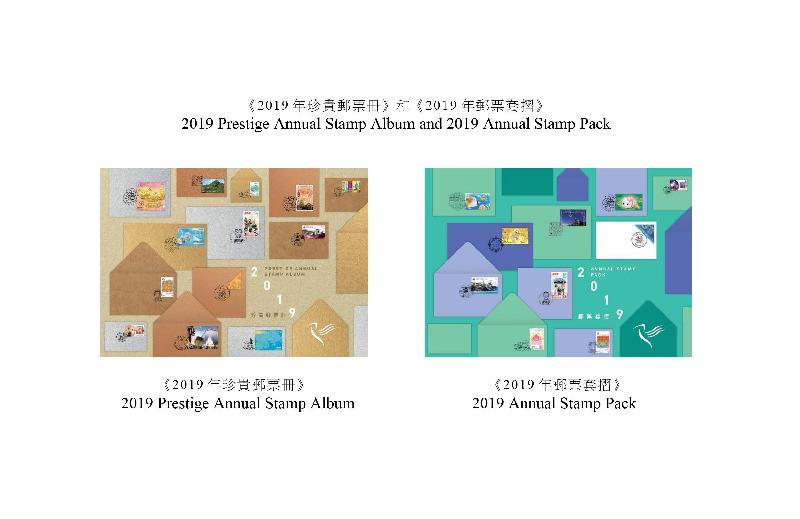
Hongkong Post to issue special philatelic products 2019 Prestige Annual Stamp Album and 2019 Annual Stamp Pack

     Hongkong Post announced today (March 30) that the 2019 Prestige Annual Stamp Album and the 2019 Annual Stamp Pack will be released for sale at all 38 philatelic offices and the PostShop at the General Post Office, as well as through "ShopThruPost" (www.shopthrupost.hk), from tomorrow (March 31).

     Diverse in themes, the stamp issues released by Hongkong Post in 2019 commemorated some of the key events of the year and introduced a rich variety of interesting topics ranging from historic moments and heritage to art and culture, from infrastructure and nature to the uniqueness of Hong Kong. Stamps are small in size yet what lies behind their diversified topics are a wealth of knowledge and fascinating stories. Along with unique and exquisite designs, each stamp is beloved by stamp collectors and the general public.

     The 2019 Prestige Annual Stamp Album, priced at $628, contains a comprehensive collection of special and commemorative stamps, souvenir sheets and stamp sheetlets issued by Hongkong Post in 2019. The 2019 Annual Stamp Pack, priced at $228, contains all special and commemorative stamps issued by Hongkong Post during the year. Designed with the concept of a treasure box, the 2019 Prestige Annual Stamp Album and the 2019 Annual Stamp Pack present special and commemorative stamps as links between people and memories in life. Browsing through this album, the remarkable designs and diversified themes of the stamps issued in 2019 will enable a look back on a delightful "Philatelic Tour of Natural Wonders".

     Information about the 2019 Prestige Annual Stamp Album and the 2019 Annual Stamp Pack is available on the Hongkong Post website at www.hongkongpost.hk and via the Hongkong Post mobile app.

Photo  


Survey results of 2019 Annual Earnings and Hours Survey released

Monthly wage
 
     According to the statistics released today (March 30) by the Census and Statistics Department (C&SD), the median monthly wage of employees in Hong Kong (excluding government employees as well as student interns, work experience students, and live-in domestic workers as exempted by the Minimum Wage Ordinance (MWO)) in May – June 2019 was $18,200. This was 3.8% higher than the median of $17,500 in May – June 2018.
 
     The change in monthly wage in 2019 when compared with 2018 is useful in reflecting the change in take-home pay of employees between these two years.
 
     In May – June 2019, the 10th, 25th, 75th and 90th percentile monthly wages of Hong Kong employees were $10,000, $13,100, $28,200 and $44,600 respectively. They were 1.0%, 3.8%, 3.3% and 3.0% higher than the corresponding figures in May – June 2018 respectively (Table 1).
 
     As shown in Table 2, increase in median monthly wage was generally observed for both male and female employees and for all age groups, educational attainments, occupational groups and industry sections.
 
Hourly wage
 
     The median hourly wage of employees in Hong Kong in May – June 2019 was $73.0, 3.6% higher than the median of $70.5 in May – June 2018. The 5th, 10th, 25th, 75th and 90th percentile hourly wages were $41.0, $43.9, $52.2, $114.9 and $186.2 respectively. The overall hourly wage distribution of employees is shown in Table 3. The numbers of employees earning less than selected hourly wage levels are shown in Table 4.
 
     In May – June 2019, the median hourly wage of male employees was $81.0 while that of female employees was $64.7. Analysed by age group, the median hourly wage of employees at age 35 – 44 was the highest ($83.9), followed by employees at age 25 – 34 ($76.5) and at age 45 – 54 ($74.6). The median hourly wages of employees of different sexes, age groups, educational attainments, occupational groups and industry sections are given in Table 5.
 
Further information
 
     The above wage statistics were compiled based on the data obtained from the 2019 Annual Earnings and Hours Survey (AEHS). The purpose of the survey is to provide comprehensive data on the level and distribution of wages, employment details and demographic profile of employees in Hong Kong. These statistics are useful for studies on labour-related topics by the private sector and the Government. They are also essential inputs for analyses related to the Statutory Minimum Wage. A sample of about 10 000 business undertakings was selected for the survey in 2019.
 
     Wage(s) is defined to include basic wage, commission and tips not of gratuitous nature, guaranteed bonuses and allowances, and overtime allowance paid to an employee in the survey period. It does not cover bonuses and allowances of gratuitous nature, end of year payment and payments in kind. Number of working hours is the sum of contractual/agreed working hours (including meal breaks if they are regarded as working hours according to the employment contract or agreement with the employer) and overtime hours worked at the direction of employers.
 
     By arranging the hourly wages of all employees from the smallest to the largest value, the median hourly wage is the hourly wage of the employee who ranks in the middle of all the employees concerned. In other words, the median hourly wage is the hourly wage value that delineates the lowest 50% of all the employees concerned.
 
     Percentile hourly wage figures are useful in discerning the distribution of hourly wage of employees. The pth percentile hourly wage is the hourly wage value which delineates the lowest p% of all the employees concerned, where p can be any integer value from 1 to 99. For instance, the 10th percentile hourly wage is the hourly wage value that delineates the lowest 10% of the employees. The 25th percentile, 50th percentile and 75th percentile hourly wages are also known as the lower quartile, median and upper quartile hourly wages respectively.
 
     The median and percentile monthly wage figures are derived similarly as the median and percentile hourly wage figures.
 
     Regarding the survey coverage, AEHS covers all business undertakings irrespective of their employment sizes and industries, except those engaged in agriculture, forestry and fishing activities. All employees of business undertakings falling within the scope of the survey who are under the coverage of the MWO are included in the survey. Government employees as well as student interns, work experience students and live-in domestic workers as exempted by the MWO are excluded.
 
     Details of the wage statistics compiled from the 2019 AEHS and the survey methodology are given in the 2019 Report on Annual Earnings and Hours Survey, which will be available by early April 2020. Users can then download this publication free of charge from the website of the C&SD at www.censtatd.gov.hk/hkstat/sub/sp210.jsp?productCode=B1050014.
 
     Enquiries concerning the survey results of AEHS can be directed to the Wages and Labour Costs Statistics Section (2) of the C&SD at 3105 2369.


Phishing email related to The Hongkong and Shanghai Banking Corporation Limited

The following is issued on behalf of the Hong Kong Monetary Authority:
 
     The Hong Kong Monetary Authority (HKMA) wishes to alert members of the public to a press release issued by The Hongkong and Shanghai Banking Corporation Limited on phishing email, which has been reported to the HKMA. Hyperlink to the press release is available on the HKMA website for ease of reference by members of the public.
 
     Anyone who has provided his or her personal information to the email concerned or has conducted any financial transactions through the email should contact the bank concerned using the contact information provided in the press release, and report to the Police or contact the Cyber Security and Technology Crime Bureau of the Hong Kong Police Force at 2860 5012.