Lands Department issues six pre-sale consents in first quarter of 2020

     The Lands Department (LandsD) issued six pre-sale consents for residential developments in the first quarter of 2020.
 
     The six pre-sale consents for five residential developments (of which three are phased developments) involve a total of 3 340 residential units. One development in Sai Kung, comprising 33 residential units, is expected to be completed in 2020. Two phases of a phased development in Tuen Mun and one phase of a phased development in Yuen Long, comprising a total of 1 368 residential units, are expected to be completed in 2021. One development in Tuen Mun and one phase of a phased development in Tseung Kwan O, comprising a total of 1 939 residential units, are expected to be completed in 2022.   
 
     The department also issued two consents to assign in the first quarter of 2020. The two consents to assign involve a total of 1 000 residential units in two phased developments in Tai Po and Lantau Island.
 
     As at the end of March 2020, 24 applications for pre-sale consent for residential developments and eight applications for pre-sale consent for non-residential developments were being processed.
 
     The 24 applications in respect of residential developments being processed involve a total of 7 595 residential units. Details are set out as follows:
 

No. of applications Year in which developments are expected to be completed No. of residential units involved
3 2020 83
6 2021 1 032
14 2022 5 956
1 2023 524

 
     In addition, three applications for consent to assign involving a total of 2 237 residential units are being processed.
 
     Members of the public can obtain up-to-date information on consents issued for the past quarter and cases pending approval as at the end of March 2020 by visiting the LandsD's website (www.landsd.gov.hk).
 
     Intending purchasers are advised to study carefully the details of the development and the sale procedures, through information available from public advertisements, and sales brochures and price lists released by the developer, before making a deposit for purchase. The sales brochure for a development also contains a summary of the provisions of the Deed of Mutual Covenant, including information on the common parts, the number of undivided shares assigned to each unit, the term of years for which the manager is appointed, the basis on which the management expenses are shared among the owners of the units, the basis on which the management fee deposit is fixed and the retained areas (if any), as well as a summary of the provisions of the government land grant, which intending purchasers are recommended to read carefully.
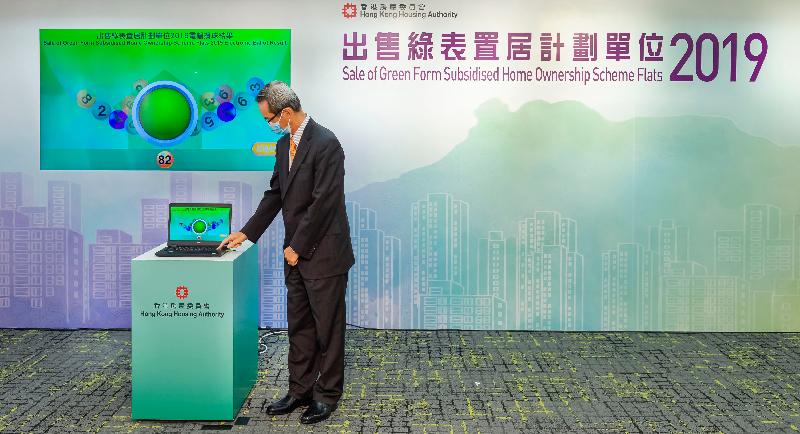


Ballots drawn for Sale of Green Form Subsidised Home Ownership Scheme Flats 2019 (with photos/video)

The following is issued on behalf of the Hong Kong Housing Authority:

     Ballots were drawn today (April 6) for the Hong Kong Housing Authority (HA)'s Sale of Green Form Subsidised Home Ownership Scheme (GSH) Flats 2019 (GSH 2019). The Chairman of the HA Subsidised Housing Committee, Mr Stanley Wong, officiated at the ballot drawing. Due to the current situation of the pandemic, the HA arranged a live broadcast of the entire process through its Facebook page for public viewing. Public and media were not arranged to attend on-site.

     Two new developments, Dip Tsui Court in Chai Wan and Ching Fu Court in Tsing Yi, providing a total of 3 696 flats, are put up for sale under GSH 2019. Dip Tsui Court will provide 828 flats with saleable areas of about 17.4 square metres to about 29.7 sq m (about 187 square feet to about 320 sq ft). Ching Fu Court will provide 2 868 flats with saleable areas of about 17.4 sq m to 43.8 sq m (about 187 sq ft to about 471 sq ft). In addition, a total of 14 rescinded flats, arising from cancellation of the Agreements for Sale and Purchase from Lai Tsui Court in Cheung Sha Wan under GSH 2018, will also be put up for resale under GSH 2019. The saleable areas of the rescinded flats range from about 17.1 sq m to about 42.0 sq m (about 184 sq ft to about 452 sq ft).
          
     By applying a discount of 51 per cent to the assessed market values, the selling prices of the two new GSH developments range from about $820,000 to about $2,730,000. The average selling prices for Dip Tsui Court and Ching Fu Court are $65,660 per sq m (i.e. $6,100 per sq ft) and $58,800 per sq m (i.e. $5,460 per sq ft) respectively on saleable area basis. By applying the same discount of 51 per cent to the assessed market values, the selling prices of rescinded flats in Lai Tsui Court range from about $1,340,000 to about $3,410,000.

     A total of around 48 000 applications were received by the HA for GSH 2019, comprising around 44 000 carry-over Green Form applications from Sale of Home Ownership Scheme (HOS) Flats 2019 and around 4 000 new applications. Amongst them, around 38 000 were from family applicants (in which around 20 000 applied to join the Priority Scheme for Families with Elderly Members) and around 10 000 were from one-person applicants.
 
     The ballot conducted today is to determine the applicants' priority sequence based on the last two digits of their application numbers. For applicants holding the same drawn digits within individual application categories, their order of priority will be randomly generated by computer.

     The ballot results have been uploaded to the dedicated webpage on the HA/Housing Department website (www.housingauthority.gov.hk/gsh/2019). The randomly generated order of all applications will be uploaded to the webpage tomorrow (April 7). It will also be displayed from tomorrow at the GSH Sales Unit, the Customer Service Centre in Lok Fu, the estate offices and District Tenancy Management Offices of the HA, the estate offices of the Hong Kong Housing Society and the Home Affairs Enquiry Centres of the Home Affairs Department. Applicants may also call the HA sales hotline 2712 8000 for enquiries.
 
     The HA will invite applicants holding a valid Green Form Certificate to submit the supporting documents of their income and assets within a specified period for detailed vetting according to this randomly generated order to ascertain whether individual applicants meet the eligibility criteria for GSH 2019 and the final priority for flat selection of eligible applicants. The HA will send notifications in batches to invite eligible applicants according to their priority under the application category to select flats at the office of the GSH Sales Unit in Kwun Tong (GSH Sales Unit) tentatively from mid-2020 onwards.

     If applicants under the carry-over arrangement from HOS 2019 to GSH 2019 have successfully purchased a flat under HOS 2019, their applications for GSH 2019 will be cancelled immediately, and vice versa.

     The sales brochures covering full details and the price lists for the developments under GSH 2019 will be made available for public collection at the GSH Sales Unit seven days before the commencement of the flat selection. Soft copies of these documents will also be uploaded to the designated websites for the developments. Building models and doll houses of the two new developments will be displayed and panels/associated documents/drawings of all the developments under GSH 2019 will be exhibited at the GSH Sales Unit for viewing by the public seven days before commencement up to the end of the flat selection period.

Photo  Photo  


Total number of reported drug abusers in 2019 declines but number of cannabis abusers substantially increases

     The Action Committee Against Narcotics (ACAN) noted the local drug situation in 2019. While the total number of reported drug abusers decreased compared with that in 2018, there was a substantial increase in the number of cannabis abusers, especially among young people aged under 21. Drug abuse among young adults aged between 21 and 35 and hidden drug abuse still warrant attention.
 
     According to the latest figures from the Central Registry of Drug Abuse (CRDA), the total number of reported drug abusers in 2019 decreased by 17 per cent (from 6,752 to 5,614) compared with 2018. The number of reported drug abusers aged under 21 increased slightly by 1 per cent (from 474 to 479).
 
     In addition, the number of reported cannabis abusers continued to increase in 2019, by 5 per cent compared with 2018 (from 483 to 506). For reported young drug abusers aged under 21, cannabis was the most common type of psychotropic substance abused, with the number of reported abusers rising by 48 per cent (from 154 to 228).
 
     The number of newly reported drug abusers decreased by 11 per cent (from 1,727 to 1,544) compared with 2018, and among them 46 per cent were young adults aged between 21 and 35. The median history of drug abuse of newly reported abusers (i.e. the time for abusers to be reported to the CRDA by reporting agencies from their first drug abuse) was 5.5 years, compared with 4.9 years in 2018, indicating that the problem of hidden drug abuse persists.
 
     The total number of reported narcotic analgesic abusers dropped from 3,627 in 2018 to 2,874 in 2019, registering a fall of 21 per cent. The total number of reported psychotropic substance abusers (PSAs) decreased by 13 per cent (from 4,000 to 3,471) from 2018. Among the newly reported cases, the number of PSAs (at 1,336) continued to be substantially higher than that of narcotic analgesic abusers (at 181).
 
     Heroin remained the most common type of single drug abused among all reported drug abusers, but the number of reported abusers decreased by 21 per cent (from 3,626 to 2,872) compared with that of 2018. Methamphetamine (commonly known as "Ice") continued to be the most common type of psychotropic substance abused, with the number of reported abusers falling by 18 per cent from 2018 (from 1,570 to 1,291).
 
     The CRDA figures for 2019 are available on the website of the Narcotics Division (ND) (www.nd.gov.hk/en/index.htm).
 
     The ACAN Chairman, Dr Ben Cheung, said today (April 6), "Although the total number of reported drug abusers in 2019 decreased compared with that of 2018, the number of cannabis abusers, especially young abusers aged under 21, continued to increase and is a matter of concern. Cannabis is a drug. Taking cannabis will cause addiction, hallucination, IQ loss, anxiety, depression and more. Members of the public should be clearly aware of the harmful effects of taking cannabis. Young people should also stay vigilant and should not try drugs out of curiosity or peer pressure. Anyone encountering drug problems or knowing that his or her family members or friends have drug problems can seek help through the ND's instant messaging service 98 186 186 or 24-hour hotline 186 186."
 
     The Commissioner for Narcotics, Ms Ivy Law, said, "Some overseas jurisdictions have legalised the recreational use of cannabis in recent years. Products containing cannabis in different forms are available for sale in the local shops or online stores in these jurisdictions. Members of the public, especially young people, may have the misconception that cannabis is not harmful. To tackle the problem head-on, we will continue to strengthen publicity work to provide correct information on the harms of cannabis abuse, rectify mistaken concepts about this drug, and help members of the public identify cannabis products so that they can avoid breaching the law inadvertently."


Effective Exchange Rate Index

     The effective exchange rate index for the Hong Kong dollar on Monday, April 6, 2020 is 109.1 (up 0.1 against last Friday's index).


Import of poultry meat and products from Kozhikode District, Kerala State, India suspended

     The Centre for Food Safety (CFS) of the Food and Environmental Hygiene Department announced today (April 6) that in view of a notification from the World Organisation for Animal Health (OIE) about an outbreak of highly pathogenic H5N1 avian influenza in Kozhikode District, Kerala State, India, the CFS has instructed the trade to suspend the import of poultry meat and products, including poultry eggs, from the district with immediate effect to protect public health in Hong Kong.
      
     A CFS spokesman said that Hong Kong has currently established a protocol with India for the import of poultry eggs but not for poultry meat. According to the Census and Statistics Department, no poultry eggs from India were imported into Hong Kong last year.
      
     "The CFS has contacted the Indian authorities over the issue and will closely monitor information issued by the OIE on avian influenza outbreaks. Appropriate action will be taken in response to the development of the situation," the spokesman said.