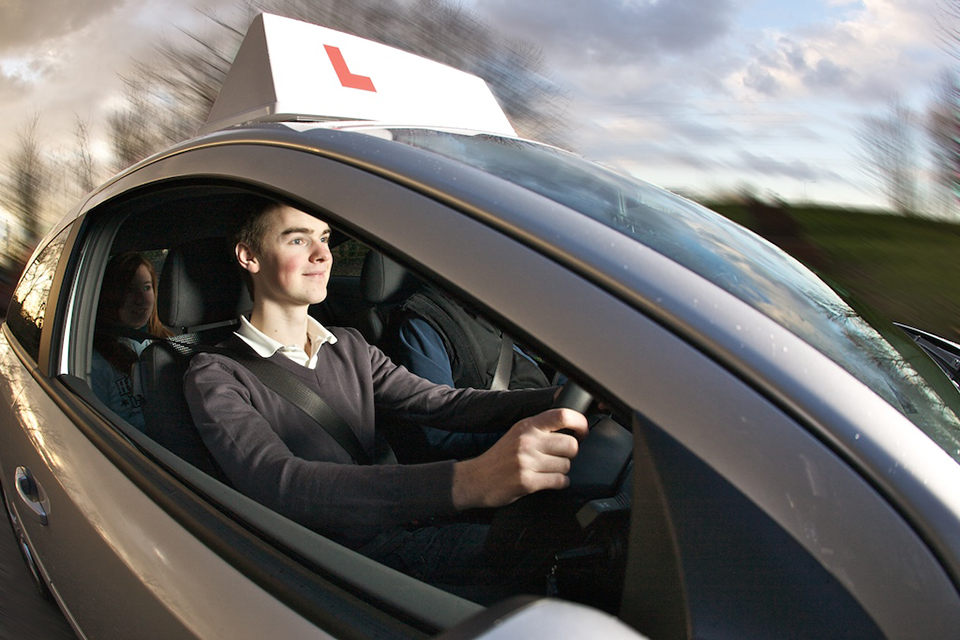
News story: Learner drivers on motorways from 4 June 2018

Updated: Added the date (Monday 4 June 2018) that the law will change, advice about driving near learner drivers on the motorway, and added a Welsh translation of the news story.

From Monday 4 June 2018, learner drivers will be able to take driving lessons on motorways in England, Scotland and Wales.

This will help to make sure more drivers know how to use motorways safely.

At the moment, you can only have motorway lessons after you’ve passed your driving test. Some newly-qualified drivers take lessons through the voluntary Pass Plus scheme.

How the change will work

Learner drivers will need to be:

  • accompanied by an approved driving instructor
  • driving a car fitted with dual controls

Any motorways lessons will be voluntary. It will be up to the driving instructor to decide when the learner driver is competent enough for them.

Until the law changes, it’s still illegal for a learner driver to drive on a motorway.

The change only applies to learner drivers of cars. Learner motorcyclists won’t be allowed on motorways.

Trainee driving instructors won’t be allowed to take learner drivers on the motorway.

Motorway driving isn’t being introduced to the driving test as part of this change.

Making sure road users are ready for the change

The change is being well-publicised so that:

  • driving instructors and learner drivers are prepared
  • other road users know what to expect

The Highway Code rules on motorways will be updated.

Driving near learner drivers on the motorway

As with any vehicle on the motorway, keep a safe distance from a learner driver in front of you. Increase the gap on wet or icy roads, or in fog.

You should always be patient with learner drivers. They may not be so skilful at anticipating and responding to events.

Driving instructor vehicles and training

Driving instructors can decide if they want to use a driving school rooftop box during motorway lessons, based on its instructions.

The car will need to display L plates on the front and rear if the rooftop box is removed.

Driving school car
It will be up to the instructor whether or not they keep their driving school rooftop box on the car.

Guidance for driving instructors

Learning materials and the syllabus for learning to drive a car are being updated to include motorway lessons.

The Driver and Vehicle Standards Agency won’t give driving instructors extra training on providing motorway lessons.

The driving instructor’s National Associations Strategic Partnership has produced best practice guidance to help instructors.

Preparing drivers for a lifetime of safe driving

The changes are being made to allow learner drivers to:

  • get broader driving experience before taking their driving test
  • get training on how to join and leave the motorway, overtake and use lanes correctly
  • practise driving at higher speeds
  • understand motorway specific traffic signs
  • understand what to do if a vehicle breaks down on a motorway
  • improve their confidence to drive on the motorway unsupervised after passing their driving test


News story: New ‘Cumbria Exchange’ portal is launched

Cumbria Exchange will build on the strong community spirit that exists in the area, by helping businesses and the community find each other for mutual benefit.

It will function as an online matching service, by quickly connecting those who need help, to those who can provide it.

It works on a simple ‘offers and needs’ basis.

Councillor David Moore, Chair of the Copeland Community Fund said;

This is an exciting collaboration that the community and businesses have been waiting for.

The sense of community spirit in Cumbria is phenomenal, but alone this isn’t enough, we needed a place that people can go to understand what help is needed, and what support is available.

Cumbria Exchange is a simple forum that makes this process easier.

We didn’t want to wait for a flood or crisis, this is something that can get maximum benefit for the community at all times.

For businesses, it tells them what the community really needs, and for community organisations it give them a place they can go to ask for help, whether that be advice, manpower or equipment.

It will only succeed if people use it, so I would urge community groups and businesses to submit your requests and offers, however big or small.

Community organisations simply submit a ‘support wanted’ request if they need help, however big or small.

Businesses can post in the ‘support offered’ area if they have specific skills, expertise or equipment that can be of benefit to the community.

Cumbria Exchange is the result of a group of organisations and community groups identifying a need for a more coordinated approach to creating social and economic impact.

It was developed as collaboration between the Copeland Community Fund, Cumbria Community Foundation, Low Level Waste Repository Ltd, the Nuclear Community Network (Sellafield Ltd and supply chain), Britain’s Energy Coast, Business in the Community and United Utilities.

It is a result of numerous community groups and local businesses identifying the need for a more coordinated way of supporting each other.

Anyone can submit a request or offer by going to Cumbria Exchange.

For support please contact by Telephone: 01946 598352 or Email: info@cumbriaexchange.co.uk


News story: Call for evidence: Home Office treatment of vulnerable adults.

The ICIBI has started an inspection of how effectively, efficiently and consistently the Home Office’s Borders, Immigration and Citizenship System (BICS) treats vulnerable adults when it encounters them.

The evidence gathering process for this inspection has started and the inspectorate’s established stakeholders will shortly be asked for their input. However, the Independent Chief Inspector is keen to receive written evidence from anyone with relevant knowledge, expertise or first-hand experience of this subject, and in particular any recent examples of good or poor practice.

The inspection will examine Home Office BICS policies, guidance, training and practice in relation to vulnerable adults encountered at the border and in the UK, including where this involves other agencies. It will focus on face-to-face encounters, but will also consider the extent to which paper-based BICS processes are capable of capturing and responding to evidence of vulnerability.

The inspection will not look at vulnerable adults in immigration detention, as this is the subject of a separate review by Stephen Shaw (with whom the inspectorate is in dialogue). Nor will it look in detail at asylum casework , Potential Victims of Modern Slavery (PVoMS), the Vulnerable Persons Resettlement Scheme, or the provision of asylum accommodation, as each of these topics has been covered in inspections that have either been published recently or are due to be published in the next few months.

Please email the Chief Inspector:
chiefinspector@icinspector.gsi.gov.uk

or write to:

ICIBI

5th Floor

Globe House

89 Eccleston Square

London SW1V 1PN

The deadline for submissions is 23 March 2018.


Speech: Reiterating the call for a 30-day ceasefire, without delay, in Syria

Thank you Mr President.

And thank you also to Under-Secretary Generals Lowcock and Feltman for their clear and factual briefings and for reiterating to all of us on this Council the ongoing horror of the conflict in Syria, and in particular in Eastern Ghouta, because that is where it is clear the situation is most dire by a huge order of magnitude.

It was five days ago that we sat in this Council and all of us raised our hands in support of a 30-day ceasefire, which we hoped would provide some relief to Syria’s people. This was a desperately needed step. A step that came too late for many. In Eastern Ghouta alone, Médecins Sans Frontières reported that at least 630 people were killed and 3,000 injured in the week before Resolution 2401 was agreed, with women and children representing nearly 60 percent of the wounded and 50 percent of the deceased. We continue, as well, to condemn attacks on Damascus from Eastern Ghouta.

Let us recall the demands of our resolution. It called for at least a 30-day ceasefire, without delay, to allow for the delivery of humanitarian aid and medical evacuation.

Without delay means right now. Immediately. That there should be no delay. We all voted for these demands and we committed to use our influence to ensure this.

In response, Russia has declared a five-hour daily humanitarian window. That is not what this Council demanded, nor what Russia agreed to use its influence to ensure. A five-hour window has not delivered and cannot deliver any meaningful improvement on the ground. Under-Secretary General Lowcock has made clear that the United Nations cannot get humanitarian convoys in and out within that timeframe, as has the International Committee of the Red Cross.

Humanitarian pauses of a few meagre hours are no substitute for a sustained ceasefire, which is vital to ensure delivery of life-saving humanitarian assistance and medical evacuations. If Russia is able to deliver a five-hour pause, let it deliver a 24 hour one, as they agreed on Saturday.

Mr President,

Let us now take stock of the situation in Syria, and specifically in Eastern Ghouta where the situation is at its most desperate, and review if any real change has occurred in the past five days. Has the resolution been implemented? Has there been a ceasefire? Any delivery of humanitarian aid? Or any medical evacuations? Has the passing of this resolution bought any relief to the people of Syria?

The fighting has not stopped. All of the main armed opposition groups have committed to the full implementation of Resolution 2401. The Assad regime has not, and has in fact ignored the resolution we passed. Reports of attacks and airstrikes by pro-regime forces continue. 22 airstrikes reportedly took place even during Russia’s so-called humanitarian pause.

And, as if it could not get any worse, there have been disturbing reports of use of chlorine gas. Doctors in Eastern Ghouta reported to the Syrian American Medical Society that 16 patients, including six children, were suffering from symptoms indicative to exposure to chemical compounds following an alleged regime attack on Sunday, only one day after the resolution was passed.

Since Saturday, not a single aid convoy has been able to access Eastern Ghouta to provide relief to the desperate civilians.

The World Health Organisation estimates that one thousand people are now in need of medical evacuation from Eastern Ghouta. None have been evacuated since the resolution was passed.

The consequences of the failure to implement the resolution are clear. The casualties continue to rise. The horror continues. The Syrian Observatory for Human Rights report at least 14 civilians, including three children, were killed on Sunday.

In short, in the words of one doctor from Eastern Ghouta, “nothing has changed.”

Mr President,

It is the responsibility of us all to ensure that Resolution 2401 is enacted in full.

In the words of my Foreign Secretary, “The Assad regime must allow the UN to deliver humanitarian aid, in compliance with Resolution 2401, and we look to Russia and Iran to make sure this happens, in accordance with their own promises.”

I implore all those with influence over the Syrian regime to act now to ensure that the ceasefire, which they supported in this chamber, is implemented in full and immediately.

To do anything less is an affront to this Council, this United Nations and the international system that we live by.

We will continue to monitor implementation of Resolution 2401 and commit to returning to this Council regularly until we see it respected.

Thank you Mr President.


News story: Transport Secretary Chris Grayling commits to delivering a modern railway in the south-west resilient to extreme weather

Transport Secretary Chris Grayling has today (28 February 2018) committed to delivering a modern railway in the south-west that is resilient to extreme weather, in the government’s response to a report by the Peninsula Rail Task Force.

Improving the resilience of the South West Peninsula is part of the biggest overhaul of the Great Western route since Brunel started work on the line more than 175 years ago, with £5.7 billion being invested in modernising the line and improving journeys for passengers. Central to this vision are upgrades to stretches of railway that run close to the sea through Teignmouth and Dawlish, safeguarding their future against damage as when storms washed away part of the line at Dawlish in 2014.

The government has already provided £15 million for Network Rail to design a long-lasting solution to this problem, in addition to the £40 million spent by Network Rail to repair the damage caused in the 2014 storm.

Transport Secretary Chris Grayling said:

We are investing in the biggest modernisation of our railway network since Victorian times, providing faster, more reliable and more frequent services for passengers across the country.

The 2014 storms caused devastation to Dawlish and huge disruption followed. It has been a key priority since I became Transport Secretary.

That’s why we’re investing in the infrastructure of the region – making it easier for people to get around and better connecting the south west to the rest of the country. And that’s why sorting out the route through Dawlish is my number one national rail priority.

From the summer, passengers will be also able to take advantage of 29 Intercity Express trains running from London to Penzance. The new bi-mode trains will provide faster, more comfortable and more reliable services, adding an additional 1000 peak time seats compared to today.

Other improvements include:

  • the start of a two-train per hour service between Plymouth and Penzance.
  • the end of ‘Pacer’ trains
  • free Wi-Fi on all GWR trains
  • substantial car park extensions at stations across the peninsula including a completed scheme at Tiverton Parkway and further schemes at St Erth and Taunton
  • investment of £9 million to update the Cornish sleeper service
  • instructing GWR to examine how the line between Exeter and Okehampton could see the reinstatement of regular train services.

Elsewhere in the region:

  • the government is investing more than £1.6 billion in upgrading the A303 near Stonehenge, linking the south-east and the M5 in the south-west to improve journey times, reduce congestion and improve air quality for millions of people, while also supporting 120,000 extra jobs and 100,000 new homes across the region
  • local authorities will benefit from £1.3 billion funding to maintain local roads in the current funding period
  • the government awarded more than £970 million in local growth funding to boost jobs and business in the area
  • the government announced at the Budget to invest £79 million to build the A30 link road for St Austell
  • the government is investing £60 million in a series of local road schemes, with funding from the National Productivity Investment Fund

Rail media enquiries