News story: Inspection reports to be published on 28 March 2018

Four reports published tomorrow.

The Home Secretary will lay the reports on or around 2:30pm on Wednesday 28 March 2018.

  • An inspection of how the Home Office considers the ‘best interests’ of unaccompanied asylum seeking children
  • A re-inspection of Border Force’s identification and treatment of Potential Victims of Modern Slavery
  • An Inspection of Border Force operations at Stansted Airport
  • An inspection of exit checks


Statement to Parliament: Northamptonshire County Council: statement

Mr Speaker, with permission, I wish to make a statement about the independent inspection report on Northamptonshire County Council.

Everyone in this House, regardless of party, appreciates the crucial role that local government plays as the frontline of our democracy.

Delivering vital services on which we all depend and helping to create great places to live.

And, in doing so, making the most of every penny they receive from hard-pressed taxpayers to secure better outcomes.

All of which builds confidence and trust between local authorities and those they serve.

Which is why the situation in Northamptonshire is of such concern.

Prior to my instigation of the report, there were signs that Northamptonshire’s situation was deteriorating.

External auditors at Northamptonshire had lodged adverse value for money opinions in audit reports…

…suggesting that the council was not managing its finances appropriately.

The former leader resigning in May 2016, also signalled the need for change.

As late as last year, the Local Government Association conducted a financial Peer Review…

…which concluded there were issues with delivering the Next Generation reforms and, again, with the mismanagement of its finances.

The then Chief Executive Paul Blantern resigned in October 2017.

These reports, along with the concerns raised by district councils in Northamptonshire…

…and by Hon Members of this House with local constituencies…

…prompted me to act, as I was concerned that there were potentially fundamental issues within the authority.

On 9 January 2018, I informed the House that I had concerns regarding the financial management and governance of the council.

I therefore decided to exercise my powers under section 10 of the Local Government Act 1999 to initiate a Best Value inspection of the council.

And I appointed Max Caller, an experienced former Chief Executive and Commissioner, to conduct this…

…and report on whether the council was complying with its Best Value duty.

Mr Caller submitted his report on 15 March.

And I placed a copy in the library of this House so that everyone could see what he had found and see his recommendations.

And before I go any further, I would like to thank Mr Caller, and his assistant inspector, Julie Parker…

…for their dedication and focus in conducting such a thorough and prompt review.

When I commissioned the Best Value inspection, I asked the Inspector to consider 4 things in particular:

First, whether the council has the right culture, governance and processes to make robust decisions…

…on resource allocation and to manage its finances effectively.

Second, whether the council allowed adequate scrutiny by councillors.

Third, whether there were strong processes and the right information available to managers and councillors…

…to underpin service management and spending decisions.

And fourth, whether the council was organised and structured appropriately to deliver value for money.

Mr Speaker, I have reflected on the contents of the Caller report.

It is balanced, it’s rooted in evidence and compelling.

The Inspector has identified multiple apparent failures by Northamptonshire County Council in complying with its Best Value Duty.

Failures on all counts.

Whilst I recognise that councils across England have faced many challenges in recent years, the Inspector is clear that…

… Northamptonshire’s failures are not down to a lack of funding or because it is being treated unfairly or is uniquely disadvantaged compared to other councils.

In fact, his report says that:

“for a number of years, NCC has failed to manage its budget and has not taken effective steps to introduce and maintain budgetary control”.

Furthermore, the complex structure of financial support meant oversight was difficult and accountability blurred.

This report says that Northamptonshire’s Next Generation approach – which envisaged outsourcing many of the council’s functions – had no:

“hard edged business plan or justification to support these proposals”.

This “…made it difficult to ensure a line of sight over costs and operational activity”…

…and “made it impossible for the council, as a whole to have any clarity or understanding as to what was going on”.

Similarly, the inspector found that Northamptonshire County Council used capital receipts to support revenue spend…

…without documentary evidence demonstrating compliance with the Statutory Guidance and Direction.

Furthermore, until this February, there was no report to full council on the proposed projects and their benefits.

He says that “Savings targets were imposed without understanding of demand, need or deliverability…

…and it is clear that some Chief Officers. did not consider that they were in any way accountable…

…for the delivery of savings that they had promoted.”

On the question of scrutiny, the report says that:

“The council did not respond well, or in many cases even react, to external and internal criticism…

…Individual councillors appear to have been denied answers to questions that were entirely legitimate to ask…

…and scrutiny arrangements were constrained by what was felt the NCC executive would allow.”

Mr Speaker, I want to emphasise that the report also indicates that the hardworking staff of Northamptonshire County Council…

…are not at fault and have worked hard to provide quality services.

With all of this mind, it is clear that I must consider whether further action is necessary to secure compliance with the Best Value duty.

In doing so, I want to reassure the residents of Northamptonshire that essential services will continue to be delivered.

The Inspector is clear that “the problems faced by NCC are now so deep and ingrained that it is not possible to promote a recovery plan…

… that could bring the council back to stability and safety in a reasonable timescale.”

He recommends that “a way forward, with a clean sheet, leaving all the history behind, is required”.

I am therefore minded to appoint Commissioners to oversee the Authority…

…using my powers under section 15 of the Local Government Act 1999.

From day 1, I propose that they take direct control over the council’s financial management and overall governance.

Getting these basics right must be the first step in stabilising this authority.

I also propose giving them reserved powers to act as they see fit across the entirety of the authority’s functions…

…if they consider that they must step in.

My officials are writing to the council and district councils today to this effect and they can make representations on my proposal.

I will consider any representations carefully before reaching a final decision.

The Caller report makes a clear recommendation on restructuring, and notes there are a number of options available.

So, in addition, I’m inviting Northamptonshire County Council and the district and borough councils in the area…

…to submit proposals on restructuring local government.

I would like those councils to think about what is right for their community and the people they serve…

…and to come forward with proposals.

This invitation and the letter to Northamptonshire that I mentioned earlier have been published today and copies placed in the Library.

It is clear to me that any proposals from the councils should seek to meet the criteria for local government restructuring…

…that I have previously shared with the House.

Namely, that proposals should:

  • improve local government
  • be based on a credible geography
  • and command a good deal of local support

I will be particularly interested in hearing how the councils have consulted with their communities…

…to ensure that Northamptonshire’s future is truly locally-led.

Mr Speaker, the findings of Mr Caller’s inspection report on Northamptonshire County Council are extremely serious.

Which is why this government is prepared to take decisive action…

…to ensure that local people receive the high quality services they need and deserve.

And to restore faith in local government in Northamptonshire.

I commend this Statement to the House.


News story: MOT rule changes: 20 May 2018

Updated: Added Welsh translation.

The way that the MOT test works in England, Scotland and Wales will change from Sunday 20 May 2018.

The MOT test works differently in Northern Ireland.

The changes will affect cars, vans, motorcycles and other light passenger vehicles.

There are 5 main changes you need to know.

1. Defects will be categorised differently

Defects found during the MOT will be categorised as either:

  • dangerous
  • major
  • minor

The category the MOT tester gives each item will depend on the type of problem and how serious it is.

MOT testers will still give advice about items you need to monitor. These are known as ‘advisories’.

What the new categories mean

Item result What it means about the item How it affects your MOT result
Dangerous A direct and immediate risk to road safety or has a serious impact on the environment.

Do not drive the vehicle until it’s been repaired.

Fail
Major It may affect the vehicle’s safety, put other road users at risk or have an impact on the environment.

Repair it immediately.

Fail
Minor No significant effect on the safety of the vehicle or impact on the environment.

Repair as soon as possible.

Pass
Advisory It could become more serious in the future.

Monitor and repair it if necessary.

Pass
Pass It meets the minimum legal standard.

Make sure it continues to meet the standard.

Pass

2. Stricter rules for diesel car emissions

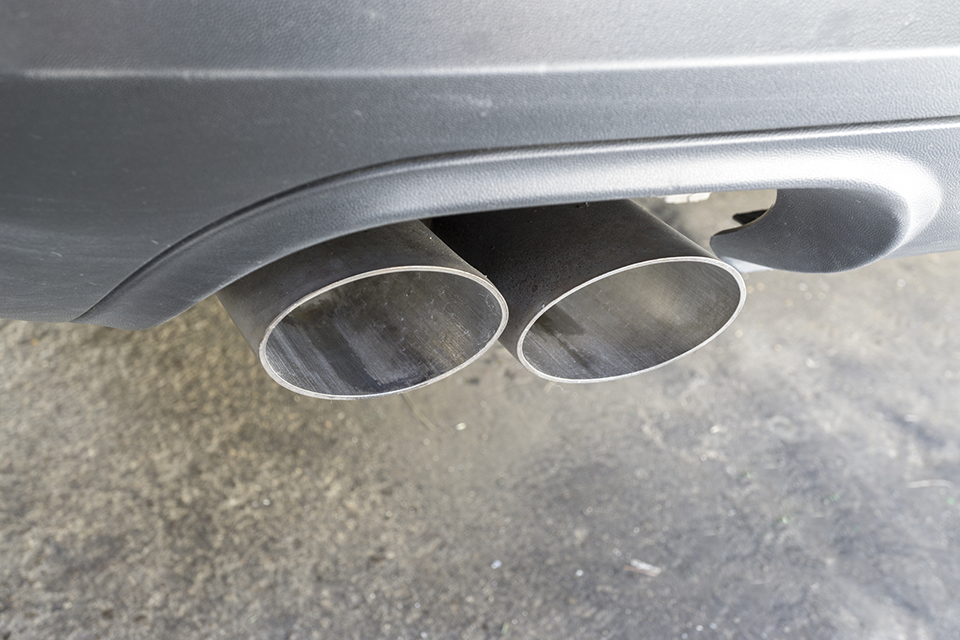
Diesel exhaust

There will be stricter limits for emissions from diesel cars with a diesel particulate filter (DPF).

A DPF captures and stores exhaust soot to reduce emissions from diesel cars.

Check your car’s handbook if you don’t know if your car has a DPF.

Your vehicle will get a major fault if the MOT tester:

  • can see smoke of any colour coming from the exhaust
  • finds evidence that the DPF has been tampered with

3. Some new things will be included in the MOT

Daytime running lights on a car
Daytime running lights will be checked on vehicles first used from 1 March 2018.

Some new items will be tested during the MOT.

They include checking:

  • if tyres are obviously underinflated
  • if the brake fluid has been contaminated
  • for fluid leaks posing an environmental risk
  • brake pad warning lights and if brake pads or discs are missing
  • reversing lights on vehicles first used from 1 September 2009
  • headlight washers on vehicles first used from 1 September 2009 (if they have them)
  • daytime running lights on vehicles first used from 1 March 2018 (most of these vehicles will have their first MOT in 2021 when they’re 3 years old)

There will be other smaller changes to how some items are checked. Your MOT centre will be able to tell you about these.

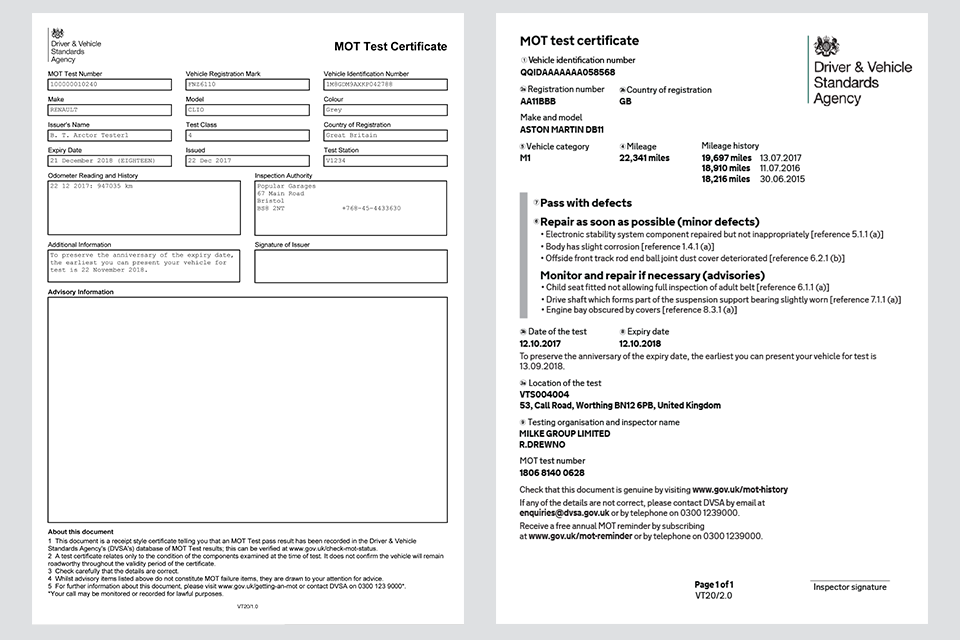
4. The MOT certificate will change

Current and new MOT certificate design
The current MOT test certificate (left) will change to a new style (right) to list the new types of defects.

The design of the MOT certificate will change.

It will list any defects under the new categories, so they’re clear and easy to understand.

The service to check the MOT history of a vehicle will be updated to reflect the changes.

5. Some vehicles over 40 years old won’t need an MOT

Headlight of a classic car

Cars, vans, motorcycles and other light passenger vehicles won’t need to have an MOT if they’re over 40 years old and have not been substantially changed (PDF, 62.8KB).

At the moment, only vehicles first built before 1960 are exempt from needing an MOT.

When the rules change on 20 May 2018, vehicles won’t need an MOT from the 40th anniversary of when they were registered. You can check the date the vehicle was registered online.

Example

If a car was first registered on 31 May 1978, it won’t need an MOT from 31 May 2018.

You won’t have to apply to stop getting an MOT for your vehicle.

However, each time you tax your historic vehicle (even if you don’t pay a fee), you’ll have to declare it meets the rules for not needing an MOT.

More information

The maximum fees MOT centres can charge won’t change.

In January 2018, the government decided to keep the age a vehicle needs its first MOT at 3 years, rather than extend it to 4 years.

You can get a free MOT reminder by text message or email a month before your MOT is due.

You can be fined up to £1,000 for driving a vehicle without a valid MOT.


News story: Skills Minister calls on employers to join new T level panels

Leading businesses are being urged to grasp the opportunity of working with the government to develop prestigious new T level qualifications.

Skills Minister Anne Milton has called on industry experts from agriculture, environmental and animal care; business and administration; hair and beauty; creative and design; and catering and hospitality to join the influential T level employer panels and help develop the outline content for new qualifications.

T levels are new courses, which will be on a par with A levels and provide young people with a genuine choice between technical and academic education post 16. The first subjects in digital, education and childcare, and construction will be taught from 2020.

Skills Minister, Anne Milton said:

T levels are about giving greater choice to young people to get the skills they need to achieve good jobs. It is also about businesses – we know they are crying out for a skilled workforce and T levels will create the next generation of talented employees for them.

We are already working with top industry leaders and want even more to join us to make this a success for individuals, businesses and the economy.

T level content is already being developed with the help of top firms like Rolls-Royce, IBM, Lloyds and Morphy Richards, among others.

The Department for Education wants business representatives to step-up and help design the new qualifications in T level routes which will be delivered from 2022:

  • agriculture, environmental and animal care
  • business and administration
  • hair and beauty
  • creative and design
  • catering and hospitality

Businesses can apply to be part of the T level qualification panels. The closing date for applications is 5pm Tuesday 8 May 2018.


News story: Ilford pupil celebrated in international short story competition

A school pupil recognised in an international short story competition has today (Monday 26 March) been awarded a prize for her success by Education Minister Nick Gibb, as part of the ongoing celebration of the history of the Commonwealth.

Alyssa Malley, aged ten, a pupil at Churchfields Junior School in Ilford, scooped third place out of 1,600 entries from across the Commonwealth. Alyssa’s prize-winning story focused on ending conflict through recognition of the common values shared by people across the globe.

The annual Commonwealth Class Writing Competition – which is run by the Commonwealth Secretariat and the British Council – was themed around ‘peace’ this year and the first and second prizes were awarded to pupils from India and Pakistan.

This international recognition builds on the rising standards in our schools, with over 15,969 more pupils in Ilford in schools rated good or outstanding than in 2010 and 95 per cent of Ilford schools given this rating at their last inspection.

School Standards Minister Nick Gibb said:

Congratulations to Alyssa on this achievement. Despite fierce competition, it is brilliant to see a pupil from Ilford recognised on the global stage.

Thanks to the hard work of teachers and our reforms, academic standards are rising in England, with 1.9 million more children in good or outstanding schools than in 2010.

This determination to offer every pupil a world-class education was evident at Churchfields Primary School, where I saw first-hand how pupils were broadening their understanding of the Commonwealth and its unique history.

In a visit to the school, Minister Gibb presented Alyssa with a certificate and a £30 book voucher to celebrate her achievement.

Nick Gibb presented the pupil with an award recognising her success in the Commonwealth Writing Competition. This is the second consecutive year in which pupils from Churchfields Junior School have been successful in this prestigious event, in which so many other students throughout the world take part. Alyssa commented that she was proud so many people across the world would hear her message of peaceful problem solving and she was looking forward to writing more stories in the future.

Mr Gibb also visited a lesson where pupils were being taught about the Commonwealth and what it means to be a member of this unique historic institution. Teachers were using an education resource pack – produced by the Department for Education – which aims to illustrate the importance of the Commonwealth to young people today.

Headteacher Mrs Emeny said:

Writing is a strength of Churchfields Junior School and the ministerial visit was a great opportunity for Nick Gibb to see our world-class school in action. As he toured the classrooms, I was pleased by his comments about the high levels of achievement and excellence he witnessed across the curriculum. During his visit, the Minister spoke to staff and pupils about our school ethos and how the wealth of opportunities we provide enable pupils to develop outstanding language and maths skills, as well as a deep cultural understanding.

Today’s focus on the Commonwealth comes ahead of the Commonwealth Heads of Government meeting which will be hosted by Britain in April. Leaders, business, civil society and young people from around the world will meet to discuss a common future.

Sinead Russell, Senior Literature Programme Manager and Joe White, Literature Coordinator at the British Council from the judging pane said:

It was a privilege to read so many excellent stories from around the world. Although every story differs in its approach to this year’s theme, what they all have in common is a depth of humanity and a feel for language which, quite frankly, humbled us.

All of the winning stories and highly commended entries, each illustrated by Tarsila Kruse, Children’s Book Illustrator, can be seen on the British Council’s Commonwealth Class website.

Writing tips from Children’s Writing Fellow for Northern Ireland, Myra Zepf and former Children’s Laureate, Anne Fine can be downloaded here.

The Commonwealth Class initiative enables schools to take part in online competitions and work on projects with the aim of giving young people a hands-on international learning experience based around the Commonwealth family of countries.