Speech: Address by the International Trade Secretary to the British Ports Association

Thank you Lord Berkely. I am delighted to join you today – and to see so many people from across the ports and related industries here.

It demonstrates the diversity of this sector which is so important to our international trade performance and Britain’s future as a great maritime nation.

Ports are a vital part of this country’s economy.

Not only are they important economic entities in their own right – acting as hubs for jobs, industry and innovation across industries far broader than just the maritime sector – but they also play a vital role in facilitating imports and exports – moving 95% of our trade in goods – and in maintaining our international competitiveness as a global trading hub.

They handle almost 500 million tonnes of freight each year – an £8 billion contribution in Gross Value Added to the UK economy.

They employ more than 100,000 people, supporting families across the country.

Ports are, quite simply, Britain’s gateway to the world.

And they have a brilliant future at the forefront of our global economic ambitions as Britain leaves the European Union.

We know how important it will be to preserve vital existing trading links with our current partners in the EU.

And for the first time in four decades, we will determine our own independent trade policy, able to seize the opportunity to establish new economic relationships across the globe.

Our experts in the Department for International Trade are working hard preparing for negotiations on new trade agreements with key partners including the United States, Australia and New Zealand.

We are also considering the potential of new regional partnerships such as accession to the Comprehensive and Progressive Agreement for Trans-Pacific Partnership, which would allow the UK to further establish its presence in the world’s fastest growing regions.

Boosting our international trade will bring jobs and prosperity to not only the places where goods are loaded and unloaded, but to the wider economy too.

And to make sure this happens it is vital that our ports can match the best facilities in the world and adapt to new trends and technologies.

I know that you have invested significantly to improve capacity and capabilities and will continue to do so.

But this is only one piece of the puzzle – the cost of exports and imports is also influenced by the effectiveness of inland transport networks.

That is why I was pleased to see the Department for Transport publish a study of port connectivity earlier this year.

This study firmly made the case for investment in effective freight transport links as an enabler of economic growth and trade and that this should be a default factor in infrastructure investment decisions.

It was also a timely reminder of the importance of the ports and maritime sector in our fortunes.

And I look forward to taking discussions with the sector forward as the Government develops its five-year maritime strategy.

But for now, I’d like to thank Richard Ballantyne for supporting the Ports for International Trade Campaign. The BPA is a founding member and has been integral to its development.

This campaign will promote the essential point I referred to earlier – that ports play a vital role in our international trade as the gateway to the UK, facilitating and promoting our vibrant export sectors.

And it will make the case for the huge opportunities that are out there – not just to port towns and cities, but to all regions of the UK to grow high quality jobs and improve living standards.

This is a very important mission. We think it is essential to work with industry to make this case clearly to the public.

Because Government can’t do this alone. It will be your efforts in the ports industry that will be vital to its success. I know that some of you have already given your support to the campaign, and we’re hoping others amongst you will join in the days ahead.

And I am looking forward to speaking at its official launch event in October.

I understand invitations are on their way – so if you can bear listening to me again I hope you will attend!


Press release: Secretary of State Appointments to the Birmingham Organising Committee for the 2022 Commonwealth Games

Jonathan Browning and Zara Hyde Peters have been appointed for 4 years and 8 months commencing 5 September 2018 until 30 June 2023.

Jonathan Browning

Jonathan Browning is Chairman of the Coventry and Warwickshire Local Enterprise Partnership. He is also a Board Member for the West Midlands Combined Authority and a member of the Auto 1 Group Supervisory Board. He was previously Interim Chairman (2017) and a Non-Executive Director (2015-18) at British Cycling.

During his executive career Jonathan held a number of senior roles within the automotive industry with Volkswagen, Ford, Jaguar and General Motors. He was awarded automotive
industry ‘All Star’ in both 2011 and 2012 and received an Honorary Doctorate from Coventry University in 2017 in recognition for his contribution to the global automotive industry.

Zara Hyde Peters OBE

Zara Hyde Peters is Managing Director at North Hampshire Clinical Commissioning Group, where she relocated after a period as Strategy Director for Birmingham Community Health Care. She was previously Chief Executive of the British Triathlon Federation (2008-2014) and Director of Athlete Development at UK Athletics (2004-2008). Zara has also held Non-Executive roles with UK Sport, the Triathlon Trust and Sport Birmingham.

She competed for England at the 1994 Commonwealth Games and was awarded an OBE for national leadership services to athletics and triathlon in Great Britain in 2011.

The roles

The roles are not remunerated. These appointments have been made in accordance with the Cabinet Office’s Governance Code on Public Appointments. The process is regulated by the Commissioner for Public Appointments. The Government’s Governance Code requires that any significant political activity undertaken by an appointee in the last five years is declared. This is defined as including holding office, public speaking, making a recordable donation or candidature for election. Jonathan and Zara have declared no such political activity.


Speech: DFID Ghana Country Director’s speech at the launch of the report of the Poverty Profile in Ghana

I am very pleased to be here today to participate in the launch of this poverty profile report, and the release of new poverty data for Ghana.

This report is particularly timely coming in the wake of yesterday’s launch of Ghana’s Baseline Report on the Sustainable Development Goals, and as the Government drafts a Charter setting out the plan for Ghana Beyond Aid.

The UK has had a long-standing collaboration with the Ghana Statistical Service. In partnership with the World Bank we have supported the GSS to build its capability and produce and deliver the data needed to inform policy and development in Ghana.

We are also pleased to be supporting a new partnership between the GSS and the UK’s equivalent, the UK Office of National Statistics.

Data plays a critical role in informing policy-making. Good data allows effective decisions to be made about where to target resources and to understand which policies are most effective.

Disaggregated data – data that shows location, gender, disability, age or other characteristics – also shows us where the needs are greatest and can help ensure that no one is left behind (the overarching theme of the Sustainable Development Goals).

Ghana is one of the few sub-Saharan African countries to achieve the MDG1 target of halving extreme poverty between 1991 and 2015. However, even as economic growth in Ghana has accelerated, inequalities persist.

Yesterday, at the event launching the baseline data for the SDGs, the data from 2013 showed that the percentage of the population living below the poverty line in rural areas was six times higher than in urban areas. Today – from a quick skim of this report – it appears that the gap between regions and between rural and urban areas remains wide, and in some cases is worsening.

Over the last two decades, the UK has invested over 2 billion pounds of development aid in Ghana, working hand in hand with the Government and other development partners, and contributing to Ghana’s impressive development gains …..

… but we haven’t made a dent in the high poverty rates in the North.

Poverty in rural northern Ghana remains stubbornly high. And decades of investment by development partners in the North has been less than transformational. Historically, Ghana’s success in reducing poverty has largely been the story of the South.

Rising inequality presents a huge challenge for the government and development partners. We must maintain concerted efforts to address these inequalities in order for Ghana to leave no-one behind and achieve the Sustainable Development Goals.

Ladies and Gentlemen, this new poverty data comes at a critical time, not just in establishing progress towards the SDG’s but also to help inform the focus of the “Ghana Beyond Aid” agenda.

Let me be clear – the President’s vision for a self-reliant Ghana is inspiring and is applauded by the UK and all development partners. In the long term, economic development with investment and, critically, jobs is the sustainable pathway to self-reliance.

But “Ghana Beyond Aid” must address the issue of why, despite record economic growth, inequality in Ghana is rising. The “Beyond Aid” agenda has so far focused only on investment, infrastructure and trade and there is a risk that Government, and development partners, shift their gaze from the immediate task of improving the lives of the poorest and most vulnerable in Ghana.

Ghana Beyond Aid can’t just be about Ghana’s “self-reliance” through industrialization. It has to be address the “self-reliance” of the poorest and most marginalized Ghanaians – including out-of-schoolchildren, vulnerable women and people with disabilities.

So the data and findings to be discussed today should contribute to a national debate, not just about how Ghana moves “beyond aid”, but also about how Ghana can step up efforts to address inequalities and eliminate poverty at the same time.

The UK, as a friend and partner, stands ready to support Ghana to do this.

I am delighted to be part of this launch and I look forward to digesting the report.


News story: Minister commits to transnational partnership

The Universities Minister has hailed the UK and US as the ‘heavyweights of higher education’ and reinforced the special relationship between the two countries by pledging to forge transnational education partnerships.

Sam Gyimah spoke at the US-UK Fulbright Commission’s reception in the House of Commons (12 September) to celebrate their 70th anniversary, and committed £1million for UK-US international exchanges. The funding will help more young people and academics, including those from disadvantaged backgrounds, experience the world-class education that each country has to offer, building on the over 23,000 educational exchanges Fulbright have facilitated.

The Universities Minister praised the work undertaken by the Fulbright Commission and reaffirmed the UK Government’s commitment to a global outlook beyond Brexit.

The Universities Minister Sam Gyimah said:

At the heart of our great nations’ success is great education. The UK and the US are both powerhouses on the international stage, attracting talented students and teachers from across the globe to broaden both of our horizons.

I recognise that, with the prospect of Brexit here in the UK, there is much concern as to what the future holds for our relationship with the outside world. Let me reassure you with this gesture that we are committed to the UK remaining open to the world and becoming even more global and internationalist in outlook.

As the only scholarship programme supporting students and scholars on both sides of the Atlantic, across all disciplines, the US-UK Fulbright Programme is a prime example of the special relationship that has blossomed between our two countries. And it is a partnership of which we are extremely proud.

Penny Egan, Executive Director of the US-UK Fulbright Commission:

As we approach the 70th anniversary of the signing of the treaty that created the US-UK Fulbright Commission, we warmly welcome the UK Government’s endorsement of our work and its recommitment to our future. This significant extra funding will allow us to create more opportunities for British students, academics and teachers and even up the awards available on both sides of the Atlantic.

This is a bilateral partnership that celebrates the exchange of innovative ideas and best practice, cementing lasting collaborations and a deeper understanding of each other’s country. We are enormously grateful for the continuing support of both governments, that will enable us to invest in future generations of Fulbright scholars.

The UK and US have long been seen as the powerhouses for higher education, with the two countries making up 9 out of ten of the world’s best universities.

The funding builds on a strong history of the UK-US bilateral education relationship, and will introduce a programme enabling teachers from the UK to develop and share their professional skills and academic knowledge in the US.


Speech: V&A Dundee is ready to open its doors

Scotland Secretary David Mundell has hailed the arrival of the V&A Dundee, which opens on Saturday ( 15 September).

He said:

It is an incredibly important moment.

An amazing treasure trove from one of our greatest cultural institutions is about to be shared with millions of visitors from Scotland, the UK and around the world.

It was a great privilege for me to speak at tonight’s (Wednesday 12 September) gala dinner and enjoy an all-too-brief tour of the exhibitions.

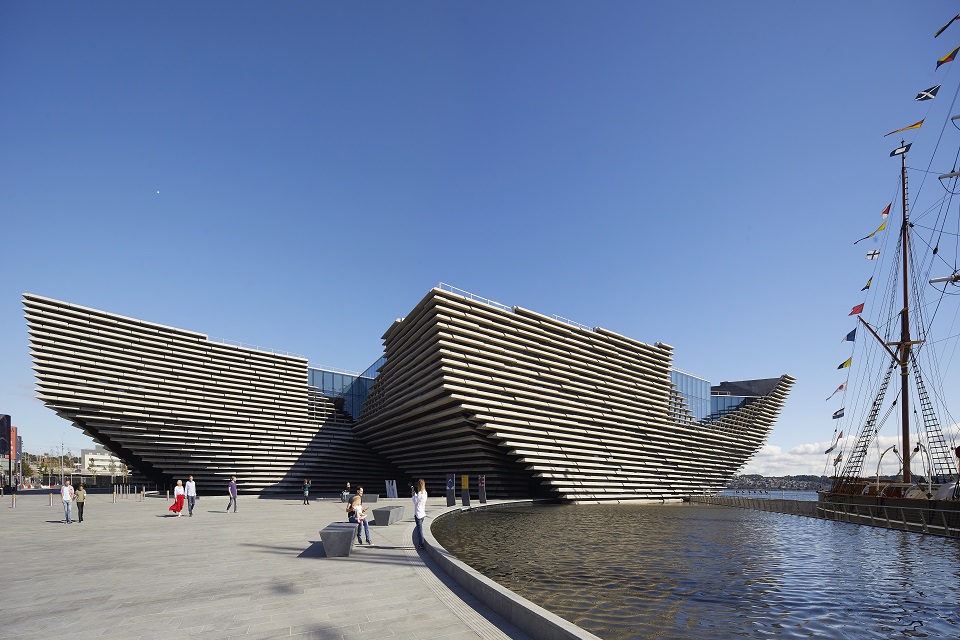
Architect Kengo Kuma’s new building, on Dundee’s wonderfully redeveloped waterfront, is simply breath-taking.

!!1
V&A Dundee Scotland ©HuftonCrow_070

Iconic is an overused word – but it is an instant icon.

I love the juxtaposition with that much-loved symbol of Dundee, RRS Discovery; the old and new side by side in city that is redefining itself for the 21st century.

But V&A Dundee is about much, much more than a stunning building.

Ultimately, it will be judged by its exhibitions and events.

Having been inside, I’m in no doubt it’s going to be a huge success.

Inspired by the richness of Scottish art and design down the centuries, backed by the world-renowned strength of the V&A’s collections and driven by an exceptional team of curators, it is a place people will want to return to time after time.

It is a place that people will cherish and a source of real pride for Dundee.

It will delight our senses, challenge our preconceptions and – of course – nurture generations of young minds.

I firmly believe V&A Dundee will quickly become as well-loved as our other great institutions. Our National Museum of Scotland in Edinburgh, for example, or Glasgow’s Kelvingrove Museum and Art Gallery. Or, indeed, ‘V&A London,’ as we’ll have to start calling it.

The UK Government awarded an additional £5 million for the project in the 2016 Budget.

We all owe a huge debt to everyone involved in the delivery of this inspiring project – surely the biggest single investment in culture and the arts in our lifetimes.

So I want to put on record my thanks all those who have turned the dream into reality, from the City Council to the V&A staff, from the builders to the architect.

They have worked wonders to enrich the cultural life of Dundee, Scotland and the whole of the UK.