News story: Qatari jet export deal swings into action

The deal, worth around £5bn includes the aircraft and a bespoke support and training package. Qatar is now buying nine Hawk trainers, rather than six, which will also be welcome news for BAE Systems’ factories in Warton and Brough which make the jets.

Welcoming the news, Defence Secretary Gavin Williamson said:

This monumental, multi-billion-pound deal is now officially in place, and those from across government and industry who have worked so hard on it together can be extremely proud to see it reach this stage. It’s a massive boost to the British defence industry, helping to support thousands of jobs, and it will help us further build the trust between the UK and Qatar to tackle the challenges we both share, support stability in the region and deliver security at home.

UK Export Finance’s (UKEF) £5bn package of support was vital to securing the deal, including by providing financing and insurance. UKEF’s role is to support UK exports including by providing export finance to enable overseas buyers to purchase goods and services from the UK, and export insurance for companies selling overseas.

International Trade Secretary, Dr Liam Fox said:

The UK Government is proud to be a part of this hugely significant export contract, supporting BAE Systems, its nearly 35,000 employees and the 9,000 companies in its supply chain.

This support from UK Export Finance will sustain jobs in one of the UK’s key industrial sectors, support economic growth, and strengthen our own defence capabilities as well as those of a key strategic ally.

BAE Systems Chief Executive, Charles Woodburn said:

This contract, effective today, represents a significant step in BAE Systems’ long-term relationship with the State of Qatar, as it becomes the ninth country to choose Typhoon. The proven combination of Typhoon and Hawk will provide the Qatari Armed Forces with the most advanced and flexible multi-role combat aircraft on the market today, along with best in class support and training.

The Defence Secretary Gavin Williamson and his Qatari counterpart, Dr Khalid bin Mohammed al Attiyah, oversaw the signing of the deal in Doha in December. Deliveries of the first Typhoon aircraft are expected to commence in 2022.

The deal also involves a package of training and co-operation between the British and Qatari Air Forces which will see them working closely together in the future. A new UK-based Typhoon joint squadron, reformed as No.12 squadron, will comprise both Qatari Emiri Air Force and RAF personnel, including pilots and ground-crew based at RAF Coningsby in Lincolnshire ahead of the delivery of the aircraft. It represents a unique initiative, with the RAF not having formed a squadron with another nation since the Second World War and the Battle of Britain.

The UK and Qatar share mutual interests in countering violent extremism, and ensuring stability in the region, and the deal further reinforces those ties by helping to prevent terrorism from spreading and protecting the prosperity and security of the UK at home.

Qatar is the ninth country to purchase the Typhoon, with the deal sustaining thousands of UK jobs. The MOD continues to bang the drum for the UK’s world-leading aerospace industry, with sales of defence equipment to foreign customers surging by 53% last year to £9bn.

The UK is a world-leader in the combat air sector, with a mix of skills and technologies unique in Europe, supporting over 18,000 highly skilled jobs. The sector delivers a turnover of more than £6bn a year and has made up over 80% of defence exports from the UK over the last ten years.

The support follows the launch of the Government’s Export Strategy, which sets out how the government will support businesses of all sizes to make the most of the opportunities presented by markets around the world.


Press release: Southampton paedophile jailed after Solicitor General’s referral

A man who sexually assaulted a young girl on repeated occasions has had been jailed after the Solicitor General, Robert Buckland QC MP, referred his sentence to the Court of Appeal for being too low.

Antonio Lawrie, now 22, sexually assaulted the victim at least 16 times over a period of several months. Lawrie was reported to the police when a witness saw him with his hand under the victim’s dress.

Lawrie was originally sentenced at Southampton Crown Court in June, where he was given 2 years imprisonment suspended for 2 years. He was also ordered to complete a rehabilitation activity, and put on the Sex Offender’s Register for 10 years. Today, after the Solicitor General’s referral, the Court of Appeal increased his sentence to 3 years immediate imprisonment.

Speaking after the hearing, the Solicitor General said:

“Lawrie carried out a campaign of sexual assault against a young girl, and I hope that she will take some comfort from the increased sentence today. Lawrie continues to pose a threat to other children, and it is therefore important that he serves an immediate custodial sentence.”


Speech: Supporting Denuclearization

Thank you very much indeed Madam President and I’d like to echo the Kuwaiti representative and the Equatorial Guinea representative in sending our condolences to all those around the world who have been affected by the recent hurricanes and flooding. And I think the Kuwaiti representative was quite right to point out the link with climate change and this is one reason why this Council needs to stay abreast of the developments on climate change, so thank you to him for raising that.

I’ve listened very carefully Madam President to what colleagues have said this morning. The unity of the Council has been really critical on this issue and all the more so because on other issues including those relating to WMD, Council action has been blocked and it’s been blocked because of one Council member. We have a very significant opportunity Madam President to improve the strategic situation on the Korean Peninsula. I think the Swedish representative referred to this as a momentous moment and I think that’s exactly the right word to use. What is happening on the Korean peninsula has the potential to affect the countries of the two colleagues sitting at the table. But if we can get it right, if we can make a success of non-proliferation in DPRK then we improve safety and security, not just for the region, but actually for the whole world.

You said Madam President that the Council had passed historic sanctions showing historic unity. We have a real chance for success here and I find it very hard to comprehend why anyone, why one Council member would put that opportunity at risk given what is at stake.

The Chinese ambassador referred to the 1950s and the Cold War. We don’t debate how DPRK came about to have nuclear weapons, but we all agree that it is vital that she completes denuclearization, and I’ll come back to that point in a minute. But it’s a very serious issue Madam President. It has, if you like, been hanging over the region and the world since the 1950s and the Council has been united recently in trying to tackle it and we would appeal to all Council members not to put that unity at risk but to continue efforts.

I wanted to thank the Undersecretary-General for her briefing. I think there have been as she said some important political developments and we welcome the upcoming trip of President Moon and we hope this will further encourage DPRK to take decisive steps towards denuclearization. I did just want to say in that context though there is no equivalence between WMD and possession and threats to use and the sorts of bilateral co-operative military exercises that we have seen between the United States and the Republic of Korea.

And I think as other speakers did Madam President I want to echo the fact that next week our leaders will be here for High-Level Week. These important questions will be discussed. People will be looking at the Council even more than usual to see our leaders take their responsibilities and deliver unity and progress so this critical issue of WMD and nuclear proliferation can be properly addressed.

Turning to sanctions Madam President, all evidence related to sanctions implementation is reviewed with care and States that neighbour DPRK have a particular responsibility. And our unanimously agreed sanctions measures clearly draw a distinction between legitimate economic activity and sanctionable offences. And I’d just like to say that I very much welcome the assurances that the Chinese Ambassador set out today.

And we particularly need, for the reasons you set out Madam President in your national capacity, we particularly need monitoring of DPRK coal exports and oil exports. DPRK has shown itself able to seek creative ways to bypass checks and violate sanctions. We support the US assessment that the UNSC mandated cap on imports of refined petroleum has likely been breached. We need to be vigilant about this and this includes ship-to-ship transfers of refined petroleum to DPRK vessels at sea. The cap demonstrates international commitment to upholding the rules-based international order and we call on all States but – particularly given their special nuclear responsibilities – particularly P5 Members to ensure that agreed sanctions are adhered to.

You mentioned the Panel of Experts Madam President and a number of colleagues have also referred to that. We think it is important that the Panel of Experts report should be submitted in its original form. The Panel have produced an extensive and well-researched report, showing the extent of DPRK’s sanctions evasion, and the Security Council has unanimously agreed a comprehensive set of resolutions on DPRK, and publication of these reports is one of the commitments we have all signed up to. So we look to all colleagues on the Council to enforce these commitments strictly and the independent Panel reporting is a very essential tool. I just want to stress that it is an essential tool for carrying out sanctions implementation to the full and ensuring that evasions are clamped down on.

On the UN command, I take the points about history. As a number of colleagues have said, this is a legacy from the 1950s and it is highly unusual. All requests for shipments of material in the Demilitarized Zone must be scrutinised and they must be checked for compliance with sanctions. It is important that this diligence continues.

There has been really important outreach Madam President both by your government and by the government of the Republic of Korea, but sadly Pyongyang has not yet taken decisive steps towards complete, verifiable and irreversible denuclearization. The Council debate next week will be a very important window of opportunity that shouldn’t be wasted. The United Kingdom is fully committed to supporting and assisting denuclearization in any way that we can and I hope that next week we can see very strong and firm Council unity in support of that goal and in support of full sanctions implementation.

Thank you very much Madam President.


Press release: Phase Two of the Community Housing fund is now open

The £163 million fund is available for community-led groups to drive forward their ambitions for delivering new affordable housing schemes across England up to 31st March 2020.

Phase One of the fund launched in July, supports applications for capacity building, pre-development revenue funding and capital funding for local infrastructure projects.

Phase Two bidding is now open to eligible organisations to bid for capital grants to fund the costs of acquiring land and building community-led housing schemes.

The fund aims to give local people a leading and lasting role in delivering local affordable housing.

Jackie Jacob, General Manager for Housing Programmes, at Homes England said: “Community-led housing is about giving local people the lead to solve local housing problems and provide affordable homes in their communities.

“At Homes England, we’re committed to increasing the supply of affordable housing where it’s most needed. It’s great to make funding available for community groups across England to transform how the homes are delivered locally.”
Bidding is open to a range of organisations. Both Local authorities and Registered Providers may apply on behalf of community groups to support them through this process.

Bidding for both phases is now open on a Continuous Market Engagement basis via the Homes England Portal. This will remain open to new applications until funding is fully committed or until 31 December 2019, whichever occurs first.

Further details are available in the Prospectus and the Addendum to the Prospectus for Phase Two published on Gov.uk

For further media information please contact:

Nosheen Haque, 0161 200 6131, nosheen.haque@homesengland.gov.uk
Or Patsy Cusworth, 020 7393 2201, patsy.cusworth@homesengland.gov.uk

Notes to editors:

In order to ensure that the schemes supported by the Community Housing Fund are truly community-led, proposals should ensure that:

• Meaningful community engagement and consent occurs throughout the development process. The community does not necessarily have to initiate and manage the process, or build the homes themselves, though some may do;

• The local community group or organisation owns, manages or stewards the homes and in a manner of their choosing, and this may be done through a mutually supported arrangement with a Registered Provider that owns the freehold or leasehold for the property; and

• The benefits to the local area and/or specified community must be clearly defined and legally protected in perpetuity.

Bidding is open to all organisations which are, or intend to become, constituted as a body corporate, or an equivalent form of constituted body. Eligible organisations include, but are not restricted to:

• Registered charity;

• Company Limited By Guarantee;

• Community Benefit Society

• Co-operative Society;

• Community Interest Company;

• An organisation of another type operating as a social enterprise and principally reinvesting their surpluses for social benefit;

• Registered Provider of social housing; or

• Local authority.

Organisations which intend to be the landlord of low-cost rental properties funded by Homes England capital grant programmes must be – or intend to become – registered as a provider of social housing (a ‘registered provider’) with the Social Housing Regulator (‘the Regulator’) before completion of any developments funded through those programmes and any payment of funding. It is not, however, a requirement to be a registered provider before applying for Homes England grant.

The requirement to be a registered provider does not apply to organisations that will not act as the landlord of low-cost rental property. Where an organisation is delivering homes for low-cost homeownership – including shared ownership – for example, there is no requirement for that organisation to be a registered provider.

Local authorities or Registered Providers may apply on behalf of community groups and other organisations and, in those cases, the lead bidding organisation will remain directly accountable for the funds, where appropriate.
For applications not directly submitted by community-led organisations the applicant must demonstrate how the identified community will be engaged in the development proposal and how this will support the objectives of the Fund.

All organisations applying to the Fund will be required to submit details of the proposed activity through the Homes England bidding portal

Homes England is the new housing delivery organisation that has been created to adopt a more commercial approach to respond to the long term housing challenges facing this country. The new, expanded agency will play a far bigger role in investing in supply and intervening in the market to help deliver 300,000 homes a year by the middle of the next decade.

Homes England will act differently from its predecessor, bringing together money, land, expertise and planning and compulsory purchase powers to accelerate the supply of new homes and address affordability issues in areas of highest demand.

For more information visit Gov.uk or follow us on Twitter


News story: Spacecraft bound for the Sun due to leave Stevenage factory for testing

The UK is at the heart of this European Space Agency (ESA) mission to uncover the secrets of our planet’s star. Solar Orbiter will provide close-up views of the Sun’s polar regions, tracking features such as solar storms and the solar wind which causes Earth’s atmosphere to light up as the Aurora or Northern Lights. The north and south poles of the Sun ‘flipped’ in 2013 and Solar Orbiter will also explore this phenomenon.

ESA selected Airbus Defence and Space in the UK as the prime contractor on the mission in 2012, to lead a team of companies and universities from all over Europe that supply various parts of the spacecraft.

The UK is a world-leader in solar physics research and its scientists are in high demand on solar missions. UK scientists were instrumental in proposing the Solar Orbiter mission to ESA and the UK Space Agency funded teams from University College London, Imperial College London and the RALSpace to design and build three out of the ten state-of-the-art scientific instruments on board the spacecraft, and to contribute to a fourth.

Business Secretary Greg Clark said:

Our space sector is going from strength to strength with full backing from the Government’s modern Industrial Strategy and the UK Space Agency. We have world-class scientists and a strong track record of exporting to countries all over the world. From sending spacecraft to the Sun to supporting new technologies here on Earth, our commitment to the European Space Agency will continue to deliver ground-breaking discoveries, highly-skilled jobs and substantial economic returns to Britain.

Solar Orbiter will follow in the footsteps of NASA’s Solar Parker Probe which launched in August. The two missions will offer complementary perspectives of the Sun – Parker Solar Probe will travel through the Sun’s atmosphere, while Solar Orbiter will observe the surface. In fact, their close operation should allow Solar Orbiter to capture images of the NASA spacecraft.

UK Space Agency Head of Science Chris Lee said:

This is an exciting time for solar science. UK research and engineering teams are at the heart of this mission which will help us understand more about our star – the Sun – and its effects on us all here on Earth.

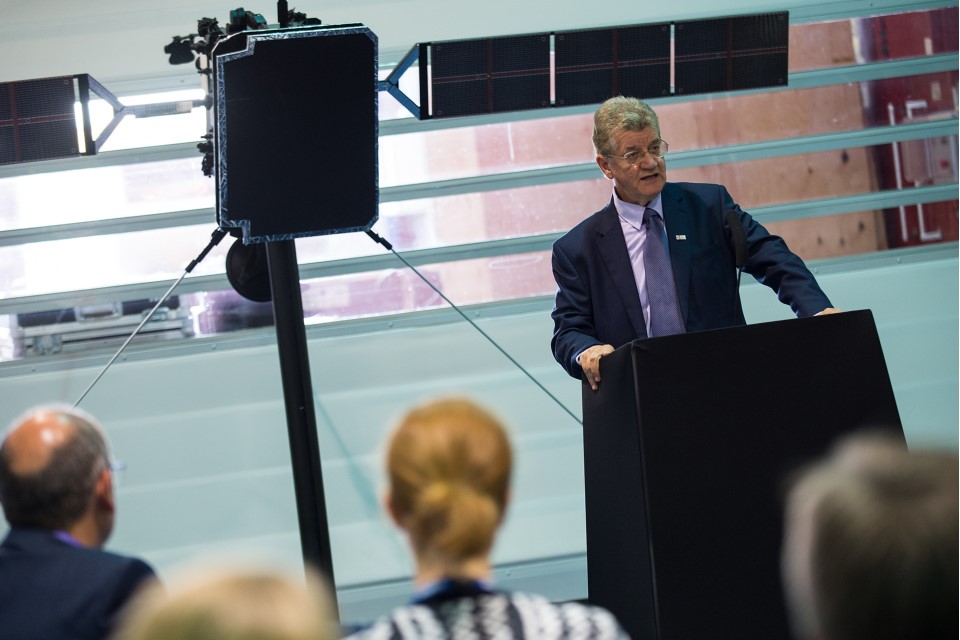
""
Chris Lee, Head of Science, UK Space Agency. Credit: Airbus/Max Alexander.

Engineers at Airbus have designed and built the spacecraft to withstand the scorching heat from the Sun that will hit one side, while the other is frozen as the orbit keeps it in shadow. The design is based on the BepiColombo mission which is due to launch next month and travel to the closest planet to the Sun, Mercury – another ESA mission with significant involvement from UK engineers and scientists.

The UK’s space sector is going from strength to strength, employing around 40,000 people and carrying our world-class science while growing the economy. In 2016 the UK committed €1.4 billion across a range of ESA space programmes, leading European space research in telecommunications and Earth Observation.

This is all supported by the Government’s Industrial Strategy, with major initiatives such as the National Satellite Test Facility at Harwell and the development of a commercial spaceport in Sutherland, Scotland, which could be the first in mainland Europe. The UK continues to be a leading member of ESA, which is independent of the EU.

UK companies have significant capabilities and expertise in satellite manufacturing. Yesterday (Sunday 16 September) a UK satellite called NovaSAR-1 which was built in Surrey by SSTL launched from India. SSTL already has 40% of the world’s small satellite export market, and this new satellite will offer low cost remote sensing capabilities and services to their global customers, with a recent deal agreed with Australia’s Commonwealth Scientific and Industrial Research Organisation (CSIRO) to provide Australia a 10% share of the satellite’s capabilities.