Abu Dhabi crown prince and chairman of Libyan presidential council discuss developments in Libya’s political process

Author: 
Sat, 2021-06-05 22:16

DUBAI: Abu Dhabi Crown Prince Sheikh Mohamed bin Zayed affirmed the UAE’s firm position toward supporting Libya and achieving the aspirations of its people toward stability, development and unity, state news agency WAM reported on Saturday.
His comments came during a meeting with the chairman of Libya’s Presidential Council Dr. Mohammed Younes Al-Manfi, who is on an official visit to the country.
At the beginning of the meeting, Sheikh Mohammed welcomed Al-Manfi and wished him success and the Government of National Unity in leading their country to safety. He conveyed greetings of Sheikh Khalifa bin Zayed, UAE president.
Both sides discussed developments in the political process in Libya and efforts to push it forward, as well as a number of issues of common concern, WAM reported.

The crown prince said his country was ready “to provide all aspects of support and cooperation to overcome existing challenges, and to continue working with regional and international parties to strengthen the pillars of peace and stability, in accordance with the aspirations of the Libyan people.”
Al-Manfi thanked the Sheikh Mohammed for the UAE’s positive stances in supporting Libya and its people in international forums.
He stressed the depth of relations between the UAE and Libya and looked forward to further strengthening and developing these relations during the coming period for the benefit of the two countries.
Libyan Foreign Minister Najla Mangoush and a number of Libyan officials also attended the meeting.
UAE Foreign Minister Abdullah bin Zayed also held talks with Mangoush during her visit, where they reviewed developments in Libya, the importance of supporting the Government of National Unity during its leadership of the transitional phase, and preparations for the upcoming elections scheduled for December.
Sheikh Abdullah said that the “UAE supports all efforts and endeavors that lead to a secure, stable and prosperous Libya and always stands by the Libyan people to achieve their aspirations for stability, development and prosperity.”

He praised the efforts made by the Government of National Unity during its leadership of the current stage and what it is doing to consolidate the pillars of security and stability in Libya and to create all the appropriate conditions for holding the elections.
Libya is seeking to extricate itself from a decade of chaos and conflict that followed the toppling of dictator Muammar Qaddafi in the 2011 NATO-backed uprising.
A formal truce signed last October set in motion a UN-led process that led to the creation of an interim government tasked with unifying the country’s divided institutions, launching reconstruction efforts and preparing for December polls.
Germany will host a new set of peace talks later this month in Berlin, with Libya’s transitional government due to attend.
(With AFP)

Abu Dhabi Crown Prince Sheikh Mohamed bin Zayed meets chairman of Libya’s Presidential Council Dr. Mohammed Younes Al-Manfi. (WAM)
UAE Foreign Minister Abdullah bin Zayed meets Libyan counterpart Najla Mangoush. (WAM)
Abu Dhabi Crown Prince Sheikh Mohamed bin Zayed meets chairman of Libya’s Presidential Council Dr. Mohammed Younes Al-Manfi. (WAM)
Main category: 

Morocco’s foreign minister meets senior Libyan officialsLibya’s PM welcomes opening of Spanish embassy in Tripoli


Turkish opposition party seeks probe into paramilitary contractor

Author: 
Sat, 2021-06-05 21:52

JEDDAH: Turkey’s main opposition Republican People’s Party (CHP) is seeking a parliamentary inquiry into a paramilitary contractor, following allegations it was training militants in Syria.

Fugitive mob boss Sedat Peker claimed that SADAT, which has close ties with the government and President Recep Tayyip Erdogan, was training Al-Nusra Front fighters and arming the group by diverting Peker’s aid convoy heading to Syrian Turkmen.

SADAT International Defense Consultancy was formed in 2012 by Adnan Tanriverdi, a retired general and former military adviser to Erdogan.

Its stated mission is to establish “defense collaboration and defense industry cooperation among Islamic countries to help the Islamic world by providing strategic consultancy, defense and security training, and supply services to armed forces and internal security forces of Islamic countries.”

It offers courses on conventional and unconventional warfare tactics, armored vehicle hunting, sharpshooting, mortar forward surveillance and other areas.

Unal Cevikoz, Istanbul deputy of the CHP and a former ambassador, filed a request for a parliamentary inquiry about SADAT.

He reiterated allegations that SADAT had violated UN Security Council rulings with its activities in war-torn countries, especially in Syria and Libya, by providing military training to civilians, establishing alternative armies, dispatching mercenaries and sending illegal weapons.

“These claims will deeply undermine our country’s international prestige and will result in challenging consequences for Turkey,” he said. “These allegations about SADAT concern countries where the Turkish Armed Forces remain active. Therefore, they carry risks for the reputation of not only Turkey but also its army. They will also push people to challenge the legitimacy of the Turkish Armed Forces’ presence in those territories.”

SADAT employs between 50 and 200 retired officers from different specialties, with many of them dismissed from the army due to their Islamic allegiance.

The CHP said the claims about SADAT should not only be viewed through a military and security dimension, but also their potential consequences for Turkey’s relations with countries that it has military agreements with.

The SADAT allegations have sparked debate about whether there is control over different armed units and if each segment has begun establishing its own paramilitary group in semi-official or informal ways.

Tanriverdi was a chief adviser to Erdogan between 2016 and 2018, attending a critical summit before the 2018 operation Afrin in Syria, along with Turkey’s National Intelligence Service head Hakan Fidan. He is also known as someone who carries weight in presidential policy choices.

“All previous parliamentary questions about SADAT remained unanswered,” Cevikoz said. “Therefore, it is now an obligation for all of us to set up an investigation commission about this company’s activities abroad.”

Neither the government nor the defense minister has so far responded to parliamentary questions from the opposition about the contractor, and no investigation has been launched into allegations about SADAT for years.

The CHP wants the public to be informed about SADAT and for all its international military activities be investigated, whether it provided military training in countries like Syria, Libya and Somalia, and whether it dispatched illegal weapons in violation of UN Security Council rulings.

In 2018, Turkish opposition politician Meral Aksener alleged that SADAT set up armed training camps in the Konya and Tokat provinces. But her request to open an investigation about these activities was met with silence.

SADAT was put on the domestic agenda following claims that its members contributed to the popular mobilization during the 2016 failed coup attempt, leading many people to label it a “shadow army.”

Peker has been a prominent mafia figure since the 1990s and fled the country last year to avoid a criminal investigation.

He has leveled accusations of corruption, mismanagement and connections to organized crime against Erdogan’s ruling Justice and Development Party (AKP).

He claimed to have arranged to send military equipment to Syrian Turkmen and shared the plan with an AKP lawmaker in order to receive permission to dispatch the trucks in 2015.

He also claimed to have opposed sending aid to Al-Nusra Front because the group was fighting Turkmen minorities in Syria. He said the trucks were diverted and sent to Al-Nusra fighters instead by a group within SADAT.

“They diverted aid trucks for Turkmen to Al-Nusra under my name, but I didn’t send them — SADAT did. I was informed about it by one of our Turkmen friends,” Peker said in a video.

Main category: 

Council of Europe meets to review Turkey’s non-implementation of key rulings Erdogan says Turkey discovered 135 bcm additional natural gas in Black Sea


Yemen official says Houthi militia fire missile, killing 14 in Marib

Sat, 2021-06-05 21:43

CAIRO: Yemen’s Houthi militia fired a ballistic missile Saturday on a government-held city, killing at least 14 people, including a 5-year-old girl, an official said.
The missile hit a gas station in the Rawdha neighborhood in Marib, according to Ali Al-Ghulisi, the Marib governor’s press secretary.
He said dozens of people were wounded in the attack.
There was no immediate comment from the Houthis.
The Iran-backed Houthi militia launched an offensive to capture oil and gas-rich Marib from the internationally recognized government in Yemen in February.
The offensive sparked regional and international condemnation, especially since Marib has served as a safe haven for thousands of internally displaced persons who have been fleeing the fighting since the start of the conflict in 20414.

The Iran-backed Houthi militia launched an offensive to capture Marib from the internationally recognized government in Yemen in February. (File/Reuters)
Main category: 

US envoy says Yemeni Houthi militia not trying to reach cease-fireFailure of UN talks with Yemen’s Houthi militia on Safer tanker ‘not surprising’ — information minister


Judiciary to simulate welding operation that preceded Beirut blast

Author: 
Sat, 2021-06-05 21:23

BEIRUT: Ten months have passed since the Beirut blast on Aug. 4 last year, and the Lebanese judiciary has still not established the cause of the massive explosion that killed 215 and injured 6,000.

Since then, the judiciary has arrested 19 people, including officers in the State and General Security departments, and has summoned dozens of people for questioning, including senior officials, such as caretaker Premier Hassan Diab, a former minister, two current lawmakers and the Director-General of State Security, Maj Gen. Tony Saliba.

Judge Tarek Bitar, who took over the case three months ago after his predecessor, Judge Fadi Sawan, was dismissed by the Lebanese court of cassation, told journalists recently that he has excluded the possibility that the explosion was caused by a “rocket attack.”

Bitar based his judgment on a report prepared by French forensic experts who did not find any remains of a missile in the port area.

Bitar said: “A missile attack is one of three possible theories; the second is that a welding mistake led to the fire that caused the explosion, and the third is that the fire was intentional.”

Bitar said he was 80 percent certain he could rule out the missile attack theory, and said that “work is continuing to determine which of the two remaining possibilities is the cause of the explosion.”

In his meeting with journalists, Judge Bitar appeared to be getting ready to announce the near completion of technical investigations and to move on to the summoning phase.

A judicial source told Arab News that “security and political officials, and even judges, will be summoned to be questioned in the coming weeks.”

Unlike his predecessor, Bitar will use judicial and constitutional means to prosecute officials who enjoy immunity.

On Dec. 10, Sawan summoned Diab and three former ministers over their negligence, but none of them showed up. Sawan had scheduled to question them as “defendants.”

On Feb. 18, Judge Sawan was dismissed from the case.

Judge Bitar has told journalists that he “might face some pressure in the coming weeks, but he will still say the truth” and that he will “submit his indictment to the judicial council before the end of the year, with physical evidence to prosecute those behind the explosion.”

More than 2,750 tons of ammonium nitrate, which had been stored in the port of Beirut since 2014 close to fireworks, exploded, destroying hundreds of houses and apartments and leaving a 40-meter-deep crater.

Bitar has focused in his investigation on discovering “the causes behind the explosion, those responsible for the ammonium shipment and its sources, and why it was kept in Beirut for seven years.”

Bitar, just like his predecessor, has stressed that “negligence” is one of the causes.

A simulation of the welding process that preceded the explosion is expected to take place in the next weeks, at the same place and with the same devices used to weld the gate of hangar 12.

The three welders who carried out this mission have been arrested, along with the owners of the company that is responsible for welding works at the port.

The judicial source also told Arab News that Bitar might summon judges who were aware of the dangers of the ammonium nitrate shipment in the port and did nothing about it.”

The families of the victims have staged protests in the port area on the fourth of every month since the explosion. This month, they threatened to storm the parliament if the defendants’ immunity was not waived.

Ibrahim Hteit, spokesperson for the families of the victims, said: “More than 300 days have passed since the massacre and officials have still not bothered even to present an apology, fearing to take any responsibility.”

He warned that the families “will not allow any company or investor to lay one stone or reconstruct the port until the truth comes out.”

Hteit and the families blamed the judiciary that, according to them, “obeys political orders.”

He said “waiving the immunity of lawmakers is crucial for the truth to come out, and parliamentary blocs are welcome to help us, if they want to. However, any bloc that abstains or refrains from voting in favor of this will be considered as a partner in crime and will become our enemy.”

“The families are preparing to stage several sit-ins outside the parliament,” he added.

Pictures of the blast victims are featured on the walls in the heart of Beirut and the road leading to the port. On Friday, a book titled “Alive Ashes” was published, containing a collection of testimonies by 203 families who lost loved ones in the explosion.


Main category: 

Lebanon receives French report regarding Beirut port blastFrench judges question fugitive former Nissan exec Carlos Ghosn in Beirut


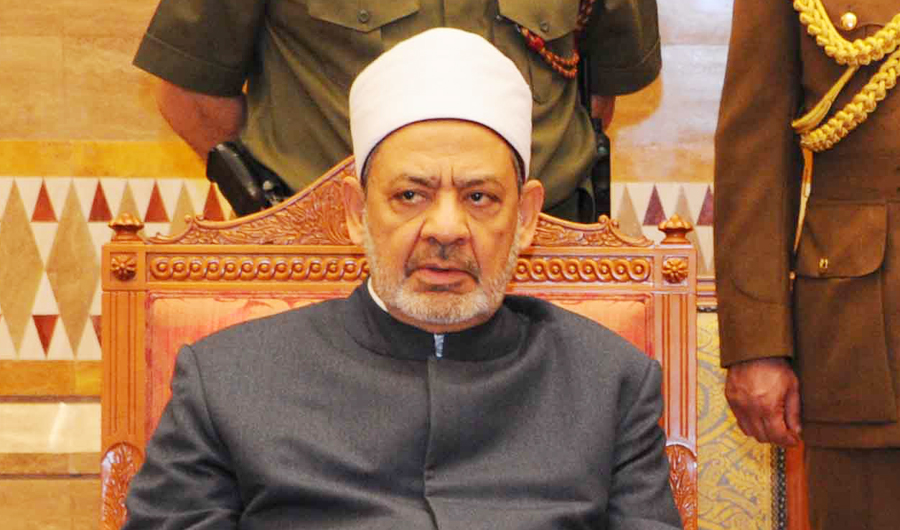
Grand Imam of Al-Azhar: Tampering with water rights is forbidden

Sat, 2021-06-05 21:17

CAIRO: The claim of ownership of some natural resources and disposing of them in a way that harms other countries is dangerous, according to Egypt’s Islamic scholar Ahmed Al-Tayeb, the Grand Imam of Al-Azhar.

During his virtual speech on Friday at the UN celebration of World Environment Day, Al-Tayeb said that religion is for those who believe in it and respect its laws, explicitly ruling that the ownership of people’s essential resources is public property.

It is not right under any circumstances, said Al-Tayeb, to consider these resources as the property of an individual, individuals or state that can use them or dispose of them without taking into consideration the states that rely on these public resources.

He said that water comes at the forefront of essential resources, and the laws of religions stipulate that its ownership should be collective and that it is forbidden that an individual, group or country usurp it without the consent of other.

This comes amid the dispute over the Grand Ethiopian Renaissance Dam (GERD) involving Egypt, Sudan and Ethiopia.

Ethiopia began work on the dam in 2011. Egypt fears the GERD will threaten its water supply from the Nile, while Sudan is concerned about the dam’s safety and its own water flow.

All negotiations between the three parties have failed to reach an agreement.

Main category: 

Egyptian minister hopes on-hold dam talks will resume soon Egypt denounces Ethiopian PM’s plan to build over 100 dams