How Iraq’s Al-Hashd Al-Shaabi turned into an Iranian foreign policy instrument

Sun, 2021-06-13 21:13

IRBIL, IRAQI KURDISTAN: It is seven years since their yellow flag first appeared in the campaign against Daesh, the extremist group which seized swathes of northern Iraq and eastern Syria in 2014. After Daesh captured large parts of northern Iraq, including Mosul, in 2014, the fighters of Al-Hashd Al-Shaabi, or Popular Mobilization Forces, won the admiration of many Iraqis for heeding Grand Ayatollah Ali Al-Sistani’s call to arms.

Since then, the umbrella organization of mainly Shiite militias has, however, adopted a more sinister cause. Last month, a convoy of Hashd fighters mounted a show of strength in Baghdad’s Green Zone, the center of Iraq’s political life, and forced the country’s elected leaders to release Qassim Musleh, a Hashd commander close to Iran who had been arrested in the western Anbar province.

Musleh has a reputation as a brutal operator. In late 2019, thousands of mainly young Iraqis took to the center of Baghdad to protest against systemic corruption and Iran’s influence over their country’s affairs.

After days of protests, snipers believed to be from Hashd units took to nearby rooftops and killed dozens of people. Musleh and his Iranian sponsors are thought to have been instrumental in ordering the killings. His recent arrest was in connection with the May 9 murder of Ihab Al-Wazni, a prominent activist in the southern shrine city of Karbala.

“Many Iraqi activists have been speaking out against Iran-backed militias’ ability to operate outside the boundaries of the law, and it makes sense that the militias would then seek to silence anyone working to constrain their positions of power,” Emily Hawthorne, Stratfor analyst for the Middle East and North Africa, told Arab News.

Kyle Orton, an independent Middle East researcher, believes Iranian-controlled militias in Iraq were behind the worst atrocities against anti-corruption protesters. “The Hashd is fairly clearly more powerful than the Iraqi security forces, both in its ability to control the social and street-level space, and the political sphere, with its control of key ministries and its effective veto-wielding bloc in parliament,” he told Arab News.

The Hashd was first formed in June 2014 to defend Iraq against Daesh after that group conquered Mosul.

In 2018, about 30 militias under the Al-Hashd-Al-Shaabi umbrella were formally included in — and paid by — the Iraqi security forces. It has a significant presence in the Iraq parliament through the Fateh coalition, which has more than 40 seats in the 329-seat assembly.

On the ground, Hashd units have repeatedly targeted Ain Al-Asad airbase in Anbar and even Erbil International Airport in Iraqi Kurdistan, both of which host US troops and personnel. The US embassy in Baghdad’s Green Zone has also been repeatedly targeted.
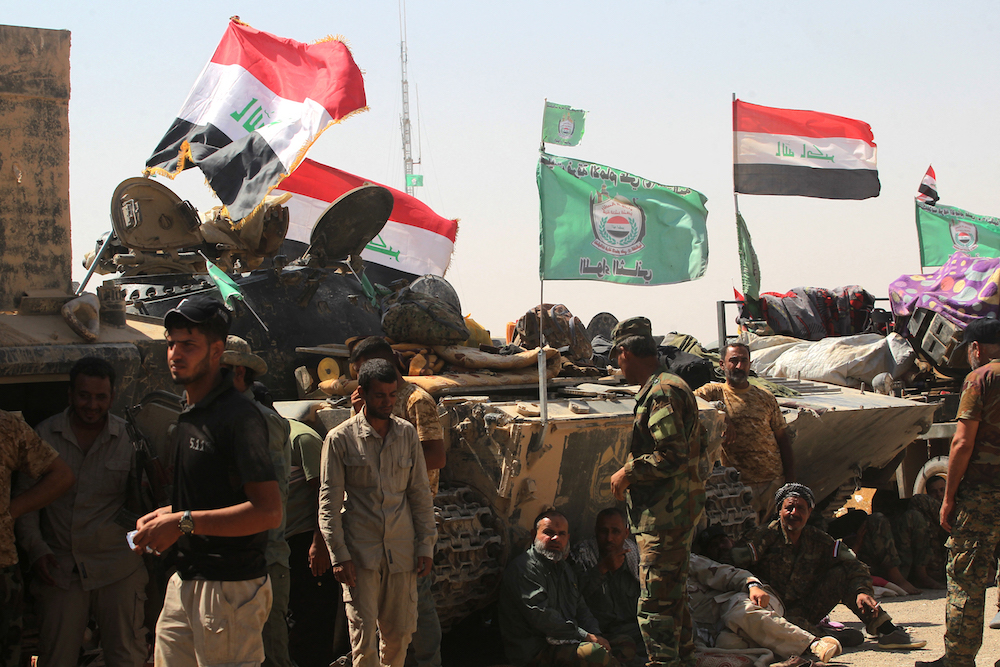

Al-Hashd Al-Shaabi fighters gather around the Tal Afar airport, west of Mosul, as they and Iraqi forces backed by local militia and a US-led coalition advanced in driving Daesh from the city in August 2017. (AFP/File)

While most of these attacks were with short-range rockets, the more recent ones have been carried out using explosive-laden attack drones, underscoring the evolving capabilities of such groups.

“The motivations for these operations are a confluence of issues,” Joel Wing, author of the “Musings on Iraq” blog, told Arab News. “Both the Hashd brigades and Iran want the US military out of Iraq. It would be a great victory for them if that happened.”

For Iran, proxy attacks by Iraqi militias are a way for it “to pressure the US over its (Iran’s) nuclear program and sanctions.”

The array of units under the Hashd umbrella is bewildering. There are militias loyal to Iraq’s Grand Ayatollah Ali Al-Sistani, widely viewed as a figure of moderation and an opponent of overseas interference in Iraq. There are even tribal defense units, the so-called Sunni Hashd.

These groups exist to make the organization seem more diverse and legitimate, both domestically and internationally. “The reality is this is a ‘popular front’ tactic. All these groups are dependent and subordinate to Iran’s Islamic Revolutionary Guard Corps (IRGC),” Orton said.

Behind an elaborate facade of names and acronyms, Iran is sponsoring an array of more effective commanders, according to the analysts. “The most powerful brigades within the Hashd are all pro-Iran,” Wing said, identifying them as the Badr Organization, Asaib Ahl Al-Haq and Kataib Hezbollah.
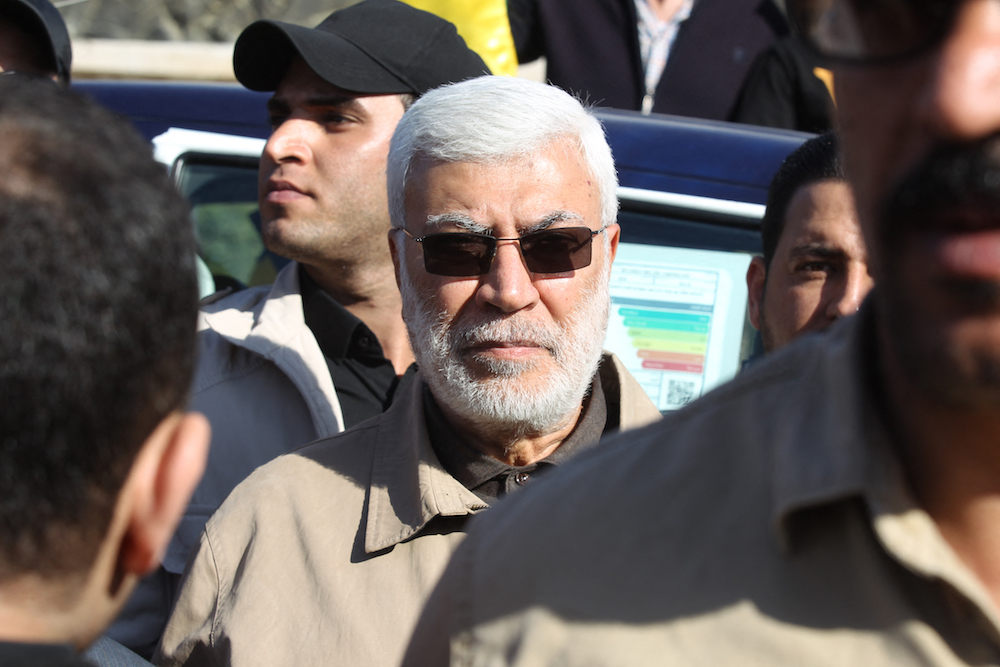

Abu Mahdi Al-Muhandis, head of the Kataib Hezbollah, was killed beside Iranian commander Qassem Soleimani at Baghdad’s international airport. (AFP/File)

Iranian policy in Iraq has, however, had its share of setbacks. In January 2020, the US killed Qassem Soleimani, the head of the Quds Force, the IRGC’s overseas arm, in a drone strike. Soleimani was the architect of Iranian policy in Iraq and elsewhere across the Middle East, from Lebanon to Syria and Yemen.

Tellingly, Abu Mahdi Al-Muhandis, head of the Kataib Hezbollah, was killed beside Soleimani as they were being driven from Baghdad’s international airport.

In May, Reuters reported that Iran had changed its strategy vis-a-vis its militia proxies. Instead of relying on the larger established groups, Tehran has started to form small elite groups that are more loyal and better trained to do its bidding in the region.

“This shift in strategy grants both Iran and established groups like Kataib Hezbollah plausible deniability whenever a smaller, likely linked group conducts an attack. It is indicative of a desire to protect the political position in Baghdad that a well-known group like Kataib Hezbollah enjoys,” Hawthorne, the Stratfor analyst, told Arab News.

Both Wing and Orton believe that the shift to smaller units masks a commitment to continued domination via plausible deniability. “Today, it’s unclear whether Iran is attempting to regain control of these factions or simply backing all the new front groups that Hashd brigades have created, to deny responsibility for attacks upon US targets in Iraq,” Wing said.

Soleimani’s death may well have caused Iran’s different power centers to experiment with divergent interests and objectives. The power centers range from the Quds Force, which organizes and trains Tehran’s proxy militias across the Middle East, to the Iranian foreign ministry.

“It has been reported that they don’t all agree on how to use their Iraqi allies,” Wing told Arab News. “The Hashd brigades were also competing with each other for a period to try to show which one was the leader of the resistance within Iraq, and the attacks were part of that.”

Orton sees Iran as adopting the same model in Iraq as it did in Lebanon in the 1980s, when it split Hezbollah from Amal, previously the dominant Shiite militia in the country. “The use of ‘new’ pseudo-groups or fronts, where they exist — some are entirely imaginary, existing solely online to claim recent attacks — is just the latest iteration of this effort to embed the Islamic Revolution in local conditions.”

That effort appears to be back on track following Soleimani’s killing. Hashd seems to be succeeding in spreading its control over broad areas of the northern Middle East. Musleh, the man at the center of the latest clashes between the militia and central government in Baghdad, is head of the Hashd in Anbar, traditionally a Sunni stronghold.

Hashd fighters have taken part in battles in neighboring Syria to help Iran prop up the Assad regime in Damascus. Hashd groups also proved instrumental in Iran’s ability to move weapons overland across Iraq into Syria.

Groups such as Kataib Hezbollah control important border points with Syria in both Anbar and Nineveh in northern Iraq, in addition to their own smuggling routes. “They are able to move men and material back and forth at will,” Wing told Arab News, referring to the paramilitary forces.

That said, Iran has been forced to change tactics in response to risks from the Israeli Air Force. Instead of shipping missiles through Iraq to its militia proxies in Syria, it has begun delivering smaller pieces of equipment along with advisers. These are much less detectable.

Given all that it has invested in these networks, the analysts are skeptical that Iran will relinquish control over them, even if it means a comprehensive nuclear deal with the US and Western powers that includes extensive sanctions relief for its economy.

“Iran will never ‘cut off’ any of the Iraqi militias, Hezbollah or the Houthis, because it cannot; they are integral, organic parts of the revolution,” Orton told Arab News.

“Any proposal in the nuclear negotiations for Iran to in some way trade its ‘proxies’ is a non-starter as such.”

Twitter: @pauliddon

Main category: 

Five rockets target Iraq base housing US contractors: security sourceAnger in Iraq as ‘assassin’ militia leader is released


Egypt welcomes Qatar invite

Author: 
Sun, 2021-06-13 21:11

CAIRO: Egypt’s Foreign Minister Sameh Shoukry said Qatar’s invitation to President Abdel Fattah El-Sisi to visit Doha is appreciated, and a diplomatic approach will be taken to set the appropriate timing for it.
“We have strong institutions that monitor and take the necessary measures to protect Egyptian interests,” Shoukry told the local Sada Al-Balad satellite channel.
He stressed that all topics related to Egypt’s security and stability, including the issue of the Muslim Brotherhood, are being addressed, and that Qatar’s response to Cairo’s demands will be evaluated.
“We are proceeding positively in removing the effects of the boycott between Egypt and Qatar, and we are also dealing with all the issues that concern us. Egypt is always striving for the best relationship with the Arab brothers,” Shoukry added.

Main category: 
Tags: 

Egypt signs 1.7 billion euros of financing deals with FranceQatar’s Al Jazeera network says it combated cyberattack


Drought-hit Jordan to build Red Sea desalination plant

Author: 
AFP
ID: 
1623588199969092300
Sun, 2021-06-13 12:39

AMMAN: Jordan said Sunday it plans to build a Red Sea desalination plant operating within five years, to provide the mostly-desert and drought-hit kingdom with critical drinking water.
The cost of the project is estimated at “around $1 billion,” ministry of water and irrigation spokesman Omar Salameh said, adding that the plant would be built in the Gulf of Aqaba, in southern Jordan.
The plant is expected to produce 250-300 million cubic meters of potable water per year, and should be ready for operation in 2025 or 2026, Salameh said.
“It will cover the need for drinking water (in Jordan) for the next two centuries,” he said, adding that the desalinated water would be piped from Aqaba on the Red Sea to the rest of the country.
Jordan is one of the world’s most water-deficient countries and experts say the country, home to 10 million people, is now in the grip of one of the most severe droughts in its history.
Thirteen international consortiums have put in bids, and the government will chose five of them by July, Salameh said.
Desalinating water is a major drain of energy, and the companies must suggest how to run the plant in Jordan, which does not have major oil reserves.
Last month Salameh said that Jordan needs about 1.3 billion cubic meters of water per year.
But the quantities available are around 850 to 900 million cubic meters, with the shortfall “due to low rainfall, global warming, population growth and successive refugee inflows,” he said.
This year, the reserves of key drinking water dams have reached critical levels, many now a third of their normal capacity.

Main category: 
Tags: 

How the Middle East can tackle the problem of water scarcityWhy water scarcity is a security risk for the Middle East


Jordan’s former royal court chief charged in Prince Hamzah sedition case

Sun, 2021-06-13 13:44

AMMAN: Jordan’s former royal court chief and another man will go on trial this week at the State Security Court (SSC) for their alleged roles in a plot to “destabilize the country.”

The country’s public prosecutor endorsed the charges against Sharif Hassan bin Zaid and Bassem Awadallah, the former royal court chief.

Both are accused of working with Prince Hamzah, the former crown prince.

In the indictment, a copy of which was seen by Arab News, Awadallah and bin Zaid are charged with “attempting to undermine the regime, and the country’s security and stability,” as well as “inciting sedition.”

On June 2, they were referred to the SSC, which looks into cases related to terrorism and state security. The court is expected to begin the trial next week.

Awadallah and bin Zaid were arrested on April 3 along with 15 other people suspected of involvement in the case, which also involved Prince Hamzah. Jordanian authorities said that Awadallah, bin Zaid and Prince Hamzah were attempting to destabilize Jordan in collaboration with “foreign entities.”

Prince Hamzah’s involvement was resolved within the framework of the Hashemite family upon directives from his half brother King Abdullah II. The Jordanian royal court published a letter signed by Prince Hamzah in which he vowed allegiance to King Abdullah and confirmed that he would act “always for His Majesty and his Crown Prince to help and support.”

The charge sheet into the sedition case said that there is enough evidence proving a “solid connection” between Prince Hamzah and the two suspects, Awadallah and bin Zaid.

It also said that bin Zaid recommended Awadallah to Prince Hamzah to help them gather external support in their plot to topple the regime and place Prince Hamzah on the throne.

The charges said that the three men regularly met at the home of Awadallah, who was reportedly “encouraging the prince to intensify his meetings with notables and tribal leaders.”

Prince Hamzah then moved to the so-called “open criticism stage,” and began attacking national institutions and accusing them of ineptitude, the indictment said.

The charges also claim that Prince Hamzah exploited a hospital tragedy to mobilize Jordanians and ignite public anger against the state.

Seven COVID-19 patients died in March in the New Salt Public Hospital, northwest of the capital Amman, when the hospital’s oxygen supply failed.

The incident triggered public anger, forcing Jordan’s health minister at the time, Nazir Obeidat, to step down.

The indictment contains a number of text messages that Awadallah, bin Zaid and Prince Hamzah sent to each other during March, days before the case became public.

On March 13, Awadallah sent a WhatsApp message to bin Zaid that said: “It is time for H.” On the same date, Prince Hamzah wrote to bin Zaid: “There is another person saying ‘go ahead.’” The latter wrote back: “This (medical tragedy) is considered the spark.”

Before nationwide rallies planned for March, 24, prosecutors said that bin Zaid sent a text message to Prince Hamzah warning: “From now on, there should not be only words, but there should be a leadership.”

Activists affiliated with the United Jordanian Movement, Hirak called for the nationwide rally to commemorate the 10th anniversary of massive opposition protests in 2011 organized by the Youth of March 24 movement.

Bin Zaid sent another message to Prince Hamzah urging him to “seize the opportunity, maybe not today or tomorrow, but I’m sure not in June, for example. God be on your side.”

In another text message to Prince Hamzah, bin Zaid said: “Things are coming my friend and, as the man (Awadallah) said again last day, the thing will occur sooner than you think.”

Main category: 

King Abdullah forms committee to oversee ‘qualitative leap’ in Jordan’s political systemJordan’s King Abdullah calls for dialogue for the nation’s interest


Two thirds of eligible people in Dubai fully vaccinated against COVID-19

Author: 
Reuters
ID: 
1623578982618377900
Sun, 2021-06-13 09:48

DUBAI: About two-thirds of people eligible for inoculation against COVID-19 have now received two doses of the vaccine in Dubai, the tourist and business hub of the United Arab Emirates, Dubai Health Authority (DHA) said.
Dubai is the most populous of the seven emirates that make up the UAE and has one of the world’s busiest airports.
For six months the UAE has been running one of the world’s fastest vaccination campaigns against COVID-19, initially using a vaccine developed by the China National Pharmaceutical Group (Sinopharm) and then adding the Pfizer/BioNTech and AstraZeneca shots and Russia’s Sputnik V.
DHA deputy director general Alawi Alsheikh Ali told Dubai Television late on Saturday that 83 percent of people aged over 16 — or about 2.3 million people — had now received at least one dose of a vaccine and that 64 percent had received two doses in the emirate.
The UAE recently said nearly 85 percent of its total eligible population had received at least one dose of a vaccine, without saying how many people had had both doses.
The UAE, which does not break down the number of cases by emirate, has seen a rise in the number of infections in the past month. It recorded 2,281 new cases on Saturday, bringing the total so far to around 596,000 cases. Daily cases peaked at almost 4,000 a day in early February.
DHA said 90 percent of the COVID-19 patients admitted to intensive care units in Dubai hospitals were unvaccinated, without specifying when that statistic was recorded.

Main category: 

UAE coronavirus cases continue to fallDubai extends COVID-19 precautionary measures to beginning of Ramadan