Syria’s humanitarian crisis raises a moral dilemma: To shun or engage with Assad regime

Author: 
David Romano
ID: 
1624993691634239900
Tue, 2021-06-29 22:07

MISSOURI, US: After more than 10 years of civil war, Syria remains a devastated country. An estimated 500,000 people have perished in the conflict, with the large majority victims of President Bashar Assad’s vicious operations to regain control of the country.

Some 12 million Syrians have become refugees or internally displaced persons after losing their homes.

At least 90 percent of the population now lives below the poverty line. Roughly one-third of Syria’s infrastructure lies in ruins. Aid organizations estimate that about 11 million Syrians are at present in need of humanitarian assistance, with famine looming as even bread and fuel supplies continue to dwindle.

Under such circumstances, the natural reflex might be to set aside objections regarding the Assad regime and move on to the difficult but very pressing work of helping people in Syria.

For all intents and purposes, Assad has won the war in any case, largely thanks to Russian and Iranian assistance. Keeping Syria isolated and sanctioned would only prolong the misery of a people that has suffered enough already, so the theory goes.

Allowing the Assad regime back into the international fold, however, poses serious moral and practical problems. Does the international community really want to “let bygones be bygones” with a ruler who has massacred hundreds of thousands of his own civilians?


Some 12 million Syrians have become refugees or internally displaced persons after losing their homes. (AFP)


Many cannot accept the moral stain that would come with forgiving a regime that used chemical weapons against its own people, intentionally targeted hospitals in airstrikes, and committed mass executions of political prisoners — among other things.

If Assad sees his crimes forgiven, the message to other authoritarian leaders dealing with political protests would seem clear: They can do as they will, and the world will soon forget their transgressions. Thankfully, leaving the Syrian people to their misery or rehabilitating the Assad regime are not the only two options available.

There remain ways to help Syrians while simultaneously keeping the regime isolated and shunned.

First of all, Assad currently only controls two-thirds of Syrian territory. Rebel-held Idlib province in the north holds on with Turkish backing, while Turkey also occupies Afrin and another swathe of territory in the northeast.

The Syrian Kurds control a large tract of territory in the northeast as well, which includes 90 percent of Syria’s oil wells and a good chunk of its agricultural land.
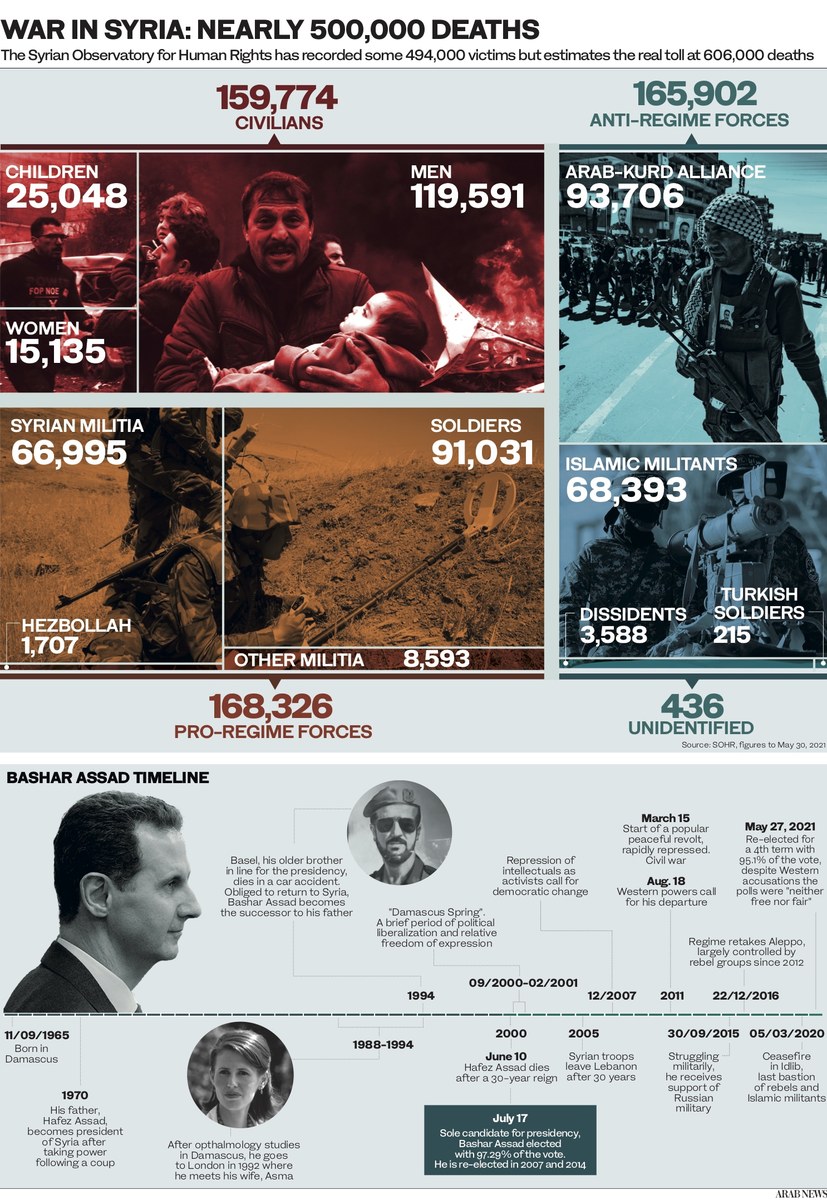
Keeping 90 percent of Syria’s oil revenues out of Assad’s hands can go a long way toward punishing his regime and empowering other Syrian actors, particularly given that oil revenues normally flow directly into government coffers (the rentier state model).

The people in these patches of territory should benefit from cross-border international assistance that does not have to pass through the Syrian capital Damascus. This requires continually renewing UN resolutions allowing for such aid, and Russia needs to be convinced not to veto such moves.

More than a million people in the rebel-controlled northwest risk being cut off if the UN Security Council does not renew authorization for cross-border aid delivery through the Bab Al-Hawa crossing at the Turkish border — the last remaining crossing for UN aid. A decision is expected in the next two weeks.

“Reaching all Syrians in need via the most direct routes is not a political choice; it is a humanitarian imperative,” David Miliband, chief executive of the International Rescue Committee, said recently. But if the past is any guide, Security Council action on Syria is not driven by what Miliband called the “stark humanitarian realities.”

In 2020, China and Assad regime-backer Russia vetoed resolutions that would have allowed two other crossing points — Bab Al-Salam and Al-Yaroubiya — to remain open. Now Russia has hinted it will block the renewal of the resolution on Bab Al-Hawa, insisting other aid routes via Damascus are available.

“It is shameful that political posturing at the Security Council is still impeding the international response to one of the worst humanitarian crises of our time,” Diana Semaan, Syria researcher at Amnesty International, said in a June 25 statement.

She added: “Years of hostilities and mass displacement have led to a humanitarian disaster in northwest Syria.”


At least 90 percent of the population now lives below the poverty line. (AFP)

Aid agencies are skeptical about the Syrian government’s ability to replace the Bab Al-Hawa aid corridor in view of its hand in last year’s fiasco in the Kurdish-controlled northeast.

In Jan. 2020, the Al-Yaroubiya crossing closed, ending UN delivery of aid across the border from Iraq. UN operations through the crossing were supposed to be replaced by deliveries from Damascus. However, the volume of aid reaching the area declined sharply due to the regime’s bureaucratic impediments and restrictions on access.

“The notion that the Syrian government can replace UN aid is absurd. Not only would it be impossible for the government to match the scale of support provided cross-border, the authorities are notorious for systematically blocking humanitarian access,” Semaan added.

Clearly, until the Assad regime changes or adopts the kind of reforms necessary to safeguard people under its rule, no one should rush to encourage a return of Syrian central government control over these areas.

The Kurdish-led enclaves in particular should be recognized as a more legitimate and authentic local political authority than the Assad regime. This can occur without calling into question the territorial integrity of the Syrian state.

There exists a myriad of historical and contemporary examples of such recognition, whether in the form of governments in exile or governments in control of only a portion of a state’s territory.

The Kurdish-led cantons have in fact proved much more liberal toward various religious and ethnic groups in their territory than the Assad regime, and more democratic as well. In the case of Turkish-backed Idlib province, a return to central government control would also precipitate yet another refugee crisis, with people fleeing the Assad regime’s vengeance.
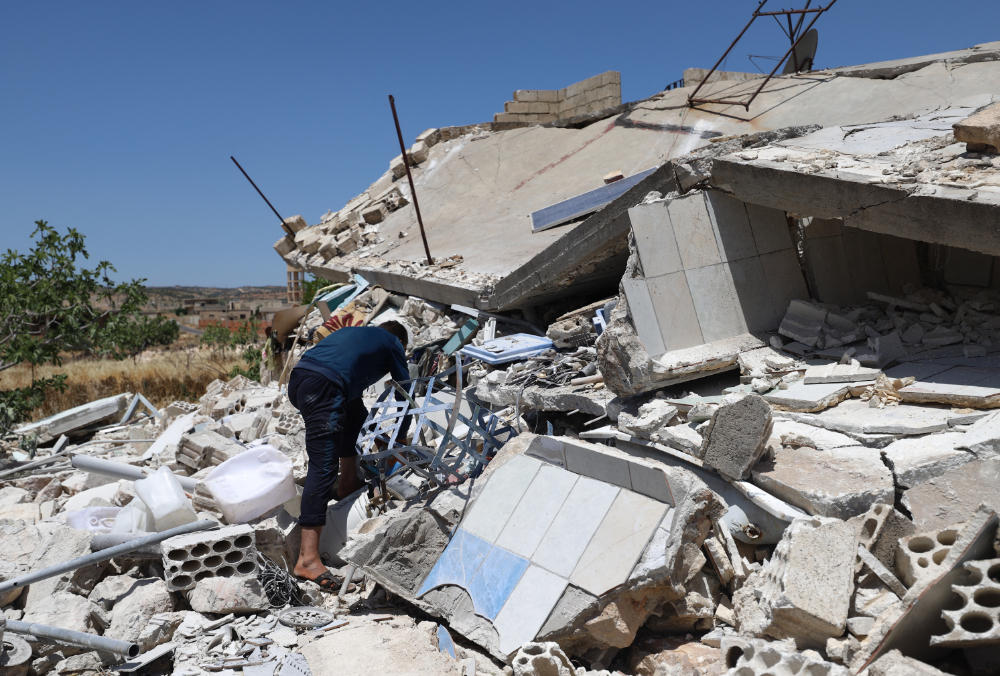

Roughly one-third of Syria’s infrastructure lies in ruins. (AFP)

For the Syrian population that remains under the writ of Assad, the international community needs to find ways to support their economic recovery without empowering or recognizing Assad’s regime.

This means avoiding broad and wide-ranging sanctions on Syria. While more narrow, targeted sanctions against the Assad regime and its officials can and should continue, the Syrian people as a whole need not fall within this sanction net.

A lot of basic infrastructure in Syria also needs rebuilding, of course, but such projects seem difficult to contemplate for an international community that does not wish to recognize or rehabilitate the Assad regime.

This task might therefore best be left to Assad’s Russia patrons, according to one school of opinion. Its logic goes something like this: It was Russian air power and Russian-supplied armaments that destroyed much of the infrastructure in any case, so let them be the ones to rebuild it.

On the diplomatic front, state-controlled media in Damascus recently hailed the resumption of Syrian relations with a number of Arab states and even a few Western ones — claiming that the thaw in relations came “after Syrian President Bashar Assad won a landslide re-election victory” in May.
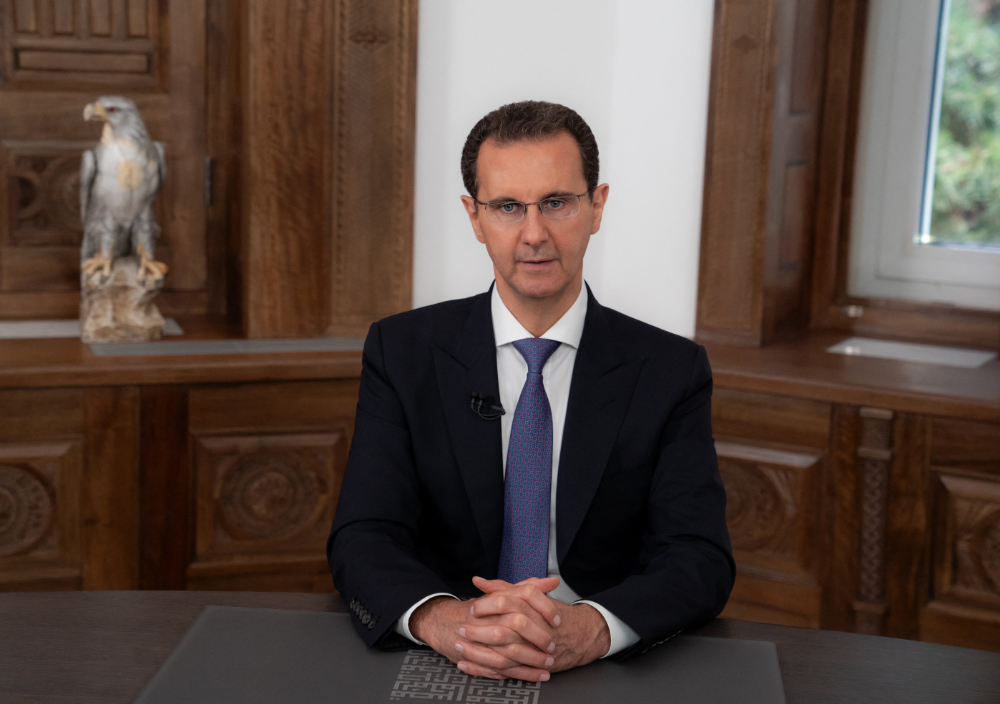

Allowing the Assad regime back into the international fold poses serious moral and practical problems. (AFP)

Leaving aside the dubious nature of Assad’s elections, the fact remains that channels of communication with Syria need to be reopened at some point.

A majority of Arab League states seem to now support some level of reconciliation with Assad’s Syria and Syria’s readmission to the organization. This seems necessary if only to coordinate humanitarian aid for the Syrian people.

Without some form of Arab constructive engagement in Syria, the future of the country could well be decided by the Middle East’s new powers: Iran, Russia, Turkey and Israel.

The way forward thus appears littered with the same kind of contradictions that bedeviled Syria throughout its civil war: A series of bad and worse options, none of which offer a very satisfactory resolution.

• David Romano is Thomas G. Strong Professor of Middle East Politics at Missouri State University

Main category: 

US troops in Syria attacked after airstrikes on militiasUN draft resolution calls for Syrian aid through 2 crossings


Houthis order assets of private bank in Yemen to be frozen

Tue, 2021-06-29 21:57

AL-MUKALLA: The Iran-backed Houthi militias on Monday ordered local financial institutions to freeze the funds and assets of a major private bank in Yemen, a day after members of the group stormed a mansion in Sanaa owned by a local businessman.

Citing a judicial order, the Houthi-controlled central bank in Sanaa told local banks and exchange firms to take the action against Tadhamon International Islamic Bank (TIIB), a commercial bank owned by Hayel Saeed Anam Group, a Yemeni family-owned conglomerate.

The Houthis did not give a reason for the court order but Yemeni officials and economists said that the group wants to bring the private sector under its control in the territories it rules, and collect tax revenues to fund its military activities.

In November last year, TIIB was forced to close its operations across Yemen following a raid by the Houthis on its headquarter in Sanaa. Employees were forced to leave the office and the bank’s cameras and servers were confiscated.

The Houthi central bank accused the business of being involved in illegal activities such as currency speculation and smuggling money abroad. The bank strongly denied the claims and reopened several days later, after the Houthis left its offices.

Waled Al-Attas, an assistant professor of financial and banking sciences at Hadramout University, told Arab News that the latest action taken by the Houthis will have little effect on the bank’s operations and the rebels are simply trying to put pressure on it to comply.

“There is no direct influence on the bank,” he said. “They meant to compel the bank to implement what the movement wants.”

If the Houthis were serious about closing the bank they would have confiscated the bank’s assets at the central bank in Sanaa and closed branches by force, Al-Attas added.

“The bank carried out operations smoothly today,” he said.

Quoting a source inside the Houthi central bank, local news site Yemen Future reported that the Houthis took the action against the bank after it refused to freeze an account of a convicted Yemeni individual.

On Sunday, local businessman Mohammed Yahiya Al-Haifi appealed to Abdul Malik Al-Houthi, leader of the Houthi movement, complaining that armed Houthis had stormed his mansion in Sanaa after accusing him of working with the Israelis and hosting a secret hiding place on behalf of the US embassy.

He accused Houthi leaders of seizing control of his mansion, freezing his bank accounts and pressuring him to relinquish his properties and businesses under the pretext that he had colluded with the US, Israel and the Arab coalition.

“They accused me of being an agent for America and Israel and working with the aggression against Yemen,” he said in his appeal.

Analysts said the targeting of Al-Haifi is part of a continuing Houthi crackdown on Yemeni businessmen and banks that refuse to cooperate with the movement’s efforts to fund its military activities across the country.

Since taking power in late 2014, the Houthis have confiscated the properties of hundreds of Yemeni politicians, journalists, human rights activists, and military and security officials in Sanaa.

An employee wearing a face mask and gloves counts local currency at a bank in the Yemeni capital Sanaa. (AFP file photo)
Main category: 
Tags: 

Yemen government and rebel fighters clash on Marib frontlineSaudi project clears 1,501 more mines in Yemen


Lebanese security forces on high alert as violent protests continue

Author: 
Zaynab Khojji
ID: 
1624993036444025400
Tue, 2021-06-29 22:02

BEIRUT: Lebanon’s Supreme Defense Council has asked the military and security services to stay on high alert to prevent attempts to destabilize the security situation amid the financial and political crises the country is facing.
The council, headed by President Michel Aoun, convened on Tuesday amid protests against the fuel shortage.
Promises to provide fuel after the partial lifting of subsidies have not reduced the public anger nor the never-ending queues at gas stations.
During the meeting, Aoun said that “what happened in front of the gas stations is unacceptable,” stressing that “humiliating citizens is unacceptable under any circumstances, and all concerned parties should work to prevent the recurrence of such scenes.”
Aoun objected to “roads being closed as they cause additional suffering to citizens.”
He said: “Everyone is entitled to their opinion, but it should not turn into chaos and riots, and the security authorities should not be lenient.”
The attempt to contain the chaos coincided with a comprehensive strike carried out by all banks in Lebanon on Tuesday to protest the attack on the headquarters of the Lebanese Swiss Bank on Hamra Street in Beirut.
The bank said that “about a hundred people occupied the bank’s general administration building on Monday and beat the employees, injuring three of them, as they used violence to force managers to make money transfers to Turkey.”
Since November 2019, banks have refrained from making transfers abroad in light of the financial crisis.
The bank’s administration said the attackers belonged to a charity called Baneen, which had demanded the courts approve the transfers, but the Judge of Urgent Matters dismissed the case.
The banks’ association condemned the attack and called on “the competent judicial and security agencies to pursue the perpetrators.”
Meanwhile, street protests continued on Tuesday as citizens blocked roads in different areas to express their anger over dire living conditions and the fuel shortage.
The rush to the gas stations that dared to operate amid the tense climate inspired several brawls.
Protesters destroyed a gas station in the Akkar region due to the owner’s reluctance to sell diesel and petrol, despite not running out, but was waiting to sell the fuel at higher prices.
Fadi Abu Shakra, a representative of the union of fuel distributors and gas stations in Lebanon, told Arab News: “A delegation from the union met the minister of interior in the caretaker government to discuss the security situation at gas stations in light of the many fights that are erupting.
“The minister asked gas station owners to refrain from filling gallons to prevent them from being stored in homes since this poses a danger to citizens, and to only sell small quantities for motorcycle owners to prevent them from selling fuel on the black market.”
Abu Shakra stressed that “fuel will be available to the Lebanese within a few days, as the remaining ships will be unloaded and the quantities delivered after the Banque du Liban began opening credits for ships anchored off the Lebanese coast.”
While covering the long queues in front of a gas station in Beirut’s southern suburbs, a foreign journalist was attacked and detained by Hezbollah on Monday.
In a statement, the Tahalof Watani publication condemned the attack on Matt Kynaston, a correspondent of the Beirut daily, NOW Lebanon, “who was only doing his job,” demanding the security and judicial agencies “pursue the aggressors and punish them as required by justice and to protect the freedom of media professionals, which is guaranteed by the Lebanese Constitution.”
In a similar vein, an investigation session with the anti-Hezbollah cleric, Ali Al-Amin, was postponed. A case was filed against him by Hezbollah supporters, who accused him of participating in a meeting in Bahrain that was allegedly attended by Israelis.
A sit-in was organized in front of the Palace of Justice in Beirut in solidarity with Al-Amin on Tuesday.
The protesters raised banners saying, “ideas are more powerful than your guns,” and “violent messages do not silence the voice of our freedom.”
Samy Gemayel, the head of Lebanon’s Kataeb Party, expressed his solidarity with Al-Amin “and support for his free and open mind in the face of oppression and close-minded people.”
He added: “We will not accept intimidation, and we will bring down the police state and the militias behind it.”

Main category: 
Tags: 

Lebanon says it thwarted drug shipment intended for Saudi ArabiaLebanon hikes fuel prices to shore up forex reserves


UN expert backs probe into Iran’s 1988 killings, Raisi’s role

Author: 
Reuters
ID: 
1624976385111847300
Tue, 2021-06-29 17:28

GENEVA: The UN investigator on human rights in Iran has called for an independent inquiry into allegations of state-ordered executions of thousands of political prisoners in 1988 and the role played by President-elect Ebrahim Raisi as Tehran deputy prosecutor.
Javaid Rehman, in an interview with Reuters on Monday, said that over the years his office has gathered testimonies and evidence. It was ready to share them if the United Nations Human Rights Council or other body sets up an impartial investigation.
He said he was concerned at reports that some “mass graves” are being destroyed as part of a continuing cover-up.
“I think it is time and it’s very important now that Mr. Raisi is the president (-elect) that we start investigating what happened in 1988 and the role of individuals,” Rehman said from London, where he teaches Islamic law and international law.
A probe was in the interest of Iran and could bring closure to families, he said, adding: “Otherwise we will have very serious concerns about this president and the role, the reported role, he has played historically in those executions.”
Raisi, a hard-line judge, is under US sanctions over a past that includes what the United States and activists say was his involvement as one of four judges who oversaw the 1988 killings. Amnesty International has put the number executed at some 5,000, saying in a 2018 report that “the real number could be higher.”
Raisi, when asked about allegations that he was involved in the killings, told reporters: “If a judge, a prosecutor has defended the security of the people, he should be praised … I am proud to have defended human rights in every position I have held so far.”
Rehman said: “We have made communications to the Islamic Republic of Iran because we have concerns that there is again a policy to actually destroy the graves or there may be some activity to destroy evidence of mass graves.”
“I will campaign for justice to be done,” he added.
Raisi succeeds Hassan Rouhani on Aug. 3, having secured victory this month in an election marked by voter apathy over economic hardships and political restrictions.
Rehman denounced what he called “deliberate and manipulative strategies adopted to exclude moderate candidates and to ensure the success of a particular candidate.”
“There were arrests, journalists were stopped from asking specific questions about the background of the presidential candidate Mr.Raisi and there was intimidation toward any issues that were raised about his previous role and background.”
Iran has never acknowledged that mass executions took place under Ayatollah Ruhollah Khomeini, the revolutionary leader who died in 1989.
“The scale of executions that we hear imply that it was a part of a policy that was being pursued…It was not just one person,” Rehman said.
He said there had also been “no proper investigation” into the killing of protesters in Nov. 2019, the bloodiest political unrest since the 1979 Islamic revolution.
“Even by conservative estimates we can say that more than 300 people were killed arbitrarily, extrajudicially, and nobody has been held accountable and no compensation,” he said.
“There is a widespread and systemic impunity in the country for gross violations of human rights, both historically in the past as well as in the present.”

Main category: 

Raisi’s hard-line stance ‘could spell trouble’Continuity of aggressive Iranian policies assured with Raisi’s election: Former senior CIA official Norman Roule


Police, Palestinians clash as Israel begins demolition in Jerusalem’s Silwan

Author: 
Reuters
ID: 
1624973177061555600
Tue, 2021-06-29 16:36

JERUSALEM: Israel demolished a Palestinian shop in the East Jerusalem neighborhood of Silwan on Tuesday, triggering scuffles between police and protesters who accused authorities of discriminatory enforcement of building permits in the holy city.
Palestinians seek East Jerusalem, which Israel captured in a 1967 war, for a future state. Israel deems all of Jerusalem its capital — a status not recognized internationally — and has encouraged Jewish settlement of predominantly Palestinian areas.
A bulldozer escorted by Israeli police flattened Harbi Rajabi’s butchers shop in the neighborhood which is overlooked by the Al-Aqsa Mosque, the third holiest shrine in Islam and the most sensitive site in the Israeli-Palestinian conflict.
The shop is one of at least eight properties that residents said were slated for demolition. The residents say many have been there for decades, even from before 1967. The authorities have earmarked the land for a park and say the shops and homes have been built illegally.
Mahmoud Basit who runs the butchers told Reuters 14 family members depended on income from there. “We have no other way to support our families,” said Basit, who added he would have to look for new work from scratch.
Deputy Jerusalem Mayor Arieh King said “around 20” buildings in Silwan — which Israel refers to by its Hebrew name Shiloach — had received demolition orders. Around another 60 buildings there were in violation of Israeli zoning laws, he told Reuters.
Palestinians in Silwan say it is near-impossible to get building permits. They see the demolitions as designed to drive them from Jerusalem. Disputing this, King said the municipality had approved hundreds of new Palestinian homes in Silwan.
Palestinian medics said 13 people were injured in Tuesday’s confrontations in Silwan. Police said two officers were hurt by stone-throwers and that three people were arrested for disorderly conduct and assault.
The municipality had given Palestinians until June 28 to dismantle the structures themselves. King said the land would be cleared to make way for the park and public buildings, adding that Silwan’s biblical links made it “an important historical site.”
Nader Abu Diab, who also received a demolition order, lives in fear of the knock on the door from municipal inspectors.
“My grandchildren ask me questions and I can’t answer them. They’re children. What can I tell them? That they’re going to demolish our home?” Abu Diab, 55, said.
His brother, Fakhri Abu Diab said he applied seven times for an Israeli permit to expand his home in Silwan “but it was always rejected”. He added that over a hundred Palestinians could become homeless if the current round of demolitions continues.
The future of another East Jerusalem neighborhood, Sheikh Jarrah, was one of the flashpoints at the heart of fighting between Israel and Palestinian militants last month.

Main category: 

Palestinian teen bears scar of eviction battle in East JerusalemJerusalem’s Sheikh Jarrah neighborhood eviction appeal delayed