Israeli PM backs down over Muslim holy site in Jerusalem
Author:
Tue, 2021-07-20 00:49
JEDDAH: Israel’s new prime minister backtracked on Monday after claiming that Jews were entitled to “freedom of worship” at Al-Haram Al-Sharif in Jerusalem, the third-holiest site in Islam.
In fact, the site is administered by Jordan through the Islamic Waqf, and Jews may visit but not pray. Naftali Bennett’s office made it clear on Monday that he now accepted the status quo had not changed.
There was outrage among Palestinians on Sunday when more than 1,600 Jewish extremists paraded through the site, and Israeli security forces fired rubber bullets and tear-gas grenades at Muslim worshippers in Al-Aqsa Mosque to clear their path.
The Jewish extremists were marking Tisha B’Av, a day of mourning and repentance to commemorate the destruction of two temples more than 2,000 years ago. Jews believe the hilltop compound is where the temples once stood, and refer to it as the Temple Mount, the holiest site in Judaism.
A Palestinian man argues with Israeli border guards in the flashpoint city of Hebron in the Israeli-occupied West Bank on June 18, 2021.(AFP / MOSAB SHAWER)
Under former Prime Minister Benjamin Netanyahu, Jewish extremists frequently breached the compound under police protection and provoked clashes with Muslim worshippers.
Political analyst and Arab News columnist Osama Al-Sharif said: “Even though Bennett has backed down for now the reality is that Israel will continue to disregard the status quo agreement and will allow Jewish groups to storm the site.
“At one point there will be a catastrophic incident that will result in another intifada or even a regional war. The world needs to put limits to Israeli violations before such a catastrophe occurs.”
Israeli soldiers attack Muslims as Jewish extremists break status quo at Al-AqsaAfter war with Israel, a grieving Gaza marks Eid Al-Adha holiday
US ‘always there for Jordan,’ Biden tells King Abdullah
Author:
Mon, 2021-07-19 23:43
JEDDAH: The US “will always be there for Jordan,” President Joe Biden told King Abdullah on Monday as the Jordanian monarch arrived in Washington for an official visit.
Biden called the king a “good, loyal, decent friend.”
“You’ve always been there, and we will always be there for Jordan,” he said.
Abdullah said his region has many challenges. “You can always count on me, my country and many of our colleagues in the region,” he told Biden.
White House press secretary Jen Psaki said talks between the king and the president would be “an opportunity to discuss the many challenges facing the Middle East and showcase Jordan’s leadership role in promoting peace and stability in the region.”
The two leaders are expected to discuss the conflict in Syria, from where more than 1 million refugees have fled to Jordan, and a difficult security situation in Iraq, a US administration official said. At least eight drone attacks and 17 rocket attacks have targeted the US military presence in Iraq since Biden took office in January.
King Abdullah and Egyptian President Abdel Fattah El-Sisi visited Baghdad in June for talks with Iraqi Prime Minister Mustafa Kadhimi. The Biden administration sees Jordan as a moderate voice in the region that can help “balance and counter” some of the more malign influence coming from Iran, the administration official said.
The Jordanian king had a difficult relationship with Biden’s predecessor, Donald Trump, who he saw as undercutting the prospect of peace between Israelis and Palestinians with his 2017 declaration of Jerusalem as Israel’s capital. Biden has no plans to reverse US recognition of Jerusalem as the capital.
King Abdullah is the first Arab leader to meet face-to-face with Biden. The president will host Kadhimi at the White House next week, and Biden has invited Israel’s new prime minister, Naftali Bennett, to visit later this summer.
King Abdullah is also set to have a working breakfast on Tuesday with Vice President Kamala Harris, and to meet Secretary of State Antony Blinken. Queen Rania and Crown Prince Hussein are expected to join King Abdullah for the White House visit.
Jordan sentences two sedition plotters to 15 years hard labor
Lebanese president says talks on new PM will begin next Monday
Mon, 2021-07-19 23:28
BEIRUT: Lebanon’s President Michel Aoun announced on Monday that parliamentary consultations to choose a new prime minister will begin on July 26.
Lebanon has been run by a caretaker government for nearly a year. Meanwhile the nation’s currency has collapsed, many people have lost their jobs and banks have frozen customers’ accounts in what has been described as one of the most severe financial crises the world has seen in modern times.
Saad Hariri, who was chosen as prime minister-designate nine months ago, resigned on Thursday after months of negotiations with Aoun failed to result in the formation of a new government. The previous administration, led by Prime Minister Hassan Diab, resigned amid public anger following the explosion at Beirut’s port on Aug. 4 last year.
Since then, the escalating financial collapse has fueled hunger, unrest and fuel shortages as the country struggles with its worst crisis since the civil war that began in 1975. The Central Bank’s foreign reserves are rapidly running out and the nation’s currency has lost most of its value since 2019, pushing more than half of the population into poverty amid soaring prices.
A delegation from the US Department of Treasury’s Terrorist Financing and Financial Crimes office arrived in Beirut on Monday. It will meet “with financial sector interlocutors and civil society groups to engage in discussing issues related to corruption, illicit finance and counterterrorism,” according to the US Embassy in Lebanon.
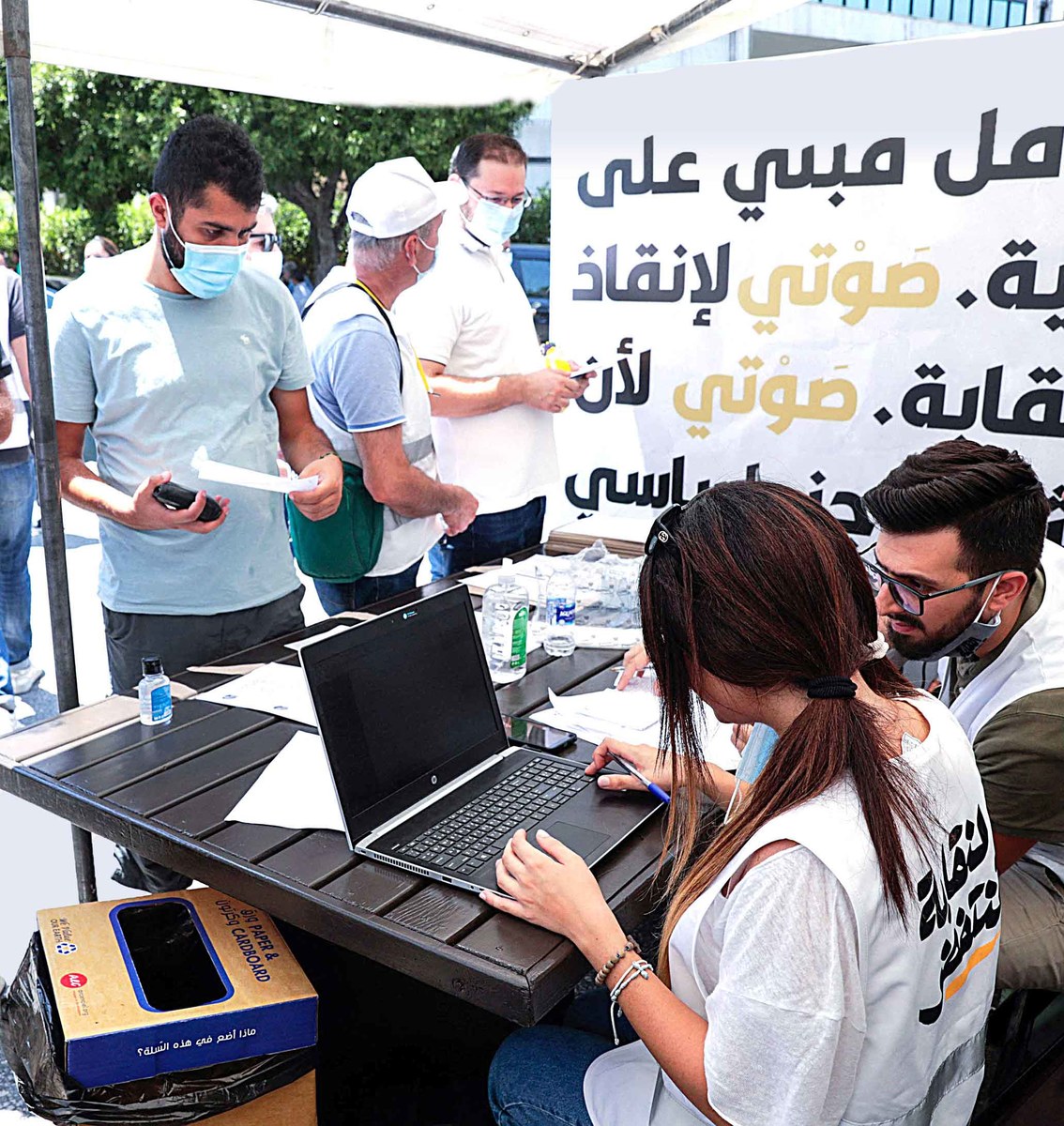
The results of the Syndicate of Engineers elections held in Beirut showed that voters are taking a new path. (File/AFP)
Dana Stroul, the US deputy assistant secretary of defense for the Middle East, warned on Saturday that “the inability of the Lebanese to put food on their tables could lead to violence.”
She also expressed concerns that “the failure to form a government and Hezbollah’s ongoing attempts, due to the support it receives from Iran, to challenge the Lebanese state” are “keeping Lebanon weak and not providing an alternative to the legitimate government.”
FASTFACT
Dana Stroul, US deputy assistant secretary of defense for Middle East, warned that ‘the inability of the Lebanese to put food on their tables could lead to violence.’
She added that “the Pentagon is closely monitoring the situation and encouraging Lebanon’s leaders to take prompt steps to prevent the outbreak of this type of violence.”
Meanwhile the results of Syndicate of Engineers elections in Beirut on Sunday suggested that voters are beginning to take matters into their own hands. The opposition Syndicate Revolts coalition, which formed during the Oct. 17, 2019 revolution, achieved a resounding victory over the ruling parties that is unprecedented in the history of syndicate elections in Lebanon.
Activist Ralph Germany, from the opposition Tahalof Watani (My Nation’s coalition), told Arab News: “The people, including engineers, are angry at the parties in power. Usually the educated class in any society is the one that holds its parties accountable; this is what civilized peoples do.
“Through their votes the engineers wanted to tell the parties in power that the people are not sheep.”
The opposition alliance won about two-thirds of the votes in what is being seen as a referendum on the extent to which the revolution groups are united in opposition to the ruling authority.
A total of 8,727 people voted in the poll out of more than 46,000 registered syndicate engineers, many of whom work outside of Lebanon. Aref Yassin of the Syndicate Revolts coalition won 5,798 votes to become head of the syndicate, succeeding Jad Thabet.
Yassin defeated the candidate backed by the Future Movement and Amal Movement, Bassem Al-Oueini, and the candidate backed by other ruling parties, Abdo Sukaria, by a margin of about four to one.
The ruling parties had tried to disrupt the election by spreading rumors designed to smear the opposition candidate and discourage voting.
“The parties in power fought dirty to stay in charge,” said Germany. “These parties were benefiting from the syndicate by making certain deals, especially since (the syndicate) has a say in urban planning, the fate of marine property, and granting licenses.
“When the ruling parties were in charge, every decision served their own interests.”
‘God help this country:’ Lebanon in limbo as PM-designate Hariri quitsDozens injured in Lebanon as protests turn violent amid rising tensions
Egypt vows firm stance on protecting Nile water security: President tells China
Mon, 2021-07-19 23:11
CAIRO: Egyptian President Abdel Fattah El-Sisi has told China that his country would maintain its firm stance on preserving its water security in the face of an ongoing dispute over a giant Nile dam project.
During talks with Chinese Foreign Minister Wang Yi, on Sunday, Abdel Fattah El-Sisi reiterated Egypt’s historical rights to the Nile waters and stressed the need to reach a binding legal agreement about the operation of the Grand Ethiopian Renaissance Dam (GERD) that worked in the interests of Egypt, Sudan, and Ethiopia.
Yi pointed out Beijing’s understanding of the importance of the Nile River to Egypt and its interest in helping to find a solution to the impasse.
An official spokesperson for the Egyptian presidency said Cairo was keen to strengthen its strategic partnership with China which had been established for 65 years.
The Chinese minister noted the acceptance of Egypt as a dialogue partner in the Shanghai Cooperation Organization, a Eurasian political, economic, and security alliance.
Since the start of the coronavirus disease (COVID-19) pandemic, relations between Egypt and China have been further cemented through the signing of a joint manufacturing agreement for the Sinovac vaccine in Egypt, and El-Sisi said he hoped the two countries could continue to work together in bolstering international efforts to tackle the global health crisis.
The president added that Egypt was keen to draw on Chinese expertise in supporting development programs and national infrastructure projects, including integration into the Belt and Road Initiative.
To mark this year’s 65th anniversary of the establishment of diplomatic relations between the two countries, Egypt and China inked an agreement to set up a governmental cooperation committee to advance bilateral cooperation in a range of fields.
The GERD project was among a number of regional and international issues discussed in talks chaired by Egyptian Foreign Minister Sameh Shoukry and Yi.
Shoukry said a mutually beneficial deal was needed on the dam scheme that preserved the Nile water security of downstream countries Egypt and Sudan, and he noted the importance of China’s position on the issue.
The two sides also talked in detail about ways to resolve the Palestinian crisis.
Battle for the Nile
How will Egypt be impacted by Ethiopia filling its GERD reservoir ?
EU ‘not satisfied’ with Ethiopian unilateral decisions on Nile dam: Egyptian ministerSecond filling of Ethiopia’s giant dam nearly complete – state media
Iraq market bomb kills at least 35 on eve of Eid holiday
Mon, 2021-07-19 19:46
BAGHDAD: An explosion ripped through a busy market in the Iraqi capital Monday killing at least 35 people, according to medical sources, in an apparent suicide bombing ahead of Eid holiday celebrations.
In one of the worst attacks in Baghdad in recent years, body parts of victims lay scattered across the previously bustling market, that had been crowded with shoppers buying food ahead of the Islamic festival of Eid Al-Adha, according to an AFP photographer.
Some 60 people were also wounded in the blast, medics said.
Iraqi President Barham Salih called the bombing in the densely populated majority-Shiite suburb of Sadr City a “heinous crime,” and offered his condolences.
“They are targeting our civilians in Sadr City on the eve of Eid,” Salih said in a message on Twitter. “They do not allow people to rejoice, even for a moment.”
Eight women and seven children were among the dead, according to a medical sources, who said the toll lay between 28 and 30 killed.
There was no immediate claim of responsibility, but two security sources told AFP it was caused by a suicide bomber wearing an explosive belt.
Iraqis light candles for the victims of the blast in Sadr City, Baghdad. (AFP)
Video footage shared on social media after the blast showed bloodied victims and people screaming in terror. The blast was so strong it ripped the roofs off some market stalls.
“A terror attack using a locally-made IED (improvised explosive device) in Woheilat Market in Sadr City, in east Baghdad, left several victims dead and others injured,” Iraq’s interior ministry said in a statement.
Refrigerators full of water bottles were drenched with blood, and shoes were strewn on the ground alongside fruit, AFP journalists said.
“It’s a sad Eid night in Iraq,” the International Committee of the Red Cross said. “Our deepest sympathies and sincere condolences to those who lost their loved ones.”
Baghdad Operations Command, a joint military and interior ministry security body, said it had launched an investigation into the blast, and police and forensic teams late Monday were searching through the smoking wreckage for clues.
In January, the Daesh group claimed responsibility for a rare twin suicide bombing that killed 32 people — also at a crowded market in Baghdad.
That blast was the city’s deadliest attack in three years.
Such violence was commonplace in Baghdad during the sectarian bloodletting that followed the US-led invasion of 2003, and later on as Daesh swept across much of Iraq and also targeted the capital.
But after years of deadly violence, militant attacks have become relatively rare in the capital Baghdad.
The attack sparked a furious response from Iraqis on social media.
“Terrorism and the government’s failure keep on stealing our lives,” tweeted Alaa Sattar, a youth activist. “The authorities have nothing but condolences to dole out and empty investigative committees.”
Another Twitter user wrote “every Eid, there’s a tragedy in Baghdad. It’s impossible to celebrate like the rest of humanity.”
Iraq declared Daesh defeated at the end of 2017 after a fierce three-year campaign.
Yet the group’s sleeper cells have continued to operate in desert and mountain areas, typically targeting security forces or state infrastructure with low casualty attacks.
The US-led coalition that had been supporting Iraq’s campaign against Daesh has significantly drawn down its troop levels over the past year, citing the increased capabilities of Iraqi forces.
The United States, which provides the bulk of the force, has 2,500 troops left in Iraq — down from 5,200 a year ago.
They are mainly in charge of training, providing drone surveillance and carrying out air strikes while Iraqi security forces handle security in urban areas.
Sadr City, where Monday’s bomb blast took place, is named after revered Shiite cleric Mohammed Al-Sadr.
His son, Moqtada Sadr — a firebrand cleric with millions of followers and in command of paramilitary groups — is a crucial player in Iraqi politics who has often protested against the influence of both the United States and Iran.
The boycott by Sadr of upcoming elections slated for October is a blow to Prime Minister Mustafa Al-Kadhemi, who had called the early vote in response to demands by pro-democracy activists.