Syria shot 7 of 8 Israeli missiles, Russian military says
Thu, 2021-07-22 00:54
MOSCOW: Syria’s air defense forces shot down seven out of eight missiles launched by Israeli warplanes during a raid that targeted the Syrian province of Aleppo, the Russian military said.
Rear Adm. Vadim Kulit, the head of the Russian military’s Reconciliation Center in Syria, said that four Israeli F-16 fighter jets targeted facilities southeast of Aleppo in Monday’s strike.
Kulit said seven of eight missiles launched by the Israeli fighter jets were downed by Syrian air defense units that used Russia-supplied air defense systems Pantsyr-S and Buk-M2.
One missile damaged the building of a scientific research center in Safira, he said. A Syrian military official previously said in remarks carried by the state news agency SANA that Israel carried out an aerial attack in the Aleppo province late on Monday.
He said that Syrian air defenses shot down most of the missiles in the attack that occurred just before midnight.
FASTFACT
The Britain-based Syrian Observatory for Human Rights, a war monitor that has activists on the ground in Syria, said the Israeli airstrikes targeted weapons depots that belong to Iranian-backed militia operating in Aleppo’s Safira region.
The Britain-based Syrian Observatory for Human Rights, a war monitor that has activists on the ground in Syria, said the Israeli strikes targeted weapons depots that belong to Iranian-backed militia operating in Aleppo’s Safira region.
The group said the strikes were followed by loud explosions. The weapons depots were located inside Syrian military posts, the group said.
Israel has launched hundreds of strikes against Iran-linked military targets in Syria over the years but rarely acknowledges or discusses such operations.
Israel fears Iranian entrenchment on its northern frontier, and it has repeatedly struck Iran-linked facilities and weapons convoys destined for Hezbollah.
Russia has waged a military campaign in Syria since 2015, helping President Bashar Assad’s regime reclaim control over most of the country after a devastating civil war.
Moscow also has helped modernize Syria’s military arsenals and train its personnel.
Israeli-led mission sails to Sudan for major Red Sea coral studyKosovo repatriates citizens from Syria camps
Three shot dead in riots as Iran regime runs out of water
Thu, 2021-07-22 00:26
JEDDAH: At least three people have been shot dead, one of them a police officer, in a week of rioting and protests over water shortages in the southwestern Iranian province of Khuzestan.
The police officer was killed in the port city of Mahshahr during what county governor Fereydoun Bandari described as “riots.”
In Izeh, local governor Hassan Nobovati said a “young person” was shot dead by “rioters” and 14 police officers were injured. Authorities in the town of Shadegan said a protester had been shot dead by “opportunists and rioters.”
“The people of Khuzestan are staging nightly protests, protests that have been festering for years,” the reformist newspaper Arman-e Melli said
Videos posted online have shown protests in Ahvaz, Hamidiyeh, Izeh, Mahshahr, Shadegan and Susangerd, with security forces violently dispersing protesters.
The videos show hundreds of people marching, chanting anti-regime slogans, while surrounded by riot police. In some, there is the sound of gunfire.
The reformist Etemad newspaper said the hashtag “I am thirsty” in Arabic was trending on social media to draw attention to Khuzestan’s plight. Khuzestan is home to a large Sunni Arab minority, which has frequently complained of marginalisation.
In 2019, the province was a hotspot of anti-government protests that also shook other areas of Iran.
“There were signs of protests and unrest in the province a long time ago, but the officials, like always, waited until the last minute to address them,” Etemad said.
The regime in Tehran sent a delegation of deputy ministers to Khuzestan last week address the water shortage. On Wednesday, state TV showed a long line of water trucks it said were from the Islamic Revolutionary Guard Corps, a day after army trucks did the same.
Over the years, blistering summer heatwaves and seasonal sandstorms have dried up Khuzestan’s once fertile plains. Scientists say climate change amplifies droughts.
President Hassan Rouhani said this month that Iran was going through an “unprecedented” drought, with average rainfall down 52 percent compared to the previous year.
This month, rolling blackouts began in the Tehran and several other large cities, in part over what authorities describe as a severe drought and surging demand for power. Rainfall has decreased by almost 50 percent in the past year, leaving hydroelectric power generation dams with dwindling water supplies.
Water worries in the past have sent angry demonstrators on to the streets in Iran. “As nearly 5 million Iranians in Khuzestan are lacking access to clean drinking water, Iran is failing to respect, protect, and fulfill the right to water, which is inextricably linked to the right to the highest attainable standard of health,” the group Human Rights Activists in Iran said.
Iran says police officer killed in unrest amid water protestIran orders week-long shutdown in Tehran amid fifth COVID wave
UN Security Council condemns ‘cowardly terrorist attack’ in Baghdad
Author:
Wed, 2021-07-21 23:21
NEW YORK: The members of the UN Security Council condemned “in the strongest terms the cowardly terrorist attack” on a busy market in Baghdad on Monday.
The blast, the deadliest in the Iraqi capital over the past six months, took place in Al-Wuhailat market as families prepared for Eid Al-Adha. It left more than 30 people dead and dozens injured.
According to multiple reports, Daesh claimed responsibility for the suicide attack as women and children were among the dead and wounded.
Offering their “deepest sympathy and condolences” to the victims’ families and the Iraqi government, council members underscored the need to hold “perpetrators, organizers, financiers, and sponsors of these reprehensible acts of terrorism accountable and bring them to justice.”
They urged all UN member states to cooperate with the Iraqi authorities during their investigation as it is in line with their obligations under international law and security council resolutions.
In a statement issued on Wednesday, the 15-member body reiterated that any acts of terrorismare “criminal and unjustifiable, regardless of their motivation, wherever, whenever and by whomsoever committed.”
Emphasizing that terrorism constitutes one of the most serious threats to international peace and security, council members reminded nations that combating terrorism is an obligation under the UN Charter, international law, international human rights law, international refugee law, and international humanitarian law.
The council reiterated its support for the “independence, sovereignty, unity, territorial integrity, democratic process and prosperity of Iraq.” It vowed to continue the fight against terrorism, including against Daesh.
Pope Francis ‘deeply saddened’ over Baghdad explosionFamilies lay to rest loved ones after deadly Baghdad blast
Report: Lebanon could turn into ‘Venezuela of the Mediterranean’
Wed, 2021-07-21 22:30
BEIRUT: The cost of food in Lebanon has skyrocketed 700 percent over the past two years, and more importantly, the increase has picked up pace in recent weeks, according to a Crisis Observatory report released on Wednesday.
The Crisis Observatory is an interdisciplinary research program launched by the American University of Beirut (AUB) to track the repercussions of the economic crisis in Lebanon.
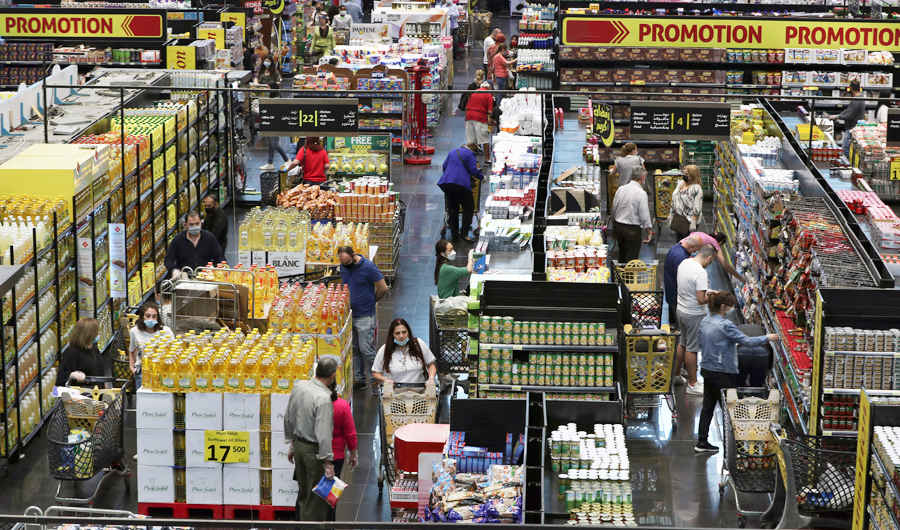
The report reflected the current state of the country as malls and shops, usually bustling with Eid Al-Adha celebrations, were empty and stagnant this week as much of Lebanon’s middle class can no longer afford to go shopping due to the dramatic increase in prices.
All of this is amid the country’s inability to form a government as Lebanon is teetering on the edge of social and economic collapse.
While the AUB Crisis Observatory report revealed staggering financial shortcomings, it also concluded that Lebanon could turn into the “Venezuela of the Mediterranean” and it predicted a majority of the Lebanese people would struggle to secure their minimum needs without the help of relief institutions.
The report said the exponential and weekly increase of basic food prices is an indicator that the country is “slipping into hyperinflation.”
The price of a basic food basket increased by more than 50 percent in less than a month, Crisis Observatory at the American University of Beirut said. (AFP)
The price of a basic food basket increased by more than 50 percent in less than a month, it said, while clothing has become somewhat of a luxury. Families complained about their inability to buy new clothes for their children on Eid Al-Adha because, as one mother put it, the pants she used to buy at 30,000 pounds are now sold for 400,000 pounds.
FASTFACT
The American University of Beirut Crisis Observatory report concluded that Lebanon could turn into the ‘Venezuela of the Mediterranean’ and it predicted a majority of the Lebanese people would struggle to secure their minimum needs without the help of relief institutions.
“We were expecting to see more customers on Eid Al-Adha, but people’s purchasing power has plummeted,” Therese, owner of a bar in Beirut, said.
“Lebanese expatriates who came to summer in Lebanon have helped revive the tourism a little bit, but we are afraid of what will happen once they leave.”
The report, accessed by Arab News, said the price of basic food items “have dramatically increased in the first half of July,” according to the price lists of Lebanon’s economy ministry and the price courses conducted regularly by the observatory’s researchers.
According to the observatory, “the prices for basic food items, including vegetables, grains, dairy products, beef, eggs, and oil, have soared by more than 700 percent since July 2019, before the financial and economic collapse.”
The price of local bread, which is supposed to be subsidized with a wheat and flour import at the official exchange rate, has increased by 233 percent since May 2020, the report said.
Based on food prices in the first half of July, a family of five was spending more than 3.5 million pounds on food per month. That figure does not take into account the additional costs for water, electricity or cooking gas.
“According to these prices, a family’s budget just for food is around five times the minimum wage, which stands at 675,000 pounds,” the report said. “That was once worth almost $450, but today barely fetches $30 on the black market.”
The observatory linked the inflation of food prices to the devaluation of the Lebanese pound against the US dollar, where the Lebanese currency has lost more than 90 percent of its value in the past two years. According to the report, the inflation “is expected to continue with the projected additional decline in the Lebanese pound’s value in the coming months.”
The fate of Lebanon remains unknown amid the collapse of state institutions.
The country’s politicians have failed to form a government, almost a year after the resignation of Hassan Diab’s government in the aftermath of the catastrophic Beirut blast on Aug. 4, 2020, which killed 211 people and injured more than 6,000.
Nine months after he was designated as prime minister, Saad Hariri announced his inability to form a government on July 15 and stepped down. He failed to reach an agreement with Lebanon President Michel Aoun over a second lineup that Hariri had presented to him.
The parliamentary consultations, aimed at designating a new Sunni figure to form a government, are set to take place on Monday. All of this despite a Sunni resentment against the Lebanese president and his political party’s way of dealing with the prime minister’s constitutional powers.
Imams and khatibs heavily criticized Lebanese politicians in their Eid khutbahs. Some of them even mentioned Aoun by name in an attempt to hold all politicians responsible for the poverty, shortages, and struggles that Lebanon has been grappling with for months.
Hezbollah’s Iranian weapons undermine Lebanon, US national security: Joe BidenIsraeli shells southern Lebanon, escalating military tension
German woman caught Covid in Iran jail, daughter says
Author:
AFP
ID:
1626895205196505200
Wed, 2021-07-21 22:24
BERLIN: The daughter of a German-Iranian woman held in Iran said Wednesday that her mother has contracted Covid-19 in prison and her life is in “imminent danger.”
Nahid Taghavi was arrested at her Tehran apartment in October after years fighting for human rights in Iran, in particular for women’s rights and freedom of expression, according to the human rights group IGFM.
According to Taghavi’s daughter, Mariam Claren, the 66-year-old architect is being held in Tehran’s notorious Evin prison, where she is awaiting sentencing on a “security charge.”
“At the beginning of this month, a Covid-19 outbreak started in the women’s wing” of the prison and “authorities have not implemented the required hygiene measures,” Claren said in a statement.
Taghavi has tested positive for the virus and her condition is “very bad,” Claren said.
“She is suffering from a fever, chills and severe pain in her limbs,” she said, noting that her mother suffers from pre-existing conditions including high blood pressure and diabetes.
“For someone at her age with pre-existing health conditions and now testing positive for Covid-19, her life is in imminent danger,” she said, calling for her mother’s immediate release.
Germany’s foreign ministry said in October that it was aware of the arrest of a German-Iranian woman in Iran, but did not name the detained citizen.
Iran is rushing to contain a new record surge in Covid cases, with government offices, banks and many businesses shut in the capital Tehran on Tuesday.
Already hit by the deadliest outbreak in the Middle East, the Islamic republic has been gripped by what authorities warned would be a “fifth wave” driven by the aggressive Delta variant.