Beirut blast survivors lose hope as Lebanon lurches from one crisis to another

Sat, 2021-08-07 23:02

DUBAI: A year has passed since an explosion devastated Beirut and the lives of its inhabitants. More than 200 people died and tens of thousands were left homeless when a huge cache of improperly stored ammonium nitrate ignited inside a warehouse at the Port of Beirut, triggering a blast from which the shockwave was felt as far away as Cyprus.

The disaster befell a population already reeling from months of hardship following the collapse of Lebanon’s banking system, multiple waves of COVID-19 outbreaks, and a government too paralyzed by infighting to respond.

Baydzig Kalaydjian, a Lebanese-Armenian teacher and journalist, was in Cyprus when the blast occurred. She quickly returned to Beirut and now volunteers at DAFA, a campaign group that provides food parcels, clothes, and helps renovate homes. 

“That day, as Lebanese, we were brutally killed,” said Kalaydjian, one of whose friends lost both eyes during the explosion. “No matter how much time passes, we still carry with us the need for truth, justice and accountability. What else can we do? We continue to fight for justice and demand for real change in the Lebanese political system.”

Indeed, to mark the first anniversary of the August 4 blast and to reaffirm their demand for justice, thousands of Lebanese spilled onto the streets of the capital, calling for the removal of the caretaker government.

In scenes reminiscent of the 2019 social movement known as the “thawra” — or “revolution” in Arabic — protesters once again clashed with security forces in downtown Beirut.

Survivors look back on the past year with a mixture of bewilderment, anguish, anger and even guilt. Marwa Darazi, 25, left Beirut and moved to Dubai in January 2021, where she works in public relations. The guilt of leaving her country behind weighs heavily on her conscience. “It doesn’t get any easier,” she told Arab News on the anniversary of the blast.

“August 4 changed the definition of what I thought life was. I was 24 and on the right career path. I had just rented my first apartment overlooking the port, I had my car, my freedom, my family, and my friends were around. I felt stable.

“Even though I knew my country wasn’t safe, the idea of it being my home automatically made me feel safe. But, in just seconds, it betrayed me.”

Darazi, who was seriously injured in the blast, was working for a luxury PR company in Beirut. But after the disaster, she began volunteering for Beb w Shebbek, a local charity launched by Beirut residents Mariana Wehbe and Nancy Gabriel to help rebuild people’s lives.

“I gave everything to Beirut,” Darazi said. “Every flight back I cry as if it is the first time I am leaving. There’s also the guilt of living here (in Dubai) while my parents are suffering without electricity in the heat, with rotting food in the fridge.

“Food is super-expensive now given the devaluation of the currency. Nothing seems right, no matter what I do or where I am. All I can do is sleep another night and pray the windows don’t explode. Is this normal?”
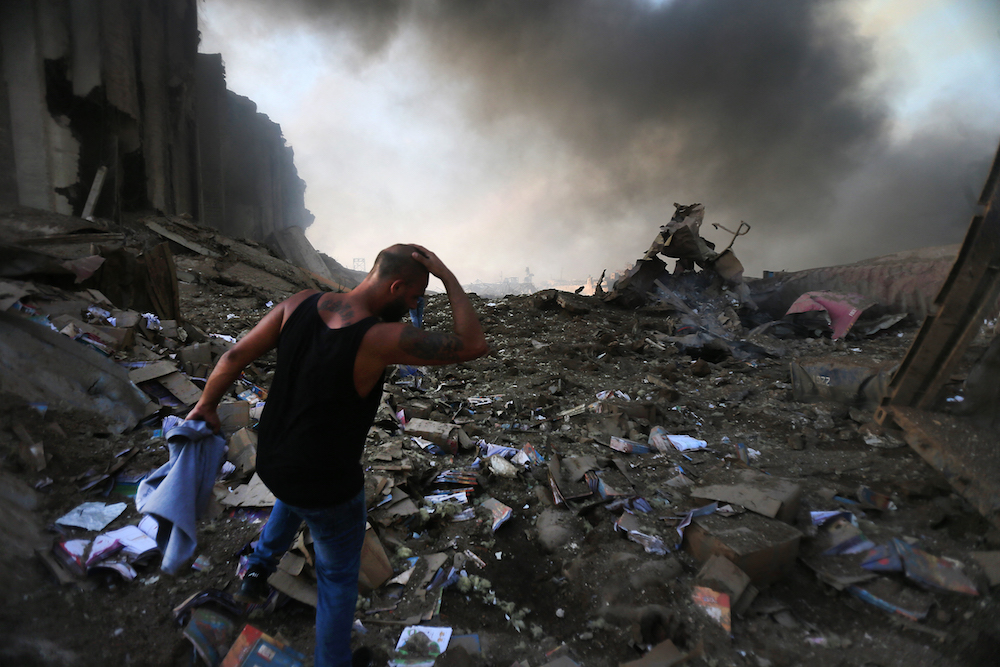

One year later, no politicians held to account and the country facing soaring poverty, a plummeting currency, angry protests and shortages of basic items from medicine to fuel, many blast survivors are simmering in the lead up to the tragedy’s first anniversary.  (AFP/File Photo)

Annie Vartivarian, a Lebanese-Armenian gallerist and art collector, lost her daughter Gaïa Fodoulian, 29, in the blast. Vartivarian chose to stay in Beirut and continue her daughter’s work by launching AD Leb, an online platform for art and design that Fodoulian had been working on at the time she died.

Vartivarian held its first big exhibition in Beirut in April titled “Everyone is the creator of one’s own faith” — a reference to a Facebook post her daughter had published just hours before she was killed.

“After one year, I am not surprised we haven’t got anywhere,” Vartivarian told Arab News. “As a person who was born and raised in Lebanon, and lived through the whole civil war here, I know how the country operates, how things are done and how officials hide themselves.

“But this doesn’t mean I don’t have hope that things will change, especially with what Judge Tarek Bitar is doing.”

Bitar, the head of the Beirut Criminal Court, was appointed to lead the investigation into the blast in February 2021 following the removal of Judge Fadi Sawan. In early July, Bitar announced that he intended to question senior politicians and security chiefs and has requested their immunity be lifted. So far, officials have rejected his appeals.

Amnesty International, the international human rights-advocacy group, has accused Lebanese authorities of “shamelessly obstructing victims’ quest for truth and justice” in the months since the blast, actively shielding officials from scrutiny and hampering the course of the investigation.


Gaia Foudalian, the daughter of Annie Vartivarian, killed in the blast. (Supplied)

“I know that, whatever we do, Gaia will not come back,” said Vartivarian. “As a mother who wants her children to be happy, I just hope she is happy now wherever she is. But I think she will rest when there is justice for what happened, when the reality is known.”

Other survivors have chosen to leave Beirut behind. Walid Alami, a cardiologist at Beirut’s Clemenceau Medical Center, has decided to emigrate to the US. He recalls the carnage of that night one year ago.

“Within 10 seconds, the degree of destruction and the loss of life was something we hadn’t experienced even during the civil war or the Israeli invasions,” Alami told Arab News. “I was taking care of minor cuts, but my brother Ramzi, who is a surgeon, was also working throughout the night and the days and weeks that followed.”

Ramzi recently relocated to Washington D.C. “He is among thousands of doctors who have left,” said Alami. “Personally, I am working on moving back to the US because it is hard to live in Lebanon right now under these circumstances, not to mention our financial issues. Our salaries are now a tenth of what they used to be.”

He added: “It’s a dire situation and I don’t see a glimmer of hope. It will take a long time to work our way up from this deep, deep hole that we are in.”

Artist, curator and publisher Abed Al-Kadiri moved from Beirut to Paris in January 2021, but returned to Beirut to join commemorations of the anniversary.

“I wanted to be with my friends, colleagues and survivors,” he told Arab News. “We haven’t had the time or the circumstances to consciously face what happened and what we lost. I left. I was traumatized and broken. I haven’t been able to work much since leaving. I have been trying to heal. But it was really important for me to come back.”

Sarah Copland got a posting to Beirut to work in the Center for Women at the UN Economic and Social Commission for Western Asia (ESCWA) with a focus on gender equality and women’s rights.

She was just weeks away from leaving Lebanon to return to her native Australia to give birth to her second child when the explosion happened. It killed her son, Isaac, who was just two years old.
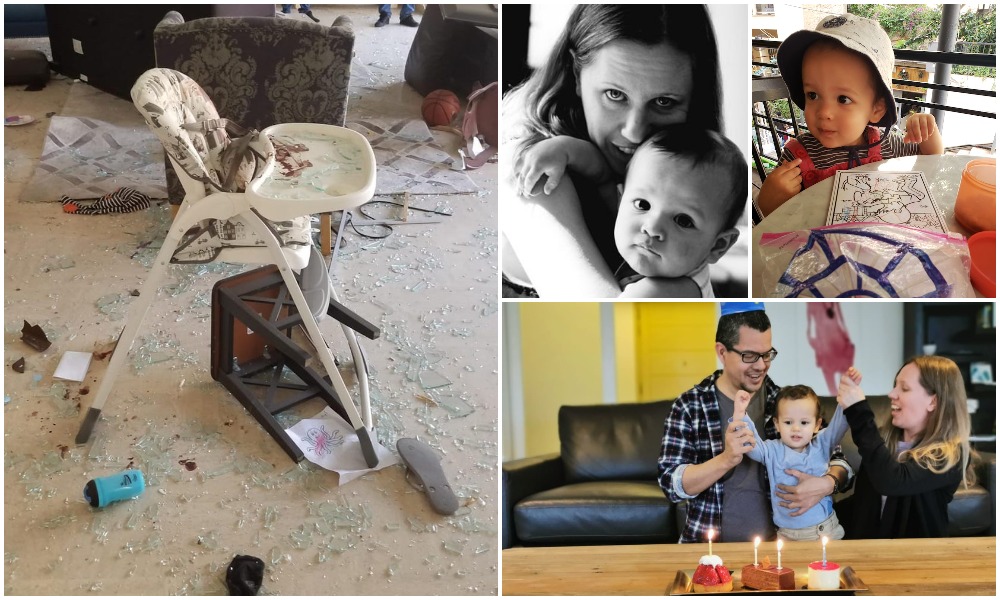

The explosion killed the son of Sara Copeland, Isaac, who was just two years old. (Supplied)

“Isaac was struck in the chest by a piece of glass,” Copland told Arab News. “We rushed him to Rafik Hariri Hospital. I was also injured and had a lot of glass embedded in me, including in my face. Being heavily pregnant, they took me away to see to my injuries. My husband stayed with Isaac, but he died a few hours later.”

Copland is still with the UN but currently on leave in Australia. She does not plan to return to Beirut, as much as she loves Lebanon and the Lebanese.

“We don’t plan to go back to Lebanon. I don’t know how most Lebanese experience the trauma of seeing the remnants of the explosion every day. It just adds to so much trauma and I don’t think we can inflict that on ourselves.

“Lebanon has quickly declined since the explosion. It was already on the way, but now everything has gotten worse so much faster.”

——————–

Twitter: @rebeccaaproctor

Images of victims of the Beirut blast displayed near the port. (Supplied)
Main category: 

Why the trauma does not end for Beirut blast survivors


Egypt denies halting Dabaa nuclear plant project

Author: 
Zaynab Khojji
ID: 
1628361106703709500
Sat, 2021-08-07 21:31

CAIRO: The Ministry of Electricity and Renewable Energy has denied that the construction of the Dabaa nuclear plant project in Egypt will be suspended.
The ministry confirmed that the construction of the plant — which is expected to be commissioned in 2026 — will continue without interruption. It added that it is one of the country’s most important projects, combining the latest technologies with the highest safety levels.
The ministry said all licensing documents required from the Nuclear Power Plants Authority have been handed over to the Nuclear and Radiological Regulatory Authority to obtain a construction permit for the first and second units of the plant, to ensure the safe and reliable operation of the nuclear facilities in the future.
The ministry said the long-term equipment manufacturing operations for the first Egyptian nuclear power plant in Russia were launched during a visit headed by the minister of electricity and renewable energy to the “Tiagmash” plant, located in the Russian city of Syzran.
The Nuclear Power Plants Authority obtained a site acceptance permit from the Nuclear and Radiological Regulatory Authority on March 10, 2019. 
The permit affirms that the site complies with the standards of the International Atomic Energy Agency.
The Nuclear Power Plants Authority is currently constructing infrastructure facilities, residential neighborhoods for Egyptian and foreign workers, and the marine berth.
The site’s preparatory work is also being completed with the construction of the base, buildings and structures for excavation work.

Main category: 

Egypt’s Ahmed Elgendy wins silver in Olympic Modern PentathlonFeryal Abdelaziz wins glorious gold for Egypt in Tokyo women’s karate


Iran nuclear talks could resume in September: EU official

Author: 
Christian SPILLMANN | AFP
ID: 
1628354256522599600
Sat, 2021-08-07 16:32

BRUSSELS: Iran is ready to resume talks reviving the nuclear deal with world powers under new president Ebrahim Raisi, and meetings could take place in Vienna from early September, an EU official said on Saturday.
The senior official, speaking on condition of anonymity, said the EU’s negotiator on the file, Enrique Mora, attended Raisi’s swearing-in in Tehran last Thursday and spoke with the Iranian official designated to take charge of the nuclear talks, Hossein Amir-Abdollahian.
Amir-Abdollahian “is supposed to be the new foreign minister” in Raisi’s cabinet, but that has not yet been announced, the EU official said.
He added that it was unclear whether the nuclear talks would remain under the responsibility of the Iranian foreign ministry or be taken over by another body, such as Iran’s National Security Council.
Raisi is a hard-liner expected to consolidate the ultraconservatives’ power during his four-year term.
He succeeds the relatively moderate Hassan Rouhani whose landmark achievement during his own two-term presidency was the 2015 nuclear agreement between Iran and six world powers: the five permanent members of the UN Security Council plus Germany.
Former US president Donald Trump pulled out of the deal in 2018 and re-imposed sanctions that have choked Iran’s oil-dependent economy. Iran responded by walking back measures it had agreed to abide by.
Talks have been happening since April in Vienna to find a way to bring both sides back into full compliance.
The last round took place on June 20 with no date set for when they would continue. The EU chairs the meetings.
The United States has said it is “an urgent priority” to get Iran back to the table.
But tensions have risen, notably with an attack by drones last week on an Israeli-linked tanker off Oman that killed a Briton and a Romanian on board.
The G7 — the United States, Britain, Canada, France, Germany, Italy and Japan — blamed the attack on Iran. Tehran denies the accusation.
Iran’s decisions to increase uranium enrichment and restrict UN inspectors’ access to some nuclear facilities have unsettled the West.
“The EU would like Iran to freeze the nuclear activities,” the EU official said, but admitted Russia and China did not back its language on that position.
He added that Mora’s meeting with Amir-Abdollahian was “very useful,” even though many issues remain unclear.
The Iranians said they want to get back to Vienna “as soon as possible, not just for talks but to achieve an agreement — they want a success,” the EU official said.
He added that the Iranians had not mentioned any changes to their position in the talks, and Mora had informed the United States of the substance of his talks with Amir-Abdollahian.
“If there is no agreement, the situation for Iran will be much worse,” the EU official predicted. “We will work on the assumption we will get an agreement.”

Main category: 

Iran rejects G7 and US allegations over drone attack on shipUS urges Raisi to resume Iran nuclear talks in Vienna ‘soon’


Jordanian troops kill smuggler at Syrian border

Author: 
Associated Press
ID: 
1628344253958817100
Sat, 2021-08-07 13:47

RAMALLAH: The Jordanian military on Saturday said it thwarted an attempt to smuggle drugs and weapons into the country from neighboring Syria, killing one smuggler and wounding several others.
The military said in a statement it seized a “large quantity” of narcotics as well as ammunition and a communications device, and that the smugglers fled back to Syria. It said the incident occurred at dawn in Eastern Jordan and gave no further details.
On Wednesday, Petra News Agency reported that the Jordanian authorities thwarted an attempt to smuggle half a million pills from Syria into Jordan.
Jordan is a close Western ally and has long been seen as an island of stability in a turbulent region. The kingdom hosts more than 650,000 Syrian refugees.

Main category: 

Jordan’s king thanks Saudi Arabia for its supportLebanon seizes 5m captagon pills at Beirut port


‘Knowledgeable’ UN envoy gains international support to end Yemen war 

Sat, 2021-08-07 15:59

ALEXANDRIA: Acclaimed as an experienced diplomat who has handled conflicts in the Middle East for two decades, the UN special envoy for Yemen Hans Grundberg has received support from regional and international countries along with Yemeni factions to end the war in Yemen. 

On Friday, UN Secretary-General Antonio Guterres named the Swedish diplomat Grundberg as his special envoy for Yemen, succeeding Martin Griffiths, a Briton. 

The UN chief said the new envoy would draw on more than 20 years of experience in international affairs to help resolve the war in Yemen. He cited his role in helping Yemenis broker the Stockholm Agreement that defused fighting in the western province of Hodeidah in late 2018. 

Shortly after the announcement, the Yemeni government, Saudi Arabia, the US and other countries congratulated the new envoy and expressed support for his mission to end the war in Yemen. 

Saudi Foreign Minister Prince Faisal bin Farhan said the Kingdom would stand by the new UN envoy and backed all peace efforts to end the war. 

“We wish him success in his new role and look forward to working with him. The Kingdom will continue to support all efforts to reach a political solution that helps bring peace and prosperity to Yemen,” Prince Faisal said on Twitter. 

The internationally recognized government of Yemen also expressed support for the new UN envoy and repeated demands for resuming the peace process and reaching a political settlement that would end the Houthi takeover of power. 

“The Yemeni government will continue to extend its hand to a just and sustainable peace based on the three references agreed upon nationally, regionally and internationally,” Yemen’s Foreign Ministry said in a statement carried by the official news agency SABA. It praised the new envoy as a “knowledgeable diplomat about the Yemeni crisis.”

US Secretary of State Antony Blinken said there was great international support for addressing the humanitarian crisis and ending the Yemen conflict. 

“There is unprecedented consensus on resolving the conflict and a real opportunity for peace. Only a durable agreement among Yemenis can reverse the dire humanitarian crisis,” Blinken said in a statement. 

Swedish Foreign Minister Ann Linde said the new envoy was an “excellent” diplomat and her country backed UN diplomatic efforts to end the suffering of the Yemeni people. 

“Sweden looks forward to continuing our close collaboration with the UN in support of a durable cease-fire and a political solution to the conflict in Yemen,” she tweeted. 

Peace efforts to reach a peaceful settlement in Yemen, sponsored by the Griffiths, failed as Iran-backed Houthis refused to put into place a nationwide truce and stop their deadly offensive on the central city of Marib. 

The Omani foreign ministry, whose mediators visited Sanaa in June and failed to convince the Houthis to accept the UN peace initiative, hoped that the new envoy’s expertise on Yemen would help to push for peace, stating that the sultanate would back his mission to solve the Yemeni crisis “as soon as possible.”

Since the start of the Houthi offensive in February, the former UN envoy pushed for a truce for all battlefields in exchange for opening Sanaa airport and easing restrictions on ports under Houthi control, followed by peace talks between warring factions in Yemen. 

The rebels demanded that the Arab coalition first stop its air support to the Yemeni government to accept the proposal. 

On Saturday, Hussein Al-Azzi, a Houthi official, welcomed the appointment of the UN envoy and urged him to solve the humanitarian crisis and to create “a supportive atmosphere for constructive and fruitful talks.” 

During the past seven years, Houthis have boycotted two UN envoys to Yemen and accused them of being biased. 

Other Yemeni key factions such as the separatist Southern Transitional Council (STC) and the National Resistance have also promised to comply with UN peace efforts to end the war.

Yemen experts and political analysts argue that the Houthi reluctance to end their military operations across Yemen might impede the UN envoy’s efforts to end the war. 

“The biggest challenge facing the new envoy is convincing the Houthis to accept a cease-fire. All other parties, including the legitimate government, have accepted the peace initiative,” Najeeb Ghallab, undersecretary at Yemen’s Information Ministry and a political analyst, told Arab News. 

Another challenge is dealing with powerful forces that have emerged during the war, such as the STC, which calls for partitioning Yemen into two states.

Main category: 

Yemen central bank injects old riyal bills worth billions into market to challenge Houthi banUN chief names Swedish diplomat as new Yemen envoy