Lebanon raids discover hoarded fuel, medicine and baby formula

Author: 
Najia Houssari
ID: 
1629922054661097600
Wed, 2021-08-25 23:06

BEIRUT: Raids carried out by Lebanon security forces discovered millions of liters of subsidized fuel hidden in underground tanks to be sold later on the black market at new prices. Some of the tanks were merely covered by sand.

“Monopolized” medicine and baby formula were seized, too.

News of the hoarding has only added to the anger of Lebanese citizens, who have been suffering through exhausting fuel and medicine shortages for months. Long queues outside gas stations and empty shelves at pharmacies are common across the country.

The largest quantities of hidden subsidized fuel were found in Hawsh Al-Omara in Zahle, Bekaa, where more than 1.5 million liters of gasoline were seized.

Scenes of Caretaker Health Minister Hamad Hassan raiding depots in the south of Lebanon and the Shouf area that contained medicine missing from pharmacies have also left citizens fuming.

The depots contained medicine that could treat patients with coronavirus (COVID-19), blood pressure, and respiratory problems. Antibiotics and thousands of infant formulas — all subsidized at the official rate ($1=1,500 LBP) — were also discovered.

“The raids are based on an electronic tracking system of ‘monopolized’ medicine,” Hassan said. “The system is very precise and accurate.”

The raid operation revealed a partnership between Hussein Fneish, brother of Hezbollah minister Mohammed Fneish, and Issam Ahmed Khalifa, of the NewPharm Company in Lebanon.

However, the timing of Hassan’s raids were criticized. Lebanon’s Central Bank has not opened credit lines for imports for three months as laws were put in place to prohibit free imports.

“These security campaigns and raids should have been carried out earlier,” Issam Araji, head of the Health Parliamentary Committee, told Arab News.

“Medicine and fuel should have never been hoarded. Following these raids, Lebanon seemed like a floating city in a sea of gasoline and diesel. The dangerous part is that the fuel was being stored in residential neighborhoods.”

Araji, who is also a cardiologist, said he had warned authorities about the hoarding of medicine for more than a year.

“But they insisted that people were storing the medicine in their houses,” Araji said. “People cannot afford their daily bread, how would they be able to store all of the medicine? I think that the health minister has finally decided to take action because he received information about companies hiding and storing the medicine. These campaigns will all be in vain unless offenders are punished to deter others.”

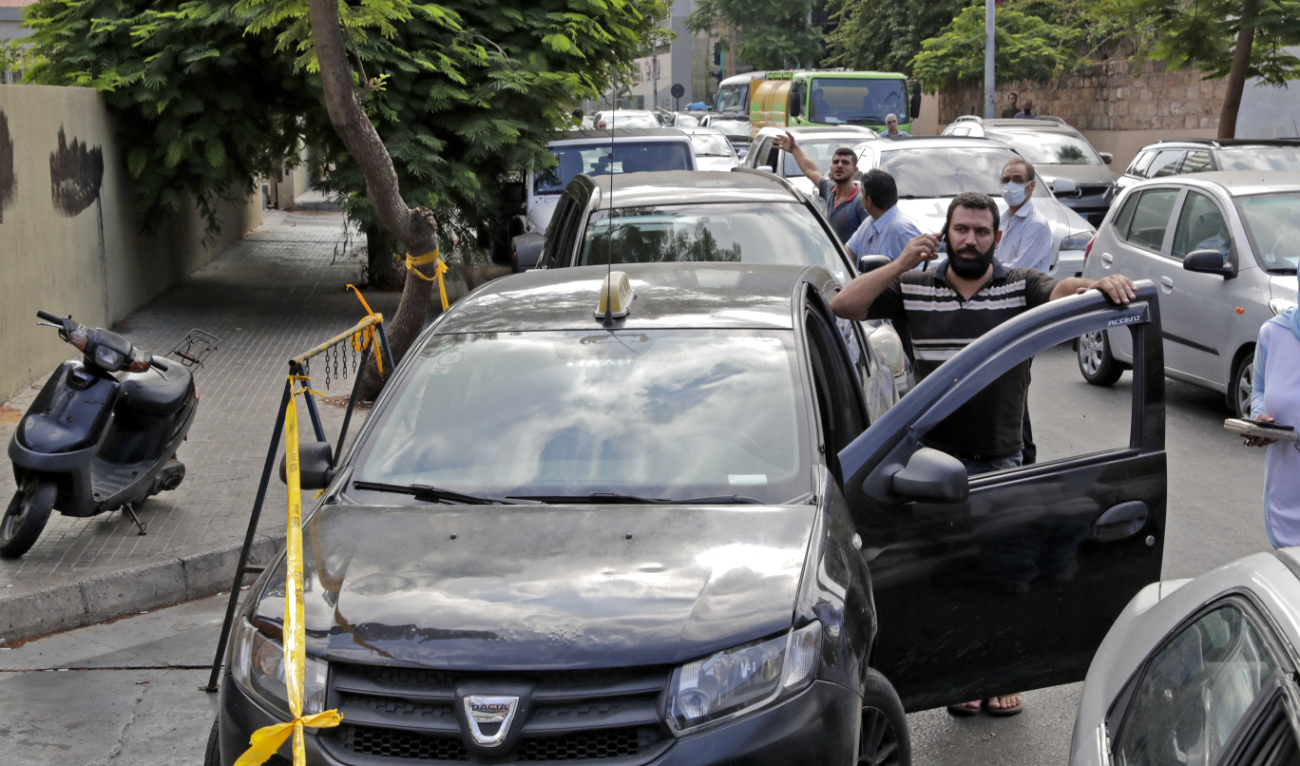
Although the country has started to unload ships of imported fuel and distribute it to gas stations, queues outside the filling stations did not get any shorter on Wednesday. Most drivers parked throughout the night and slept in their cars, hoping to fill up their vehicles in the morning.

Adnan Naccouzi, 69, suffered a stroke while waiting in a long queue for gas in the hot weather and without drinking water. He has been recovering inside the intensive care unit at a Beirut hospital for the past 24 hours.

Authorities have said fuel will be sold according to new prices, amid a gradual reduction of fuel subsidies.

As of Wednesday, a 20-liter canister of gasoline was sold for 133,000 Lebanese pounds ($88) and the same canister of diesel for 99,000 pounds. The cost of transportation has automatically increased, where the fare rose to 20,000 pounds for each passenger; more than double the price of the previous day.

Despite the public calls to arrest monopolists and put them in prison, hoarding is classified by the Lebanese penal code as a misdemeanor and sanctioned either by a fine or up to six months in prison.

Meanwhile, Judge Ghada Aoun issued a search and investigation warrant against Lebanon’s Central Bank Gov. Riad Salameh. This comes five days after setting a date for an investigation session — that he did not attend — over accusations of money laundering and money transfers abroad.

Lebanon’s State Prosecutor Ghassan Oueidat in April dismissed Judge Aoun from the case. But she has insisted on proceeding with her investigations and broke into a money exchange company with the help of activists from the Free Patriotic Movement.

In other developments, the country’s caretaker premier Hassan Diab will not appear before Judge Tarek Bitar, who is investigating last year’s Beirut blast. Diab was supposed to be questioned as a defendant in the case on Thursday, but has insisted that he should be questioned by the Supreme Council for the Trial of Presidents and Ministers.

Judge Fadi Sawan, the investigating judge who preceded Bitar, listened to Diab’s testimony in his capacity as a witness more than a year ago. In that testimony, Diab acknowledged the presence of the ammonium nitrate that was illegally stored at the port and explained why he changed his mind about visiting the site just days before the explosion.
Main category: 
Tags: 


Egypt steps up support for campaign against terror, crime groups in Sahel region

Wed, 2021-08-25 21:39

CAIRO: Egypt wants to intensify bilateral and regional efforts to combat terrorist organizations and organized crime groups in the Sahel region in central Africa, with a focus on reconstruction and development in the post-armed conflict stage.

Egyptian Foreign Minister Sameh Shoukry made the announcement during a meeting with his Sierra Leonean counterpart David Francis in Cairo on Tuesday, according to the Middle East News Agency.

The central Sahel region, which includes Burkina Faso, Mali and Niger, is facing one of the fastest growing displacement crises in the world — yet one of the most forgotten. More than 2.7 million people have been forced to flee their homes and at least 13.4 million are in dire need of humanitarian assistance, according to the UN High Commissioner for Refugees.

Ahmed Hafez, the spokesman for Egypt’s Foreign Ministry, said the two ministers share a desire to enhance trade and improve political relations between the two countries.

Both ministers signed a bilateral agreement on cooperation in the field of political consultation. They also partnered on two memorandums of understanding to enhance cooperation in the fields of culture and youth. Their aim is to facilitate communication between officials from the two countries while promoting cultural dialogue.

Burkinabe Mamouna Ouedraogo, 37, and family are among some 2.7 million people displaced from their homes in the central Sahel countries of Burkina Faso, Mali and Niger by roving crime gangs. (UNHCR photo/Anne Mimault)
Main category: 
Tags: 

Chad to halve its troops fighting Sahel militantsMacron announces Sahel troop drawdown, calls for new forceUAE begins first flights to support counter-terrorism operations in the SahelMacron: no immediate change to French military presence in Africa’s Sahel


A trial in Sweden raises uncomfortable questions about Iranian regime’s past

Wed, 2021-08-25 20:44

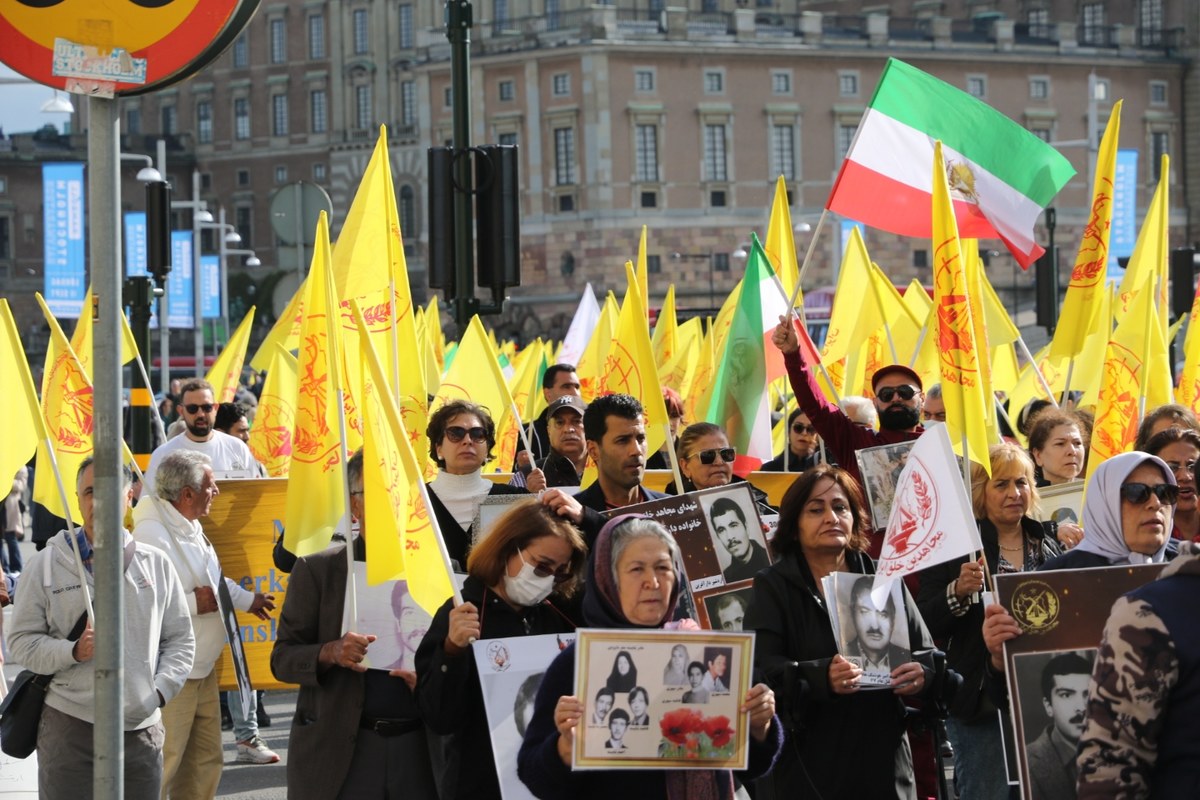
STOCKHOLM: The Stockholm District Court’s thick stone walls could not keep out the sounds of protest. Since the trial of Hamid Noury, 60, began on Aug. 10, Swedish Iranians have gathered daily outside the century-old court building to draw the world’s attention to his alleged crimes.

During a court appearance last week, Noury complained that the protesters’ chants and slogans were “insulting,” forcing the judge to ask police to request the crowd outside to quieten down.

The trial is connected to the mass execution in July and August 1988 of political prisoners who were members or sympathizers of the armed leftwing group Mujahedin-e Khalq (MEK), also known as the People’s Mujahedin Organization of Iran.

As an alleged assistant to one of the special-tribunal prosecutors, Noury is said to have been a key actor in the executions at Gohardasht prison, a facility on the northern outskirts of Karaj, about 20 km west of the capital Tehran.

The prosecution says that Noury facilitated death sentences, sent prisoners to execution and helped prosecutors gather prisoners’ names. He has denied all of the charges while claiming that the sentences were justified because of a fatwa, or religious ruling, by Ayatollah Ruhollah Khomeini, Iran’s supreme leader at the time.

The fatwa, issued in 1988, targeted the MEK, which had been outlawed by the Islamic regime in 1981 and held responsible for a series of anti-regime attacks at the end of the 1980-88 Iran-Iraq War. The MEK had been operating since 1986 from Iraq, then ruled by Iran’s archfoe Saddam Hussein.


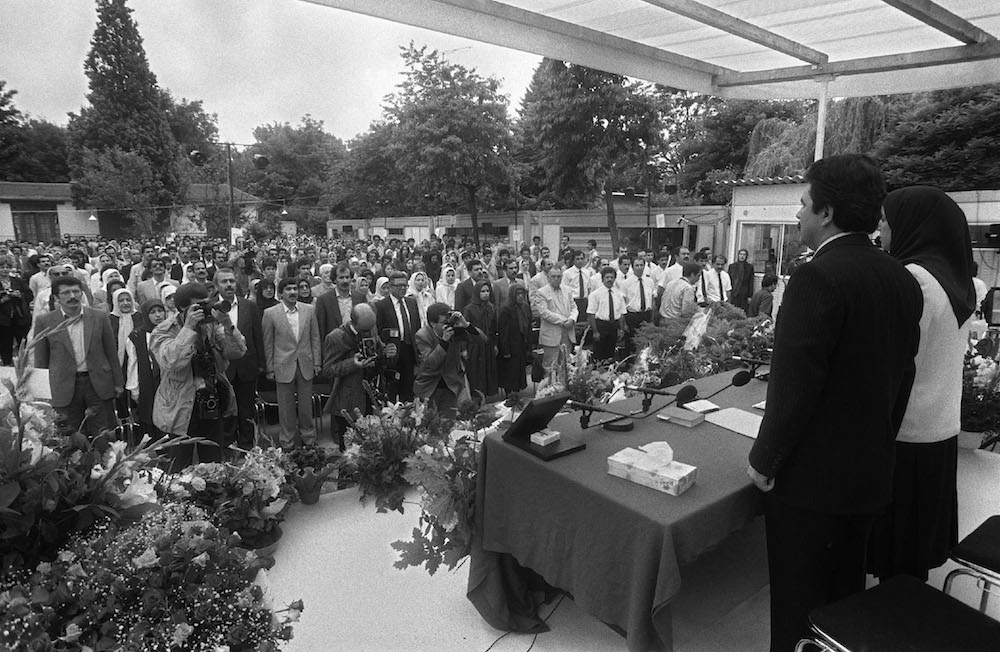
Massoud Radjavi and his wife Maryam (R), leaders of the Iranian opposition movement the People’s Mujahedeen (MEK), review militants celebrating their wedding 19 June 1985 at the headquarters of the National Council of Resistance of Iran (NCRI). (AFP/File Photo)

The families of the victims of the executions have waited three decades for justice. Now, after a complex Swedish police investigation into the suspected murders of political prisoners, they could soon find a measure of closure.

Survivors of the anti-MEK purge have testified that several inmates already had the hangman’s noose around their necks when Noury led them down what was known among prisoners as a “death corridor,” to await their hearing.

Noury is alleged to have read out the names of those who would face the specially appointed tribunal, which had likewise been nicknamed “the death commission.” Few renounced their allegiance to the MEK, so few ended up avoiding the death penalty.

“It was a kangaroo court where the so-called trial took one to two minutes,” Shahin Gobadi, a spokesman for the MEK-affiliated National Council of Resistance of Iran, told Arab News while participating in a protest last week outside the Stockholm District Court by exiled Iranians, former political prisoners and families of victims of the secret executions.

Gobadi added: “Noury served pastries to the judges on the ‘death commission’ and to the prison guards to celebrate a ‘good day’s work’.”

In one witness statement, Noury was described as “particularly cold-blooded” compared with other officials involved in a veritable industrial production-line killing system.


Kenneth Lewis (L) represents several of the plaintiffs, with the trial taking place at Stockholm District Court. (Photos by Ann Tornkvist) 

Activists managed to lure Noury to Scandinavia with a bogus offer of a luxury cruise, before tipping off local police about his scheduled arrival. Since his arrest at Stockholm airport in November 2019, the case against him has expanded.

Kenneth Lewis, representing several of the plaintiffs, told the court that although 500 to 600 prisoners were known to have died at Gohardasht within the space of a few weeks, this was merely one of several prisons where executions were taking place.

A 2018 report by human rights monitor Amnesty International, “Blood-Soaked Secrets: Why Iran’s 1988 prison massacres are ongoing crimes against humanity,” places the death toll in regime jails at about 5,000.

In the wider crackdown, which was not reserved to the prisons, an estimated 30,000 Iranian dissidents are thought to have been killed. Lewis pointed out that this toll far exceeds other well-known atrocities, including Srebrenica in Bosnia.

“It is my belief, however, that the motive, not the numbers, define genocide,” Lewis told the court in his opening statement. Indeed, Khomeini’s son and right-hand man Ahmad Khomeini is alleged to have argued strongly in favor of the fatwa at issue, saying it was time to “exterminate” the MEK in retribution for its anti-regime activities.

“It is our view that these executions constitute genocide because the fatwa was issued with the purpose of exterminating the (MEK) based on the (regime’s) religious opinion,” Lewis said.


Image of Hamid Noury and his profile from the case with Swedish police. (Photo by Ann Tornkvist)

Ali Doustkam, who fled to Sweden in 1994 and has attended the protests in Stockholm, says that the trauma of the 1988 fatwa persists despite the passage of time. “The prisoners who were executed were discarded in mass graves. Their families have not been able to bury them to this day,” Doustkam told Arab News.

According to him, suspected MEK members eliminated by the regime outside the prison system were also treated with the same disrespect in death. Branded enemies of God, they were denied the right to burial in communal cemeteries among the devout. “Parents were forced to bury their children in their backyard,” Doustkam said.

In Gobadi’s view, the Iranian “government of mass murderers” has not only avoided accountability for its actions, but has rewarded its functionaries for their “ruthless savagery,” among them Iran’s new president and former judiciary chief Ebrahim Raisi, who Amnesty accuses of being a member of the “death commission” behind the secret executions.

Raisi has denied involvement, but praised Khomeini’s “order” to carry out the purge.

“It is our ultimate wish that a conviction here leads to Noury and members of the Iranian regime being tried for crimes against humanity at an international tribunal,” Doustkam said.

Noury’s defense team has contested the evidence against their client, highlighting perceived inconsistencies and unverifiable information in witness testimonies. They have also implied that groups on social media have created echo chambers where inaccuracies have percolated over many years, converting mere hearsay into supposed facts.


The trial is connected to the mass execution in July and August 1988 of political prisoners who were members or sympathizers of the armed leftwing group Mujahedin-e Khalq (MEK). (Photo by Ann Tornkvist)

The defense has also pointed out that none of the witnesses have identified Noury as a member of the actual “death commission” tribunal, meaning he had no formal decision-making or sentencing powers. They deny Noury even worked at the prison.

While such arguments carry weight in a court of law, the families of Noury’s alleged victims are in no doubt about his moral guilt.

“He might have been a low-level operator,” Gobadi said. “But he was an integral part of the ruthless regime in Iran.”

Although only one individual is standing trial, the families of the victims of the secret executions understand the symbolic value of a successful prosecution and the possible knock-on effects.

“What is unusual about this trial is that it’s most importantly an indictment of the entire Iranian regime, and that’s a huge problem for them,” Lewis, the plaintiffs’ lawyer, told Arab News.

While Kristina Lindhoff Carleson, the lead prosecutor in the case, has ruled that there is sufficient evidence to charge Noury with only 100 killings, the sight of even one suspect being led into a courtroom in handcuffs is unprecedented.


During a court appearance last week, Noury complained that the protesters’ chants and slogans were “insulting,” forcing the judge to ask police to request the crowd outside to quieten down. (Photo by Ann Tornkvist)

“This milestone trial in Sweden comes after decades of persistence by Iranian families and victims of the 1988 mass executions,” Balkees Jarrah, associate international justice director at Human Rights Watch (HRW), said in a statement. “This case moves victims closer to justice for the crimes committed more than 30 years ago.”

The trial is only possible in Sweden because the Nordic country recognizes universal jurisdiction over certain serious crimes such as mass murder, allowing for investigation and prosecution regardless of where the crimes were committed.

HRW has said that universal jurisdiction cases are important for ensuring that those who committed atrocities are held accountable. It says the process provides justice to victims who have nowhere else to turn, and that it deters future crimes by ensuring that countries do not become safe havens for rights abusers.

“Universal jurisdiction laws are a key tool against impunity for heinous crimes, especially when no other viable justice option exists,” Jarrah said.

Members of the Swedish-Iranian community have told local media how proud they are to see authorities in their adopted home bring one of their tormentors to justice.

A verdict is expected in April 2022.

Swedish Iranians gathering outside the courtroom to bring attention to Noury's crimes. (Photo by Ann Tornkvist)
Main category: 

Iranian accused of role in mass executions to face trial in SwedenFamilies of Iran massacre victims urge world leaders to protect gravesSwedish trial offers hope of justice over Iran mass executions: HRWFamilies gather at Tehran cemetery in memory of 1988 massacre


No end in sight: Lebanon’s government crisis rages on as country on its knees 

Wed, 2021-08-25 20:47

DUBAI: More than 12 months since Lebanon’s cabinet resigned and with the country teetering on the brink of collapse, politicians look unlikely to form a much-needed government any time soon, sources warn.

Despite one of the world’s largest-ever non-nuclear explosions killing more than 200 people, soaring hyperinflation, food insecurity and crippling fuel shortages, leaders have continued to dig their heels in while two designated prime ministers have come and gone.

Najib Mikati, a billionaire businessman and former PM, is the latest to take on the mantle, promising a swift formation of a government within a month when he was appointed on Jul. 26.

“I gave my proposals, President Michel Aoun approved most of them and he made some remarks which are acceptable. God willing, we will be able to form a government soon,” Mikati said two days later. 

A month has passed, and Mikati is facing the same fate as his two predecessors — Mustapha Adib and Saad Hariri — who both failed to come to terms with Aoun.

Mikati is set to meet with the president on Thursday afternoon, with sources noting that both men are far from coming to terms on a government.  

“I believe Mikati will be forced to step down at some point like the others,” Mustapha Allouche, the Future Movement’s vice president, the party formed by Hariri’s late father, told Arab News.

According to Lebanon’s sectarian power-sharing model, the president, a Maronite Christian, and the prime minister-designate, a Sunni Muslim, must both agree on a cabinet lineup in unison that is split equally between Christians and Muslims.

“What is happening now is merely a continuation of what has transpired over the past 12 months, with each political bloc maneuvering based on its own calculations,” Rosana Bou Monsef, a political analyst and veteran columnist for Lebanese daily An-Nahar, told Arab News. 

At the core of the issue, she said, is the president’s Free Patriotic Movement trying to secure favorable terms in the upcoming government, which could stay in power until after Aoun leaves office next year.

Lebanon is set to hold parliamentary elections in May, which given the turbulent political landscape and security situation, could be delayed. This would pave the way for the upcoming government to stay in place, take key decisions moving forward and exert pressure on political opponents.  

“It is becoming increasingly clear that the problem doesn’t lie with who will head the government but with the president’s group’s unwillingness to form a government except on its terms,” Bou Monsef said.

After nine months of grueling negotiations and a number of public spats with the president, Hariri stepped down in mid-July, saying “God help Lebanon” as he left the presidential palace.

Hariri had accused the president of blocking the formation of a cabinet in which the FPM, the party he founded and currently headed by his son-in-law MP Gebran Bassil, lacks veto power.

Eddy Maalouf, an FPM parliamentarian, denied the accusations, telling Arab News that the deadlock stems from Hariri and Mikati’s attempts to encroach on the constitution and name several Christian ministers.

“They must afford the president’s bloc the same rights afforded to the other parties,” he said.

Further complicating matters is Hezbollah Secretary-General Hassan Nasrallah’s announcement on Aug. 19 that the party had secured fuel shipments from Iran. 

Amid typical governmental absenteeism, the Iranian-backed Hezbollah has seemingly taken matters into its own hands, vowing that fuel tankers would set sail to Lebanon from the sanction-ridden country. 

If Hezbollah follows through with its promise and the tankers actually do dock in Lebanon, it would open up the Lebanese state to the possibility of sanctions from the US, which has vowed to punish anyone that deals with Tehran. 

“The Iranian fuel has put Mikati in an extremely tough position as his government program was based on cooperating with the international community and Gulf countries to secure financial assistance for Lebanon,” Bou Monsef told Arab News. 

This was echoed by Maalouf, who maintained that Mikati is “hesitating in moving forward with the formation of the government in light of this development.” 

The possibility of Mikati stepping down is now gaining traction, Bou Monsef noted, “despite the international community urging him to move forward with negotiations.”

Mikati’s resignation would have a ripple effect across Lebanon’s political landscape, Allouche said. 

“If Mikati steps down, we’ll have to reconsider our calculations,” Allouche said when responding to a question on whether Hariri’s Future Movement bloc would resign from parliament. 

Sami Fatfat, a Future Movement MP, held out hope that a government would be formed but assured his party is “looking into different options, including mass resignations” if Mikati steps down.

“The next couple of days will be decisive,” he noted, as Lebanon braces for the potential arrival of the first shipment of Iranian fuel coupled with the end of Mikati’s one-month deadline. 

Main category: 

PM-elect Mikati optimistic about new Lebanon governmentLebanese President Aoun: We are on the brink of forming a new government


Russia is playing S-400 card in Turkey for strategic purposes, say experts

Author: 
Wed, 2021-08-25 19:14

ANKARA: Amid increased contact between Turkey and the western world over developments in Afghanistan and the potential refugee influx, Russia has placed the S-400 missile defense system on the table – a move that experts see as a strategy to drive Turkey away from the US and Europe.

Based on the comments by the head of Russia’s arms exporter Rosoboronexport, the Interfax news agency said that Kremlin and Ankara are about to sign a contract to supply Turkey with a second batch of S-400 air defense units.

Turkish officials have not yet reacted to the claim.

The statement, which is seen as a move to damage Turkey’s improved ties with the west and with Ukraine, coincided with the Crimea summit in Kiev, which Turkish Foreign Minister Mevlut Cavusoglu attended earlier in the week.

Turkey’s initial purchase of S-400 from Russia was a sticking point with the US and the NATO allies, rendering Ankara subject to a series of US sanctions.

The US is concerned that the Russian defense system could compromise security if Russia becomes able to secretly acquire classified information on US and NATO weaponry.

The US has forbidden Turkey’s participation in the F-35 fighter jet program, and last month President Joe Biden said he would maintain sanctions on Turkey under the Countering America’s Adversaries Through Sanctions Act (CAATSA) for buying the Russian system.

New sanctions from Washington could be disastrous for Turkey when its economy is still weak amid pandemic conditions.

Turkey’s military test-fired the S-400 in the Black Sea province of Sinop in October 2020. However, it has not fully activated the defense system, in a move considered an olive branch to the new US administration.

“Considering that Turkey has not yet fully activated even the first batch of the S-400 system, it is not reasonable for Ankara to make a new agreement with Moscow on this issue,” Prof. Emre Ersen, a Russia expert at Marmara University in Istanbul, told Arab News.

Ersen thinks the repeated statements from Russian officials regarding the S-400 seem to reflect Russia’s unease about the prospects of closer Turkish-US ties under the Biden administration as Ankara has been trying to mend ties with its Western allies in the past few months.

“The latest developments in Afghanistan and Turkey’s possible role in this issue have provided a new momentum for Turkey’s strategic relations with the West,” he said.

Mevlut Cavusoglu and his Russian counterpart Sergei Lavrov discussed the latest developments in Afghanistan on Aug. 18 and insisted on the necessity of ensuring security there.

But, a couple of days later Cavusoglu made a controversial statement during the Crimean Platform meeting in Kiev on Aug. 23, saying Turkey has not and will not recognize the illegal occupation of Crimea by Russia and will support Ukraine’s territorial integrity.

“Since the S-400 missiles remain the soft underbelly of Turkish-US relations, Moscow is most likely trying to keep this issue high on the agenda as a political instrument to make sure that Ankara remains distant from Washington,” Ersen said.

Under the $2.5 billion deal that was signed in 2017, Russia was to supply Turkey with four batteries of S-400 surface-to-air missiles.

“So far, Turkey has bought two batteries, and the second batch was optional. However, Ankara and Kremlin have been negotiating loan agreements for a couple of years. No official has spoken about the purchase of the second unit since January 2020,” Aydin Sezer, an Ankara-based Russia expert, said.

According to Sezer, Russia’s messages aim to keep Turkey away from the West at times when Ankara attaches importance to its transatlantic ties.

“It is not realistic to expect Ankara to proceed with the purchase of a second batch of S-400 when it is making lobbying efforts to return to the US F-35 fighter jet program at the same time. Therefore, it keeps its silence and will only react positively to such politically motivated calls when a new crisis emerges in its ties with the West,” he said.

Ankara and Washington held intense negotiations about the responsibility for security at Afghanistan’s Kabul international airport following NATO’s withdrawal and Turkey has used the airport mission offer as a potential area of cooperation to mend frayed ties with the US and other NATO allies, which have been tense over many issues.

Main category: 

Russia, Turkey close to signing new S-400 missile contract – IfaxUS, Turkey remain divided over purchase of Russia’s S-400s