A Mosul book cafe raises political awareness in the run-up to Iraq elections

Author: 
Thu, 2021-10-07 21:41

MOSUL, Iraq/BOGOTA, Colombia: Taking a seat at the top table at Mosul’s Book Forum cafe one evening in September, political blogger Saad Amer introduced his two guest speakers, both independent candidates running in Iraq’s Oct. 10 parliamentary elections.

This was the fifth such event organized by the Khutwa Club, a debating society that meets regularly at the northern city’s popular cafe — its foremost cultural and literary venue.

Since Mosul was retaken from Daesh extremists in 2017, the cafe has become a popular and widely celebrated hub for young activists, academics, journalists and students to share ideas.

In a country where politics is dominated by armed groups and where critics are often murdered with impunity, the Khutwa Club’s success in motivating a mostly apathetic youth is a remarkable feat in itself.
“There is a huge gap between citizens and the political system in Iraq,” Harith Yaseen Abdulqader, the Book Forum’s co-founder, told Arab News during a Khutwa Club event.

“Our goal is to help people look in-depth at the Iraqi political system and how to spread awareness among the people so that they can choose the best candidate for them, to understand the electoral program of the candidates, and understand the gaps in their programs.”

Political education is at the core of the Khutwa Club’s mission. In 2003, after decades of Baathist rule, the US and other Western powers installed a democratic system in Baghdad modelled on their own time-honored institutions.

The tenets of Western-style democracy were alien to many Iraqis, who for centuries had conducted their affairs along tribal and religious lines. Foreign powers, armed groups and corrupt individuals soon took advantage of the situation, fashioning a system that was democratic in name only.

“The goal of this club is to educate citizens about common political terms, aspects and ideas,” Abdulqader said. “Perhaps a citizen doesn’t know what liberalism is, what civic politics is, or what political Islam is, or the difference between the ruling parties and the Islamist parties.”
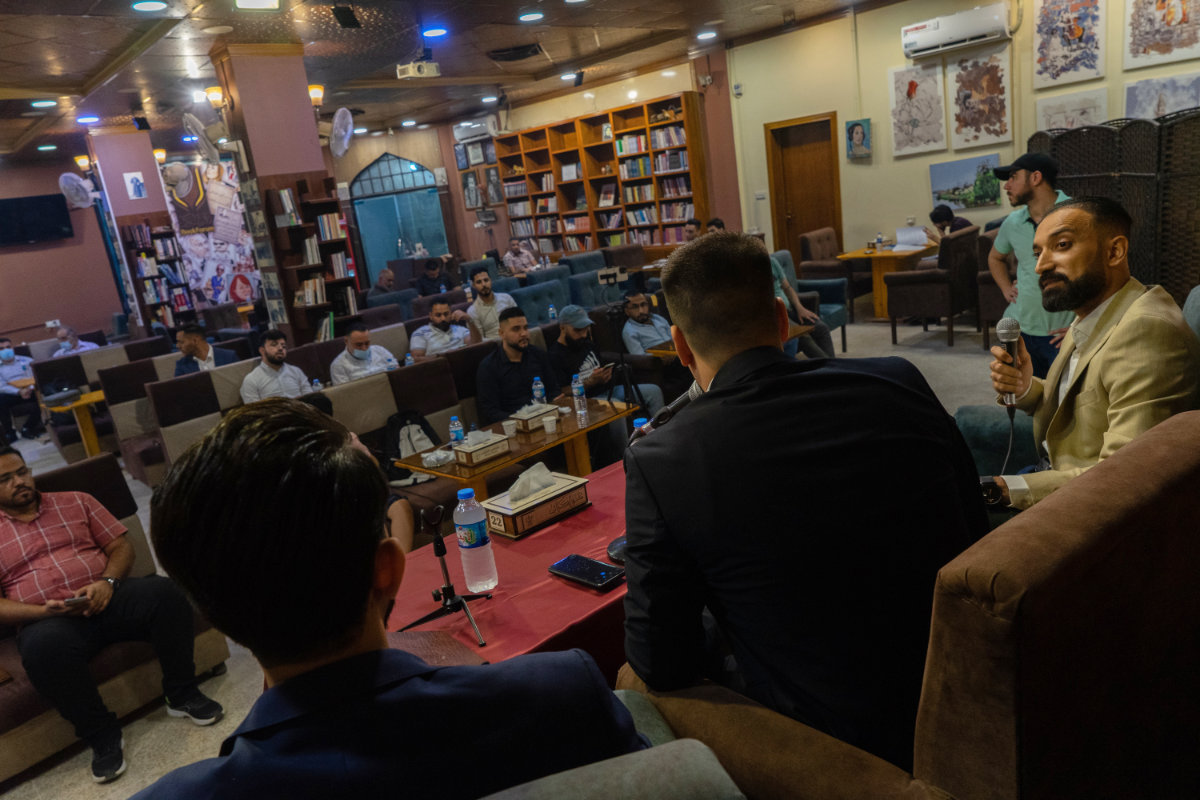

Election hopefuls are using Mosul’s Book Forum cafe to reverse the trend of political apathy among the Iraqi youth. (AFP)

There is certainly a thirst for such ideas among Iraq’s swelling ranks of jobless educated youth. Fed up with the country’s ruling elite, young Iraqis marched in their hundreds of thousands in cities across the country in October 2019, demanding the overthrow of the post-2003 order.

Although the protests secured the resignation of then-prime minister Adel Abdul-Mahdi, the movement soon fizzled out with the onset of the global pandemic and under savage attack by pro-government militias.

Crucially, without a defined political leadership heading the movement, Iraq’s young protesters were unable to translate their energy and idealism into an electoral force capable of making their demands a reality. 

By offering discussions on political literacy and participation, the Khutwa Club and others like it might be the very platforms to make that transition possible.

“Maybe what we do here will open horizons for people who want to run for election in the future,” said Abdulqader. 

“We encourage young people to engage in politics. We are trying to create new young political faces with a large support base and with an understanding of the Iraqi political process. Maybe we can be the supporters for these young people if they decided to run for election.

“For more than 17 years we have seen the same political faces. They did not offer anything new. They still made the same fake promises. We need to focus on new faces, especially the young ones. There is a difference between the mentality of a 70-year-old politician and a 35-year-old.”

Seated in the audience is Obadiah Muhammad, a 22-year-old law student and one of the club’s regular attendees. He is grateful for the opportunity to hear from local candidates running on an independent ticket.

“Mosul suffers from the dominance of big political parties,” Muhammad told Arab News. “I wanted to come today to support independent candidates, to hear what they have to say, to see if I agree with them or not.”

The Khutwa Club is unique in providing a platform for candidates who would otherwise be drowned out by the dominant parties.

“The club offers an environment to exchange opinions and challenges its guests,” Muhammad said. “We did not have such a place before in Mosul and I see it as something extraordinary.”

Mosul, situated in Iraq’s Sunni-majority northwest, was not always so tolerant of political expression. Between 2014 and 2017, when the city was the capital of Daesh’s self-styled caliphate, free speech and democratic participation were brutally suppressed.
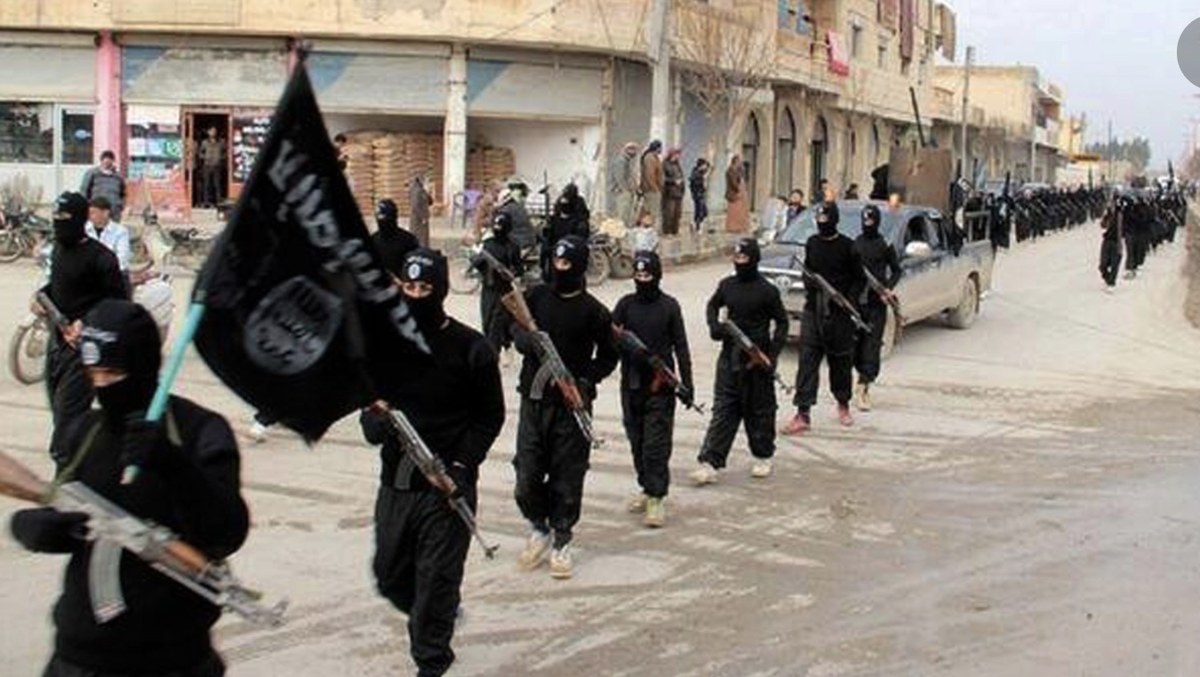

Daesh militants brutally suppressed free speech and democratic participation during their three-year rule in parts of Iraq and Syria, with Mosul as their capital. (File photo)

Even before the militants seized control, the city was anything but a bastion of free speech. Saad Amer, the political blogger chairing that evening’s Khutwa Club debate, remembers only too well how dangerous speaking out could be.

“Political thought was forbidden before 2014. Mosul had been controlled by Al-Qaeda since 2009. According to my memory, no one could speak of politics, or discuss secular or liberal ideas. Everyone was afraid,” the 28-year-old told Arab News on the meeting’s fringes.

“Everyone, including me, was just trying to keep up with life here, and when election day came, we would go to vote for a party from our ethnicity to protect us and our rights.

“After 2017, there was a sort of revolution that happened in Mosul. Young people started to feel more of a sense of freedom and more space for free speech, to speak our minds and discuss our thoughts in public.”

Even now, though, the Khutwa Club and its guests face occasional intimidation from forces that thrive in Iraq’s murky political environment.

“We do sometimes receive threats from certain political parties and some armed groups, but we always find a way to get around this and solve it,” Amer said. “Some of these threats include harsh language, not only for the club but also for the political opinions we have and our criticism of political parties.”

The independent candidates on the podium make a convincing case for a cleaner, fairer and more transparent system in Iraq, doing away with corruption, armed groups and foreign interference. But without a powerful party machinery to back them up, few stand a chance of entering parliament or effecting meaningful change once there.

Asil Al-Agha, 41, is one of the few female candidates standing for election in Mosul. A former member of Nineveh’s provincial council, running on an Iraq Renaissance and Peace Bloc ticket, Al-Agha has proven her mettle as a skilled campaigner, but is all too aware that she must operate within the confines of an imperfect system.

“A big proportion of people here are suffering from poverty and lack of jobs,” she told Arab News at her office near Mosul’s university campus. “Politicians will take advantage of this, promising jobs and money to buy votes.”

Al-Agha added: “One of the things that people suffer with here is bureaucratic red tape and corruption in state departments, where citizens are exploited and forced to pay bribes. To say nothing about health. We do not have government hospitals that provide the necessary treatment and good care.

“Even if I made it to Baghdad, it would be very difficult to work on these issues. I have to be strong and have a powerful political alliance where they can pressure others so we can get our rights. A lonely politician can’t get anything done alone. This is why I am running with a party, not independently.”

Iraq’s 2018 election, the first since the defeat of Daesh, saw the country’s lowest-ever turnout. Given the precarious health of Iraqi democracy, change from within may be the best and only hope for educated young Iraqis disillusioned by the failures of the October 2019 revolution.

“We believe that the only way to achieve change is to enter political work and participate in the elections to choose good people to run the government,” said Amer, closing the Khutwa Club event.

“This is the only available option.”

________________________

Twitter: @meethak55 and @RobertPEdwards 

Election hopefuls are using Mosul’s Book Forum cafe to reverse the trend of political apathy among the Iraqi youth. Just 4 years ago, the city served as the capital of Daesh’s brutal caliphate. (AFP)
Main category: 


Abu Dhabi crown prince visits Saudi pavilion at Expo 2020 Dubai

Author: 
Thu, 2021-10-07 22:00

DUBAI: Sheikh Mohammed bin Zayed Al-Nahyan, crown prince of Abu Dhabi and deputy supreme commander of the UAE Armed Forces, visited Saudi Arabia’s pavilion at Expo 2020 Dubai on Thursday.

Prince Turki bin Mohammed bin Fahd bin Abdulaziz, the Saudi minister of state and member of the Saudi Cabinet, received him.

Sheikh Mohamed bin Zayed accompanied Prince Turki on a tour of the pavilion, which rises six stories above the ground and features a 1,320 square-meter inclined mirrored screen. The Kingdom’s pavilion was designed to showcase Saudi Arabia’s ancient culture, heritage, the wonders of its natural landscape as well as the rapid drive and innovation of its present and future ambitions.

Prince Turki also held a meeting with Sheikh Mohammed bin Zayed inside the pavilion and conveyed the greetings of King Salman and Crown Prince Mohammed bin Salman and their wishes to the UAE people for steady progress and prosperity.

Prince Turki bin Mohammed bin Fahd congratulated Sheikh Mohammed bin Zayed on launching Expo 2020 Dubai, which has been billed as the world’s greatest show and opened its gates on Oct. 1 with more than 200 countries and companies from around the globe.

During the meeting, the two leaders discussed the distinguished bilateral relations the countries share and ways to improve them.

Sheikh Maktoum bin Mohammed bin Rashid Al Maktoum, UAE deputy prime minister and minister of finance; Sheikh Mansour bin Zayed Al Nahyan, deputy prime minister of the UAE and minister of presidential affairs, and Saudi Ambassador to the UAE Turki Al-Dakhil attended the meeting.

Main category: 

Saudi singers Aseel Abu Baker, Dalia Mubarak to perform at Expo 2020’s Jalsat concert series Al-Wasl Plaza at Expo 2020 Dubai to wow guests with 3 ‘immersive’ shows


US says return to Vienna nuclear talks with Iran must happen soon

Thu, 2021-10-07 21:33

WASHINGTON: The United States believes an “imminent” return to indirect talks in Vienna over a return to the Iran nuclear deal is necessary because the process cannot go on indefinitely, State Department spokesman Ned Price said on Thursday.
Price said a diplomatic path remained open and noted that Tehran had said it would return to the talks “soon.”
“We hope their definition of soon matches our definition of soon,” Price said. “We would like negotiations to resume in Vienna as soon as possible.” 

Main category: 

Iran’s foreign minister says nuclear talks to resume soon New alarm in US over Iran drive toward nuclear bomb


Israeli court ruling on major holy site angers Palestinians

Author: 
By JOSEF FEDERMAN | AP
ID: 
1633631120370491200
Thu, 2021-10-07 21:30

JERUSALEM: A ruling by a local Israeli court in favor of a Jewish man who prayed quietly at a flashpoint Jerusalem holy site has angered Muslim authorities. They denounced it on Thursday as a violation of the fragile status quo governing the compound.
The Al-Aqsa mosque compound is the third holiest site in Islam and the holiest site for Jews, who refer to it as the Temple Mount because it was the location of the ancient Jewish Temples. It is the emotional epicenter of the Israeli-Palestinian conflict, and tensions there helped ignite the 11-day Gaza war in May. Under informal understandings, Jews are not allowed to pray there.
The ruling by a magistrate court in Jerusalem concerned a Jewish man who had been barred from the site for 15 days after Israeli police caught him quietly praying there. The court lifted the ban several days early, ruling that the man, “like many others, prays on a daily basis on the Temple Mount.”
Noting that he did so quietly and privately, the ruling said “this activity by itself is not enough to violate the police instructions.”
Magistrate courts make up the lowest level of the Israeli judiciary and hear cases concerning relatively minor crimes.
Under a longstanding but informal arrangement known as the status quo, Jews are allowed to visit the site but not pray there. The agreement has broken down in recent years as large groups of Jews, including hard-line religious nationalists, have regularly visited and prayed at the site. The Israeli government says it is committed to maintaining the status quo.
The Palestinians and neighboring Jordan, which serves as the custodian of the holy site, fear that Israel plans to eventually take over the compound or partition it — as it did with a similarly contested holy site in Hebron, in the Israeli-occupied West Bank.
The Islamic endowment that maintains Al-Aqsa called the ruling a “flagrant violation” of the compound’s sanctity and a “clear provocation” for Muslims worldwide.
Friday prayers at the mosque are regularly attended by tens of thousands of Palestinians, and are sometimes followed by protests and clashes with Israeli police. A provocative visit by a right-wing Israeli politician in 2000 helped ignite the second Palestinian intifada, or uprising.
Israel captured east Jerusalem — including the Old City and its holy sites sacred to Jews, Christians and Muslims — in the 1967 war and annexed it in a move not recognized by most of the international community. The Palestinians want east Jerusalem to be the capital of their future state. The city’s status has been among the most divisive issues in decades of failed peace efforts.

Main category: 
Tags: 

Israeli soldiers attack Muslims as Jewish extremists break status quo at Al-Aqsa10 arrested, 9 injured as protesters at Al-Aqsa face rubber bullets


One dead as rain, floods hit south Yemen city

Author: 
AFP
ID: 
1633622961759283700
Thu, 2021-10-07 19:31

MUKALLA, Yemen: Torrential rains caused widespread floods in the southern Yemeni city of Mukalla, where a young man was electrocuted, local official said on Thursday.
The floods added to suffering in the Arabian peninsula’s poorest country, which has endured seven years of war.
The rain lashed Mukalla on Wednesday days after a powerful cyclone was downgraded to a tropical storm after making landfall in Oman where 12 people were killed.
A Yemeni official said the rains caused flooding that swept away cars in Mukalla, damaged shops and homes, and knocked down electricity poles.
“At least 10 cars were swept away and (several) homes were damaged, while a young man died of electric shock,” said the official who declined to be named.
The cars were left upended in water-logged, muddy streets.
Meteorologists in Aden, Yemen’s second city west of Mukalla on the country’s south coast, had expected a fallout from Cyclone Shaheen which struck neighboring Oman on Sunday before being downgraded to a tropical depression.
Across the Gulf in Iran, six people were reported dead while the United Arab Emirates, which borders Oman, was also put on alert.
Dozens of people are killed each year across Yemen in flash floods caused by heavy rains.
In May, the United Nations reported that around 3,700 families had been affected by torrential rains and floods that had caused havoc in Yemen since mid-April. Authorities said at least four people were killed.
About 80 percent of Yemen’s 30 million people are dependent on aid, in what the United Nations has called the world’s worst humanitarian crisis.
Yemen’s grinding conflict has claimed tens of thousands of lives and displaced millions since 2015, when a Saudi-led military coalition intervened in the country to shore up the government. Iran Iran-backed Houthi rebels had seized the capital Sanaa the previous year.

Main category: 

UN envoy calls for ‘inclusive settlement’ to end Yemen crisisYemeni woman turns home into school