Ankara wants to upgrade air force with US jets

Sat, 2021-10-09 22:51

ANKARA: Amid ongoing talks to improve ties with the administration of President Joe Biden, Turkey reportedly made a surprise request to the US to buy 40 Lockheed Martin F-16 fighter jets and 80 modernization kits for its existing warplanes.

The request is subject to approval by the US State Department and then by the US Congress, where Ankara will require further lobbying efforts.

Washington, D.C.-based law firm Arnold & Porter has recently extended for one year its $1.5 million lobbying contract with Turkey for “strategic counsel and legal consultancy services” over its participation in the F-35 fighter jet program.

Turkey’s removal from the F-35 program in 2019, after it purchased a Russian S-400 missile defense system, cost Ankara about $1.4 billion, as it had already ordered more than 100 of the jets.

Turkish President Recep Tayyip Erdogan met with Russian counterpart Vladimir Putin on Sept. 29, and said Turkey would proceed with its plan to the purchase a second batch of S-400s, despite US sanctions in December 2020, when the US blacklisted Turkey’s Defense Industry Directorate, its head and three employees.

Ankara is reportedly pondering new avenues of defense cooperation with Russia, including joint production of aircraft engines and warplanes.

Sine Ozkarasahin, an analyst at Istanbul-based think-tank EDAM’s security and defense program, thinks that after losing the F-35s and being exposed to US sanctions under the Countering America’s Adversaries Through Sanctions Act on its arms industry, this latest request is surely a way out to some extent.

“Right now, Turkey does not have the fifth generation aircraft that are crucial for keeping the military edge vis-a-vis Turkey’s geopolitical competitors. At present, the Turkish Air Force does not have another viable stopgap solution,” Ozkarasahin told Arab News.

“With its current technological know-how and familiarity with CONOPS, knowns as concept of operations, (the) F-16 Viper modernization package is a far better choice than the Russian alternative, (the) Su35. A switch to the Su35s as a stopgap would also require a significant shift in training, infrastructure and even in the military doctrine, since the Russian aircraft design philosophy drastically differs from that of western tactical aviation.”

Turkey’s fighter jet fleet mainly consists of fourth-generation US-made F-16 Fighting Falcons and older F-4 Phantom IIs.

In February, Turkey’s procurement and defense authorities initiated a new program to increase the structural life of the country’s existing fleet of F-16 Block 30 jets from 8,000 flight hours to 12,000.

The upgrade program was considered by experts as a sign that Turkey wants to keep the F-16s as its main fleet until its planned indigenous fighter jet becomes operational.

According to Ozkarasahin, Turkey’s National Combat Aircraft is expected to enter service only in the 2030s, while the first variants of the baseline will probably not be fully fifth generation aircraft — factors that would lead to a significant gap in Turkey’s air warfare capabilities.

“To catch up with contemporary air warfare trends, Turkey urgently needs a stopgap solution and then a feasible plan to acquire fifth generation capabilities. The F-16 purchase can get the job done at least for the first objective,” she said.

Ozkarasahin thinks that Washington can use the request as a political bargaining tool against Turkey.

“However, with the help of the defense industry giants like Lockheed Martin, Turkey can receive a conditional approval from Congress. Since both the Republicans and Democrats share (a) harsh stance toward Turkey, diplomatic talent will be the game changer,” she said.

In case Turkey opts for Russian Su-35 fighter jets for the interim period until it fields a fifth generation fighter, that would undermine its relations with the Biden administration and risk further US sanctions, experts note. 

Soner Cagaptay, director of the Turkish program at the Washington Institute, thinks that the latest Turkish move in requesting F-16 fighter jets and modernization kits from Washington also aims to test US sincerity and friendship.

“Perhaps it is also a way of asking the US decision-makers that although Washington removed Turkey from (the) F-35 fighter jet program over its purchase of S-400s, how about its policy over F-16s? The real question is whether the bilateral relations will get back on track or not,” he told Arab News.

“Notwithstanding recent problems in Turkey-US ties, there are still few people among decision-makers and (the) Turkish military elite who do not want to let go of what remains of US-Turkey military ties. So they are trying to add a new layer to this relationship by trying to build new bonds, new bridges in this way,” Cagaptay added.

Biden and Erdogan are expected to meet in Rome in late October.

On Sept. 23, during an interview with Turkish journalists in New York on the sidelines of the UN General Assembly, Erdogan said Washington should either deliver F-35s to Turkey or reimburse it.

Main category: 

Turkey could buy more Russian S-400 missiles despite US warningsRussia is playing S-400 card in Turkey for strategic purposes, say experts

Hezbollah member wanted for role in 1985 hijacking dies

Author: 
Associated Press
ID: 
1633809008686878000
Sat, 2021-10-09 22:52

BEIRUT: Ali Atwa, a senior Hezbollah operative who was on the FBI’s most wanted list for his role in one of the most notorious plane hijackings in aviation history, has died, the Lebanese militant group said Saturday.
Atwa, who was believed to be in his early 60s, died of complications related to cancer, Hezbollah said.
Atwa was placed on the FBI’s Ten Most Wanted Fugitives list in 2001 with two other alleged participants in the 1985 hijacking of TWA Flight 847. The ordeal, which began in Athens, Greece on June 14, lasted 16 days and left a US Navy diver on the plane dead.
The hijackers demanded the release of Lebanese and Palestinian prisoners held in Israeli prisons.
The FBI had offered a $5 million reward for information leading to Atwa’s arrest. He was accused of conspiring to take hostages, committing air piracy that led to the slaying of an American, and placing explosives aboard an aircraft.
The flight, with 153 passengers and crew members, including 85 Americans, was commandeered by the hijackers after taking off from Athens bound for Rome.
The plane was allowed to land in Beirut, where the hijackers freed 19 American women and children. They then flew to Algeria, where more hostages were released, before returning to Beirut.
There, the hijackers shot and killed US Navy diver Robert Stethem, 23, after beating him unconscious. They again returned to Algeria, released more passengers and were joined by Atwa, who had failed to get a seat on the flight and was arrested at Athens airport.
Greek authorities let him go after his co-accomplices threatened to kill more hostages. Atwa was filmed during his release in Athens covering his face with a bag.
Among those on the flight was Greek singer Demis Roussos, who was released in Beirut. On June 30, the last 39 passengers were freed in Damascus, Syria.
Days later, hundreds of Lebanese prisoners were released from Israeli prisons.
One of the hijackers, Mohammed Ali Hammadi, was arrested in Frankfurt in then-West Germany in 1987 and was convicted of the hijacking and Stethem’s slaying. Hammadi was sentenced to life in prison but was paroled in 2005 and returned to Lebanon.
A Hezbollah funeral was organized for Atwa on Saturday in Beirut.

Main category: 

Lebanese judiciary resists Hezbollah threats and political pressureHezbollah threatens Beirut blast probe judge: reports


Iraq’s young voters ponder how to effect meaningful change

Sat, 2021-10-09 22:31

BAGHDAD, Iraq / BOGOTA, Colombia: Eighteen years since the US-led invasion of Iraq toppled the Baathist dictatorship of Saddam Hussein, a whole generation has come of age knowing only the system of parliamentary democracy built in its place.

But as election day unfolds today, many young Iraqis still feel alienated from the political process and skeptical about meaningful change happening via the ballot box.

In 2003, as part of its de-Baathification strategy, the Coalition Provisional Authority teamed up with Iraqi oppositionists, many of whom had spent decades in exile, to build the vital institutions of state almost from scratch.

However, the system they built, modeled on the West’s own time-honored institutions, was alien to many Iraqis who had for centuries conducted their affairs along tribal and religious lines and were divided along sectarian lines.

Mourtatha Al-Makhsousi, a 27-year-old unemployed graduate from the eastern Iraqi city of Kut, told Arab News: “In 2003, the Iraqi opposition was working to change the regime, but they did not address it well and they failed to analyze the consequences of the changes. As a result, we have a fragile system here.

“Here in Iraq people did not know about democracy and parliamentary systems. Moreover, we are a tribal and religious community with social contradictions that cannot be controlled by a parliamentary system.

“Therefore, it required a religious appeal in the Iraqi constitution and parliament for people to vote. I suppose a majority of Iraqis still do not know how it works or how power is distributed.”

Foreign powers, armed groups, and corrupt individuals soon took advantage of the situation and the billions of dollars in aid money lavished on the country, fashioning a system that was, for the most part, democratic in name only.


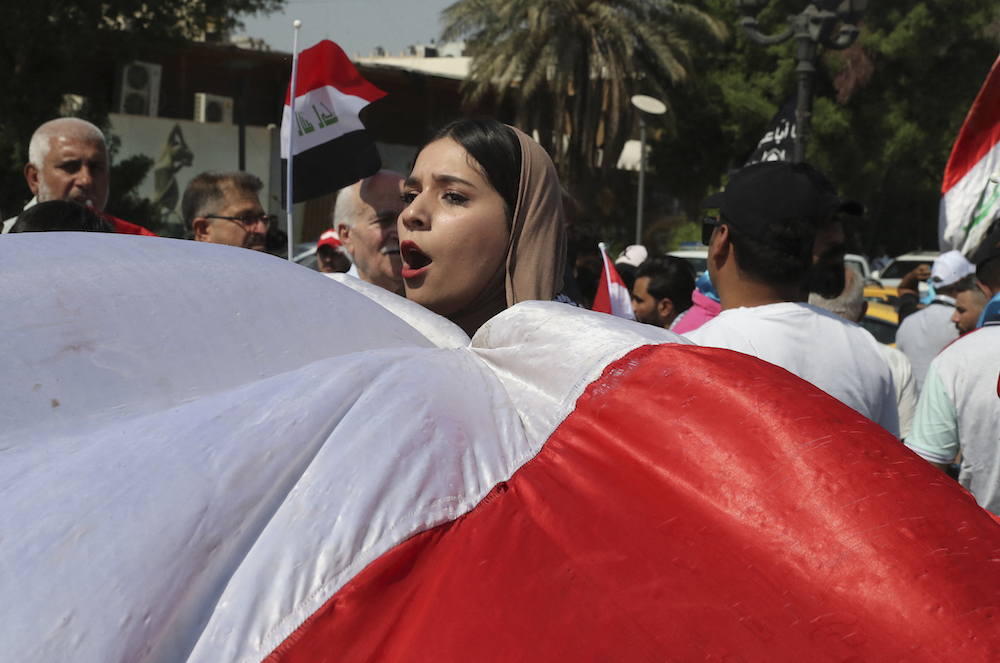
Iraqis chant slogans as they rally at Fardous square in central Baghdad, on October 1, 2021, demanding justice for demonstrators killed during the October 2020 anti-government protests, ahead of the October 10 parliamentary elections. (AFP)

Rana, a 24-year-old law graduate, also from Kut, said: “We were told there would be democracy and change. On the contrary. We had one corrupt face; now we have many corrupt faces.

“Since the invasion and until now, we have not seen real change. It is like a mafia controlling the government. They are just a group of gangsters working for their own interests, from the 2003 government until the current one.”

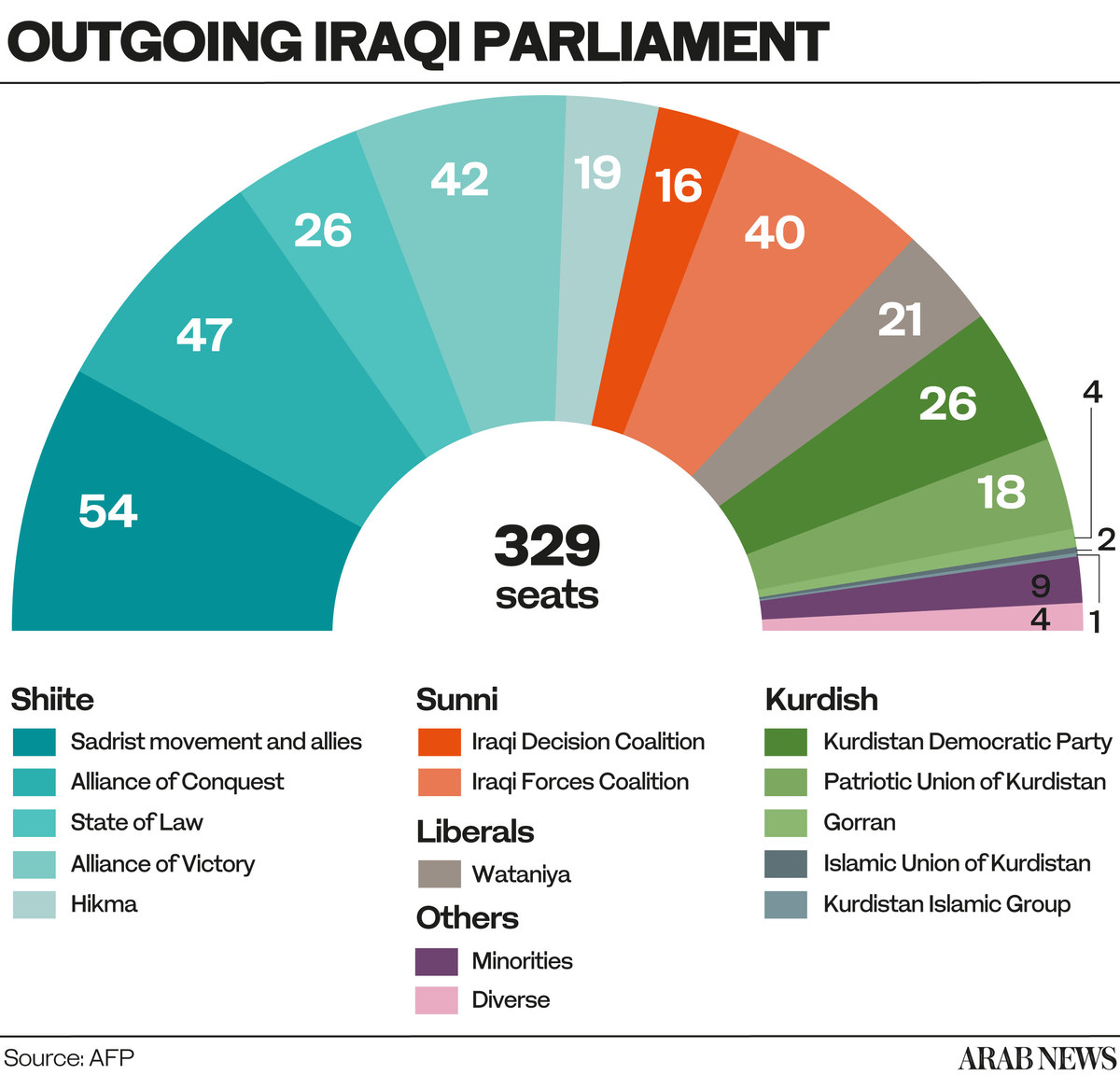
Former Iraqi Prime Minister Nouri Al-Maliki’s State of Law coalition, which maintained close ties with Iran, came to dominate national affairs in the years after 2003, leaving Iraq’s once pre-eminent Sunni minority and long-persecuted Kurds feeling excluded.


ALSO READA Mosul book cafe raises political awareness in the run-up to Iraq elections


A sectarian civil war soon enveloped the country from 2006 to 2008, followed in 2014 by the emergence of Daesh, an Al-Qaeda splinter group that went on to conquer a third of Iraq’s territory in the predominantly Sunni northwest.

Once the Iraqi security forces had reclaimed these territories in 2017 with extensive coalition air support, the country set about the gargantuan task of reconstruction and resettling millions of displaced households.

The May 2018 election was post-war Iraq’s first democratic test. But with a record low turnout, and widespread allegations of fraud, Shiite militia leaders moved almost seamlessly from the battlefields into the corridors of power, together with the followers of firebrand Shiite cleric Muqtada Al-Sadr.

And, after months of back-room wrangling, the victors chose the mild-mannered technocrat Adel Abdul-Mahdi to form a new government.

However, slow progress on reconstruction and resettlement, rising unemployment, and rolling power outages soon stoked public anger and, by October 2019, tens of thousands of young Iraqis had taken to the streets nationwide demanding the removal of the post-2003 elite.

A violent crackdown by security forces and pro-government militias left hundreds of protesters dead and thousands injured. Although it eventually secured Abdul-Mahdi’s resignation, the movement soon fizzled out with the onset of the coronavirus disease (COVID-19) pandemic.


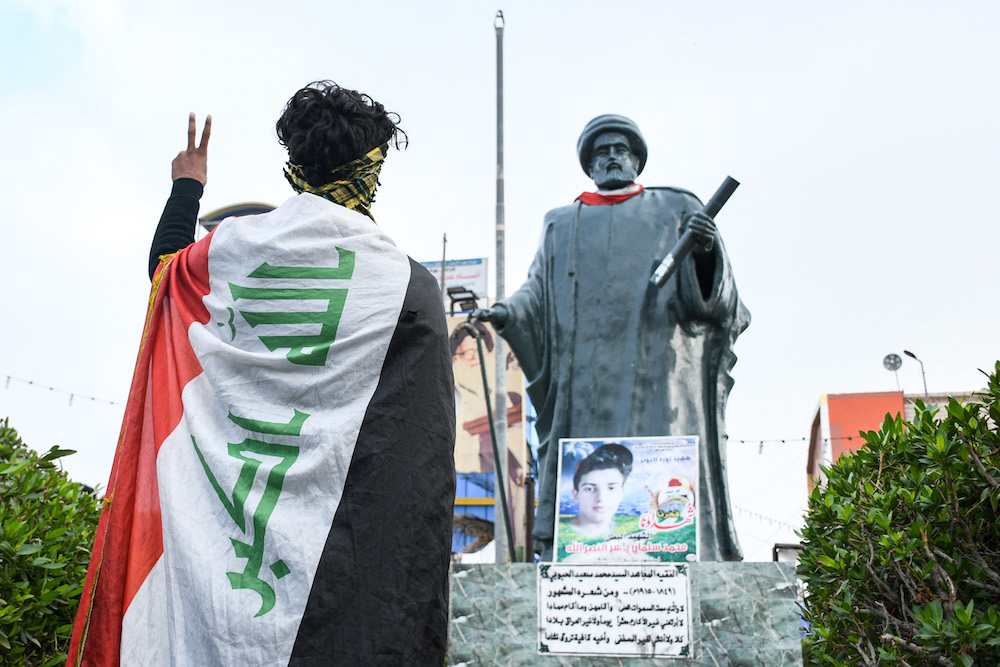
A youth draped in an Iraqi national flag flashes the victory gesture while standing before a statue of 19th century Iraqi cleric and poet Mohamed Said Al-Habboubi. (AFP/File Photo)

Rana added: “During the occupation period, people could not speak up and instead bottled up their frustrations. The grievances accumulated over the years until people could no longer hold it in. They came out on the streets in anger over the lack of services, reconstruction, security, and other injustices.

“The Iraqi youth became aware and more educated, so they came out with the revolution of October 2019. They stood against injustice and asked for the rights that have been stolen under the cover of democracy and by Islamic political parties.”

In May 2020, Mustafa Al-Kadhimi, Iraq’s former intelligence chief, was appointed the new prime minister for the period until the national elections scheduled for the following year.

Without a clearly defined political leadership heading the movement, Iraq’s young protesters were not able to translate their energy and idealism into an electoral force capable of making their demands a reality.


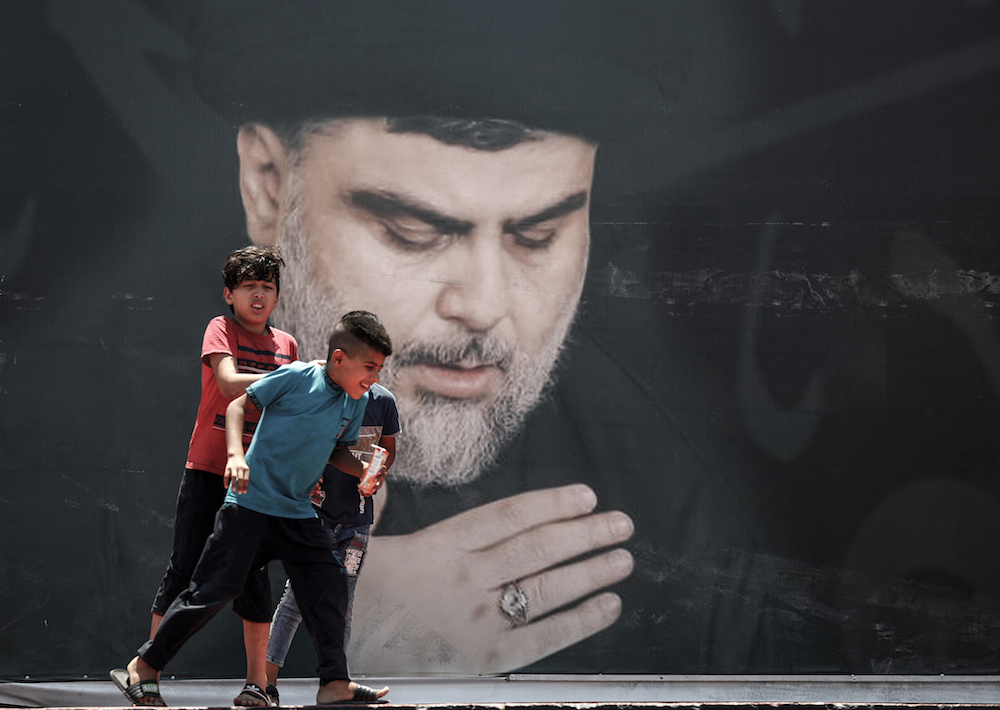
Children play in front of a large poster of Iraq’s populist Shiite cleric Moqtada Sadr, in Sadr City, east of the capital Baghdad, on July 15, 2021. (AFP/File Photo)

The handful of young revolutionaries who have chosen to run as independent candidates in the Oct. 10 election stand little chance of success against the well-oiled machinery of Iraq’s establishment parties.

Zahraa Ali, a 31-year-old freelance journalist from Fallujah in western Iraq, said: “It is not easy to be involved in the democratic process here in Iraq. If you are, you will face many issues.

“If you participate in the election, they will definitely create an issue for you. The political leaders and parties that rule Iraq treat it like a dictatorship. They are imposing their will on us.”

Ali and other local activists have organized workshops to help educate Iraqis of voting age on the democratic process, their rights, and what is at stake in Sunday’s election. “In terms of change and development, it can only be achieved by Iraq’s young people,” she added.

Nevertheless, few among Iraq’s youth hold out much hope of dislodging the post-2003 order and its powerful militia-backed parties any time soon.

Zainab Jabar, a 24-year-old unemployed graduate from Basra, said: “I boycotted the last election, and I will not participate in this one either. We already know the result, so what is the point of taking part?”


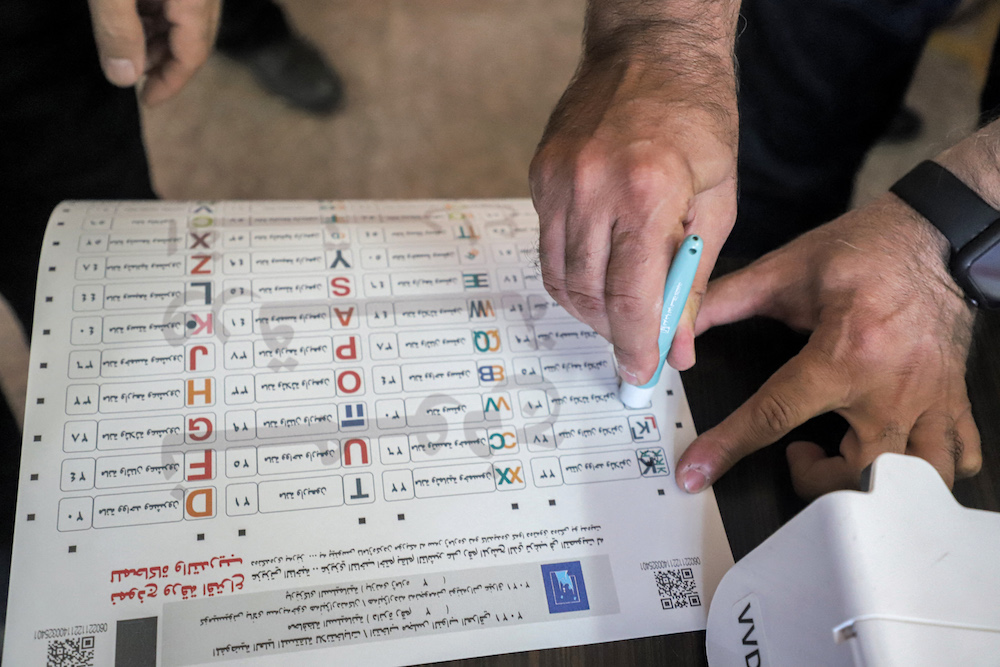
Officials of Iraq’s electoral commission undergo a polling day simulation to test run its systems ahead of the upcoming parliamentary elections. (AFP/File Photo)

Jabar was among the thousands of young people who joined the protests in Iraq’s southern city of Basra in 2019. Despite its huge oil riches, Basra remains one of Iraq’s most deprived provinces, blighted by crime, poverty, and decaying infrastructure.

“We will need 50 to 100 years to change and remove the powerful political parties in Iraq. We want the change that we demanded in our revolution in October 2019. It did not happen as we hoped,” Jabar added.

Karar Al-Duaikheil, a law student from Basra, said: “Basra is the worst city in Iraq. It is dead in terms of services, construction, education, and employment, and there are militias and uncontrolled weapons on the streets. Moreover, it suffers from killings, kidnappings, threats, and arbitrary arrests.

“Unfortunately, Basra residents do not choose the candidates they want but the ones chosen by Al-Maliki, Al-Sadr, Ammar (Al-Hakim) and other political players. None of them are clean or good people.

“In addition, tribal leaders play a significant role here. They are getting stronger, with more weapons and money. Young people do not want to select a candidate who works for his party rather than for Basra.”

Al-Makhsousi pointed out that it would take time for Iraq’s democracy to fully mature and meet the needs and expectations of its young voters.


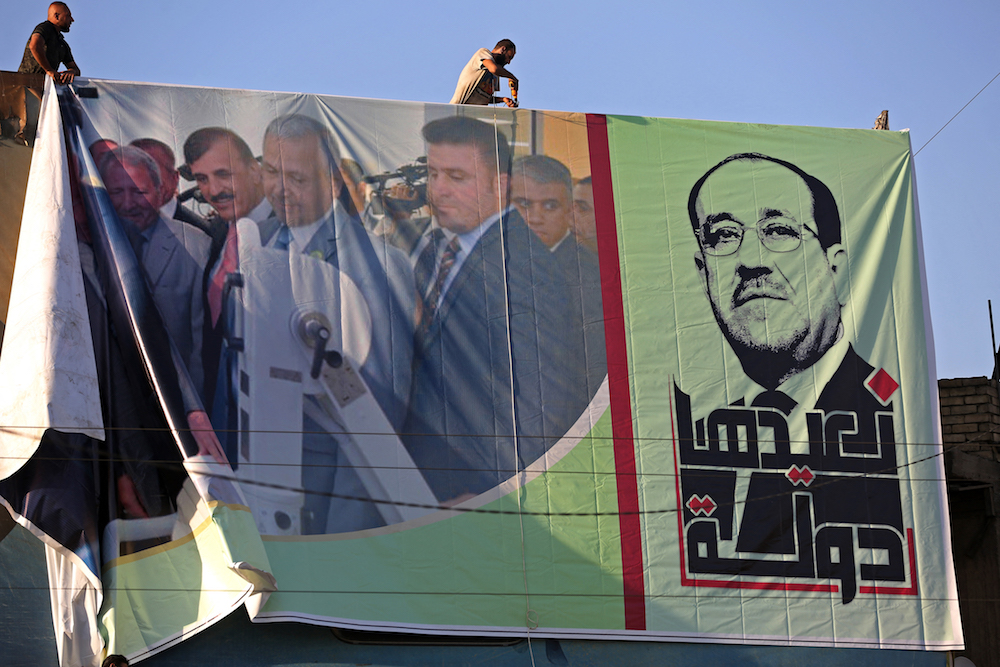
A campaign poster is seen in the Iraqi capital Baghdad on September 14, 2021, ahead of the upcoming parliamentary elections. (AFP/File Photo)

“We need more time to shape this democracy with our culture and community. We are still learning. This democracy divided us into states, regions, neighborhoods, and groups in our country.

“Wherever you go, you need a special security permit. It feels like you are not in your own country. It is as if you do not belong to it. We do not have an Iraqi nation.

“We boycotted the election in 2018. The result was very bad, and we had a regime without anything. For the upcoming election, I will be participating in order to change something, step by step.”

To this end, young people such as Al-Makhsousi have the full backing of the prime minister. In a recent tweet, Al-Kadhimi said: “Iraq counts on its youth for reform. With their persistence on a better future, the elections will be a true national triumph.

“Vote for those who preserve Iraq’s unity, sovereignty, and unique national identity. Oct. 10 is the opportunity for change.”

As election day unfolds Sunday, many young Iraqis still feel alienated from the political process and skeptical about meaningful change happening via the ballot box. (AFP/File Photo)
Main category: 

Security forces vote in Iraq’s general electionFast-rising Iraqi politician pushes rebirth of war-scarred city of RamadiA Mosul book cafe raises political awareness in the run-up to Iraq electionsUS leads western praise for Iraqi electoral commission ahead of Sunday’s vote


100 Houthis killed in heavy fighting outside central Yemeni city of Marib

Sat, 2021-10-09 21:31

AL-MUKALLA: At least 100 Houthis have been killed since Friday evening in clashes with government troops in contested areas outside the central Yemeni city of Marib, military officials said on Saturday.

The clashes broke out as the Iran-backed militia intensified its artillery shelling and ground attacks on government-controlled locations in Al-Kasara, west of Marib, as part of its push to seize control of the city, Rashad Al-Mekhlafi, a military official at Yemen’s Armed Forces Guidance Department, told Arab News.

Al-Mekhlafi said the bodies of at least 100 fighters had been abandoned in mountains and rough areas in Al-Kasara, and that the rebels had been forced to stop their attacks after failing to break through the government’s lines of defense.

“The Houthi attack (in Al-Kasara) began at nearly 8 p.m. on Friday and ended on Saturday afternoon. They used different kinds of weapons and dispatched waves of fighters.” 

Al-Mekhlafi added that Arab coalition warplanes had played a vital role in disrupting Houthi attempts to bring in military reinforcements to Marib and targeted their military locations and gatherings.

By Saturday afternoon, government forces had killed dozens of Houthis, including many military leaders, pushed back Houthi attacks, and scored limited advances in Marib province, Al-Mekhlafi said.

There was also fighting in the south and west of Marib, in Jabal Murad, Juba, and Al-Abedia.

Military officials denied Houthi media reports that residents in the besieged district of Al-Abedia had agreed to allow the militia to control it in exchange for a safe corridor for government troops.

“People there do not trust the Houthis. The Houthis launched many attacks to seize control of the district,” Al-Mekhlafi said.

The siege is in its third week, with Houthis trying to force troops and allied fighters to surrender.

The Houthis have banned humanitarian assistance from reaching more than 35,000 people and blocked residents from leaving or entering the district.

There have been warnings from local organizations and officials about starvation if the Houthis continue with the siege.

The fighting in Marib comes as US Yemen envoy Tim Lenderking on Friday began a new diplomacy shuttle in the region to revive peace efforts to end the war in Yemen and discuss ways to stop the offensive, the US State Department said.

The US envoy, who touched down in Jordan on Friday, is visiting the UAE, Saudi Arabia, and Oman. He is meeting officials from those countries, along with Yemeni government officials and civil society representatives.

“During his meetings with international partners, Special Envoy Lenderking will address the consequences of the continued Houthi offensive in Marib, which is exacerbating the humanitarian crisis, killing civilians, and defying the international consensus on the urgent need for a peaceful resolution to the conflict,” the department said.

Thousands of Yemenis have been killed since February, when the Houthis renewed an offensive to control the city.

Main category: 
Tags: 

Houthis under fire for killing displaced civilians in MaribHouthis reject calls for truce, intensify attacks on Marib


Silent Jewish prayers at Al-Aqsa rejected by Israeli appeals court following protests

Author: 
Zaynab Khojji
ID: 
1633805260106201800
Sat, 2021-10-09 21:47

AMMAN: The Israeli central court accepted the appeal by the Jerusalem police against a lower court ruling that allowed “silent” prayer by Jewish activists on the grounds of Al-Aqsa Mosque.
Wasfi Kailani, executive director of the Hashemite Fund for the Restoration of Al-Aqsa Mosque, told Arab News that the entire area of Al-Haram Al-Sharif/Al-Aqsa Mosque is an Islamic religious site that is exclusively for Muslims.
“All 144 dunums of the mosque compound is an Islamic location owned and managed by the Islamic Waqf (endowment).”
Kailani said that, while the Waqf Council welcomes visitors at certain hours, it is done with the understanding that they are welcomed to visit as tourists but not to pray, and “that the visiting rights should be open to all non-Muslims who enter Al-Aqsa with permission of Awqaf and follow their instructions.”
Kailani said Muslims from all around the world “should have access and the right of worship in Al-Aqsa.”
The earlier decision that would have changed the status quo in occupied Jerusalem was widely rejected in the region.
Jordan, whose Waqf Ministry administers the mosque in Jerusalem, condemned the initial lower Israeli court ruling. Foreign Ministry spokesperson Haitham Abulfoul said that the decision is null and void and lacks legal status under international law, which does not recognize Israeli jurisdiction on territories occupied in 1967, including East Jerusalem.
Dimitri Diliani, head of the Palestinian National Christian Coalition, said that the decision of the Israeli central court was the result of united efforts by Palestinians and their friends.
“This victory is the result of the popular anger of Palestinians from all walks of life, in addition to the stance of Arab countries, led by Jordan, whose monarch King Abdullah II is the custodian of Muslim and Christian holy places in Jerusalem.”
A 2014 Jordanian and Israeli understanding witnessed by the US says that Al-Aqsa is for “Muslims to pray and for all others to visit.”
Israeli Prime Minister Naftali Bennett backed down in July from statements that appeared to support the rights of Jews and Muslims to pray on the Muslim site, statements that would have marked a stark shift from Israel’s policy of maintaining the status quo at Jerusalem’s holy site.
Sources in the Israeli Prime Minister’s Office claimed on July 19 that Bennett had “misspoken” when he said both Jews and Muslims have “freedom of worship” on the Temple Mount, which would be a potentially explosive change after decades of Jews being permitted only to visit there, but not to pray.
The current tensions began when Bilha Yahalom, a Jerusalem magistrate judge known for her right-wing position, ruled that the silent prayer at the complex cannot be considered a “criminal act.”
This came in an appeal by Rabbi Aryeh Lippo against a police ban on his visits to the flashpoint site following his repeated prayers in violation of the agreed position for visits to the Muslim site.
The police appealed the decision, which caused ripple effects in Jerusalem and throughout the region.

Main category: