Drought gives rebirth to Kurdish village in northern Iraq
Sat, 2021-11-06 02:28
DOHUK: The ruins of an Iraqi Kurdish village abandoned 36 years ago and submerged under the waters of a dam, have suddenly resurfaced thanks to sinking water levels in the drought-hit country.
The construction of the dam, 2 km north of the town of Dohuk, started in 1985 and prompted the resettlement of Guiri Qasrouka’s 50 families.
Guiri Qasrouka was then swallowed by the waters which serve to irrigate surrounding farmland.
“Because of the drought” caused by scant rainfall in Iraq, the Dohuk dam’s water level dropped by seven meters in September and brought the village back to the surface, explained the dam’s director, Farhad Taher.
BACKGROUND
The construction of the dam, 2 km north of the town of Dohuk, started in 1985 and prompted the resettlement of Guiri Qasrouka’s 50 families.
“This phenomenon is certainly linked to climate change,” Taher said, adding that the ruins had also reappeared in 2009, 1999 and 1992.
Before the winter rains set in and the village goes under again, visitors on foot can now view the stone walls of a Guiri Qasrouka home that is still standing.
The algae-splattered and shell-indented ruins are set against a backdrop of the towering Kurdish mountains of northern Iraq.
With financial compensation, villagers, who had also fled between 1974 and 1976 during a Kurdish uprising, built a new Guiri Qasrouka nearby.
In Iraqi Kurdish city, women gain power without parityIraq’s Kurdistan health authority calls on citizens to register for COVID-19 vaccine to fight third wave
Pope to revisit island of Lesbos on trip to Cyprus, Greece
Author:
Sat, 2021-11-06 02:14
VATICAN CITY: Pope Francis will visit Cyprus and Greece next month, the Vatican said on Friday, returning to the island of Lesbos, a major port of entry for migrants into Europe.
His 35th trip abroad comes just five months after the Argentine pontiff, who turns 85 in December, was hospitalized following surgery on his colon.
“Pope Francis will travel to Cyprus from 2 to 4 December, visiting the city of Nicosia, and to Greece from Dec. 4 to 6, visiting Athens and the island of Lesbos,” spokesman Matteo Bruni said in a brief statement.
The Argentine pontiff has traveled widely since he took office in 2013, and although his schedule was suspended by the coronavirus pandemic, this year he has already made a historic trip to Iraq and visits to the Hungarian capital and Slovakia.
Migration has been a key theme — his first trip as pope, in July 2013, was to the Italian island of Lampedusa, the landing point for migrants crossing the Mediterranean from North Africa.
While there, he criticized the “globalization of indifference” over migrants.
In April 2016, he visited Lesbos at the height of Europe’s migrant crisis, where he paid a trip to Moria, the continent’s largest migrant camp that was destroyed by fire last year.
Lesbos has for years been the main entry point into Europe for asylum seekers.
Josif Printezis, the Catholic archbishop for Greek islands in the Aegean, said earlier this month that the pope “wishes to see the evolution of the refugee issue, the fruits of Greece’s efforts and make a humanitarian statement.”
He would say “that the Church and all European peoples care about refugees, and that the weight borne by Greece should be recognized by the other European countries,” Printezis said.
After his last visit to Lesbos, Francis took three Syrian families from the camp home with him, in what he described as a humanitarian gesture.
The Vatican said later that the group, selected on the grounds that their paperwork was sufficiently in order, had settled into life in Rome and started to learn Italian.
The last papal visit to the Mediterranean island of Cyprus was by Benedict XVI in 2010.
Several other visits are in the works.
The pope said in October he intends to visit Oceania for the first time next year, without saying where, and also had “in my head” trips to Congo and the rest of Hungary.
Speaking to Argentine news agency Telam, he said he was overdue a trip to Papua New Guinea and East Timor originally planned for 2020.
The pope had expressed hope he could fly to Glasgow for this month’s UN talks on climate change, another subject close to his heart, but in the end he sent only a video message.
Despite his busy schedule, there are signs that his age is catching up with him.
On returning from a grueling three-day trip to Iraq, the pope admitted he “felt a lot more tired” than during other visits.
Pope leads calls for climate action as rich nations sound alarmGreek police move homeless migrants to new Lesbos camp
Israel troops kill Palestinian teenager in West Bank
Author:
Sat, 2021-11-06 01:57
JERUSALEM: A 13-year-old Palestinian was shot and fatally wounded on Friday by Israeli troops in the occupied West Bank, the Palestinian Health Ministry said.
It said Mohammed Daadas died in hospital after being shot in the stomach during clashes between Palestinian protesters and Israeli forces in Deir Al-Hatab village, east of Nablus.
The Israeli military did not immediately comment on the report.
Two other Palestinians were injured Friday in clashes in Beita, another West Bank village where locals have struggled for months to dislodge Israeli settlers and the military from a hilltop.
The clashes come days after Israel announced it would advance plans for 3,000 more homes for Jewish settlers in the West Bank, despite international criticism.
Israel has also advanced plans to build about 1,300 homes for Palestinians in the West Bank, but critics see the move as an attempt to parry global condemnation of settlement construction.
Palestinians eye the West Bank as part of a future state, while hard-line Israelis including Prime Minister Naftali Bennett say it is a heartland of Jewish history.
Israel seized the West Bank and east Jerusalem in the 1967 Middle East war.
Hundreds of thousands of Israelis have since moved into settlements that most of the international community regard as illegal.
Bennett has ruled out formal peace talks with the Palestinian Authority, saying he prefers to focus on economic improvements.
Bennett, a hard-line former settler, presides over a motley alliance of fellow nationalists, centrists, liberals and the first Arab party to ever sit in an Israeli government.
Israeli MPs approved the government’s two-year budget on Friday, bringing stability to a shaky coalition of ideological opposites that would otherwise have collapsed, returning Israel to years of political turmoil.
“The budget we passed last night is excellent! I am mostly proud that it brings us a true and timely response to the needs of Israel 2022,” Bennett tweeted after the package was approved.
The coalition needed to pass a budget by Nov. 14 to avoid a fifth election in three years.
None of the 61 members of the coalition defected through nearly 36 straight hours of voting.
Roughly 600 separate votes on individual spending measures were required to pass the budget that sets expenditure for this year at 609 billion shekels ($194 billion) and for next year at 573 billion shekels.
Speaking on Thursday after the approval of the 2021 measures, Bennett boasted: “After years of chaos, we have formed a government, we have conquered delta (variant of the coronavirus) and now, praise God, we have passed a budget for Israel.”
The country’s largest-selling newspaper, Yediot Aharonot, said Bennett’s government had finally attained “stability and a horizon,” and would no longer “topple in the slightest wind.”
Mansour Abbas, whose Raam party forms part of Bennett’s governing coalition, said it was the first time an Arab party had played a key role in the adoption of a budget.
“This is an important step in the political integration process” of Israel’s Arab minority, he said.
Approval of the two-year budget gives the coalition stability until 2023, when Bennett is due to turn the premiership over to centrist Foreign Minister Yair Lapid.
Suggestions that the government might fall before Lapid gets to take over could have unsettled the coalition’s left wing, analysts said.
“Coalition of change,” Lapid tweeted after the budget vote.
Israeli media reported attempts by the opposition, led by former prime minister Benjamin Netanyahu’s right-wing Likud party, to peel away coalition lawmakers to vote against the budget.
Instead, the approved a budget that will increase military spending and aim to narrow gaps between the Jewish majority and Arab minority, among other priorities.
Israeli bookstores pull Irish author’s work for refusing offer of Hebrew translationBenjamin Netanyahu’s hopes for a comeback dim as Israel passes budget
Lebanese PM hopeful after crisis-busting move as calls grow for Kordahi’s resignation
Sat, 2021-11-06 00:39
BEIRUT: Lebanese Prime Minister Najib Mikati was on Friday awaiting the results of behind-the-scenes consultations aimed at bridging the gap within his government and mending ties with Saudi Arabia and other Gulf countries, after they severed diplomatic and economic ties with Beirut in protest over statements made by Information Minister George Kordahi.
MP Ali Darwish, a member of Mikati’s parliamentary bloc, told Arab News: “Through the roadmap that Mitaki announced on Thursday, he put forward an initiative to defuse the crisis.”
Darwish stressed that Mikati “is a moderate man by nature over whom there is consensus, which is essential in a country like Lebanon, so it is crucial for him to carefully and wisely handle issues.”
Mikati had once again called on Kordahi to “follow his conscience and prioritize national interest.”
Kordahi, however, is refusing to resign from the government.
Speaking about the possibility of Mikati’s government falling if Kordahi and his political team stand firm, Darwish said: “Mikati understands the Lebanese situation and believes that as long as he is prime minister, he can help Lebanon maintain good relations with the Arab countries.”
Darwish added: “If Mikati were to resign, Lebanon could face unimaginable consequences.”
The MP also said the current government “is based on a formula that brings together all the Lebanese, and if we were to lose the executive authority, we would be stripping Lebanon of the decision-making authority.”
Speaking on behalf of the anti-Hezbollah Sovereign Front, former Interior Minister Maj. Gen. Ashraf Rifi said: “Hezbollah formed governments based on its interests, controlled the state and took it hostage for Iran’s sake.”
He called on Mitaki to resign, saying: “You are the prime minister of a dysfunctional government, and the country does not need more Hezbollah governments.”
Rifi noted: “This entire regime needs to leave, starting with the president from Hell, Michel Aoun. We need to steer away from the axis of evil, and justice must be applied.”
International support for the Mikati government grew on Friday when the French Foreign Ministry announced that it is in “close contact with all parties concerned with the new conflict between Arab countries and Lebanon.”
French Foreign Minister Jean-Yves Le Drian called on “all parties, as well as Lebanese officials, to promote calm and dialogue for the sake of the Lebanese people and the stability of Lebanon,” stressing that this is “critical for the region.”
Le Drian said: “Separating Lebanon from regional crises is of fundamental importance. Lebanon must be able to count on all its regional partners to support it in implementing reforms.”
After she met with Mikati on Friday, the UN Special Coordinator for Lebanon Joanna Wronecka expressed “full support for the work of the Mikati government,” encouraging it to proceed with the required reforms.
On Thursday evening, US State Department spokesman Ned Price stressed that Lebanon must work with its partners for the sake of the Lebanese people, and leave diplomatic channels open with the Gulf countries.
Price added: “We look for ways to alleviate the suffering of the people of Lebanon.”
MP Nicolas Nahas, a member of Mikati’s parliamentary bloc, described the current political complications as “major,” noting that efforts are ongoing to curb the escalation with the Gulf states.
He added: “The issue requires a clear and integrated roadmap to rebuild confidence, and the first step begins with Kordahi following his conscience.
“If he does not resign, the president, the prime minister and the parliament speaker would need to decide what measures to take.”
Nahas stressed: “Serious work is required, and it is not permissible in any way for the people to pay the price for political disputes.”
Russian Foreign Ministry spokeswoman Maria Zakharova also commented on the crisis.
Zakharova said: “Russia is looking forward to resolving the diplomatic conflict between Lebanon and the Arab Gulf states as soon as possible.”
Zakharova pointed out that Kordahi’s statements “were made at a time when he was not yet a minister representing the Lebanese state and its government.”
Lebanese prime minister urges information minister to resign
From traditional to abstract, Arab pavilions at Expo 2020 Dubai seize the imagination
Author:
Alexandra Draycott and Amanda Engelland-Gay
ID:
1636141452228336500
Fri, 2021-11-05 22:43
DUBAI: World Expos have a long and illustrious past, not least for their lasting contributions to urban skylines and architectural world-firsts. The Eiffel Tower and Chicago’s Ferris Wheel are two of the most recognizable examples.
Despite such permanent contributions, expos have mostly been temporary events, with elaborate pavilions representing countries from every corner of the world for a limited time, only to be unceremoniously removed at the end of the duration.
Chicago built an entire temporary city in grand neo-classical style for its expo in 1893. The famous White City ultimately provided planners with a blueprint for future growth — however, the buildings themselves were not retained.
This has been a common narrative of World Expos, with pavilion structures either unused or destroyed afterward.
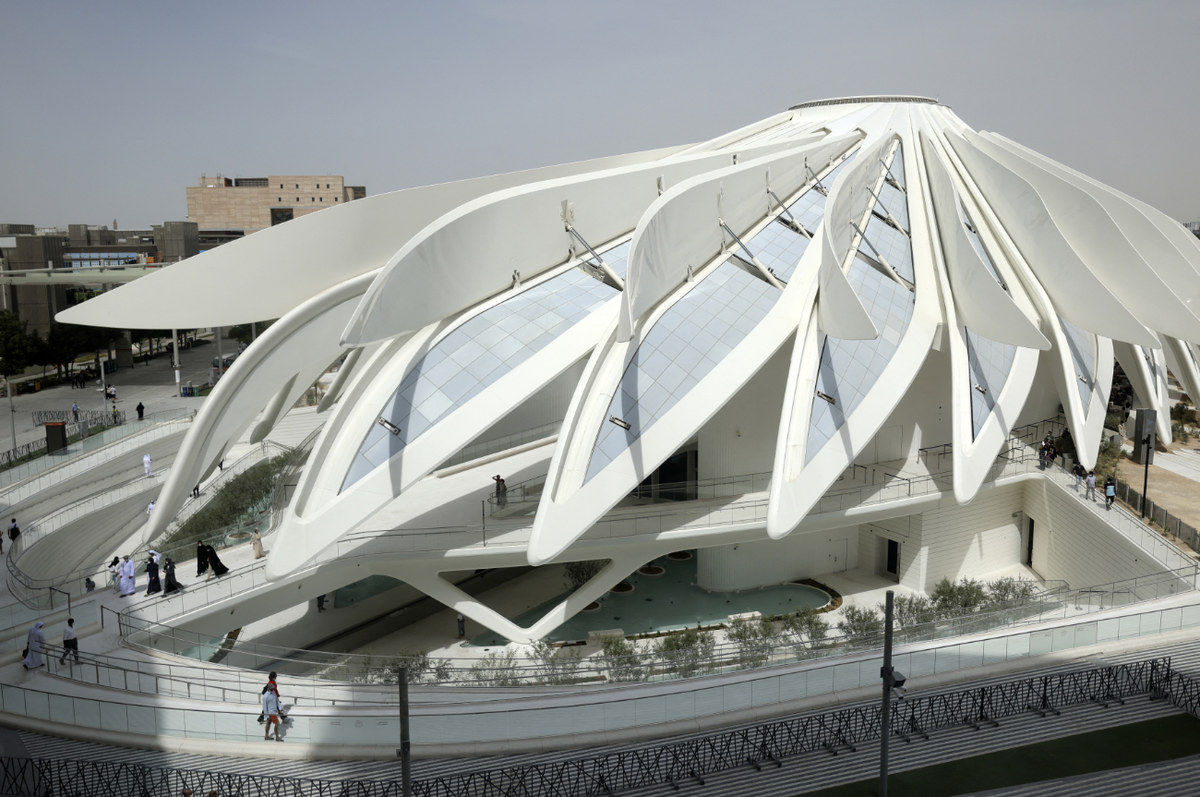
Not so in Dubai. The Expo 2020 organizing committee has designed the site to include a dedicated pavilion for each nation, in addition to other participating organizations, which are intended to remain long after the event draws to a close.
Its novel concept has resulted in more than 200 pavilions across a site twice the size of Monaco, the sovereign city state on the French Riviera.
The site is divided into three “thematic districts” that mirror the sub-themes of the event: Sustainability, mobility and opportunity.
Algeria
Some of the pavilions have been designed and built by participating countries, showcasing their own national architecture and designs, while others occupy standardized buildings assembled by the host.
Many Arab countries have built their own pavilions and put substantial resources and effort into their development (with assistance from the UAE, in certain cases).
All Gulf Cooperation Council member countries — as well as Morocco, Algeria, Lebanon, Palestine and Egypt, among others — have self-built pavilions.
Many of these are in the Opportunity District, with prime locations close to the UAE and Saudi pavilions.
Since this is the first expo to be hosted by a Middle Eastern country, Arab states have pulled out all the stops to make their mark on the event.
Architecture across the site incorporates many elements of traditional Arabic design, but the overall impression is perhaps not as visually cohesive as Chicago’s White City would have been.
Oman
Each country participating in Expo 2020 Dubai has been given the freedom to bring in its own unique design, with regional touches such as latticework, courtyards and shade structures applied throughout.
The result is a selection of powerfully individual pavilions designed to capture visitors’ interest.
Arab pavilion designs and their associated architecture can be broadly defined as falling into two camps: Traditional yet innovative, with an emphasis on history and culture; and the expressive and inventive, with an emphasis on the abstract and experimental.
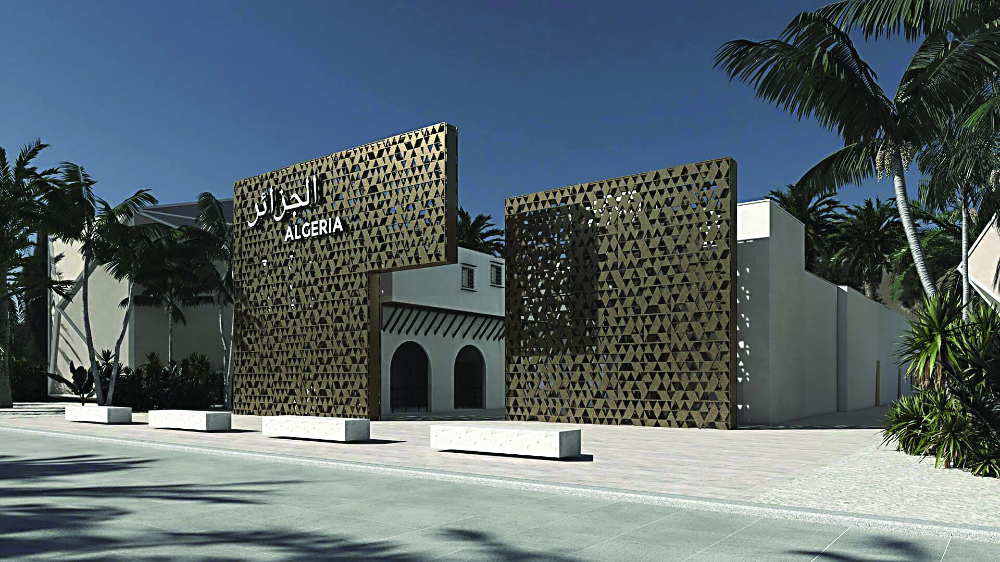
Falling into the former category is Algeria’s pavilion, modelled on the Casbah (citadel) of its capital Algiers.
In a nod to the host city, the iconic blue and white palette of Algiers has been traded for desert shades.
The design of the pavilion references traditional Algerian style, with an interior courtyard and design elements to maximize air flow.
While the pavilion’s interior courtyard provides a quiet protected space, the facade is dramatically stylized with designs resembling traditional Berber tattoos.
Bahrain
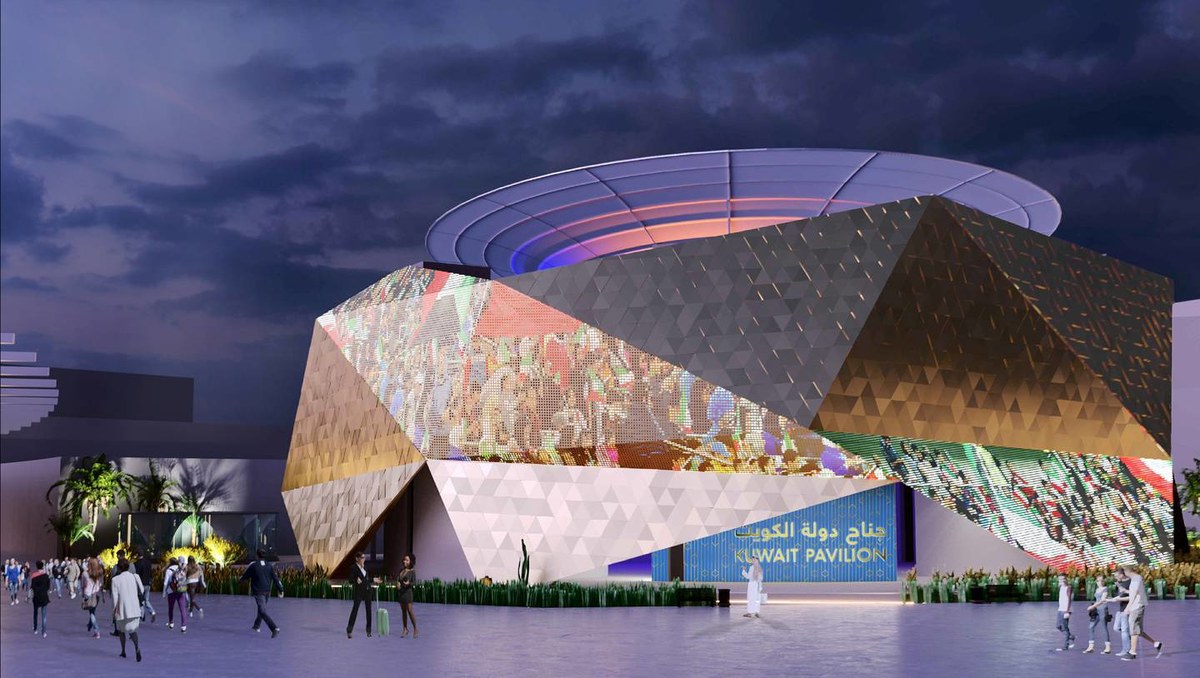
Also occupying the traditional-yet-innovative camp is Kuwait’s pavilion, an eye-catching gold structure in the Sustainability District, constituting the Gulf kingdom’s most ambitious expo contribution to date.
The design evokes the ecology of the desert, with video of camels and rolling sand dunes displayed on large external screens.
Textured gold exterior panels form a modern take on its desert terrain. In the center of the pavilion is a reproduction of a local water tower, used for the conservation of natural resources.
Another of the traditionalists is Morocco, which drew inspiration for its pavilion from its scenic earthen villages.
At 34 meters in height, spread across seven floors, it is among the tallest buildings at the expo.
The facade was built using rammed-earth construction methods, common to Morocco and inherently sustainable as the thick earthen walls keep the air inside cool.
UAE
The rooms are arranged around a central courtyard, complete with hanging gardens and other tributes to Moroccan regions and ecosystems.
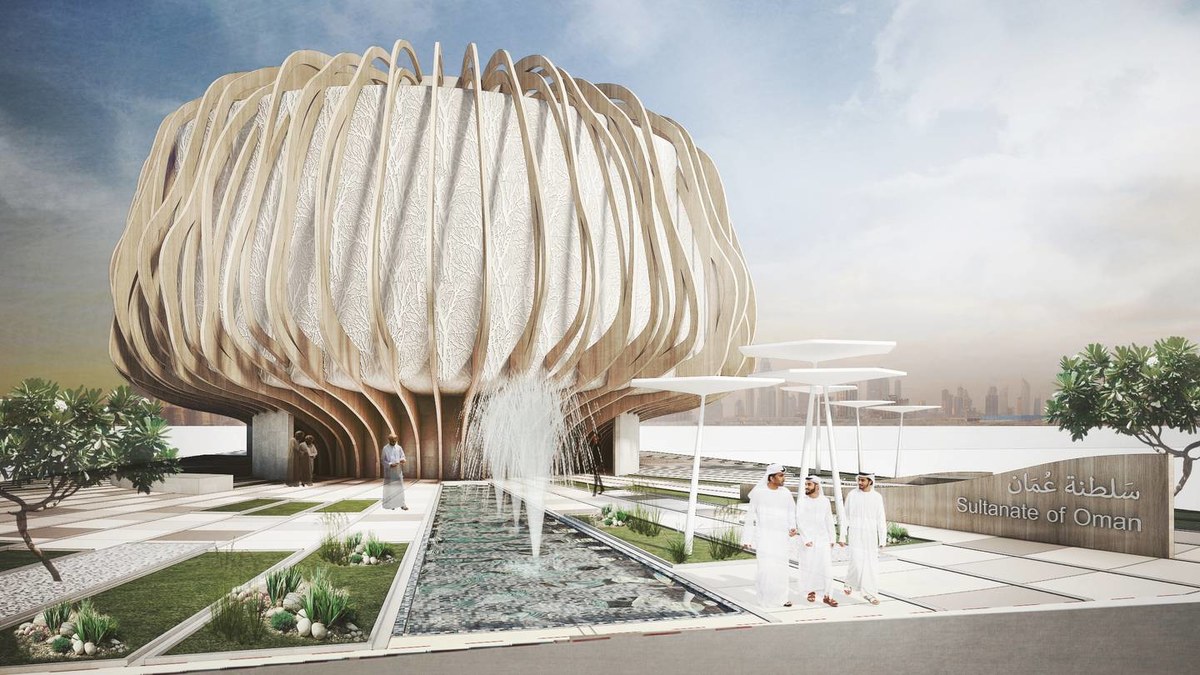
Oman, too, pays homage to its traditional roots with a focus on the ancient frankincense tree, native to Dhofar governorate.
The exterior resembles the tree, with rich curved frankincense beams that required two to three years to create especially for the expo.
Oman also has among the most creative visitor experiences, with frankincense-scented sanitizing mist at the entrance and a photo area where floor panels emit sudden jets of faintly scented mist, so that the surprise of visitors is captured on camera.
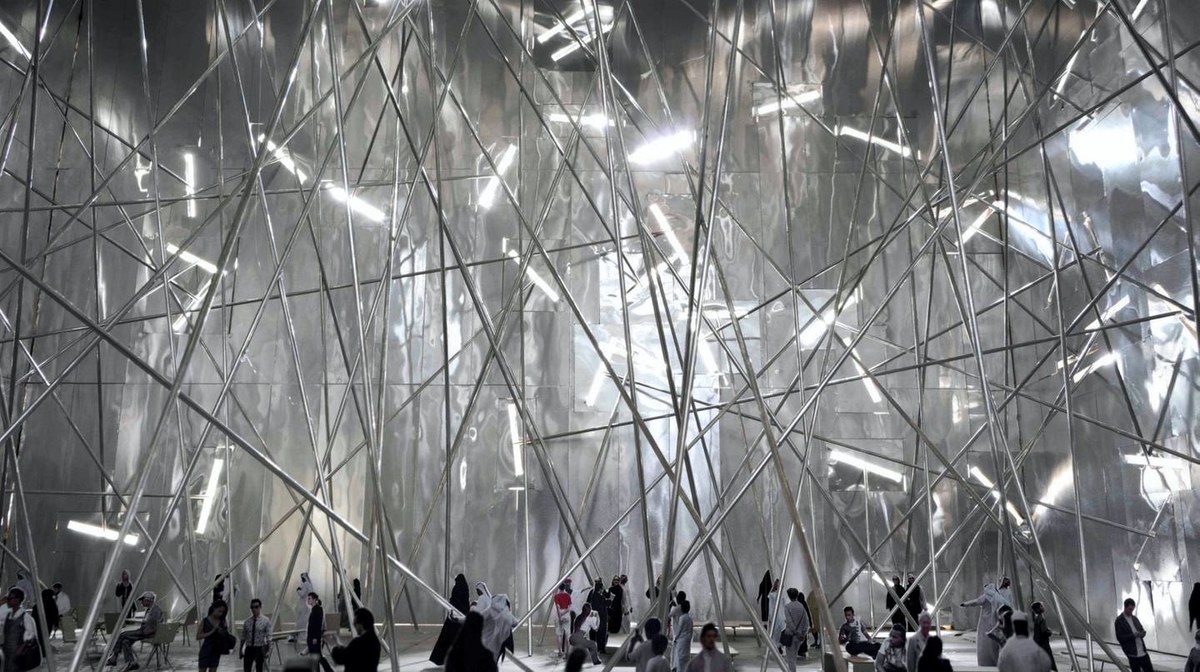
Bahrain’s pavilion is among the most striking and experimental of the expo. Designed by Christian Kerez Zurich AG, the pavilion appears from the outside to be a windowless metal box bristled with long metal rods, with no discernible entry or exit.
Instead, visitors are directed down a long ramp that takes them deeper and deeper underground, where the air becomes cooler and the sounds of the surface world recede.
Morocco
The descent is described by the architect as “a transition between the outer and inner worlds of the pavilion.”
When visitors enter the pavilion proper, they are greeted by a cavernous ceiling and bright light.
The metal rods visible on the outside are revealed to be part of a forest of floor-to-ceiling columns.
The pavilion design is intended to explore the concept of density — both in reference to the world’s growing urban density, and as a nod to the densely woven fabrics of Bahraini craftspeople.
Another nation whose pavilion design has pushed the boundaries is Saudi Arabia — the expo’s second largest after the UAE’s and an obvious crowd favorite.
The structure is a ramp angled up toward the sky, implying the ambition of the Kingdom but also doubling as a kind of window.
The underside of the ramp, which faces visitors as they enter the pavilion, features the world’s largest LED display, depicting Saudi Arabia’s spectacular natural scenery, offering visitors a glimpse into parts of the Kingdom most have never seen before.
The pavilion has earned a Leadership in Energy and Environmental Design platinum certificate in recognition of Saudi Arabia’s commitment to using sustainable construction materials and recycling waste during the construction process.
In a marked departure from past expos, country pavilions will remain a permanent feature of the Dubai landscape.
Some pavilions will be repurposed to house an Expo 2020 Dubai museum, while others will remain tied to their country of origin as venues for cultural exchange.
Kuwait
In 2010, the UAE became the first country ever to relocate its pavilion to home soil after the Shanghai Expo (in the form of 24,000 individual steel pieces). In 2015, the UAE also repatriated its pavilion from Milan.
Now the country is continuing this tradition of sustainable reuse on a far grander scale. In the legacy period after the event, the site will evolve into a residential and commercial community named District 2020, retaining around 80 percent of its existing buildings.
In the meantime, millions of Expo 2020 Dubai visitors are getting an exposure to a global environment awash with new ideas, cultural experiences and entertainment. The wide variety of architecture is a source of awe and inspiration.
And thanks to the foresight of its planners, the expo will not disappear once its six-month run expires, but will live on as a sustainable community for decades to come.
Half a million visits to Saudi Arabia’s pavilion at Expo 2020 DubaiKingdom’s pavilion at Expo 2020 brings together industry experts for first Saudi Salon