Israeli appeals court upholds ruling to return kidnapped boy to Italy

Author: 
Reuters
ID: 
1636666185631718400
Thu, 2021-11-11 00:32

JERUSALEM: An Israeli court on Thursday upheld a ruling to return to Italy a six-year-old boy, the sole survivor of an Italian cable car disaster who was kidnapped to Israel by his grandfather, Israel’s Justice Ministry said.
Eitan Biran’s maternal grandfather had appealed against a Tel Aviv family court’s decision last month to send the boy back to his paternal aunt in Italy, in a cross-border custody battle.
The child had been living with the aunt since his parents, younger brother and 11 other people died when a gondola plunged to the ground in northern Italy in May.
In September, while visiting Eitan, his maternal grandfather, without the aunt’s consent, drove him to Switzerland and chartered a private jet onward to Israel.
The aunt petitioned the family court for his return to Italy. The court found that the grandfather’s actions amounted to kidnapping under the Hague Convention on the return of abducted children.
The grandfather appealed against the ruling to a Tel Aviv district court, which the Justice Ministry said upheld the family court’s decision.
“We order the minor be returned to Italy within 15 days,” the district court said in a ruling released by the ministry. The court stayed implementation of the order for a week to enable the grandfather to appeal to Israel’s Supreme Court.
“Although the appellant took the minor away illegally, his misdeeds should not come at his grandson’s expense, and the minor should be allowed to meet with his grandfather, even in Italy,” the court said.
Lawyers for the grandfather said they will consider an appeal to the Supreme Court, after studying the ruling.

Main category: 

Israeli grandfather says he saved, not kidnapped, grandson in ItalyIsraeli court hears custody fight over cable car survivor, 6



Libyan political impasse threatens election as global powers meet on crisis

Author: 
Fri, 2021-11-12 00:28

PARIS: As political wrangling threatens to derail Libya’s proposed election, international powers see little choice but to start the vote as planned on Dec. 24 despite the risk of unravelling a year-long peace process.
Despite the lack of any agreement six weeks before the election on rules governing the vote or who can run, major states preparing to meet on Friday believe there is momentum behind the poll, diplomats say.
Western states are preparing to strengthen international backing for the election at a conference in Paris on Friday and want agreement on warning any potential spoilers that they could face sanctions.
Libya’s election was set through a U.N.-backed roadmap adopted last year that also established an interim unity government to take over from rival administrations in east and west that had been warring for years.
The peace process is seen as a chance to end the decade of instability and warfare triggered by the 2011 NATO-backed uprising that ousted Muammar Gaddafi and has since drawn in regional powers in a threat to wider Mediterranean stability.
However, with no clear agreement on the legal basis for the election, major factions may reject the vote, and analysts warn that even those who take part may seek to use any ambiguities or disputes to justify subsequent grabs for power.
“A postponement in itself is not less dangerous than maintaining the Dec. 24 date regardless of the risks. It all depends on how things are negotiated,” Jalel Harchaoui of the Global Initiative Against Transnational Crime said.
The likely candidacy of Khalifa Haftar, the commander of eastern-based forces who led a destructive assault on Tripoli in 2019-20 and who wields control in swathes of Libya, has angered many in the capital and western regions. They say no vote in areas he holds can be fair.
Some other Libyans, including powerful figures in the east, want to prevent the candidacy of Abdulhamid Dbeibah, who vowed he would not stand for election when he was appointed as interim prime minister in March. His critics accuse him of using state cash for populist policies he can use to win votes.
Other probable candidates include Saif al-Islam Gaddafi, son of the former dictator, and Aguila Saleh, speaker of a parliament that the election is intended to replace, and who issued a voting law that many Libyans see as self-serving.
Diplomats say they believe an election that includes all major figures is needed and that international monitoring of polls could help to prevent or to reveal fraud or the intimidation, suppression or manipulation of voters.
The most visible obstacle is the dispute over Saleh’s voting law, which was issued during a session that several parliament members later said lacked a proper vote or quorum.
Instead of setting both the presidential and parliamentary elections on Dec. 24 as stipulated in the U.N.’s roadmap, it said the parliamentary vote would take place at a later date along with a second round of the presidential vote.
Saleh’s law also said candidates already holding office must temporarily step down three months before the election. Both Saleh and Haftar have done so. Dbeibah has not.
Armed factions based in Tripoli have rejected the law. So has the High State Council, a body enshrined in a 2015 political agreement.
However, the state elections commission has already moved forward with the process of registering candidates and issuing voter cards. It has said a first round of the presidential election will take place on Dec. 24 with a second round, and a parliamentary election, within 52 days of that.

Main category: 

Egyptian foreign minister discusses Libyan elections, Sudan at media briefingLibyan elections must be held on time, says Egyptian president


At Raqqa ‘roundabout of hell,’ Syrian lovers find new meeting spot

Fri, 2021-11-12 00:19

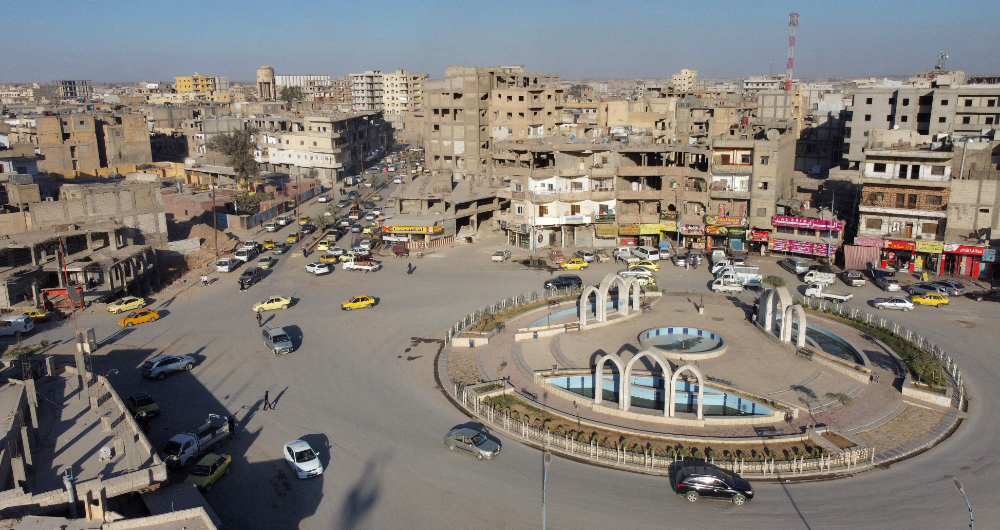
RAQQA: RAQQA: Only a few years ago, Al-Naim square was the grim stage for Raqqa’s public executions. Today, Nader Al-Hussein sits in its new arched design, waiting for his date to arrive.
“This is the best meeting point for lovers, families and friends,” the 25-year-old says, sitting on one of the rare public benches in the bustling, war-ravaged north Syria city.
“Before, we used to avoid passing near it so that we wouldn’t see blood and horror,” Hussein says.
The Al-Naim (Paradise) traffic circle was anything but heavenly when Daesh reigned over Raqqa, its former de facto Syrian capital, between 2014 and 2017.
Residents dubbed it the “roundabout of hell.”
Extremists flaunted their implementation of Shariah law in the square, carrying out flagellations, crucifixions and even decapitations on those deemed apostates or criminals.
Their marauding morality police made it impossible for lovers to meet, even in private, without risking death.
“I never dared to meet with my girlfriend in person; we used to speak only over the phone, out of fear that we may be stoned as punishment,” Hussein says.
Two years after Daesh was declared defeated in Syria, the revamped square is a far cry from the barren dirt mound that hosted some of the jihadist group’s most repulsive acts.
Arched columns have been built around a new central fountain, replacing the metal fence on whose spikes a Daesh executioner once impaled the heads he had just severed before posing for a picture.
Benches have been placed near elliptical side pools.
At night, multicolored laser lights turn the square into a rare attraction amid the drab and ghostly concrete jumble of the city, four years after Daesh left.
The roundabout is central and ringed by cafes and restaurants, making it a popular spot for families and couples alike.
“Al-Naim square has turned from hell into paradise … even lovers come here now,” says 24-year-old Manaf, declining to provide his surname and adding that he visited it often.
Around him, children dash between benches while men and women chat and snap photos. Laughter rises from a picnic spot as street vendors selling red heart-shaped balloons mill about.
In a scene unimaginable just four years ago, Mohammad Al-Ali, 37, and his wife sit side-by-side, looking out for their three children as they play around one of the empty pools.
“We never brought the kids here so that they wouldn’t see decapitated heads hanging,” he said.
“But today, the square is a space for families and children.”
Life is slowly picking up in Raqqa, where leveled buildings and traces of Daesh insignia provide stark reminders of the dark era of jihadist rule.
It was here that Daesh stoned people to death and auctioned off women from the Yazidi minority as slaves.
A few kilometers away from Al-Naim square, another infamous yet smaller roundabout used by Daesh for executions has also regained its bustle, largely owing to its location near a popular market.
For some, however, a shadow still hangs over the place known as “clock-tower square.”
“This roundabout reminds us of the tragedy we lived … it reminds us of death and suffering,” says Ahmad Al-Hamad, who was passing the square on his wheelchair on the way to the grocer’s.
“We used to see the severing of heads and hands, and executions carried out using swords,” he says.
Several of Hamad’s own relatives were beheaded in the square.
“We used to be scared of even passing near it,” he says.
The situation is similar at the nearby Al-Dallah roundabout, named after a large-scale reproduction of a traditional Arabic coffee pot that adorns its centre.
Also a former Daesh punishing ground, Raqqa residents have since dubbed Al-Dallah as “the workers’ square,” in reference to the day laborers who usually dot its sidewalks in the hope of being picked up for odd jobs.
Abdel Majid Abdallah, one of the workers, says he could never forget how Daesh used to display prisoners in cages at the roundabout.
“But today it’s a place where we come to earn a living,” the 35-year-old says.

Main category: 

Syria’s Raqqa still finding the dead, 2 years after Daesh fall200 corpses found in mass grave in Syria’s Raqqa: official


US calls on Houthis to ‘immediately release’ Sanaa embassy staff

Author: 
Thu, 2021-11-11 23:40

LONDON: The US on Thursday called for the Houthi militia in Yemen to immediately release American embassy staff recently detained in Sanaa.

At least 25 local employees for the embassy and the US Agency for International Development were detained in recent weeks by the Iran-backed group, Bloomberg reported on Tuesday.

The embassy was shuttered in 2015 shortly after the Houthis seized the capital and much of northern Yemen, sparking the conflict.

The Houthis recently raided the embassy compound and removed some of the property.

A State Department spokesperson said most of the staff had been released but some remained detained.

“We are concerned that Yemeni staff of the US Embassy in Sanaa continue to be detained without explanation and we call for their immediate release,” the spokesperson said.

The Houthis must “immediately vacate” the embassy and “return all seized property,” they added. “The US government will continue its diplomatic efforts to secure the release of our staff and the vacating of our compound, including through our international partners.”
On Tuesday, State Department Spokesman Ned Price said he did not have details on why the staff had been detained at this time.

“We are extremely concerned by reports of detentions of some of our local Yemeni employees in Sanaa, and we call for their immediate release,” he said during a press briefing.

The detentions emerged as Cathy Westley, the top American diplomat at the Yemen embassy, which is now based in Saudi Arabia, visited government held Aden on Monday.
She traveled with the US special envoy to Yemen Tim Lenderking, who was on his first trip to the country.
They met Prime Minister Maeen Abdulmalek Saeed and several other officials for talks on the conflict.

Lenderking has been tasked with finding a resolution to the war between the Iran-backed Houthis and government troops supported by an Arab coalition.

Main category: 

Rights watchdog condemns the killing of pregnant Yemeni journalistPrince Khalid reviews Yemen developments with US envoy


Arab coalition warplanes hit military locations in Houthi-held Sanaa, Saada

Author: 
Thu, 2021-11-11 22:48

AL-MUKALLA: Arab coalition warplanes on Wednesday night struck Houthi-controlled military sites in the Yemeni capital and Saada province, as government forces on the ground fought to push back the militia from Marib province.

Coalition spokesman Brig. Gen. Turki Al-Maliki said military sites were targeted in Sanaa and Saada, where ballistic missiles, weapons and explosive-rigged drones are stored and assembled. He vowed to launch more airstrikes if the Houthis did not halt their cross-border attacks.

“The militia’s cross-border attacks are absurd, and we continue to exercise restraint,” Al-Maliki said.

Sanaa residents said that large explosions rocked the city as the warplanes hit Al- Sawad military base and other locations.

The Houthis have recently escalated missile and drones attacks on government-controlled areas in Yemen and on Saudi Arabia.

On Wednesday, three missiles struck the western Yemeni city of Mocha as local officials were preparing to meet the UN’s Yemen envoy.

Saudi air defenses have shot down explosive-rigged drones and ballistic missiles fired by the Houthis toward the Kingdom.

The coalition’s aerial bombardment of Houthi targets came as troops on Wednesday and Thursday fought in flashpoints outside the strategic central city of Marib.

Yemen’s Defense Ministry said that army troops and allied tribesmen had attacked Houthi military gatherings and reinforcements in contested areas south and west of Marib city such as Al-Kasara.

Dozens of Houthis were reportedly killed or wounded during government counterattacks as coalition warplanes struck the Houthis’ military equipment and locations in Marib province.

In Marib, the government’s Executive Unit for IDP Camps said the number of displaced people from Marib’s southern districts had increased to 90,000 since September, when the Houthis started attacking Abedia, Juba, Rahabah and Hareb.

Last week, the same government body said more than 70,000 people were forced to leave their homes and displacement camps in those districts and take shelter in the city of Marib and Al-Wadi district.  

UN Yemen envoy Hans Grundberg said Thursday he had witnessed the impact of the fighting and the Houthi blockade on civilians in the besieged city of Taiz.

He called on the country’s warring factions to de-escalate and comply with peace efforts.

“These visits have given me a first-hand experience of the impact of the conflict on civilians in Taiz, including the difficulties they face moving through their daily lives,” Grundberg said, after concluding a visit to government-controlled areas in Taiz province. “It has also given me the opportunity to hear directly from Yemeni men, women and young people on how a UN-led political process can help to address the situation in Taiz as part of a sustainable solution to the conflict in Yemen.”

Main category: 

Houthi missiles hit Mocha as UN Yemen envoy visits cityArab nations condemn Houthi attacks on Saudi Arabia’s southern region