Calls mount for Israel to free Palestinians on hunger strike

Author: 
Sat, 2021-11-13 00:31

JERUSALEM: Israel is facing growing calls to release five Palestinians who have been on hunger strike for weeks to protest a controversial policy of holding them indefinitely without charge, including one who has been fasting for 120 days and is in severe condition.

Israel says the policy, known as “administrative detention,” is needed to detain suspects without disclosing sensitive intelligence, while the Palestinians and human rights groups say it denies them due process. Suspects can be held for months or years without seeing the evidence against them.

Palestinians have been holding rallies across the Israeli-occupied West Bank and Gaza in solidarity with the hunger strike and to protest against administrative detention. Prisoners have held a number of hunger strikes in recent years to protest the policy and to campaign for better prison conditions, but the latest appears to be among the most serious.

The Israeli military did not respond to a request for comment.

The five Palestinians, ranging in age from 28 to 45, have been on hunger strike for at least 32 days. A sixth prisoner ended his 113-day hunger strike on Thursday after being told he will be released in three months, his lawyer said.

Kayed Fasfous, 32, has been on hunger strike for at least 120 days and is hospitalized in Israel. His weight has dropped from 95 to 45 kilograms, according to a recent evaluation by Dr. Amit Tirosh, an Israeli physician, on behalf of Physicians for Human Rights-Israel.

He drinks around 1.5 liters of water a day and takes a few grains of sugar at a time, but stopped consuming salt because it upset his stomach and is refusing infusions. He has difficulty speaking, suffers short-term memory loss, hearing difficulty and a permanent headache, raising concerns of cognitive damage, the report said. Tirosh said his condition is “life-threatening” and that even if he stops the hunger strike, he will still need to spend several weeks in the hospital.

Tirosh said that a hunger strikes can cause “severe, prolonged and irreparable” brain and cognitive damage.

Fasfous’ detention has been suspended on health grounds, but Israel has refused his request to be transferred to a hospital in the occupied West Bank, where he says he would halt his hunger strike.

“The hospital becomes kind of a prison,” said Ran Goldstein, the executive director of Physicians for Human Rights-Israel. “He is not arrested anymore, however, he cannot leave Israel.”

Fasfous would also be subject to arrest again once he recovers. Israel regularly detains Palestinian suspects from across the occupied West Bank, including in areas governed by the internationally recognized Palestinian Authority.

Hundreds of Palestinians, including Fasfous’ brother, took part in a demonstration in the West Bank town of Dhahiriya on Thursday in solidarity with the hunger strikers.

“The only demand of Kayed is freedom,” said his brother, Khalid Fasfous. He said his brother told the family “he will be victorious if he is released or if he is martyred.”

An Israeli prison service official said three of the hunger strikers are in stable condition under 24-hour medical supervision in a prison medical facility, while another, who has been fasting for 30 days, does not require that degree of care.

Miqdad Qawasmeh, 24, who had been on hunger strike for 113 days, ended his strike early Thursday after being told he will be released in February, said his lawyer, Jawad Boulos.

Israel’s prison service said it is holding at least 488 people in administrative detention.

Roy Yellin, of the Israeli human rights group B’Tselem, said administrative detainees are held in “a Kafkaesque legal reality that Israel has created specifically for Palestinians under which they are detained for an indefinite period of time without real legal recourse to prove their innocence.”

He said administrative detainees are often held on suspicion that they might carry out an attack, with military judges granting “rubber-stamp” approval.

“Administrative detention is a measure that Israel used almost exclusively for Palestinians and almost never for Jews,” he said, calling it part of the “apartheid reality” of Israeli rule.

Main category: 

Palestinians demand Israel release prisoner on 112-day hunger strikePalestinian prisoners in Israel call off planned hunger strike

Egypt’s Expo 2020 Dubai pavilion heralds a future well-grounded in the past

Fri, 2021-11-12 23:11

DUBAI: The Egypt pavilion has proved, unsurprisingly, a major attraction of Expo 2020 Dubai. Since the inception of World Expos in the 19th century, the country has consistently taken part in the event, attending as a marquee participant in the 1851 Great Exhibition in London.

Egypt’s pavilions and displays at previous World Expos have historically been among the most popular and prominent, often focused on the nation’s agricultural and industrial growth as well as its rich history.

For instance, one guidebook from the 1851 show mentions “a fine exhibit of Egypt’s chemical products.” Then, between 1876 and 1904, Egypt used World Expos to stimulate interest in its cotton industry and the infrastructure that supported it, such as bridges and railroads.

But above all, Egypt has always been ahead of the game in developing an experiential format for World Expos, adding sensory richness and a feeling of “being there” to its displays.

Again, looking back to 1851, one commentator noted: “The Egyptian exhibit was one of the larger exhibits … its entrance consisted of an arch suggesting entry into an ancient Egyptian temple.”


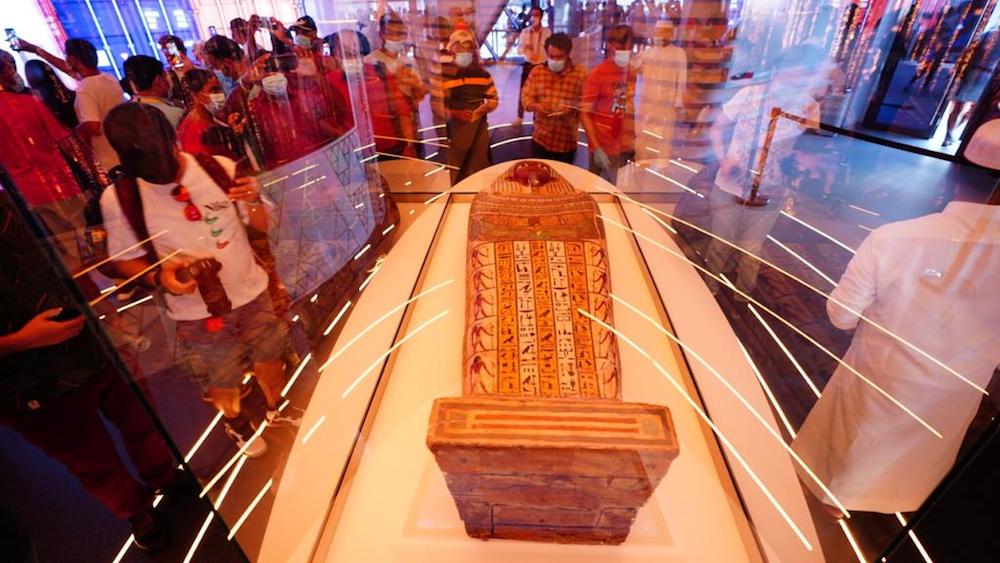
Since the inception of World Expos in the 19th century, Egypt has consistently taken part in the event, and always been a major attraction. Dubai 2020 is no different. (AFP)

Similarly, media reports from the St. Louis World’s Fair of 1904 said: “The greatest attraction of all, undoubtedly, is the ‘Streets of Cairo’ with its 180 men, women and children, theaters, camels, donkeys, and dogs.”

Little of this showmanship has been lost in the decades since. At Expo 2020 Dubai, Egypt again used its pavilion to showcase its national story, while carefully curating an ambitious vision for its future.

Designed by Egyptian architect Hazem Hamada, the pavilion covers 3,000 square meters and combines the authenticity of Egypt’s remarkable history while simultaneously highlighting its ambitious Vision 2030 agenda.

The four-story pavilion has a prime location close to Morocco and Saudi Arabia in the Opportunity District. In a nod to its heritage, the building is imprinted with hieroglyphics, while three sharp angles near the entrance are indicative of its iconic pyramids.


Designed by Egyptian architect Hazem Hamada, the pavilion covers 3,000 square meters and combines the authenticity of Egypt’s remarkable history. (AFP)

The structure stands in stark contrast to its neighbor Switzerland, whose pavilion is a mix of steel, cubic architecture, and a mirrored facade — old and new, standing side by side, each bold and unique in their own way.

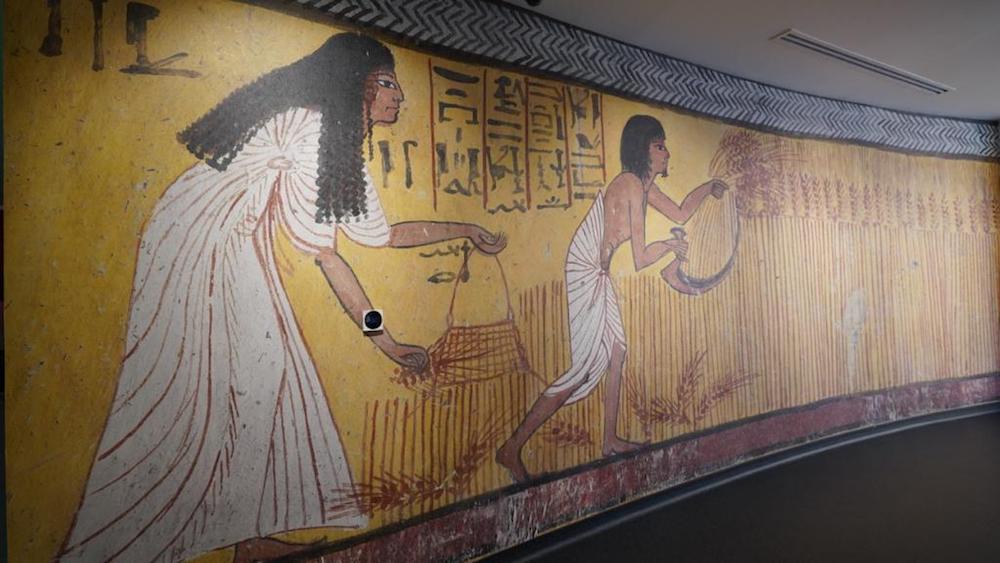
Upon entering the Egyptian pavilion, visitors are taken through a 15-minute guided tour of a series of displays drawing on the key moments of Egyptian history. Visitors are both guided by a “real life” host and welcomed by a virtual guide, highlighting Egypt’s duality of authenticity and modernity.

The opening display welcomes visitors in music and cascading projections of golden hieroglyphics that flow down the walls like rain. Alongside these digital manifestations of modernity are the famed artifacts of Egypt’s past.

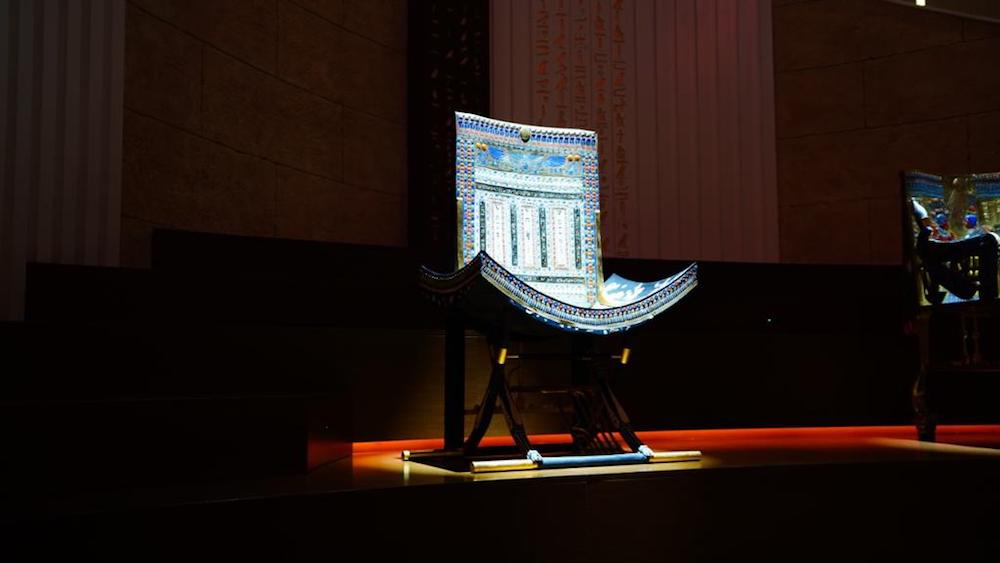
One notable exhibit is the sarcophagus of the priest Psammitic, son of Pediosit, recently discovered in the archaeological dig sites of Saqqara. An instantly recognizable replica of King Tutankhamun’s golden funerary mask is accompanied by replicas of three of his sarcophagi.

FASTFACT

* 3,000sqm – Area of the Egypt pavilion at Expo 2020 Dubai, standing at 19m in height & spread across 4 levels.

* 3 – Original antique Pharaoh statues on display, offering a glimpse of what’s in store at the Grand Egyptian Museum. 

* 4,000 – Years of trade & innovation attached to Egypt’s name — a unique brand to attract new investment.

These pieces offer visitors a tantalizing glimpse of things to come when Cairo’s much-anticipated Grand Egyptian Museum finally opens its doors, where the largest collection of Tutankhamen relics will be put on display together — several for the first time since their discovery.

As with Egypt’s previous World Expo forays, the 2020 pavilion is carefully balanced to leave not only a lasting cultural impact but also to convey a bigger message.

Several displays emphasize Egypt’s Vision 2030 agenda and the range of sustainable development opportunities it has to offer. Organizers are keen to present Egypt as a favorable investment destination connecting the world to the African continent.

The Suez Canal Economic Zone, Egypt’s smart cities, and its tourism developments are just a few of the nation’s investment vehicles of choice.


The pavilion’s “finale” brings everything together in a digital collage of art, music, and dance, combining tradition with vision, old with new. (AFP)

By telling the story of its ancient civilization, the Egyptian pavilion’s message to investors is this: Let history be our guide. With some 4,000 years of innovation and trade attached to its name, Egypt can argue its vision is built upon raw experience.

The pavilion’s “finale” brings everything together in a digital collage of art, music, and dance, combining tradition with vision, old with new, water with desert, green landscapes with blue oceans, and modern trade with ancient crafts. It is a bold, unique, engaging, and impressive display.

Throughout the six months of Expo 2020 Dubai, the Egyptian pavilion will host important figures from science, sport, the arts, and culture. It is staging more than a hundred events on topics ranging from urban development and tourism to sustainable development, agriculture, and quality of life for women and young people.

In addition, it is hosting nine exhibitions on antiquities, education, real estate, and investment, which will feature workshops, seminars, networking events, and cultural salons.

Given its long and proud history of World Expos, it is scarcely surprising that Egypt’s organizing committee knows how to draw a crowd. And with such a jam-packed program of events on offer, it will no doubt build on this well-earned reputation, in this and many World Expos to come.

Since the inception of World Expos in the 19th century, Egypt has consistently taken part in the event, and always been a major attraction. Dubai 2020 is no different. (AFP)
Main category: 

Expo 2020 Dubai visit figure approaches 3 millionJordan’s PM visits Dubai for Expo 2020


Turkey jails Kurdish politician’s wife over typo in medical form

Author: 
Fri, 2021-11-12 22:55

The wife of a Kurdish politician in Turkey has been handed a two-and-a-half-year jail sentence over a typo in a medical report related to a miscarriage she had.

The case has been denounced as an “appalling” example of political persecution by an EU official.

A Diyarbakir court sentenced Başak Demirtaş, who is a teacher, and her doctor on Thursday for submitting a falsified medical report, a Kurdish news agency reported.

The case relates to hospital admissions and two surgeries that Demirtaş had following a miscarriage in 2015. Her legal team said she was charged with fraud because a doctor’s note requesting five days of medical leave was issued during an appointment on Dec. 11, but was erroneously dated Dec. 14, four days later.

She later took unpaid leave for months to recover from the incident.

Demirtaş’s husband, Selahattin Demirtaş, is the former leader of the pluralist, pro-Kurdish Peoples’ Democratic Party, and is one of the high-profile political prisoners jailed in Turkey during the president Recep Tayyip Erdoğan’s crackdown on opposition movements.

Nacho Sánchez Amor, the European parliament’s rapporteur on Turkey, wrote on Twitter: “The sentence of (Başak Demirtaş) to 2.5 years of prison for a mere clerical error concerning a medical record is appalling and seems beyond common sense. It just looks so political. It gives the measure of the worrying state of the Turkish judiciary.”

Demirtas’s lawyers said that although the Diyarbakır court board ruled that the hospital record book showing the dates she attended should be submitted as evidence to show that a mistake was made, the court handed down the sentence without looking at it.

“While the truth is apparent, sentencing Başak Demirtaş as a result of such a trial is openly unlawful and grossly unfair … It is the product of a mentality of collective punishment,” Demirtaş’ team said. 

“In spite of this situation, we will keep on waging our legal struggle. We still believe that the ruling will be overturned by the (appeals court) and justice will be served.”

Selahattin Demirtaş was jailed when his party won enough seats in the 2015 general election to destroy Erdogan’s majority. He faces more than 100 charges, the majority of which are terrorism-related.

He denies all allegations against him.

The EU has been embroiled in a long-running dispute with Turkey over its failure to abide by European Court of Human Rights rulings, many of which pertain to political prisoners.

The court of human rights ordered Demirtaş’s immediate release last year, ruling that his detention goes against “the very core of the concept of a democratic society.”

Main category: 

Kurd leader Demirtas urges world to denounce Turkey’s ‘unjust war’Europe’s top human rights court orders immediate Turkish release of jailed Kurdish leader Demirtas


Lifeless Lebanon lurches into new turmoil amid worsening economic crises

Author: 
Reuters
ID: 
1636742070688480900
Fri, 2021-11-12 21:39

BEIRUT: Lebanon continued its freefall into economic turmoil on Friday, with the medical, fuel, and food crises worsening and no political initiative being taken to overcome the deteriorating situation.

The value of the Lebanese pound dropped to record lows, trading at 23,000 Lebanese pounds to the dollar on the black market.

This crash was at least partly due to a speech given by Hezbollah Secretary-General Hassan Nasrallah on Thursday evening, in which he reaffirmed his hostile positions toward Saudi Arabia and called on the Lebanese to have “patience,” offering no solutions to their mounting problems.

Fuel prices suddenly shot up on Friday. The price of a 20-liter gasoline canister ranged between 310,800 and 319,600 Lebanese pounds, the price of a diesel canister reached 311,000 pounds, and gas cylinders were selling for 266,000 pounds.

The average price of fuel is now equivalent to half of the minimum wage.

Gas station owners reported an approximately 50 percent “decline in the sale of fuel.”

Meanwhile, Economy Minister Amin Salam on Thursday decided to reduce the weight of a bundle of bread while maintaining its current price, which is the highest it has ever reached.

A 1,050-gram bundle is now sold for 9,500 Lebanese pounds.

The Ministry of Economy attributed this to “the high prices of flour, diesel and other materials.”

Olivier de Schutter, the UN special rapporteur on extreme poverty and human rights, issued a statement following a 12-day mission to study poverty in Lebanon, a copy of which Arab News obtained from the UN office in Beirut.

“The Lebanese authorities’ destruction of the national currency, political deadlock, and reinforcement of long-standing inequalities have plunged the country into abject poverty,” he said in the report.

“Lebanon is not a failed state yet, but it is a failing state, with a government failing its population,” he added.

“The destruction of the Lebanese pound has devastated lives and impoverished millions.”

De Schutter described the crisis in Lebanon as “manufactured.”

He added: “While the population is trying to survive day-to-day, the government wastes precious time evading accountability and scapegoating refugees from the comfort of their offices.

“This outrageous level of inequality is furthered by a tax system that rewards the banking sector, encourages tax evasion and concentrates wealth in the hands of the few. In the meantime, the population is subject to regressive taxes that hit the poorest most.

“This is a human-made disaster that was long in the making.”

De Schutter expressed his concern that the “political leadership seems unwilling to see the relationship between tax reform and poverty alleviation and underestimates the benefits of social protection systems for rebuilding the economy, especially in times of crisis.

“Unfortunately, I heard no credible poverty alleviation plan from the government that does not rely on international donors and non-governmental organizations. Dependence on international aid is not sustainable and in fact it weakens state institutions.”

The UN expert added: “The question is what political leaders spent the resources on.

“For decades, Lebanon ignored the need for social policies, including strong welfare programmes and public service infrastructure, and instead focused on unproductive sectors like banking, continuously expanding public debt and devoting those resources to debt servicing.”

He added: “Lebanon has an opportunity to rethink its economic model. Continuing to incentivize a failed model based on rentierism, inequality, and sectarianism will only sink the population further into destitution.”

He warned that the international community would not take Lebanese reforms seriously “until a credible plan is proposed for how to transform the economy, address inequality, ensure tax justice, and prevent further political stalemates,” warning that the donor community was running out of patience with the Lebanese government.

“After losing $240 million to the scam of arbitrary and unfavorable exchange rates, they need to see that the government is serious about transparency and accountability, and a rights-based approach can guide the government’s efforts in this process.”

De Schutter told Reuters: “Lebanon’s officials are living in fantasy land. This does not bode well for the country’s future.”

Prime Minister Najib Mikati’s government, formed in September, is yet to convene amid an ongoing political dispute.

Meanwhile, the reserve in hard currencies at the Central Bank is shrinking to such an extent that it is no longer possible to support medicines for chronic diseases. This decline in economic capacity comes after the Central Bank lifted support for regular medicines.

The crisis has now affected patients suffering from severe and chronic diseases, especially cancer patients, who lack access to life-saving medicines.

Economist Dr. Louis Hobeika told Arab News: “The state’s revenues have vanished. The customs dollar, which is still priced according to the official exchange rate, is no longer logical, and it must be gradually raised, not immediately raised to the exchange rate on the Central Bank’s official platform.”

He added: “Politicians knew that we were on the verge of such a crisis three years ago, but they did not do anything and waited for solutions from abroad, and this did not happen.”

The economist added: “The reserves dried up, and the Central Bank says that it has only $13 billion, but it could be less.”

Hobeika said that the Ministry of Economy’s issuance of a new price for fuel coming just two days after another price was issued — which included an increase of 2,000 Lebanese pounds — indicates the extent of the crisis.

After meeting with Parliament Speaker Nabih Berri, Information Minister George Kordahi reiterated on Friday that he does not intend to resign from the government “without guarantees” — a position that Hobeika believes will “worsen Lebanon’s economic crisis after its political crisis with the Gulf.”

Hobeika added: “We have not yet seen the results of the economic boycott of Lebanon. We now fear for the fate of the Lebanese working in the Gulf, but what if the crisis affects transfers to universities, charities and civil society organizations? What if Gulf Air traffic stops? Won’t Lebanon suffocate? Patience will not do any good then.”

Despite growing pressures, it appears unlikely that the Lebanese will take to the streets to renew their protests. This popular reluctance to express anger “is way more than mere frustration, it is a loss of purpose,” Hobeika said. 

“Citizens are stuck in a hellish, vicious cycle.”

Main category: 

‘No magic wand’ to resolve Lebanon’s economic crisis In a country with no electricity, Miss Internet Lebanon is crowned


Lack of contact from Iran govt ‘astonishing’: UN nuclear watchdog

Author: 
Jastinder KHERA | AFP
ID: 
1636737807968186900
Fri, 2021-11-12 16:27

VIENNA: The head of the UN nuclear watchdog said Friday it was “astonishing” that he has had no contact with the new Iranian government over several important outstanding issues since it took office.
Rafael Grossi, director general of the International Atomic Energy Agency (IAEA), had been hoping to visit Iran before the next meeting of the IAEA’s Board of Governors starts on November 22 but made clear on Friday that he was disappointed that no invitation had yet been forthcoming.
Grossi’s latest comments come as diplomats prepare for international talks in Vienna to restart later this month on the restoration of the 2015 Iran nuclear deal.
In parallel with those efforts, the IAEA has been trying to resolve several other issues with Iran, including restrictions on some of its inspections activities imposed earlier this year.
Grossi visited Tehran in September where he clinched a deal over access to surveillance equipment at Iran’s nuclear facilities but had hoped to return soon afterwards to have further discussions with the government of ultraconservative President Ebrahim Raisi, who took office in August.
“I have not had any contact with this government… that has been there for more than five months,” Grossi told reporters, adding that the only exceptions had been “technical conversations” with Iran’s new atomic energy chief Mohamed Eslami.
“This is astonishing and I am saying it openly because I’m saying it to them,” Grossi said.
“There’s a long list of things we need to discuss,” he said.
Days after Grossi’s September visit to Tehran, the IAEA complained that contrary to the agreement struck there it had been denied “indispensable” access to a centrifuge component manufacturing workshop where it needed to service equipment.
Another long-standing issue between the IAEA and Iran relates to questions the agency has about the previous presence of nuclear material at undeclared sites in the country.
The agency has said in numerous reports that Iran’s explanations about the material have not been satisfactory.
Discussions on those issues at the Board of Governors meeting could lead to a resolution critical of Iran.
On November 29, just a week after the start of that meeting, diplomats are due to convene for the talks on the 2015 deal, known as the Joint Comprehensive Plan Of Action (JCPOA).
Those talks have been suspended since June.
The JCPOA began disintegrating in 2018, when the United States unilaterally pulled out under President Donald Trump and began imposing crippling sanctions on Iran, including a unilateral ban on its oil exports.
In response, Iran began in 2019 disregarding strict curbs on its nuclear activities under the JCPOA.
Trump’s successor Joe Biden says he hopes to return to the agreement but progress toward reviving the deal has been slow.

Main category: 

UK urges Iran to back plan to revive nuclear dealIran’s Raisi warns West against ‘excessive’ nuclear demands