Tunisian town revolts over trash crisis

Author: 
Sun, 2021-11-14 01:15

AGAREB: As tear gas and protest cries filled the air in the Tunisian city of Agareb, Mabrouka Ben Ibrahim vowed to demonstrate for her daughter, whose death she blames on a nearby rubbish dump.

Yousra, 21, died in 2019 after being bitten by a mosquito that came from the toxic trash site, Ben Ibrahim said.

“I lost my daughter and I don’t want other families to lose their children because of the filth in this landfill,” the 59-year-old said.

Residents say rubbish dumped at the site, including dangerous industrial and medical refuse, has caused a string of diseases from cancer to vision problems and infertility.

Authorities decided to close the site in September after declaring it full but reversed course on Monday, prompting angry street demonstrations that degenerated into clashes with security forces.

In the early hours of Tuesday, a protester died of what relatives said was tear gas inhalation, although authorities have blamed his death on an unrelated health condition.

The protests come amid a garbage crisis across Sfax province that has seen refuse piling up on pavements after the closure of the Agareb site, the province’s main dump.

Residents say the site, around three km from the town center and stretching over 35 hectares, has become a public health disaster since it opened in 2008.

“Two years after it was opened, we started seeing an increase in allergies, respiratory diseases and miscarriages as a direct result of burning of trash and the release of toxic gases” from the site, said Bassem Ben Ammar, a doctor who has worked in the town for two decades.

“The number of cancer cases has shot up.”

Even as the smell of tear gas dissipates, the stench of refuse still hangs over the town of 40,000.

“During the summer and throughout the year, the mosquitos and the disgusting smell never leave us. We can’t even open our windows,” demonstrator Adel Ben Faraj said.

The dump, situated in the middle of a nature reserve, receives more than 620 tons of waste every day, according to Ines Labiadh of the FTDES rights group.

Ben Ammar said the site was a destination for “waste of all kinds, including medical waste, amputated body parts and even fetuses.”

The Environment Ministry said medical waste was treated before going into the dump.

The site, one of 13 official landfills in the North African country, serves around 1 million people and receives waste from numerous factories in the city of Sfax, Tunisia’s main industrial hub.

As in the rest of Tunisia, only a small fraction of the region’s waste is recycled, with the rest either buried or incinerated.

Residents say the site was only meant to be active for five years, but its use was extended and it continued operating despite a judge ordering its immediate closure in 2019.

It was deemed full and finally shut down in late September, but authorities reopened it this week, triggering renewed outrage among residents.

Activists have warned that similar protests could easily flare over other landfill sites in Tunisia.

Labiadh told AFP that less than 10 percent of the country’s waste was recycled.

“This is damaging public health and the environment” around landfill sites, she said, calling on the state to set up a functioning recycling system.

Many of the landfill sites are found in marginalized areas.

“Today there are demonstrations in Agareb, but tomorrow they could happen around dumps in the capital. No dump in Tunisia is immune,” she said.

“Some areas have clean air, while others are marginalized and deprived of basic rights.”

In Agareb, some residents have been using art to campaign for a solution.

Maamoun Ajmi, a 29-year-old architect, is part of the “Maneche Msabb” (I’m not a rubbish dump) art collective.

He showed AFP two of his artworks — one a portrait of Yousra as an angel, the other showing a rat eating the section of the Tunisian constitution dealing with environmental rights.

He was among activists who met with President Kais Saied in Tunis on Thursday to highlight the town’s plight.

Ajmi told AFP the protesters had nothing to do with politics.

Main category: 
Tags: 

El-Sisi affirms Egypt’s support for new Tunisian governmentTunisian union calls for a strike in southern town

Anti-Houthi forces move out from Hodeidah

Sat, 2021-11-13 22:16

AL-MUKALLA: Yemen’s Joint Forces on the country’s western coast announced on Friday a withdrawal from several liberated districts in the province of Hodeidah, including areas in Hodeidah city.

The Joint Forces, an umbrella term for three major military units in the country’s western coast, said that it had withdrawn forces from areas in Hodeidah that are included in a truce under the UN-brokered Stockholm agreement and would redeploy the withdrawn forces to other areas.

“Our religious and patriotic duty prompts us into defending more important fronts where we can exploit insufficient defenses,” the forces said in a statement, claiming that the Stockholm agreement constrained the forces and prevented them from taking control of the city of Hodeidah.

“The Joint Forces considered it a mistake to remain surrounded in defensive fortifications barred from fighting by an international decision, while the various fronts require support in all forms, including opening new fronts to reverse Houthi gains.”

Local military officers told Arab News by telephone on Saturday that they received orders from commanders on Wednesday to pull out of Hodeidah within 24 hours.

Long convoys of military vehicles carrying fighters and military equipment were seen leaving the districts Al-Houk, Hays, Attuhayta, Bait Al-Fakih, the Kilo16 sector and Sanaa Street in Hodeidah city.

The forces built sand barricades and deployed forces along a small coastal area called Al-Hayma, 80 kilometers south of Hodeidah, the officers said.

The Joint Forces are formed of three major military units — the Giants Brigades, National Resistance and Tehama Resistance — that were merged under the supervision of the Arab coalition in July 2019.

The forces managed to repel Houthi advances in Hodeidah province and largely committed to the agreement despite having the power to liberate the remaining Houthi-held areas in Hodeidah.

Shortly after the departure of the Joint Forces, the Houthis stormed cities and villages in Hodeidah as their leaders in Sanaa announced the seizure of province.

Under the Stockholm agreement in late 2018, the Yemeni government, whose forces reached the outskirts of Hodeidah city after a successful military offensive, agreed to stop attacking Hodeidah in exchange for the Houthi handover of the city’s seaport to neutral Yemeni forces that were not involved in the war under the aegis of the UN.

At the same time, the government the Executive Unit for IDP Camps said that at least 1874 people have been forced into fleeing their homes in Hays, Attuhayta and Bait Al-Fakih into safer places outside Hodeidah since Thursday when the Joint Forces began moving troops out of the province.

“The number is expected to increase. This huge number of displaced people are in urgent need of intervention by humanitarian partners,” the government body said in a statement.

The Yemeni government said in a statement carried by the official news agency that it was not alerted ahead of time about the withdrawal of forces from Hodeidah.

The UN Mission to Support the Hodeidah Agreement also said that it was not informed in advance about the withdrawal.

“We are liaising with the parties to establish the facts on the ground and call on them to ensure the safety and security of civilians in and around those areas where shifts in front lines have taken place,” the UN mission said on Twitter.

A Yemeni pro-government fighter is pictured during fighting with Huthi rebels on the south frontline of Marib, the last remaining government stronghold in northern Yemen, on November 10, 2021. (AFP)
Main category: 

US politicians condemn Houthi breach of US Embassy in YemenHouthi missiles hit Mocha as UN Yemen envoy visits city


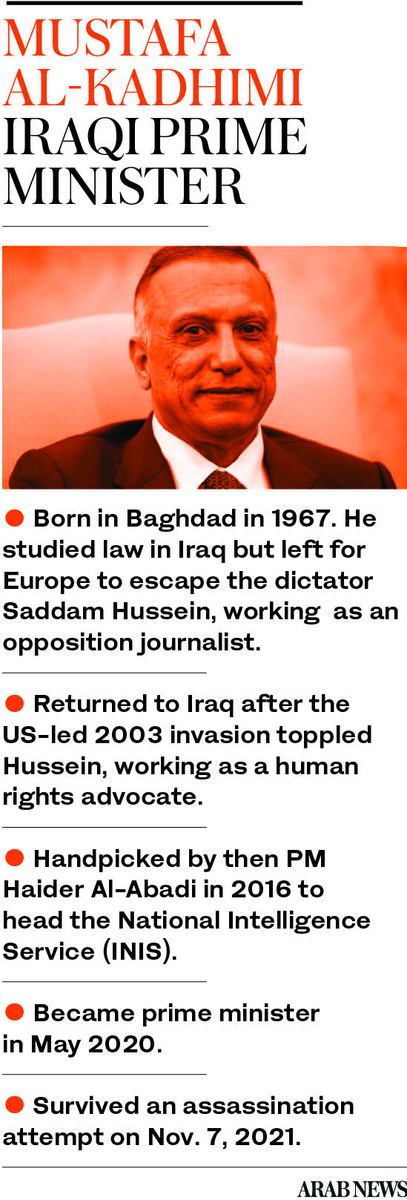
Attempt on PM Mustafa Al-Kadhimi’s life shows destructive effect of pro-Iran factions on Iraqi state

Author: 
Paul Iddon
ID: 
1636831117645657500
Sat, 2021-11-13 22:17

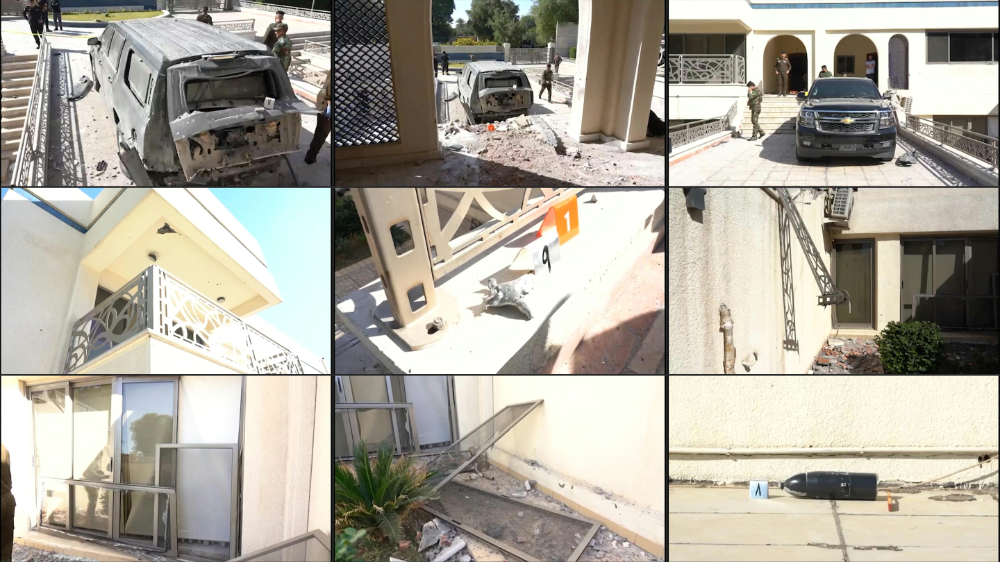
IRBIL, Iraqi Kurdistan: In the early hours of Nov. 7, three quadcopter drones armed with explosives detonated inside the grounds of the official residence of Iraq’s prime minister, Mustafa Al-Kadhimi, injuring seven members of his security detail.

Al-Kadhimi, who escaped with only light injuries, promptly released a statement appealing for calm. The question as to who was behind the attack, however, remained unanswered and open to speculation.

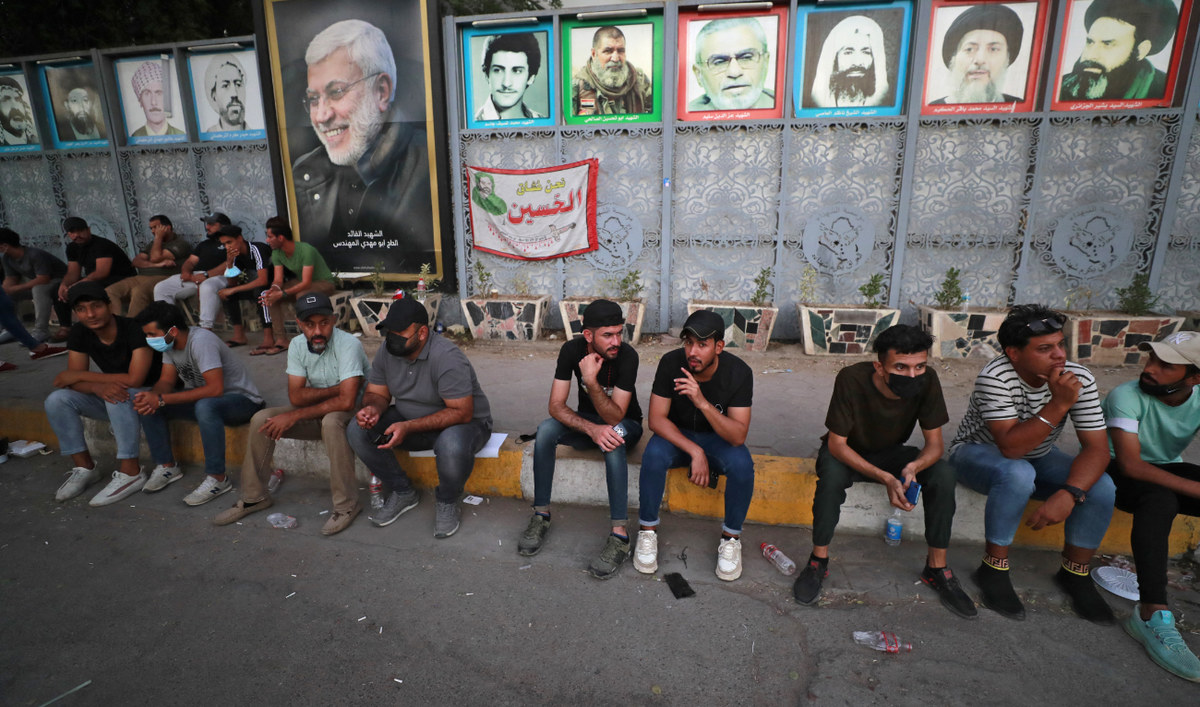
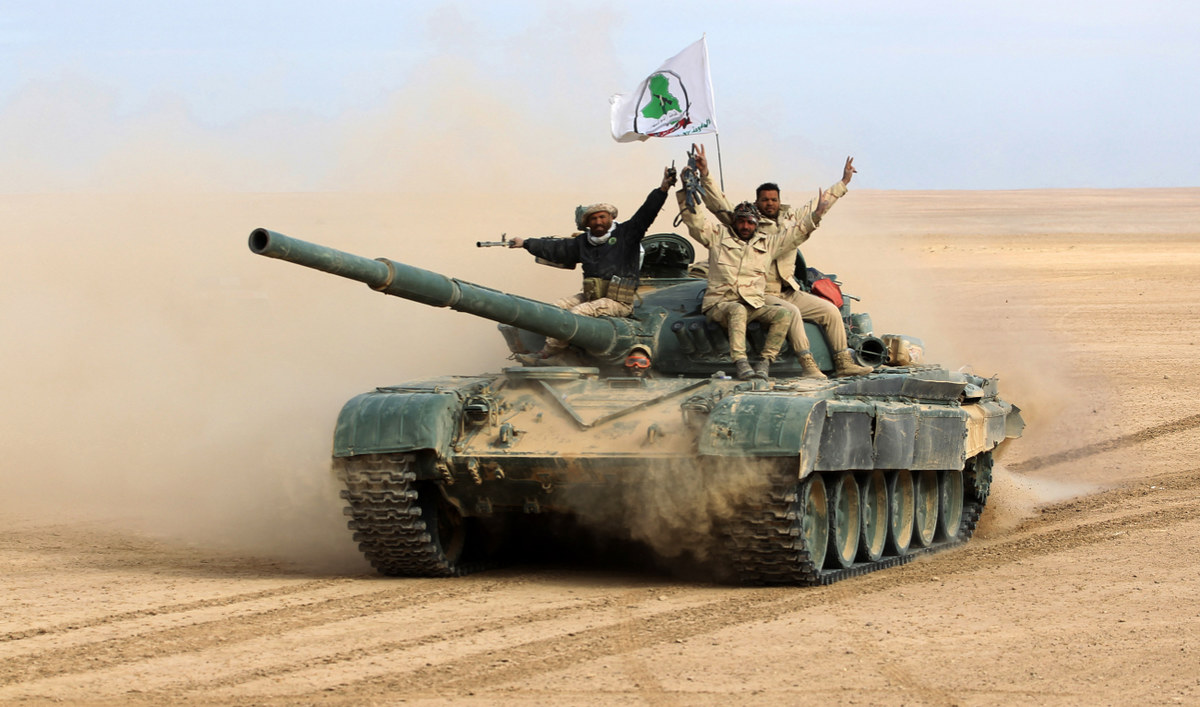
Topping the list of likely conspirators are fighters affiliated with Iraq’s vast network of Iran-backed Al-Hashd Al-Shaabi militias, also known as the Popular Mobilization Forces.

Established in 2014 during the war against Daesh, these groups have since morphed into something of a fifth column within the Iraqi state, officially absorbed into the state security apparatus, but largely operating under their own chain of command.

They have carried out similar drone attacks in recent months, targeting US troops stationed in Iraq and the semi-autonomous Kurdistan region with the aim of forcing their withdrawal.

If Al-Hashd Al-Shaabi was indeed responsible for the attempt on Al-Kadhimi’s life, it raises the question: Did Iran sanction the attack?

Kyle Orton, an independent Middle East analyst, believes the identity of the culprit or culprits behind the attack on Al-Kadhimi’s residence is murky by design, giving the Iran-backed militias the luxury of plausible deniability.

“Iran’s militia network, especially in Iraq over the last few years, has worked to create various splinter groups to claim responsibility for some of their more politically sensitive attacks,” Orton told Arab News.

“It isn’t clear whether these groups actually exist beyond social media — at most, they are cells answerable to preexisting Iranian Islamic Revolutionary Guard Corps-run militias.”

The IRGC and its extraterritorial Quds Force exert tight control over their Iraqi militia proxies, their personnel, training, finances and access to weaponry, including explosive-laden drones, and demand total ideological loyalty to Supreme Leader Ayatollah Ali Khamenei.

Such a brazen attack “does not proceed if Tehran does not want it to,” said Orton. “Again, exactly how this came about — whether it was an order from IRGC Quds Force leader Esmail Qaani or a Qaani non-veto of a militia initiative — we will probably never know.”


Security forces inspect the aftermath of a drone strike on the prime minister’s residence. (AFP)

Then there is the question of whether the militias actually intended to assassinate Al-Kadhimi or simply wanted to intimidate him and send a message.

In May 2020, militiamen encircled Al-Kadhimi’s residence in Baghdad’s fortified Green Zone in an apparent attempt to apply pressure on him. That was most likely because Al-Kadhimi has consistently sought to strengthen Iraqi state institutions, curtail the power of these militias, and restore genuine Iraqi sovereignty since he assumed office.

Orton, however, has little doubt the attackers were out to kill Al-Kadhimi on Nov. 7. “There has been a lot of analysis suggesting that this was a warning to Al-Kadhimi, rather than an attempt to assassinate him, but this strikes me as too clever by half,” he told Arab News.


If Al-Hashd Al-Shaabi was indeed responsible for the attempt on Al-Kadhimi’s life, it raises the question: Did Iran sanction the attack?

“Al-Kadhimi was injured in the attack and it strains credulity to believe that the IRGC agents who did this had calculated it to injure seven of his bodyguards and wound the prime minister, but kill nobody.”

The timing of the attack was also hardly coincidental. In October, Iraq held parliamentary elections, which had been a core demand of the popular grassroots protest movement that began in October 2019 against rampant corruption, unemployment and Iranian influence.

Several of Tehran’s consulates and missions across the country were torched by Iraq’s young protesters, who have increasingly come to view Iran as a foreign occupying power. Iran-backed militias responded by killing hundreds of demonstrators.

The protest movement nevertheless succeeded in forcing then-prime minister Adel Abdul-Mahdi to step down, clearing the way for new elections. However, the Oct. 10 ballot saw the country’s lowest ever turnout at just 41 percent.


The IRGC and its extraterritorial Quds Force exert tight control over their Iraqi militia proxies. (AFP)

Iran-backed political factions fared poorly. The Fatah Alliance won a paltry 17 seats, a substantial loss compared to the 48 they secured in 2018. Al-Sadr’s alliance, Sayirun, meanwhile, increased its share, taking 73 of the parliament’s 329 seats.

Given the desire of Al-Sadr and his supporters to reduce foreign influence in Iraq, the result came as a blow to Iran’s regional strategy. Insisting that the election had been rigged, militia supporters came out in strength to demand a manual recount.

Qais Al-Khazali, leader of the Iran-backed Asaib Ahl Al-Haq militia, joined the protests against the result the night before the drone attack on the prime minister’s residence, during which he accused Al-Kadhimi of orchestrating the “fraudulent” election results.

“The timing is surely related to the aftermath of the election,” said Orton. “The attacks on people close to Al-Kadhimi, particularly senior officers, a number of whom were murdered, began months ago, when the militias could see Al-Kadhimi forging a coalition against them ahead of the elections.”
 

Opinion

This section contains relevant reference points, placed in (Opinion field)

Orton believes that Al-Kadhimi will stay the course in his efforts to cement the authority of the Iraqi state. “The prime minister is likely to continue his policy of trying to rein in the militias through legal instruments, whether it’s indictments for attacks on demonstrators or corruption,” he said.

But, as the Nov. 7 attack shows, Al-Kadhimi’s success is not necessarily guaranteed. “If Iran feels seriously threatened in Iraq, it has tools beyond a no-confidence motion in parliament to change the Iraqi prime minister,” Orton said.

Not everyone is convinced that the perpetrators intended to kill Al-Kadhimi, or that the message was intended solely for him.

“Certain Iran-backed militias with connections to both Kataib Hezbollah and Asaib Ahl Al-Haq were trying to send Al-Kadhimi a message to back off,” Nicholas Heras, senior analyst and program head for State Resilience and Fragility in the Human Security Unit at the Newlines Institute, told Arab News.

“But they’re also trying to signal more widely, to Al-Sadr, that they can choose violence if they are frozen out of the political spoils in Iraq.”

Al-Sadr has burnished his credentials as an Iraqi nationalist by repeatedly calling for militias in the country to be disarmed and for their weapons to be handed over to state security forces.

“This attack likely occurred with the knowledge of Iran, but Iran likely tried to discourage it, and the attack happened anyway,” Heras said.


Al-Kadhimi has consistently sought to strengthen Iraqi state institutions, curtail the power of these militias

The question now is how Al-Kadhimi ought to respond to the attack. “Al-Kadhimi’s next move is fraught with peril,” said Heras. “He can escalate and take on these militias head-on and risk a civil conflict within the Iraqi Shiite community.

“But if he backs down and does not respond, he creates a bad precedent of tacit acceptance of this behavior that could establish a norm in Iraq for years to come.

“Therefore, Al-Kadhimi is most likely to go the route of police action, with arrests and trials.”

Twitter: @pauliddon

Main category: 

Iraqi PM unhurt after failed assassination attempt at his residenceWhy Mustafa Al-Kadhimi is seen as Iraq’s safest pair of hands


Probe launched after video shows emaciated patients tied to filthy beds in Lebanese healthcare center

Sat, 2021-11-13 22:11

BEIRUT: Lebanese health officials have launched an investigation after video images reportedly filmed by a doctor showed emaciated patients tied to filthy beds in a city healthcare center.

The footage documented by the Wataawanou Association charity, sparked public outrage when broadcast on news channels on Friday.

It highlighted poor conditions in rooms and corridors at the Santa Maria Healthcare Center in Byblos that caters for 55 male and 15 female patients with neurological and mental illnesses.

Shots showed skeletal-looking patients sitting or lying on dirty beds, unable to speak, and some with their hands strapped to the bed. Pots with spoiled food and loaves of moldy bread were seen in a kitchen, and other images appeared to depict unhygienic bathrooms.

After the video went viral, Lebanese Health Minister Dr. Firas Abiad and Minister of Social Affairs Hector Hajjar visited the center on Saturday to inspect the premises along with a team of experts from the World Health Organization’s office in Lebanon.

“An investigation has been opened to hold those responsible accountable and define the reasons why the center reached such a deteriorating state without informing the ministry, which has a duty to ensure that its patients are treated in good conditions,” Abiad said.

The ministry has arranged for the Santa Maria patients to be moved to other facilities pending the completion of a clean-up operation there.

A similar health scandal was exposed in February 2019 at Al-Fanar Hospital in Al-Msayleh, in southern Lebanon. Again, patients were transferred to other health centers, including the one at Byblos which received 38 people out of around 90.

Following the airing of the latest footage, officials at Santa Maria Healthcare Center reportedly attempted a swift clean up and prevented journalists from entering the premises.

Abiad told Arab News: “Despite the attempt to clean up, what we have seen shows great neglect and the extent to which the economic crisis in Lebanon has affected the center.”

Lebanon is in the midst of an economic and financial meltdown which has left 55 percent of the country’s population below the poverty line.

“All social welfare centers in the world are facing problems, but many reasons have led us here in Lebanon,” Abiad added. “The patients’ families do not check on them. They leave them in the centers and forget about them. If one family had complained, we would have acted.

“In addition, the health observers affiliated with our ministry are no longer doing their job. The health observer who is supposed to visit the center said that the cost of coming here from Beirut has become equivalent to half of his monthly salary.

“The Ministry of Health pays the center 24,000 Lebanese pounds ($15.88) per day on behalf of each patient it hosts, but this amount is no longer worth anything.

“The director of the center told me that the state is no longer pumping water in the region because of the lack of diesel in the stations, and he has to buy water himself, which is extremely costly, so it is natural for cleaning services to worsen and consequently the patients’ hygiene,” the minister said.

However, he pointed out that none of these issues justified the situation at the healthcare center.

Abiad noted that there were around 50 other centers in Lebanon offering similar services, and that the ministry had distributed 2,000 cards to patients this year allowing them access to the facilities.

“Thousands of others already have this card while other patients have been placed in such centers by their families who cannot provide them with the required health services,” he said.

Santa Maria Healthcare Center director, Joseph Harb, said he had “not received the fees the center is due since the beginning of 2021, amounting to 900 million Lebanese pounds, which constitutes a major obstacle to securing water, fuel, and food.”

Abiad added: “These centers have not received their dues because of the delay in contracts awaiting transfer of credits for payment. The unpaid dues are calculated based on the official rate, that is 1,507 Lebanese pounds to the dollar, while the costs these centers have to endure are very high. This also applies to first-class hospitals and associations, which causes a major problem.

“The healthcare system in Lebanon is unfair. The severe economic crisis has further revealed its flaws and disadvantages,” he said.

Lebanon's Minister of Health Dr. Firass Abyad. (Supplied)
Main category: 

Hospital probed for false medical aid claimsBeirut blast investigator forced to suspend probe for 3rd time


Jordan dam reserves at all-time low as water crisis looms

Sat, 2021-11-13 19:39

AMMAN: Amid a delay in rainfall, Jordan’s major dams are either completely empty or facing critically low water levels, putting the country on the verge of an unprecedented drought crisis should dry weather conditions persist.

Of the kingdom’s 14 major dams, three are now empty, according to officials, who said that emergency plans are being put in place to save farmers in the fertile Jordan Valley, known as the food basket of Jordan.

In recent remarks to Arab News, Omar Salameh, spokesperson of the water ministry, said that the Waleh, Mujib and Tanour dams in the southern desert regions have dried up due to crippling drought.

Salameh added that the King Talal and Wadi El Arab dams in the north are not yet empty, but are reporting critically low water levels.

“All in all, all the country’s dams have reached their lowest water levels due to extremely dry seasons over the past two years,” he said.

The official explained that the 2020-2021 rain season — from December to May — was “very low” and brought 60 percent less rainfall than the annual average.

“This coupled with high temperatures and high demand on water has led to all the consequences we are having now.”

However, citing data from the Jordan Meteorological Department, the official said that the delay in rainfall is “not exceptional” and that “it’s still too early to declare an emergency water situation.”

In a recent report, the JMD said that delayed rainfall is expected as a result of climate change, adding that rainfall in autumn makes up less than 20 percent of the total wet season.

Salameh said that the ministry has put in place short and long-term plans to address a possible dry season.

With low water storage in dams meaning less water to be portioned out to farmers, Minister of Agriculture Khaled Hneifat announced that farmers in the Jordan Valley are now permitted to drill wells to access groundwater for irrigation — a practice that was previously prohibited in the country.

During a recent meeting with the Lower House’s water and agriculture committee, Secretary General of the Water Authority of Jordan Bashar Bataineh said that Jordan’s water deficit in 2021 stands at 40 million cubic meters, of which half is in Amman, the densely populated capital of about 4 million people.

Head of the Jordan Valley Farmers’ Union Adnan Khaddam blamed the government for the “risky” water situation, adding that it “stood idly by and took no action.”

Khaddam was quoted in local media outlets as saying that the King Talal Dam, the largest in the kingdom, has reached “dangerously low levels.”

He added: “The dam covers 80 percent of the water needs of farmers in the Jordan Valley, but the available quantity in the dam is very low,” he said, warning of serious drought if rain does not arrive.

National conveyor project

Jordan, classified as the world’s second most water-scarce country, announced the launch of the Aqaba-Amman Water Desalination and Conveyance National Project (AAWDC), described as “the largest water generation scheme to be implemented in the history of the kingdom.”

During a meeting with lawmakers, Bataineh of Jordan’s Water Authority said that the megaproject will “ensure the country’s water stability until 2040.”

The water ministry announced that the AAWDC, once completed, will generate 130 million cubic meters of water each year.

Launching the project’s first phase in February 2020, the government said that the AAWDC will be implemented on a build-operate-transfer basis and will provide a sustainable water resource for future generations in all parts of the kingdom.

The government said at the time that the strategic scheme is part of the Jordan’s efforts to adapt to climate change, dwindling water resources and population growth.

Additional water from Israel

On Oct. 12, Jordan signed an agreement with Israel to purchase an additional 50 million cubic meters of water outside the framework of the peace agreement and what it stipulates in regard to water quantities.

The additional water Israel will provide will come from the Sea of Galilee.

The water ministry issued a statement at the time, quoting an unnamed source who said that the agreement was signed following a meeting in Amman of technical committees from both sides.

The agreement “was proof that we want good neighborly relations,” Karine Elharrar, Israel’s minister of infrastructure, energy and water resources, told Israeli media.

Jordan and Israel in July said that they had reached a deal under which the latter will sell an additional 50 million cubic meters of water annually to the kingdom following a meeting between the foreign ministers of both countries.

Waleh dam in Madadaba governorate. (Al-Mamlakah TV)
Mujib dam in Karak governorate. (Al-Mamlakah TV)
King Talal Dam in Jerash governorate. (Al-Mamlakah TV)
Main category: 

Forum offers game-changing solution for Arab water scarcitySaudi Arabia attends Cairo conference to discuss regional water security action plan