NAJAF, IRAQ: Influential Shiite cleric Moqtada Sadr, the big winner in initial results from Iraq’s election last month, on Thursday called on the “losers” not to disturb the war-scarred country’s democratic process.
His appeal came after weeks of tensions that peaked in early November when an explosives-laden drone hit the residence of Iraqi Prime Minister Mustafa Al-Kadhemi, in what his office called an assassination attempt.
Final results of the October 10 legislative ballot have still not been announced. But the Conquest (Fatah) Alliance, the political arm of the pro-Iran Hashed Al-Shaabi, suffered a decline in seats from 48 to around 15, leading it to denounce the outcome as “fraud.”
The Hashed is a paramilitary network now integrated into the regular forces.
Sadr, who campaigned as a nationalist and critic of Iran, was the big winner with more than 70 of the 329 seats, according to the initial count.
At a press conference, he addressed “political forces who consider themselves the losers of these elections” and said their defeat “should not open a path to the ruin of Iraq’s democratic process.”
What they are doing, he added, “will only accentuate the people’s rejection of you.”
No group claimed responsibility for the drone attack in which Kadhemi was unhurt.
It occurred two days after security forces clashed with supporters of Iran-backed parties near the high-security Green Zone, where Kadhemi lives.
Despite their electoral losses, the Hashed will remain a political force as the country’s myriad of factions engage in marathon negotiations to form alliances and name a new prime minister.
Sadr, however, reiterated the necessity of forming a majority government, saying: “Our options, as an individual or entity, are either as a majority government or opposition.”
Since the election Sadr, who once led a militia against American and Iraqi government forces, has repeatedly said that the future prime minister should be from his party.
Experts say he could try to build a parliamentary majority by allying with groups outside of the Shiite community.
The new government, elected in a ballot with record-low turnout, will take power in a country mired in corruption and economic crisis.
Water scarcity cost Iraq two million tons of wheat in 2021: Minister Iraqi migrants caught in border tensions in Belarus fly home
UN security council calls on Houthis to end US embassy raid, release hostages
Author:
EPHREM KOSSAIFY
ID:
1637275007518531700
Fri, 2021-11-19 01:34
NEW YORK: The UN Security Council condemned “in the strongest terms” the Houthis’ ongoing breach of the former US embassy compound in Sanaa, calling on the Iran-backed militia to immediately withdraw their militants from the premises and release the detainees.
The US had issued similar calls to the Houthis last week after the rebels stormed the compound that formerly hosted the US embassy in the Yemen capital and took hostage an unspecified number of Yemenis working at the premises.
The embassy raid came on the heels of a visit by a mission representing the five permanent members of the UN Security Council (the US, the UK, France, Russia, and China). During the visit, they voiced support to the Yemeni government and criticized the Houthis, condemning their attacks on Saudi Arabia and the ongoing Marib offensive.
The US State Department has vowed to intensify its “diplomatic efforts to secure the release of our staff and the vacating of our compound, including through our international partners.”
The US transferred its embassy to Riyadh in 2015 at the onset of the civil war in Yemen.
Security council members specifically called for the protection of a diplomatic mission that has been temporarily recalled, “together with its property and archives.”
In a statement, the council “recalled the fundamental principles enshrined in the 1961 Vienna Convention on Diplomatic Relations and the 1963 Vienna Convention on Consular Relations notably the prohibition against the intrusion into the diplomatic property as well as the inviolability of the premises of the mission and their immunity from search, requisition, attachment or execution.”
Secretary-General ‘deeply concerned’ about two UN staff members detained by Houthis in SanaaUS calls on Houthis to ‘immediately release’ Sanaa embassy staff
Libya’s powerful ex-minister announces bid for president
Author:
Fri, 2021-11-19 01:12
TRIPOLI: Libya’s former interior minister announced on Thursday his bid to run for president in the much-anticipated elections next month, the latest candidate to join the race for the highest office in the devastated by years of civil war.
Fathi Bashagha submitted his candidacy papers in Tripoli, and declared that his political platform envisages “a new Libya” based on justice, respect for human rights and a market-led economy.
The 59-year-old is the fourth candidate to join the race, which has so far seen three controversial figures announce their bids, including a son of the country’s late dictator Muammar Qaddafi and a powerful military commander.
The vote faces growing uncertainty. Libya has been wracked by chaos since an uprising toppled Qaddafi in 2011. The country had for years been split between a government in the east and a UN-supported administration in Tripoli, aided by western-based militias.
“Libya will not go back to pre-2011. We will build a new Libya,” Bashagha told reporters in announcing his bid.
“We will bring an end to suffering, tears and blood.”
“Libya will turn from a rentier state into a free-market economy,” he added.
“We will be embracing reform, reconciliation and the reconstruction.”
A former air force pilot and businessman, Bashagha served as interior minister from 2018 until earlier this year in the UN-supported regime headed by Fayez Sarraj, establishing himself as a powerful figure in western Libya.
He cultivated ties with Turkey, France and the US, but also with Egypt and Russia which backed his nominal rivals in the intra-Libyan conflict.
Sarraj’s regime stepped down after a new transitional government was elected by Libyan delegates in Geneva in February under UN-mediated talks.
Bashagha was a contender for the post of prime minister but in the end, Abdul Hamid Mohammed Dbeibah was chosen to lead the transitional Cabinet.
The interim government’s task is to steer Libya toward national reconciliation and lead the nation through general elections set for Dec. 24.
Bashagha survived an attack on his motorcade on a Tripoli highway in February, when gunmen opened fire on his motorcade.
He was unhurt but at least one of his guards was wounded.
The race kicked off on Sunday, when Saif Al-Islam Qaddafi, the son and one-time heir apparent of the late dictator, filed his official candidacy papers in the southern town of Sabha. Saif Al-Islam, who is wanted by the International Criminal Court on charges of crimes against humanity, spent recent years in hiding after he was released from a militia-run prison in the town of Zintan in June 2017.
On Tuesday, the commander of a self-styled army that answered to Libya’s east-based administration, Khalifa Haftar, announced his bid.
Haftar’s forces had previously besieged Tripoli in a year-long campaign to try to capture the Libyan capital.
He is also a defendant in at least three separate federal lawsuits filed in a US court where plaintiffs allege their loved ones were killed or tortured by his forces.
Libya’s influential Parliament Speaker Aguila Saleh joined the race late on Wednesday.
The 77-year-old has led the country’s House of Representatives that came to power in the 2014 elections, which ended up being contested.
In the aftermath, Libya split further into rival administrations in the east and west, and the lawmaking body fled from Tripoli to the eastern city of Tobruk after a court ruled it was no longer legitimate.
The December elections also face other obstacles, including occasional infighting among armed groups, the deep rift that remains between Libya’s east and west, and the presence of thousands of foreign fighters and troops.
Former Libyan PM Ali Zeidan runs for president, number of candidates reaches 10Libya’s eastern commander Haftar announces election bid
With cultural reawakening, Egypt poised to enchant the world once again
Fri, 2021-11-19 00:14
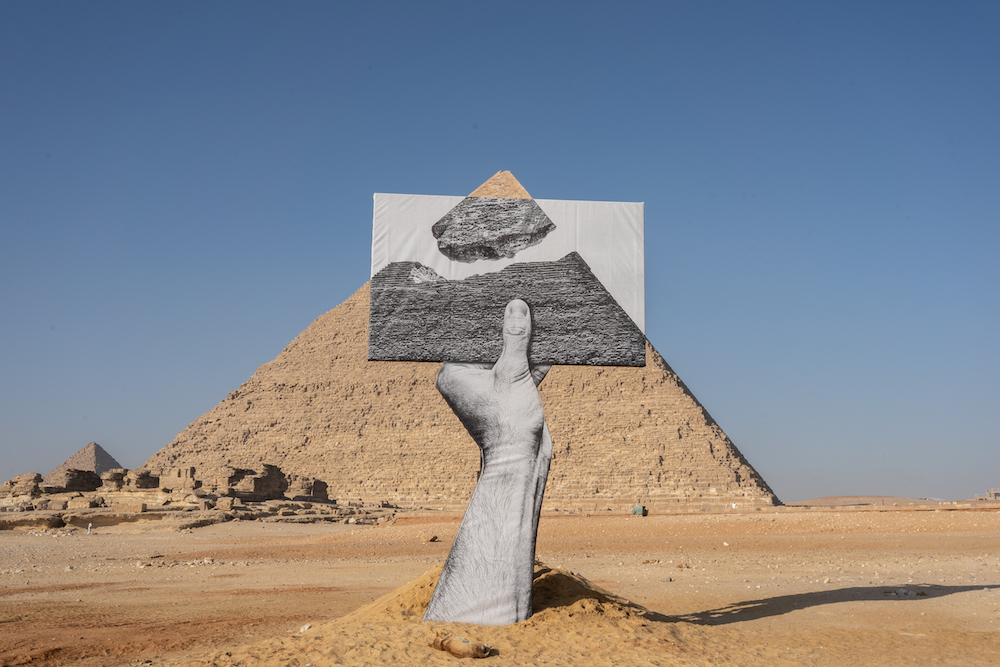
CAIRO: Egypt, the land of Tutankhamun, Cleopatra, Naguib Mahfouz and Ahmed Zewail, is witnessing a renaissance in its arts and cultural scene. A few weeks ago, the 4,500-year-old UNESCO World Heritage site of the Giza pyramids was transformed into a platform for contemporary art at “Forever Is Now.”
The exhibition, organized by Art d’Egypte, showcased the work of 10 international artists for the first time in the historic setting.
The renewal movement is backed by the government, institutional players, independent patrons, artists and curators who are pushing the cultural scene in two directions: The revival of a prolific past and the celebration of a promising future.
JR’s Installation ‘Greetings from Giza’ – Credit: Hesham El Sayfi – Courtesy of Art d’Egypte. (Supplied)
Nadine Abdel-Ghaffar, the founder of arts and heritage consultancy Art d’Egypte, said: “The world knows Egypt’s artistic and cultural past. However, they are not aware of the present, the contemporary. We aim to educate, raise awareness, and bring opportunity to these places by activating spaces and involving the surrounding community.”
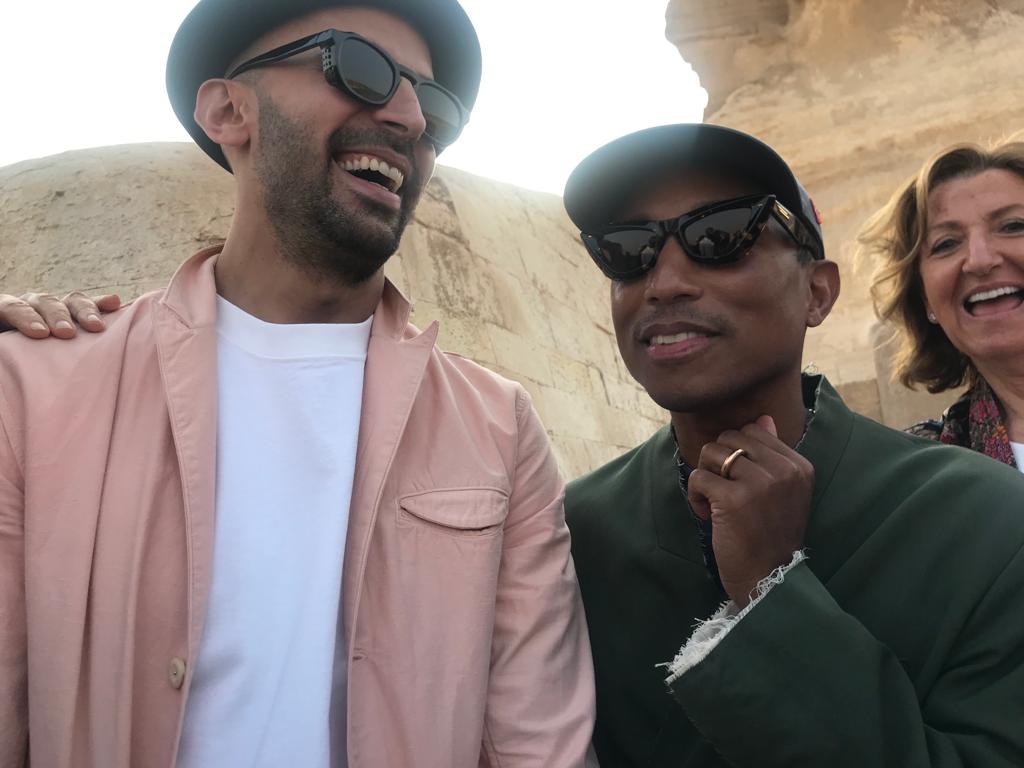
“Forever Is Now” presented artistic installations against the backdrop of the pyramids, and featured Italian artist Lorenzo Quinn and French artist JR — the latter accompanied by his friend and supporter American record-producer and singer Pharrell Williams.
The exhibition sought to establish a dialogue between the ancient past and the present, and to “question time as a continuum that both separates and unites civilizations.”
Abdel-Ghaffar told Arab News that the display, which ended on Nov. 8, “succeeded in its mission of democratizing art by making it accessible in public spaces, attracting 20,000 visitors a day from schools, universities and people from all walks of life.”
Contemporary Art displayed in old Downtown Cairo. (May Barber)
In April this year, the world watched in awe as the “Golden Parade” of 22 mummies (18 kings and four queens) traveled in decorated carriages through the streets of Cairo from the Egyptian museum in Tahrir Square to their new home of the National Museum of Egyptian Civilization.
NMEC now showcases selections from the artifacts of the ancient Egyptian pharaohs, highlighting their contributions, such as the invention of writing and mummification.
Royal mummies carefully displayed in temperature-controlled glass cases include Ramses II, known as Ramses the Great; Thutmose III, once described as the Napoleon of Egypt; and Queen Hatsheput, one of the few women who ruled ancient Egypt.
Preserving the past is central to today’s thriving Egyptian cultural scene, and lends itself to architectural restoration. Al-Ismaelia, an Egyptian real estate investment company, has joined partners in efforts to restore the capital’s 150-year-old architectural legacy established by the Khedive Ismail in the 19th century.
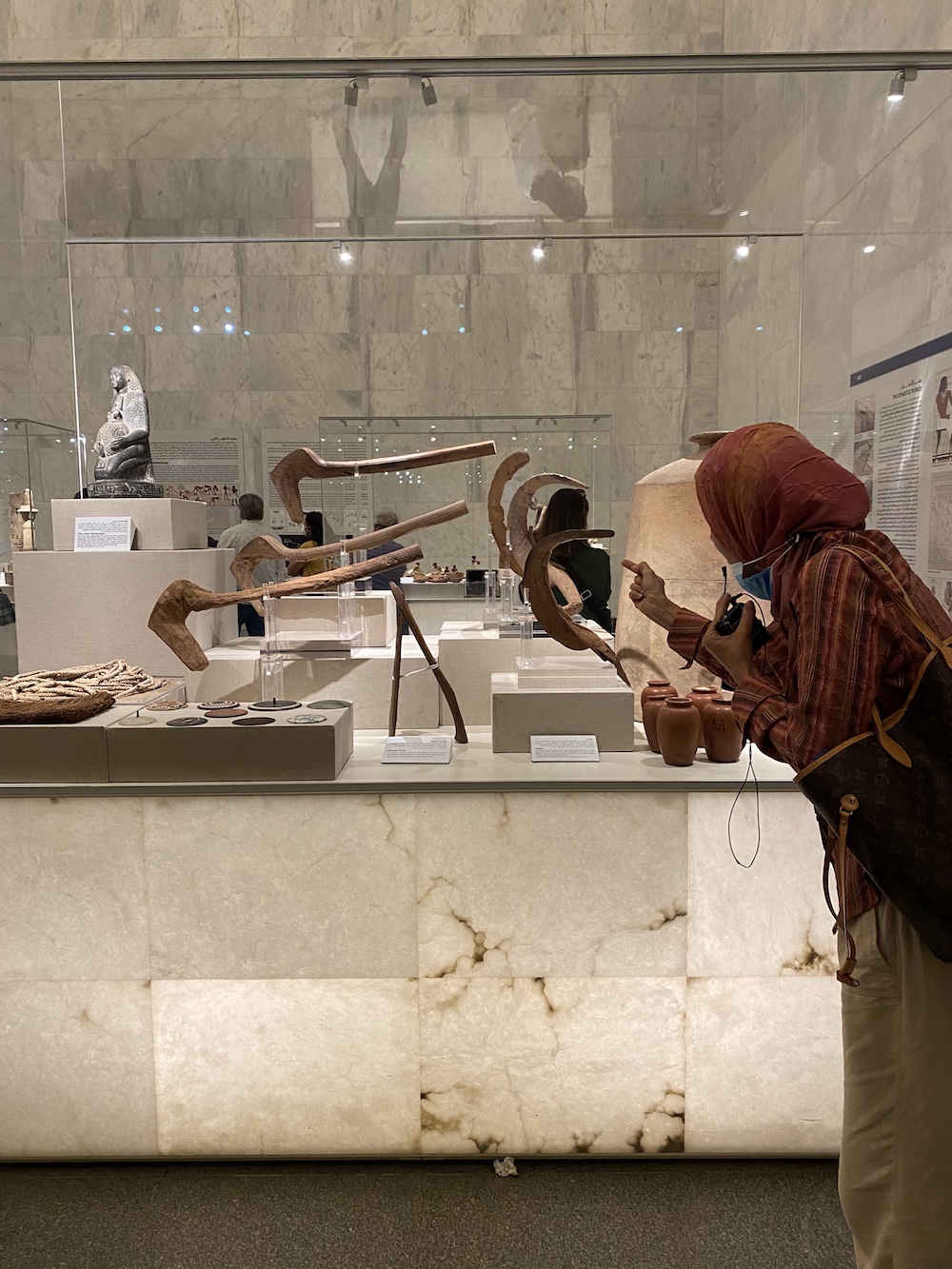
Egyptian Guide Hiba leading a tour Inside the National Museum of Egyptian Civilization. (May Barber)
“Breathing life into design magic,” the company set out to preserve iconic buildings such as La Viennoise, a 125-year-old landmark built in 1896 by English architect La Viennoise, and Cinema Radio Complex, built in 1932 as the center of Cairo’s theater and performance arts scene. The center has hosted performances ranging from Umm Kulthum in the 1920s to recent acts by Bassem Youssef and Abla Fahita.
“In the pursuit of reviving a district and building of a community, some opt for politics and others opt for football. We opted for art and culture,” Eman Hussein, deputy CEO of Al-Ismaelia, told Arab News.
Aiming to transform the downtown area into an inclusive district, Al-Ismaelia linked restoration projects with a range of art and culture exhibitions.
“When you uplift one aspect of the community, the whole ecosystem is uplifted,” said Hussein.
A close exchange between French Artist JR and his friend, musician Pharell at Giza. (May Barber)
Today, the company owns 25 properties in downtown Cairo, many of which have been transformed as co-working spaces, rental accommodation, retail outlets and offices.
Al-Ismaelia’s plans were put on hold amid the turmoil surrounding the 2011 Egyptian uprising before the projects resumed in collaboration with the government.
“Restoration has challenges in every step,” Hussein said. These range from acquiring the building from as many as 90 different owners all the way to licensing, infrastructure issues and operational limitations such as power supply.
However, she is pleased with the outcome, and said the district is benefiting from an authentic revival of the past, a contemporary flair, plus strong support for art, culture and homegrown concepts.
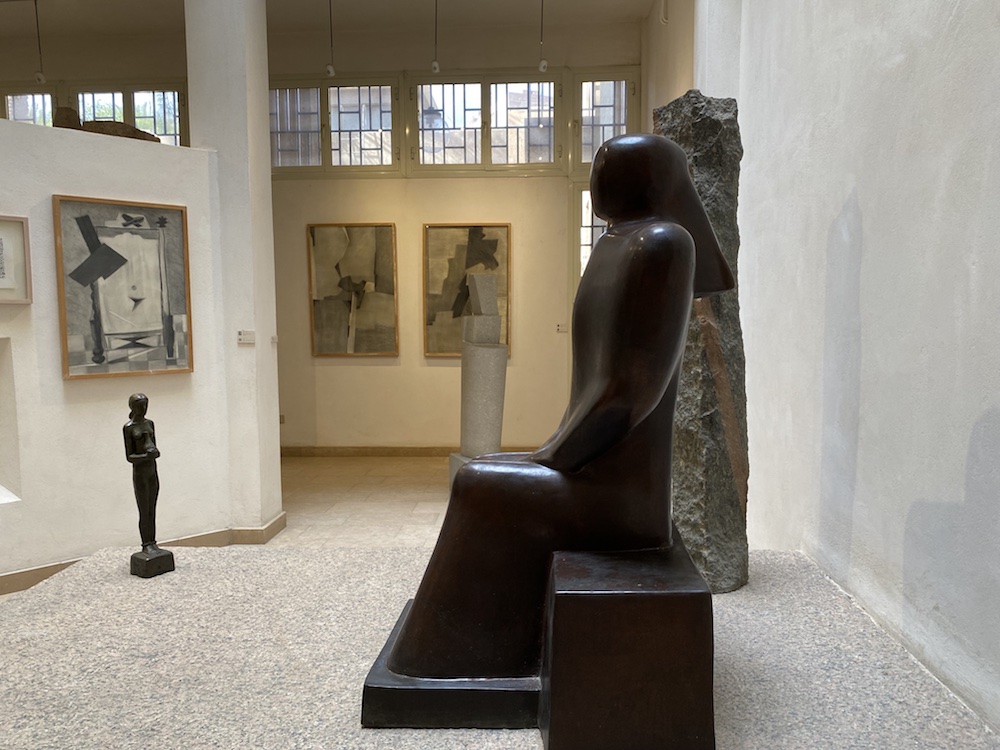
Views inside the late Egyptian Sculptor Museum Adam Henein. (May Barber)
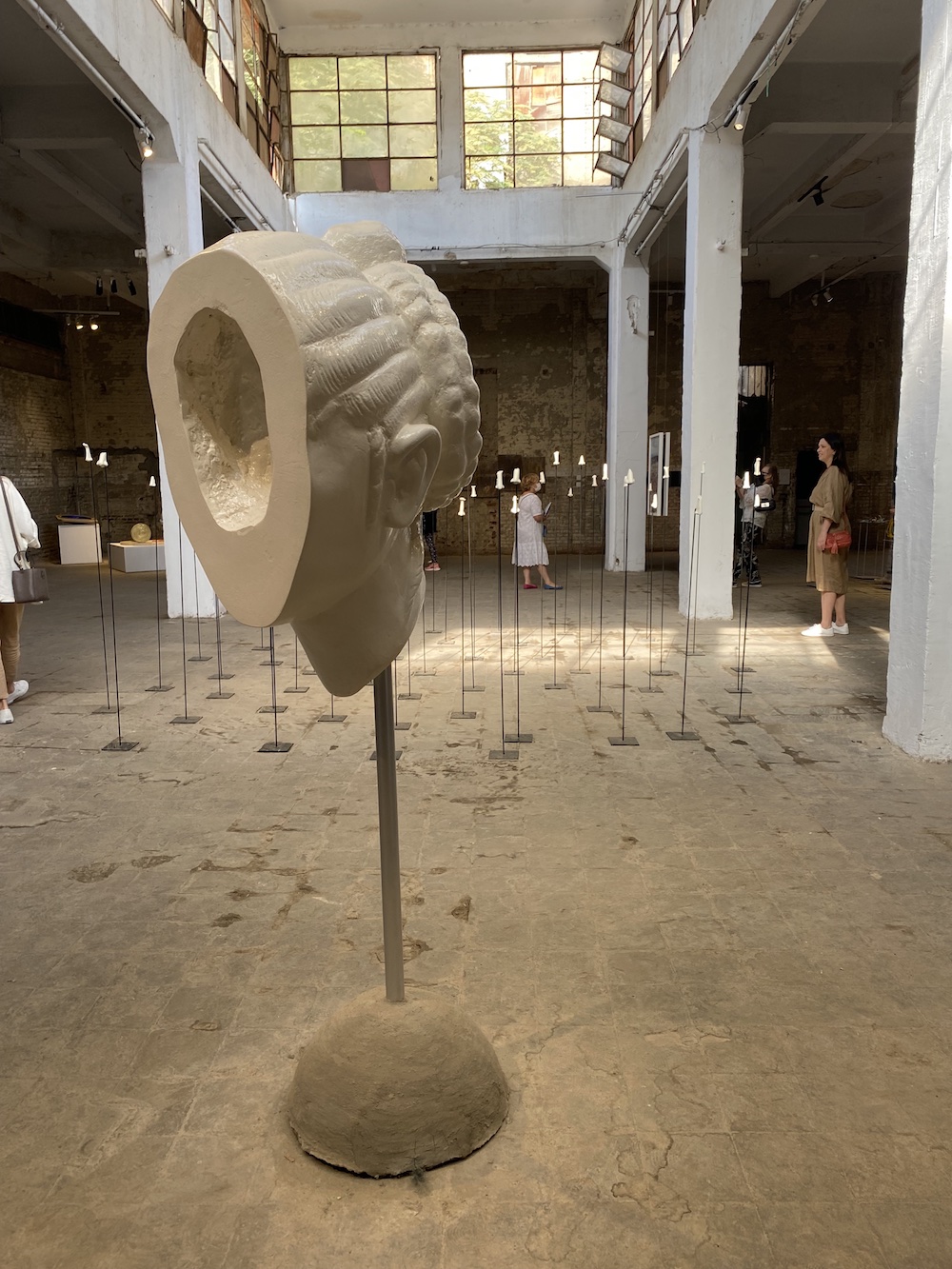
The movement to revive the past is accompanied by a strong contemporary cultural agenda. Today, the historic old Cairo district is home to pop-up galleries and contemporary art exhibitions.
Perhaps one of the most intriguing showcases is Ai-Da, a three-legged robot that responds to the Riddle of the Sphinx with AI-generated messages and AI-informed drawings. Ai-Da’s arrival in Egypt caused controversy after the robot was briefly detained by authorities who feared that it was a spying device.
Cairo’s affluent Zamalek district is also home to established contemporary art galleries, including Zamalek Art Gallery, Art Talk Gallery and the Ubuntu art gallery.
The three-story Adam Henein Museum in the Giza district includes a sculpture park owned by the late artist Adam Henein (formerly known as Samuel) and managed today by Inas Luca, who, as the Adam Henein Foundation director, has been “entrusted with his treasures,” as she puts it.
Henein, who died in 2020, founded the annual Aswan International Sculpture Symposium. The museum is dedicated to displaying his drawings, paintings and sculptures, including a collection previously displayed in the Metropolitan Museum in 1999-2000.
Lorenzo Quinn’s Sculpture ‘Together’ at Forever Is Now – Credit: Hesham El Sayfi – Courtesy of Art d’Egypte. (Supplied)
What is next for Egypt’s cultural scene? The country is patiently awaiting the outcome of the latest expeditions of Zahi Hawass, the archaeologist, National Geographic explorer and former minister of state for antiquities
Hawass has partnered with Netflix for a five-episode docu-series to be aired next year that will unlock the mystery of the death of Tutankhamun.
The world is also eagerly awaiting the opening of the Grand Egyptian Museum, which promises to be another momentous occasion.
For a country of 105 million people and an ancient civilization that continues to influence literature, film architecture and fashion, it is evident that there is no shortage of human capital and intellectual wealth, and that Egypt is ready to enchant the world once again.
————
May Barber is an architect and brand management consultant focused on sustainability and purpose-driven projects.
Egypt prepares to open first, and largest, antique reproductions factory in Middle EastEgypt retrieves 114 smuggled antiquities from France
Kuwait detains 18 suspected of financing Lebanon’s Hezbollah — media
Author:
Reuters
ID:
1637268886737614800
Thu, 2021-11-18 23:57
CAIRO: Prosecutors in Kuwait have detained 18 people suspected of financing Lebanon’s powerful Shiite Muslim group Hezbollah, the newspapers Al-Qabas and Al-Rai reported on Thursday.
Al Qabas said the prosecution ordered the detainees to be held at the central prison for 21 days while investigations continue into alleged “membership in a prohibited party, money laundering and spying.”
The Interior Ministry did not immediately respond to a Reuters request for comment. Gulf Arab states in 2016 designated Iran-allied Hezbollah a terrorist oganization.
Lebanon is facing a diplomatic crisis as Gulf states become increasingly dismayed by Hezbollah’s expanding influence over Lebanese politics.
Saudi Arabia, Kuwait and Bahrain last month expelled Lebanese diplomats and recalled their own envoys following a minister’s critical comments about the Saudi-led military intervention in Yemen. Riyadh banned all imports from Lebanon.
Saudi Arabia’s foreign minister said the measures were driven not just by the comments by information minister George Kordahi, made before a new cabinet was formed, but rather by Riyadh’s objections to the “domination” of Hezbollah.
Sunni Muslim Saudi Arabia and Shiite Iran have been locked for decades in proxy conflicts across the region.
Kuwait has long maintained balanced ties between its larger neighbors, but in 2016 it convicted a group of Shiite Kuwaitis for spying for Iran and Hezbollah, accusing Tehran at the time of seeking to destablize it. Iran had denied any connection.
Earlier this month, several of those convicted in that case were released under a pardon issued by Kuwait’s ruling emir under an amnesty aimed at defusing a domestic deadlock between the government and opposition lawmakers.