Iran losing ‘precious time’ with nuclear stance: European diplomats
Tue, 2021-12-14 01:55
PARIS: Iran’s positions in talks over its nuclear development programme are “inconsistent” with the terms of the deal to limit it, diplomats from the western European countries negotiating with Tehran, said on Monday.
After a five-month pause, talks resumed on salvaging the Joint Comprehensive Plan of Action (JCPOA) in Vienna on November 29.
The 2015 agreement aimed to prevent Iran from developing an atomic bomb, a goal Tehran has always denied. The deal ensured sanctions relief in return for tight curbs on Iran’s nuclear programme, which was put under extensive UN monitoring.
Diplomats from Iran, Britain, China, France, Germany and Russia, the signatory countries to the 2015 agreement, are attending the current talks.
“We have had many hours of engagement, and all delegations have pressed Iran to be reasonable,” said the diplomats, from Britain, France and Germany.
“As of this moment, we still have not been able to get down to real negotiations,” they added.
“We are losing precious time dealing with new Iranian positions inconsistent with the JCPOA or that go beyond it.”
Donald Trump pulled the US out of the accord in 2018 and US President Joe Biden wants to negotiate Washington’s return, with US diplomats participating at one remove from the main talks.
Iran wants Washington to lift a raft of sanctions, and is asking as well for guarantees.
On Sunday, Iran’s chief negotiator at the talks, Ali Bagheri, reported progress on drawing up an agenda.
“The two parties are at the point of agreeing on the matters which should be on the agenda,” Tehran’s chief negotiator Ali Bagheri told the official IRNA news agency.
“It’s a positive and important evolution since, at the start, they weren’t even in agreement on the issues to negotiate.”
Iranian officials maintain they are serious about committing to the talks.
But the Western countries have accused Tehran of having backtracked on the position it held earlier this year.
Last week, Biden warned that the United States was preparing “additional measures” against Iran as expectations grow that the talks are set to fail.
G7 says Iran must stop nuclear escalation Vienna talks on Iran nuclear deal resume amid tensions
Tunisia’s president says he will call constitutional referendum, elections next year
Author:
Reuters
ID:
1639431100656204400
Mon, 2021-12-13 00:38
TUNIS: Tunisian President Kais Saied said on Monday he would call a constitutional referendum next July, a year to the day after he seized broad powers in moves his opponents call a coup, and that parliamentary elections would follow at the end of 2022.
Laying out the timeline for his proposed political changes in a televised speech, Saied said the referendum would take place on July 25, following an online public consultation that will start in January.
Saied’s announcement of a road map out of the crisis has been awaited since he suspended parliament, dismissed the prime minister and assumed executive authority.
While those moves appeared very popular after years of economic stagnation and political paralysis, opposition to his stance has sharpened, including from political parties and other major domestic players that were initially supportive.
The delay in detailing the path forward, and the two months it took Saied to name a new prime minister, have added to concerns about Tunisia’s ability to address an urgent crisis in its public finances.
The referendum date is Tunisia’s Republic Day and the anniversary of his sudden intervention, which has cast doubt on the North African country’s democratic gains since the 2011 revolution that triggered the “Arab spring” revolts.
Saied in September brushed aside most of the 2014 democratic constitution to say he could rule by decree during a period of exceptional measures, and promised a dialogue on further changes.
He said in Monday’s speech that parliament would remain suspended until Tunisians vote for a replacement assembly on Dec. 17, 2022, the date he has declared to be the official anniversary of the revolution.
The anniversary had previously been marked on Jan. 14, the date when autocratic ruler Zine el-Abidine Ben Ali fled the country, after agreement among political factions and civil society groups that took part in the uprising.
“We want to correct the paths of the revolution and history,” Saied said in his speech, after lambasting critics of his intervention.
Saied said he would appoint a committee of experts to draft a new constitution, to be ready by June ahead of the referendum.
A clear pathway to ordinary constitutional order may be important for Tunisia to secure international financial assistance as it struggles to finance its fiscal deficit and next year’s budget as well as debt repayments.
It has opened talks with the International Monetary Fund, but major donors have indicated they are not willing to step in without what they have called an “inclusive” approach.
There was no immediate comment from Ennahda, the biggest party in parliament, or from the powerful UGTT labor union. Mohammed Abou, a former minister, said in a televised interview that Saied’s “violation of the constitution” amounted to a coup.
Tunisia’s union calls for early elections, says democratic gains are threatenedTunisia records first case of omicron variant
Sudan security forces fire tear gas at anti-coup protesters
Author:
Tue, 2021-12-14 00:15
CAIRO: Security forces fired tear gas on Monday to disperse protesters in Sudan’s capital in the latest street demonstrations against the October military coup and subsequent deal that reinstated deposed Prime Minister Abdalla Hamdok.
Thousands of people took to the streets in Khartoum and other Sudanese cities as part of relentless demonstrations that have engulfed the country since the military seized power on Oct. 25.
The coup upended a fragile planned transition to democratic rule more than two years after a popular uprising forced the removal of former President Omar Bashir and his government in April 2019.
Hamdok was reinstated last month amid international pressure in a deal that calls for an independent technocratic Cabinet under military oversight led by him.
The agreement included the release of government officials and politicians detained since the coup.
The Nov. 21 deal, however, was rejected by the pro-democracy movement, which insists power be handed over to a civilian government to lead the transition.
Their protests follow the slogan: “No negotiations, no compromise, no power-sharing” with the military.
Footage circulated on social media Monday purportedly showed demonstrators marching in different locations in Khartoum and its sister city Omdurman. One video showed thousands of protesters in Khartoum’s district of Bahri, many of them waving Sudanese flags.
Activist Nazim Sirag said security forces used tear gas to disperse people marching in a street near the presidential palace in Khartoum.
Protesters were seen in online videos throwing tear gas canisters back at forces.
There were no immediate reports of casualties.
The US Embassy in Khartoum said in a tweet: “We stand with the Sudanese people as they seek freedom, peace, and justice in today’s demonstrations, and welcome their government’s commitment to protection of peaceful protesters.”
Monday’s protests were called by the Sudanese Professionals Association and the so-called Resistance Committees, which spearheaded the uprising against Bashir and then the military coup.
The protests came a few days ahead of the third anniversary of the start of the uprising against Bashir.
In past rounds of demonstrations security forces used violence, including firing live ammunition at protesters, according to activists.
At least 44 people were killed and hundreds wounded in protests triggered by the coup.
The protests have increased pressure on the military and Hamdok, who has yet to announce his Cabinet.
The prime minister on Sunday appointed new acting governors of the country’s provinces to replace those named by coup leader Gen. Abdel Fattah Al-Burhan, head of the ruling Sovereign Council, after the coup.
Sudan’s military must rebuild trust with opponents, says UN envoyUN ‘cautiously welcomes’ Sudan accord amid post-coup erosion of trust
Abu Dhabi crown prince voices hope for Mideast stability in talks with Israel PM
Author:
Tue, 2021-12-14 00:08
ABU DHABI: Abu Dhabi Crown Prince Sheikh Mohammed bin Zayed Al-Nahyan hosted Israel’s Prime Minister Naftali Bennett on Monday in the first ever public meeting between the UAE’s de facto ruler and an Israeli leader.
Israel’s ambassador to Abu Dhabi said the issue of Iran was on the agenda for their talks, which follow the formalization of Israel-UAE relations last year under a US-led regional initiative.
While shared concern about Iranian activity was among reasons for the diplomatic moves, the UAE has also been trying to improve relations with Tehran. Releasing photographs of Bennett and Sheikh Mohammed smiling and shaking hands, the Israeli leader’s office described the meeting as “historic.”
A statement on state news agency WAM said Sheikh Mohammed voiced hope for “stability in the Middle East” and that Bennet’s visit would “advance the relationship of cooperation toward more positive steps in the interests of the people of the two nations and of the region.”
The Palestinians, whose diplomacy with Israel has been stalled since 2014, have deplored the Israeli-UAE rapprochement.
Israeli Ambassador Amir Hayek declined to elaborate on any discussion of Iran but he told Israel’s Army Radio: “The prime minister did not only come here solely to address the Iranian issue.”
With world powers now trying to renew the Iran nuclear deal, Abu Dhabi last week sent an envoy to Tehran.
A US delegation is due in the UAE this week to warn Emirati banks against noncompliance with sanctions on Iran.
Iran has not been mentioned publicly by Bennett since he set off on Sunday to the UAE with pledges to promote bilateral commerce and other forms of civilian cooperation.
The Israel Hayom newspaper, quoting unnamed officials, said Bennett was expected to brief Sheikh Mohammed on intelligence regarding Iranian-supplied militias and drones in the region.
Israel last month broached setting up joint defenses against Iran with Gulf states.
Hayek said military sales to UAE are in the works, though Israeli industry sources say advanced Israeli air defense systems have yet to be offered.
“Israel is in cooperation with a new friend, with a partner for the long-term, and the considerations will be both considerations of defense and also considerations of how you work with a country which is very, very, very friendly to Israel,” Hayek said.
Israel-UAE bilateral trade in goods alone reached nearly $500 million so far in 2021 — up from $125 million in 2020 — and is expected to continue growing rapidly.
Abu Dhabi crown prince, Israel leader discuss ties, regional issuesIsrael extends travel restrictions for a further 10 days
PM Mustafa Al-Kadhimi’s plea for national unity strikes a chord on Iraqi nation state’s centenary
Mon, 2021-12-13 23:20
DUBAI: Iraq was a cradle of civilization long before it was established as a modern nation state exactly 100 years ago, the country’s prime minister, Mustafa Al-Kadhimi, said during a speech on Saturday marking the country’s centenary.
Addressing the Iraqi public in a televised message, he said the special occasion was an ideal opportunity to look at the country objectively, take pride in its achievements and admit where it had made mistakes.
Although the Iraqi state as we know it today was formally established by the British at the Cairo Conference in 1921, “it does not mean that Iraq was not a country a hundred years ago,” Al-Kadhimi said.
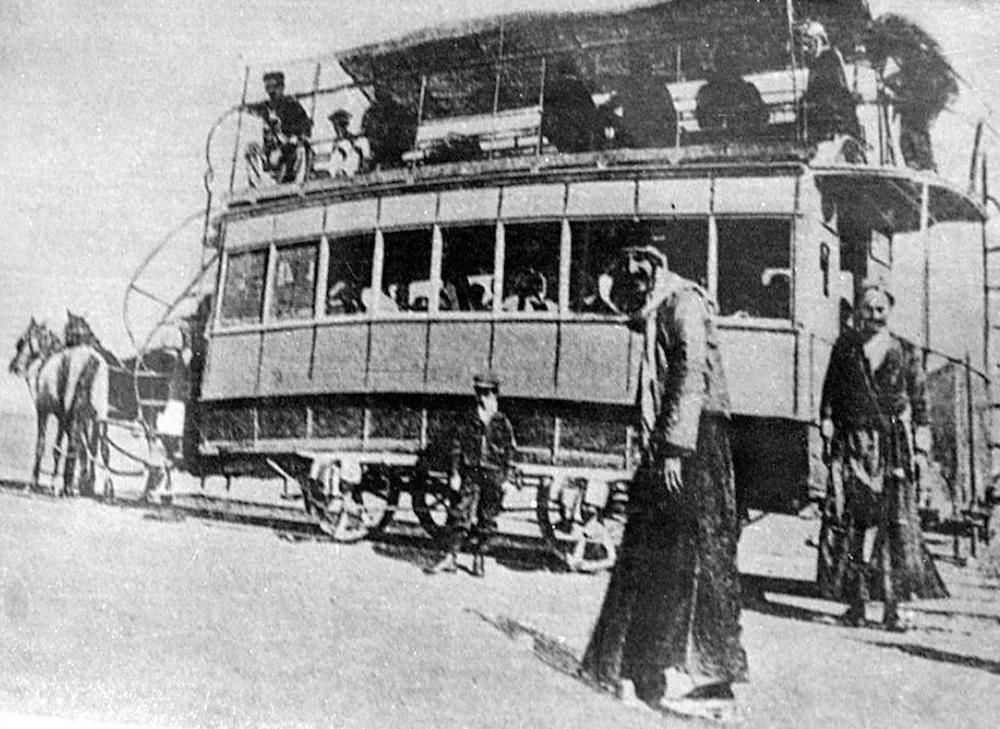
A horse-drawn tram makes its way through a Baghdad street in this picture dated 1925. (AFP)
“The ground upon which Iraqis are standing firmly was the first country known to humanity, the first law to organize human life, the first policeman whose job was to protect people, and the first military soldier to defend the borders and sacrifice himself.
“Here, on the land guarded by the souls of your parents and ancestors, was the first economic organization to preserve rights, property, sale and purchase, and the first punishments for human rights violators.
“It was the first of poetry, art and culture, the first base of mathematics, and the first moment of revelation and prophecy.”
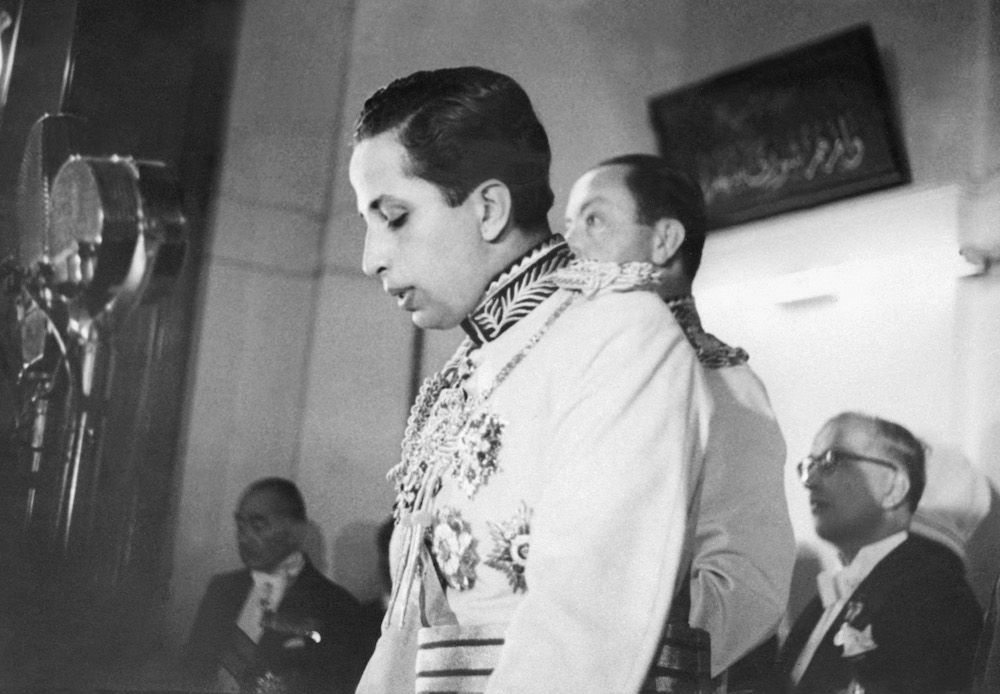
The young King Faisal II of Iraq takes the oath at the age of 18, in front of the Parliament May 5,1953 in Baghdad. (Intercontinentale/AFP)
Indeed, humanity owes many of its earliest achievements in a number fields, including agriculture and astronomy, to the civilizations that flourished in ancient Mesopotamia, the land between two rivers, more than five millennia ago.
From the Akkadians and the Assyrians to early Islamic civilization, the peoples who inhabited this region created many of the world’s first known institutions of government, systems of writing and numeracy, and epic works of literature.
In his centenary speech, Al-Kadhimi said it was the responsibility of all Iraqis, no matter their political alignment, to recognize this heritage, pass it on to future generations, and protect it from those who seek to manipulate it for their own ends.
“It is time to look at our country objectively and be proud of its achievements and admit its mistakes,” he added. “And we move forward armed with our inheritance and the abilities of our people to stand together with all successful countries.”
Arab leaders sent messages of congratulations to the people of Iraq on the anniversary, including Saudi Crown Prince Mohammed bin Salman, who spoke with Al-Kadhimi by telephone on Sunday, according to the Iraqi PM’s media office.
In his own message of support, Egypt’s President Abdel Fattah El-Sisi described the centenary as an important moment in the shared history of the Arab world.
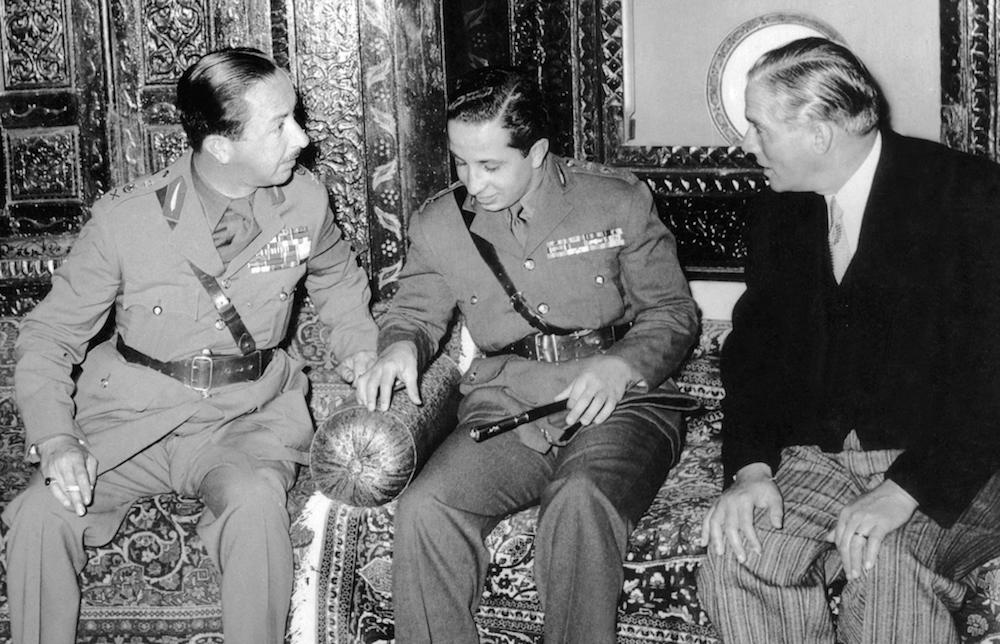
A picture dated 1957 shows King Faisal II (C) with Lebanese President Camille Chamoun (R) and King Faisal’s uncle Abdel Illah during the King’s visit to Lebanon. Abdel Ilah became a regent to the throne after King Faisal’s father King Ghazi died April 6, 1938. (AFP)
“One hundred years have passed since the Cairo Conference in 1921, which launched the establishment of the Iraqi state as an extension of an ancient civilization rooted in the depths of history,” he said.
“One hundred years have witnessed many milestones in the path of Iraq, the Arab nation, and indeed the whole world. On my own behalf, and on behalf of the Egyptian people, we congratulate brotherly Iraq on this precious occasion, wishing its great and honorable people peace, security and stability, and hoping that Iraq would always remain an asset for the Arab nation.”
After gaining its independence from the British Mandate established after the First World War, the kingdom of Iraq was founded in 1932 under Faisal I, a member of the Hashemite dynasty who was born in Saudi Arabia.
He ruled for 12 years, under a constitutional monarchy imposed by the British, until his death from a heart attack at the age of 48. Faisal’s son, King Ghazi, took the throne but died six years later in a car accident in Baghdad. The title of king fell to Faisal II, who was just 3 years old, and so his reign began under the regency of his uncle, Crown Prince Abdallah.
Highly intelligent, and leading a country blessed with a wealth of natural resources, Faisal seemed destined to build on the foundations established by his father and grandfather when he took the throne, at the age of 18, in 1953. Iraq at the time was prospering; oil revenues were flowing in and the country was undergoing rapid industrialization.
But the tide would soon start to turn against the kingdom. Iraq’s close relationship with the British — a policy Faisal II continued — became the source of increasing hostility, which was exacerbated by the Suez crisis in 1956.
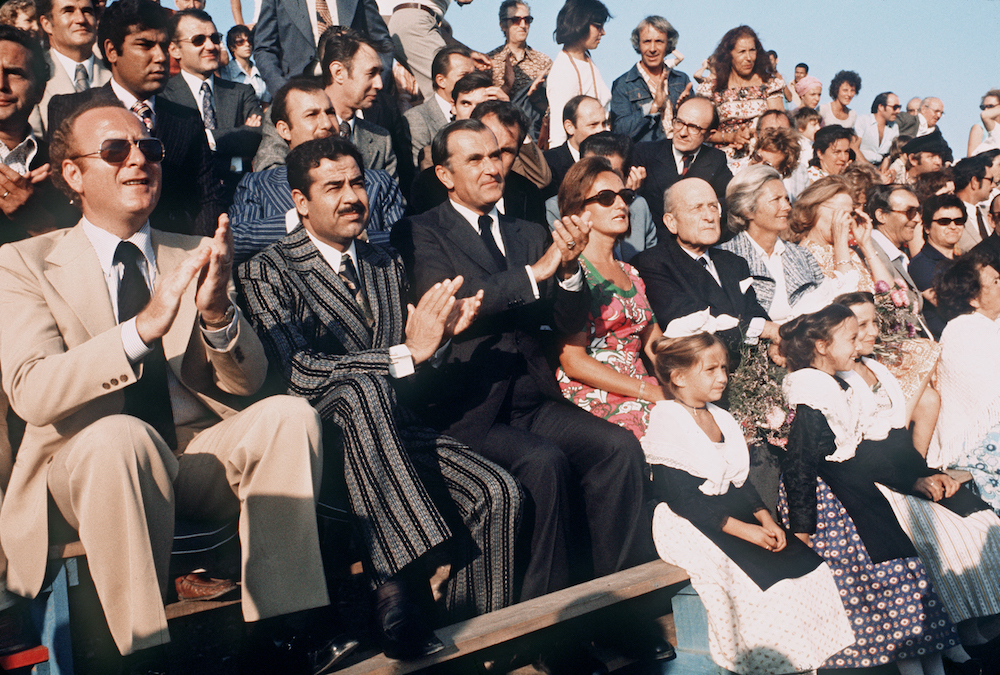
Iraqi leader Saddam Hussein (2L), French Defense Minister Yvon Bourges (3L), Bernadette Chirac (4L) Prime Ministers’s wife, and les Baux-de-Provence’s Mayor Mr. Tuillier (1L) applaud during a corrida organized by the municipality in honor of the Iraqi leader on September 7, 1975 in Les Baux-de-Provence, southern France. (AFP)
On July 13, 1958, when two army brigades were ordered to go to Jordan to help quell a crisis in Lebanon, Abdul Karim Qassim, a disaffected officer leading one of the units, saw his chance and sent troops to the Qasr Al-Rihab palace in Baghdad. By early the following morning, they had surrounded the royal residence with tanks and opened fire.
Shortly after 8 a.m., King Faisal II, his uncle the crown prince and other members of the royal family and their staff were ordered to leave through a rear entrance and killed.
Many Iraqis still believe this was the start of a catastrophic downhill slide for the nation. While it lasted less than four decades, the constitutional monarchy is viewed by many as a golden period in Iraqi history. The king’s execution gave way to a tumultuous republic and, ultimately, the brutal dictatorship of Saddam Hussein.
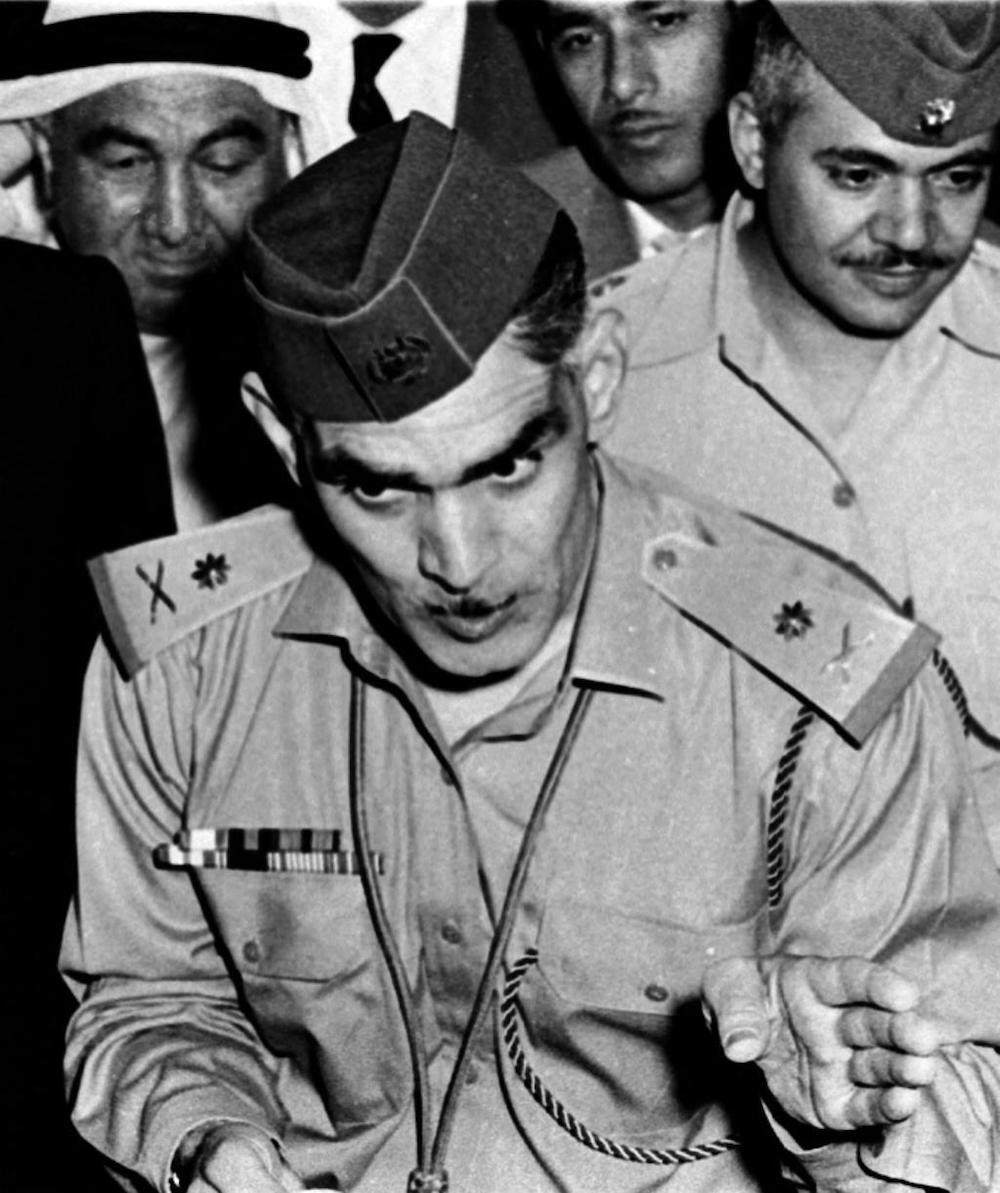
Undated picture of Iraqi president Abdul Karim Qassim, who overthrew King Faisal II in a coup on July 14, 1958. Qassim was himself deposed in a coup on Feb. 8, 1963, and executed the following day. (AFP)
More than 60 years later, Iraq is redefining itself yet again and reasserting its sovereignty. On Thursday, Dec. 9, Iraqi officials announced that the US had officially ended its combat mission in Iraq, reassigning all remaining troops to a training and advisory role. US forces had returned to Iraq at the invitation of the Baghdad government to help combat the Daesh extremist group that had seized territory in the northwest of the country and in neighboring Syria during the summer of 2014.
The ongoing presence of foreign forces in Iraq has long been a source of political disagreement in Baghdad, with many nationalist and pro-Iran factions demanding a full withdrawal.
“After a matter of days, we will witness the withdrawal of all combat forces of the international coalition from Iraq within the scope of the strategic agreement with the American side, and their role will be in the areas of advice, as a sign of the ability of Iraqi forces in all its categories to preserve the security of Iraq, stabilize its people and its continued development,” Al-Kadhimi said.
However, the overarching theme of Al-Kadhimi’s centenary speech was an appeal for all Iraqis to recognize what unites them rather than what divides them, for the common good of the country.
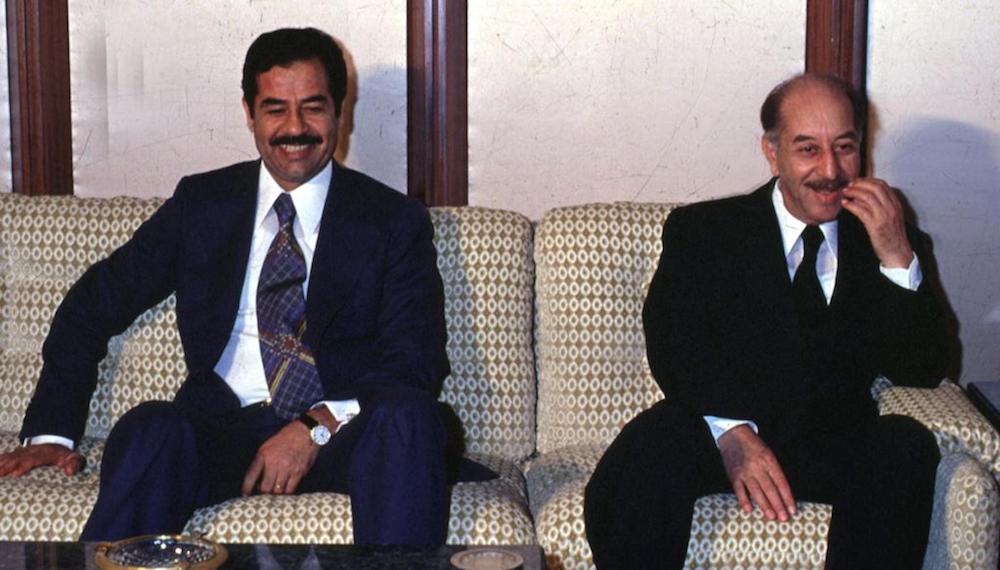
Photo dated 1976 shows former Iraqi President Ahmad Hassan Al-Bakr (R) sitting with then-Vice President Saddam Hussein in Baghdad. Al-Bakr took power in July 1968 following the ouster of Gen. Abdul Rahman Aref and stepped down in July 1979 for health reasons. (AFP)
“Amid the political challenges and efforts that the last election has arranged, everyone should be reassured: We will not allow them to touch your safety and stability,” he said.
“Despite all the differences, the political powers, new currents, independent people and elites are the sons of this country and they are keen on it and its safety.
“The difference in views and directions fades in front of everyone’s belief that Iraq is our umbrella and our home, and to mess with it and its future is a red line,” he added.
“This is Iraq, your Iraq, and the Iraq of all humanity. To preserve it and to inherit it is our duty.”