Watchdog says UN monitors needed in violence-hit Darfur
Author:
Thu, 2021-12-16 00:44
CAIRO: A human rights watchdog urged the UN on Wednesday to deploy monitors to Sudan’s western region of Darfur, where a surge in tribal clashes has killed more than 180 people since October.
Human Rights Watch said in a statement that the monitors should include experts on gender-based crimes, a year after the UN Security Council ended the mandate of a peacekeeping mission known as UNAMID in Darfur.
The violence between Arabs and non-Arabs in the war-wrecked region came as Sudan plunged into upheaval after an October military coup that removed Prime Minister Abdalla Hamdok’s government.
Though Hamdok was reinstated last month in a deal with the military, Sudan’s pro-democracy movement has rejected the settlement and insists on a transition led by a purely civilian government.
Mohamed Osman, HRW’s Sudan researcher, said tribal clashes over the past year in Darfur have left “a trail of devastation” in the region.
At least 183 people were killed, and dozens wounded since October, with thousands displaced and some crossing into neighboring Chad.
Osman called the latest violence a “stark wake-up call” for the international community to act.
“The UN’s priority should now be to ramp up human rights monitoring and ensure rigorous scrutiny of Sudan’s efforts to protect millions of Darfuris,” he said.
The Security Council terminated the UNAMID on Dec. 31, 2020 and replaced it with a much smaller and solely political mission, whose mandate will be ended in June next year. HRW said the departure of UNAMID has caused a “gap in monitoring the abuses” fueled by impunity for atrocities committed in Darfur.
Death toll in Sudan’s Darfur tribal clashes hits 138: medics35 killed in clashes in Sudan’s restive Darfur – officials
Lack of jobs, crisis drive Iraqi Kurds to migrate
Thu, 2021-12-16 00:32
RANYA, Iraq: The specter of unemployment haunts both students and teachers at universities in northern Iraq. Many speak of growing numbers of empty seats in classrooms across the semi-autonomous Kurdish region — seats once occupied by students who have left for Europe.
Those who remain, like 21-year-old law student Zhewar Karzan, are making plans to leave.
He sees no future at home, in the town of Ranya, nestled among picturesque mountains, rivers and Lake Dukan, the Iraqi Kurdish region’s largest lake. A college degree provides no guarantee of a job, and his parents struggle to pay the bills, he said.
Come spring, Karzan plans to try his luck and leave with other hopeful migrants. His brother Jiyar, who in 2016 paid a smuggler to take him to Italy from Turkey, eventually reached Britain and now supports the entire family back home while working in a pizza restaurant.
“I will join him,” said Karzan.
Iraqi Kurdish youth face a tough choice: Endure unemployment and corruption at home, or try to sneak into Europe at the risk of financial ruin, or even death during the perilous journey.
Though there are no firm statistics, a substantial number of young Iraqi Kurds are believed to have left, seeing no hope in their country. Meanwhile, students who stayed are struggling to get motivated because getting an education is no longer a sure path to a job.
Across the Middle East, struggling economies have failed to keep pace with growing populations. In the three Iraqi Kurdish provinces, between 43,000 to 54,000 jobs would need to be created every year to absorb new waves of young people joining the labor force, according to UN estimates.
The gap between tepid economic growth and a “youth bulge” has led to persistently high unemployment. Among Iraqi Kurds between the ages of 15 and 29, it’s 24 percent for men and 69 percent for women, according to a UN survey.
Kurds, others converge in French camp, seeking to reach UKHow viable is the Kurds’ autonomous rule in northeastern Syria?
UN chief says cross-border aid to Syria rebel bastion vital
Author:
Thu, 2021-12-16 00:01
NEW YORK: Cross-border humanitarian aid to Syria remains vital, the United Nations Secretary-General said in an internal report Tuesday, as a UN authorization allowing aid into rebel-held areas in the country’s northwest without approval from Damascus is set to expire.
A rare moment of cooperation between the US and Russia in July allowed for a six-month extension of activity at Bab Al-Hawa, the only border crossing through which aid reaches the rebel stronghold of Idlib province. That authorization is due to expire on Jan. 10.
“Cross-border assistance remains lifesaving for millions of people in need in north-west Syria,” Antonio Guterres said in a confidential document obtained by AFP, adding that over four million people were in need of crucial assistance across the country.
The US and several European nations believe the UN authorization for the crossing between Syria and Turkey should renew automatically for an additional six months, without the need for a new vote.
But Russia, a key ally to the Damascus regime, has previously opposed the move, invoking Syrian sovereignty.
Moscow has linked any potential extension to Tuesday’s report, as well as a possible new vote.
The cross-border mechanism has been operating since 2020 through Bab Al-Hawa, after the Russian-imposed removal in 2019 of three other access points in Syria.
BACKGROUND
A rare moment of cooperation between the US and Russia in July allowed for a six-month extension of activity at Bab Al-Hawa, the only border crossing through which aid reaches the rebel stronghold of Idlib province. That authorization is due to expire on Jan. 10.
In Tuesday’s document, the UN chief refers to another project for humanitarian operations, this time across the front lines, to reach Idlib.
“If implemented, this plan will make operations across the front lines more predictable and effective,” Guterres noted.
However, he insisted upon the importance of the Bab Al-Hawa crossing.
“At this point such cross-line convoys, even if deployed regularly, could not replicate the size and scope of the cross-border operation,” he said.
Guterres said some 4.5 million people in Syria need help this winter, up 12 percent from the previous year, because of the economic crisis and the global pandemic.
Only 2.9 percent of the Syrian population is fully vaccinated, according to the report.
More than 3 million people live in Idlib province, much of which is controlled by jihadists and allied rebels.
In June, the UN said around 2.4 million people there were in need of humanitarian aid.
Syria state media say US forces ‘kidnapped civilians’ near Deir EzzorIsraeli official says Syria must not have chemical weapons
Lebanese purchasing power continues to shrink amid financial collapse
Wed, 2021-12-15 23:53
BEIRUT: The Lebanese pound hit record lows this week, trading at almost LBP29,000 to the US dollar, leading to an intervention from the Banque du Liban that allowed the exchange rate to drop to LBP27,000.
This spurred self-employed professionals to call for a national state of emergency to be declared, while the transport sector announced that Thursday would be a “day of anger.”
Further exacerbating the situation in Lebanon, the director-general of telecom company Ogero, Imad Kreidieh, said he had applied for an urgent advance to purchase fuel to continue operating the electrical generators for telecom networks.
“But President Michel Aoun refrained from signing decrees since the Cabinet is not convening, which may lead to the suspension of our services and interruption of internet services,” he added.
In light of Lebanon’s increasing financial challenges, the purchasing power of Lebanese citizens has shrunk by 95 percent, while the minimum wage has become the equivalent of about $24.
The head of the Syndicate of Food Importers, Hani Bohsali, said: “The situation is too dangerous. It is not limited to the exchange rate or price increase. Food security is in danger. Regardless of the ability to secure dollars for imports, the problem has become in the consumer’s ability to purchase goods. Chaos is pervading markets.”
The heads of professional syndicates met on Wednesday and expressed “deep concerns about the comprehensive deterioration that has crossed the line and is now threatening the country’s foundations.”
The syndicates called for the need to declare a national state of emergency, accompanied by “vigorous work” to initiate a political solution to save the country and put in place a clear and effective rescue plan, especially “in the absence of serious solutions” for social and economic issues.
“BDL and the Association of Banks in Lebanon ought to take urgent measures to make it easier for the professional syndicates to withdraw their deposits in Lebanese and foreign currencies as soon as possible,” the syndicates demanded, threatening to sue BDL and ABL, and carry out massive protests.
HIGHLIGHT
Self-employed professionals called for a national state of emergency to be declared, while the transport sector announced that Thursday would be a ‘day of anger.’
There are no prospects of the Cabinet convening any time soon, as Hezbollah and the Amal Movement insist on removing Tarek Bitar, the judge leading the probe into the Beirut port blast, before attending any sessions.
Bitar has reiterated his demand for the arrest of former finance minister, MP and leader in the Amal Movement, Ali Hassan Khalil.
Some political observers interpreted these developments as “new means of pressure against the continuous disruption of Cabinet sessions by Hezbollah and the Amal movement,” while other pro-Hezbollah observers believed this was “a new American means of pressure to besiege the party.”
Parliament Speaker Nabih Berri, an ally of Hezbollah, told his visitors on Wednesday: “99 percent of our suffering in Lebanon stems from internal disputes.”
He accused Aoun and the Free Patriotic Movement of opposing the Taif Agreement and abstaining from implementing laws, especially the law on electricity which, he said, was to blame for over 45 percent of the state’s financial deficit.
Berri said that he and Hezbollah did not want Bitar to be removed from the port probe. Rather, they were demanding that the investigation abide by the law and constitution.
“The law granted judges the right to be tried before a special tribunal, as well as it granted MPs, presidents and ministers the right to be tried before a parliamentary body. Why were these rules and principles not adhered to?”
Lebanon looks to keep COVID-19 cases down over the holidays Lebanese caught between old and new $100 banknotes
What the growing US-Israel rift means for the Iran nuclear issue
Wed, 2021-12-15 22:57
WASHINGTON: Talks to revive the Iran nuclear deal, which could see stringent sanctions on Tehran lifted in exchange for guarantees to halt its uranium enrichment program, resumed in Vienna at the end of last month.
However, delays and obstructions by the hard-line government of Iran’s President Ebrahim Raisi, Israeli attacks on Iranian targets in Syria, and increasingly combative rhetoric from Tel Aviv have collectively cast doubt on the success of the renewed dialogue.
Jean-Yves Le Drian, the French foreign minister, told a parliamentary committee on Dec. 7 that he fears the Iranians are playing for time in an attempt to water down the terms of the deal.
“We have the feeling the Iranians want to make it last and the longer the talks last, the more they go back on their commitments and get closer to capacity to get a nuclear weapon,” Le Drian was quoted by the Reuters news agency as saying.
Soon after the talks resumed, the head of Israel’s intelligence agency Mossad, David Barnea, vowed that Israel will never allow Iran to acquire nuclear weapons, indicating that the Naftali Bennett government is losing patience with diplomatic efforts and is increasingly willing to use force.
Indeed, on Dec. 7, Israel launched a rare airstrike against Syria’s main port of Latakia. According to the Syrian Observatory for Human Rights, a UK-based conflict monitor, the strike destroyed an Iranian weapons shipment. Israel’s military is yet to comment on the attack.
“Iran will not have nuclear weapons — not in the coming years, not ever,” Barnea said at an agency awards ceremony in early December. “This is my personal commitment: This is the Mossad’s commitment.”
“Our eyes are open, we are alert, and together with our colleagues in the defense establishment, we will do whatever it takes to keep that threat away from the state of Israel and to thwart it in every way.”
Barnea and Benny Gantz, Israel’s defense minister, made a rare joint trip to Washington last week where they reportedly pressed senior White House officials on the need to seriously consider joint strikes on key Iranian military and nuclear targets.
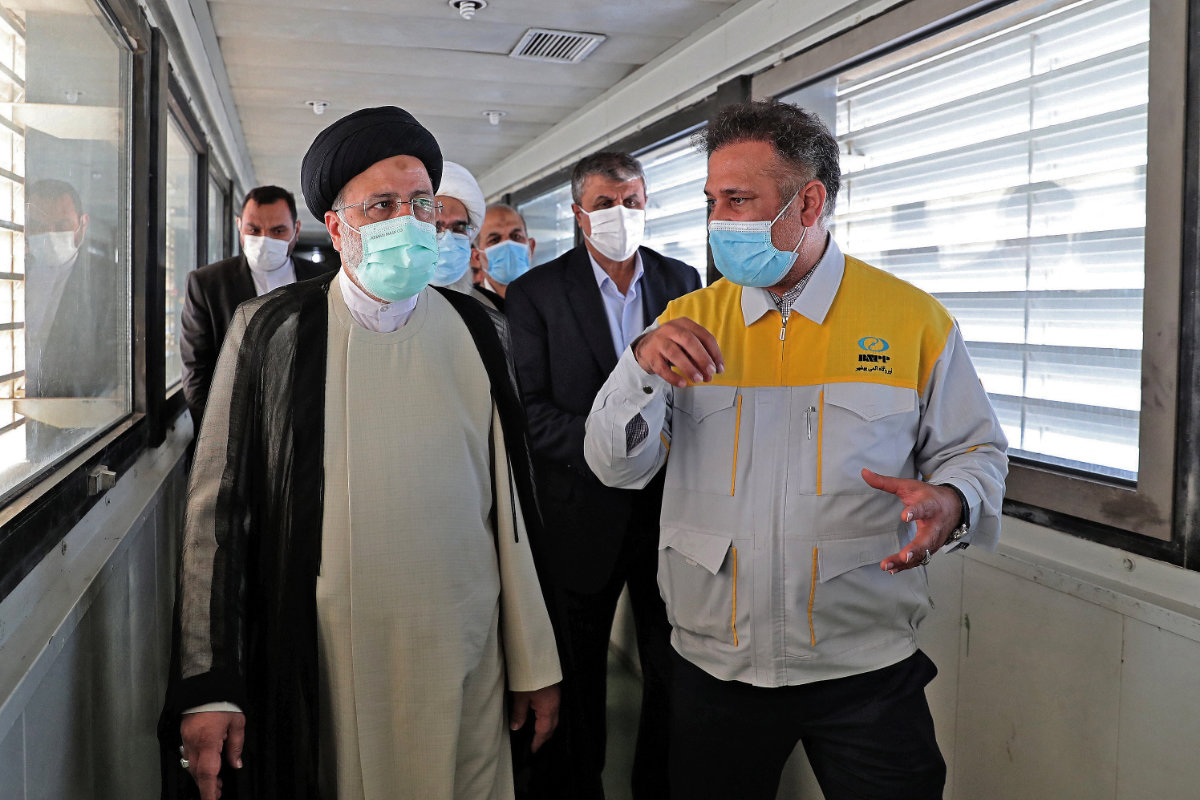
A handout picture provided by the Iranian presidency on Oct. 8, 2021 shows Iran’s President Ebrahim Raisi visiting the Bushehr Nuclear Power Plant. (AFP)
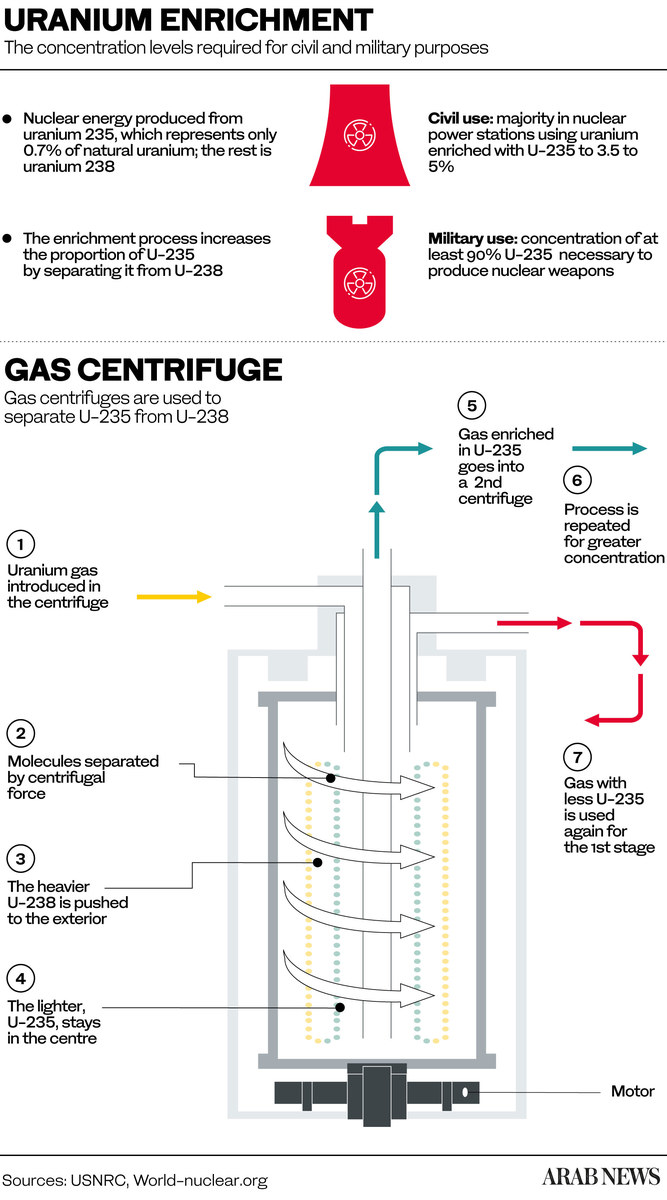
Iran has accelerated enrichment since the US withdrew from the accord in 2018, with then-president Donald Trump claiming the deal did not go far enough in curtailing Tehran’s atomic ambitions. Iran has long insisted its program is purely for civilian energy purposes.
US President Joe Biden, who helped negotiate the original deal in 2015 as Barack Obama’s vice president, wants to rejoin a strengthened nuclear agreement, which co-signatories Russia, China, Britain, France, Germany and the EU have fought hard to salvage.
However, Israel is not convinced that reviving the 2015 deal will curb Iran’s nuclear capabilities and its ballistic missile program, to say nothing of its destabilizing influence across the Middle East. Instead, the Israelis want a more forceful deterrent on the table.
The window for reaching a nonmilitary resolution to Iran’s nuclear program is closing fast. Israeli intelligence indicates Iranian nuclear scientists are preparing to enrich uranium to 90 percent purity, bringing Tehran closer than ever to building a bomb.
Unless further enrichment is prevented, Iran could stockpile enough weapons-grade uranium in the coming months to produce a viable nuclear weapon with little warning.
Israel’s frustration with the Biden administration’s stance has been steadily building in recent weeks. In a video published on his YouTube channel, Naftali Bennett called on fellow world leaders to not allow Iran to get away with what he called “nuclear blackmail.”
Israeli officials are concerned Biden’s negotiating team will roll back sanctions on Iran, both nuclear and terrorism-related, thereby releasing billions of dollars that the regime desperately needs, in exchange for only minimal guarantees on curtailing its nuclear program.
Furthermore, Bennett has hinted that Israel is prepared to take matters into its own hands if the US accepts a “less for less” interim deal with Iran that would potentially give the regime sufficient latitude to achieve nuclear weapons breakout in the near future.
Such an incremental deal could end up further emboldening Iran’s regional transnational terror network by providing Shiite proxies in Iraq, Lebanon, Syria, Yemen and beyond with funding previously denied to them under harsh sanctions.
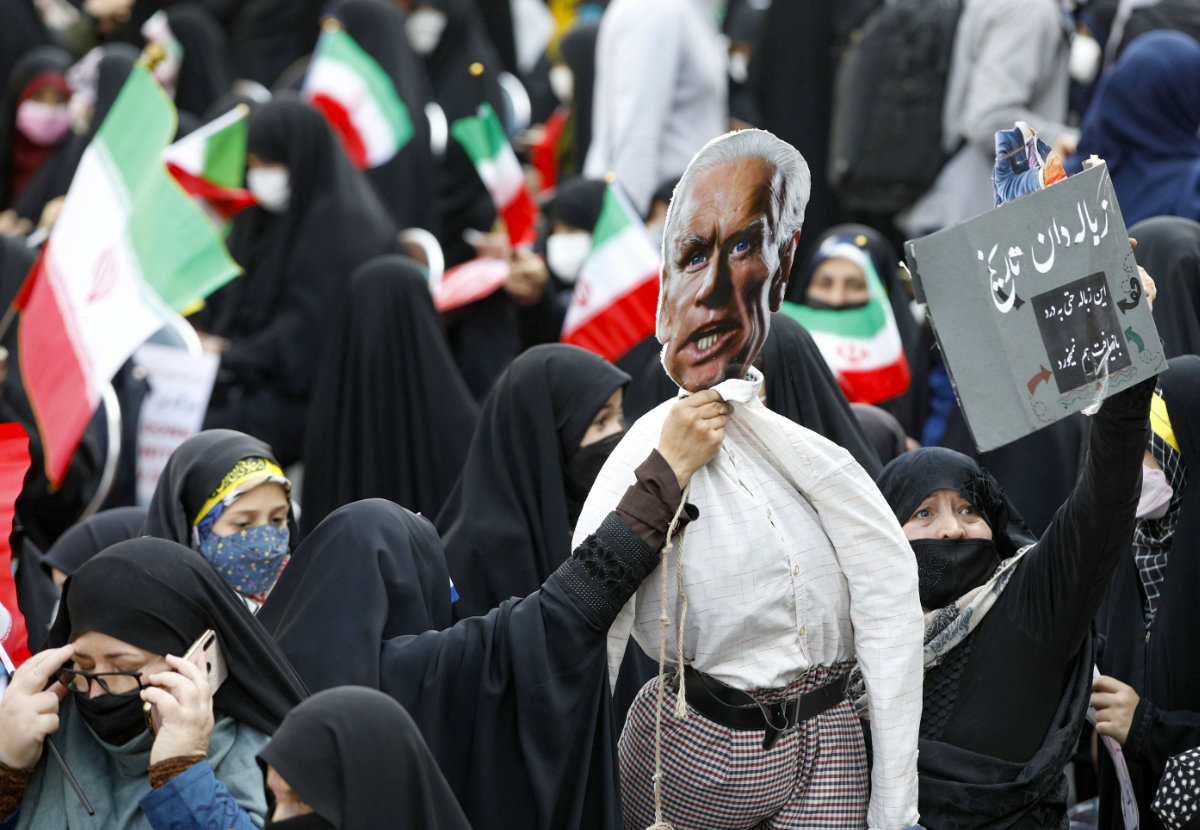
Iranian protesters raise a dummy of US President Joe Biden during a rally outside the former US embassy in Tehran on Nov. 4, 2021, to mark the 42nd anniversary of the start of the Iran hostage crisis. (AFP photo)
“To chase the terrorist du jour sent by the Quds Force does not pay off anymore,” Bennet said in a televised conference hosted by Reichman University on Nov. 23. “We must go for the dispatcher.”
The US and Israel have traditionally acted in lockstep on the issue of containing Iran, so the recent divergence of opinion and the growing prospect of unilateral Israeli action is raising concerns in Washington.
“Naftali Bennett’s government tried hard to cooperate with the Biden team when they came into office to present a joint front on Iran policy because they genuinely thought it could get the US to listen to them more,” said Gabriel Noronha, executive director of the Forum for American Leadership and previously the State Department’s special adviser for Secretary of State Mike Pompeo’s Iran Action Group.
“They’ve increasingly realized they were naive on this point and have begun speaking out in the press more and more with their complaints, while at the same time US officials are leaking details of Israeli military operations to the press.
“Both Israeli officials and the US military leadership believe there is a need to have a credible military threat to deter Iran’s nuclear program. However, they are at odds with Biden’s political appointees at the State Department, National Security Council, and Colin Kahl — the number three official at the Pentagon — who remain under the delusion that appeasement toward Iran is the best path forward.”
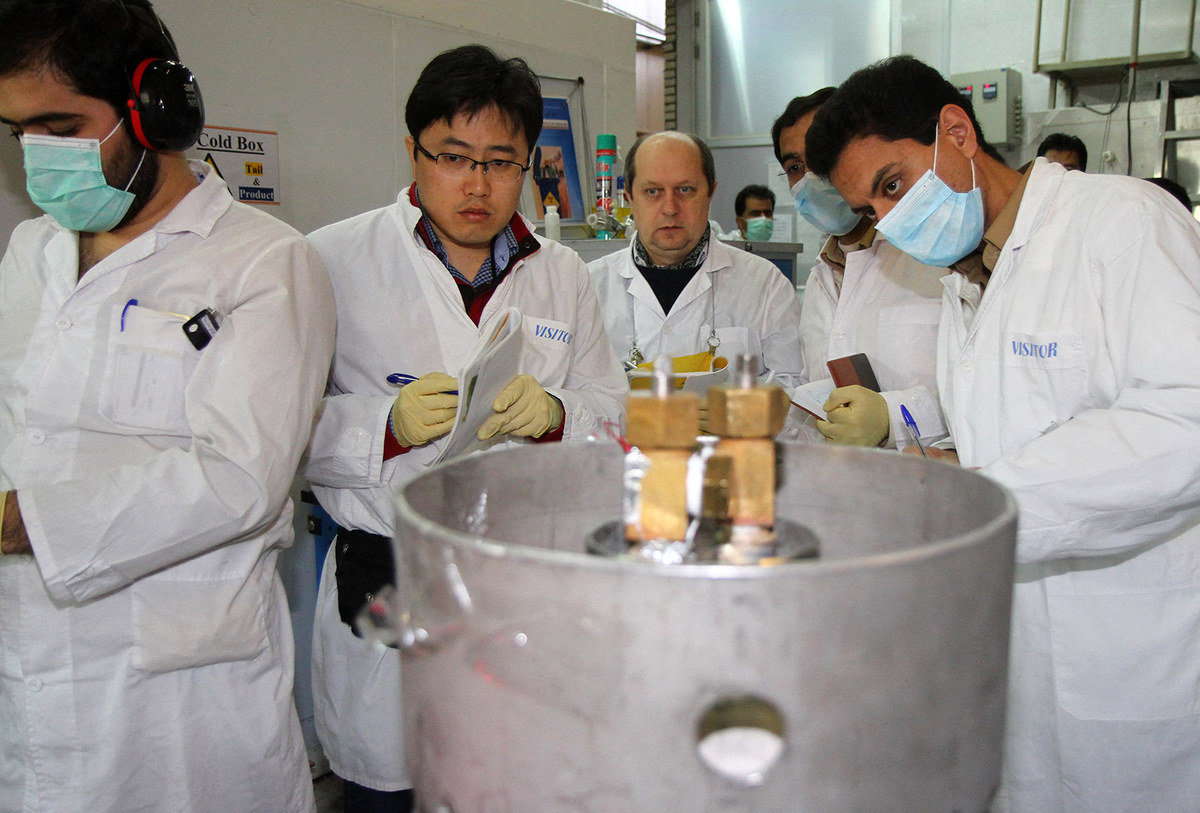
Inspectors of the International Atomic Energy Agency had been repeatedly denied complete access to Iranian nuclear facilities. (AFP file photo)
Noronha warned against downplaying Israel’s complaints in the quest to revive the nuclear deal, arguing that taking the country’s security concerns seriously might actually enhance US leverage over Iran.
“The US needs to change its approach and recognize that Israel is its best partner against the Iranian threat because its military, diplomatic and economic pressure against the regime gives the US more leverage in negotiations,” he told Arab News.
“Many Israeli officials are incredibly frustrated by Washington’s antagonism toward Israeli policy, which is just trying to ensure its basic security needs are met. Israel can help the US — and its negotiations — by continuing to take covert action against Iran’s oil exports and its nuclear program.
“The US would be wise to share more intelligence with Israel to advance and support its operations, as well as accelerate its military cooperation on a potential airstrike against Iran’s nuclear facilities.”
One area in which the Biden administration sharply differs from Bennett’s outlook is its willingness to accept a “threshold state” when it comes to Iran’s nuclear capabilities.
Indeed, it would appear the Biden White House is prepared to tolerate a status quo in which Iran holds the components for “nuclear breakout,” including the requisite knowledge, military hardware and enrichment capacity, without actually building a nuclear weapon.
By contrast, the Israelis believe such a threshold state is just as serious as Iran actually developing a nuclear weapon.
Ellie Cohanim, who was deputy special envoy to monitor and combat antisemitism at the State Department under the Trump administration, is concerned the Biden administration is not listening to Israeli concerns.
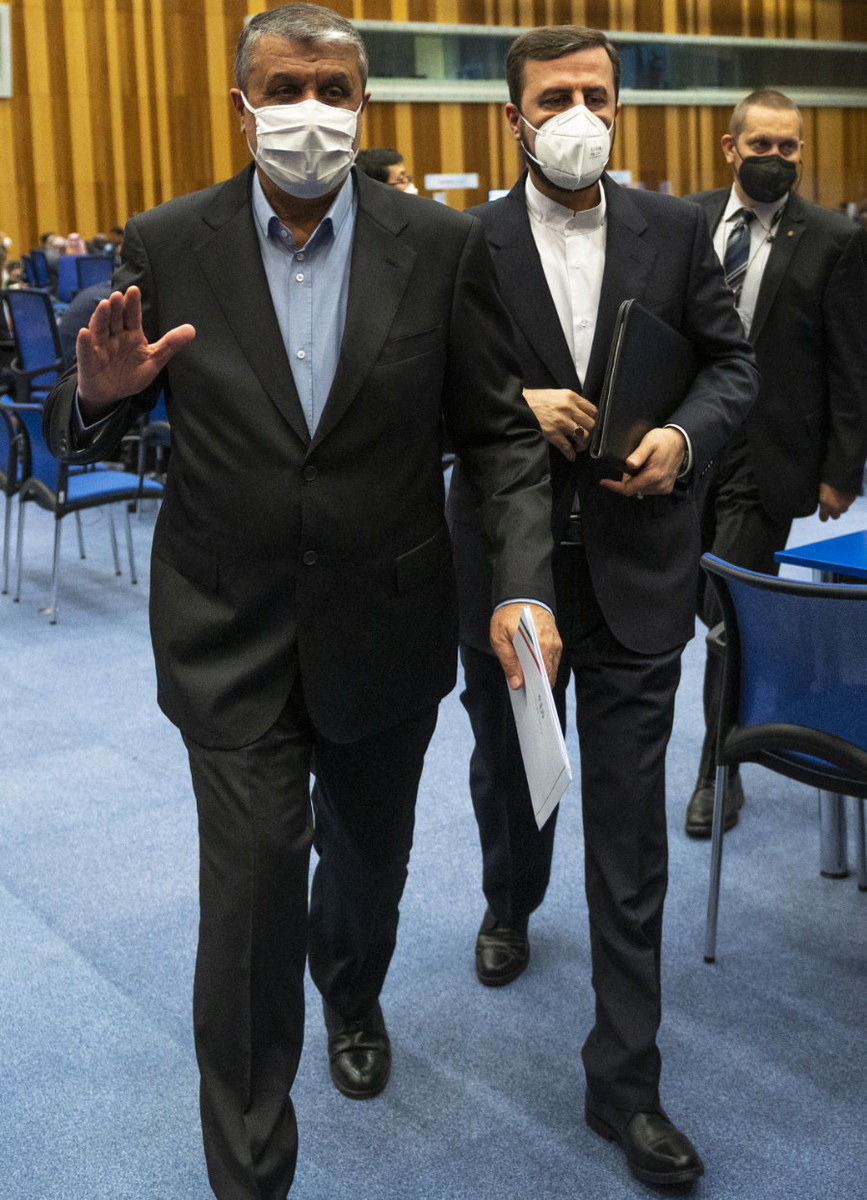
Iran atomic energy chief Mohammad Eslami (L) and Kazem Gharib Abadi (C), Iran’s governor to the International Atomic Energy Agency (IAEA), depart after attending an IAEA meeting in Vienna, Austria on Sept. 20, 2021. (AFP)
“It seems that, behind the scenes, the differences between the Biden administration and its Iran negotiating team with the Israeli government are growing,” Cohanim told Arab News, adding that the Biden team has failed to replicate the Trump administration’s “zero tolerance” policy.
“Israeli PM Bennett has stated on the record that the US and world powers need to wake up to the fact that the Iranian regime is seeking nuclear weapons, and so it would appear there is a sense of frustration that the Israelis have with the current US administration,” she told Arab News.
“President Donald Trump stated clearly that he would never allow Iran to develop a nuclear bomb on his watch, and it is time for US President Joe Biden to go on the record stating the same.
“The Israelis have demonstrated time and again their premier intelligence capability, especially in relation to Iran. The Biden administration would be well advised to rely on Israeli intelligence data and take any necessary military actions to end Iran’s nuclear weapons activity should Israel ever assess that the Iranians had crossed the line when no further alternatives exist to kinetic activity.”
Where this line is drawn remains a point of contention between Biden and Bennett’s national security teams. Failure to reach a common position could result in unilateral Israeli action against Iran’s nuclear infrastructure. And, yet, the rift seems wider than ever.
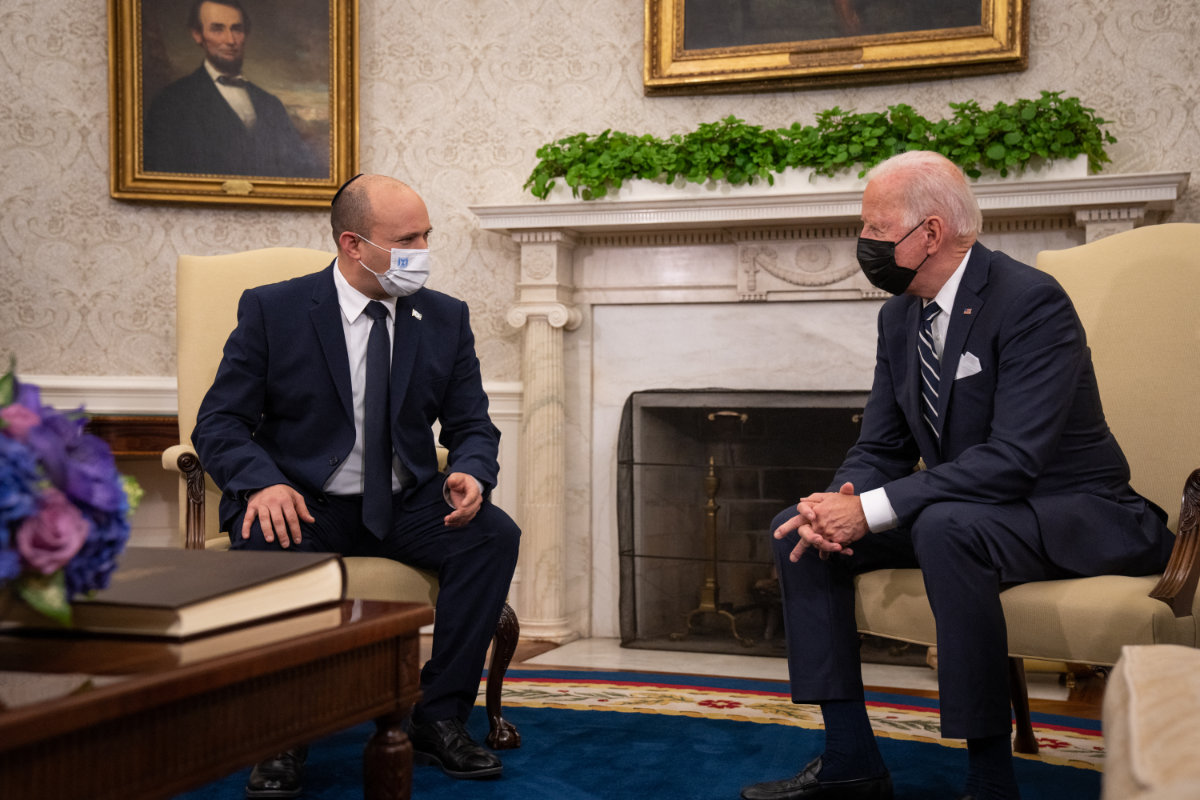
US President Joe Biden meets with Israeli Prime Minister Naftali Bennett at the White House on August 27, 2021 in Washington, DC, during talks focused on Iran. (AFP photo)
“Ever since Prime Minister Bennett’s visit to Washington to meet President Biden, senior Israeli officials have been publicly talking about their displeasure with Biden’s plan to move full steam ahead with diplomacy with the Islamic Republic,” Bryan Leib, executive director of Iranian Americans for Liberty, told Arab News.
“Just a week ago, Biden’s US special envoy to Iran was in Israel meeting with several senior Israeli officials, but it was reported that PM Bennett chose not to meet with him.
“For the last 40 years, the Iranian regime has been censoring, oppressing and murdering its own citzens, while its leaders publicly call for the destruction of the US and the world’s only Jewish nation, Israel,” Leib said.
“Diplomacy with the Islamic Republic will fail once again because they are not rational actors that truly seek peace and a brighter future for their people.”
Iran lets UN replace nuclear site’s damaged cameras: ReportsIran nuclear escalation means ‘we are rapidly reaching the end of the road,’ warn France, Germany, UK