Rights violations on all sides of Ethiopia conflict, UN says
Sat, 2021-12-18 00:31
GENEVA: All sides in the deepening conflict in northern Ethiopia are committing severe human rights violations and should pull back from their year-old war, the UN said.
An estimated 5,000 to 7,000 people are detained, including nine UN staff, under a state of emergency and its “excessively broad provision” declared by the government last month, the UN Deputy High Commissioner for Human Rights, Nada Al-Nashif, said.
“Many are detained incommunicado or in unknown locations. This is tantamount to enforced disappearance, and a matter of very grave concern,” she told a special session of the UN Human Rights Council.
Ethiopia’s Ambassador to the UN in Geneva, Zenebe Kebede, did not comment directly on the accusations of detentions, but said that there was a failure to condemn what he said was a series of abuses by rebellious forces from the northern Tigray region.
“Ethiopia is being targeted and singled out at the Human Rights Council for defending a democratically elected government, the peace and the future of its people,” he said.
Thousands of civilians have died and millions have fled in the conflict between the federal government and rebellious forces including fighters loyal to the Tigray People’s Liberation Front, which dominated Ethiopia’s ruling coalition for nearly 30 years.
Al-Nashif said people had been detained in Oromiya and Benishangul-Gumuz regions this month.
“I also deplore increasing hate speech and incitement to violence by federal and regional authorities, as well as other public figures, particularly targeted against Tigrayans and members of the Oromo community,” she added.
The forum will consider a draft resolution brought by the EU that condemns violations by all sides. If adopted, it would set up an international commission of rights experts on Ethiopia to investigate and report back after a year.
The US called for the resolution’s adoption and for the Ethiopian government to “release all civilians and allow international monitors timely access to detainees.”
Ethiopia’s Zenebe rejected the resolution and said the government would not work with any such commission.
He added that the state-appointed Ethiopian Human Rights Commission had already worked with the UN rights office to investigate accusations of abuses, and was ready to do so again.
That joint investigation published last month found that all sides in Tigray’s conflict had committed violations that may amount to war crimes.
Diplomats expected the vote on the resolution to be close at the 47-member-state forum.
The African Group of countries said that “any politicization of the investigation process must be avoided” and that the EU had “totally ignored its positions and advice on this delicate situation.”
The proposed investigative mechanism was “counterproductive and likely to exacerbate tensions,” it said, calling for the resolution to be rejected.
In Addis Ababa, Ethiopian government spokesman Legesse Tulu did not respond to requests for comment.
Ethiopia urged to free reporters held under emergency lawsTigray rebels retake Lalibela in Ethiopia
Death toll in Darfur tribal clashes reaches 199
Author:
Sat, 2021-12-18 00:42
KHARTOUM: At least 199 people have been killed in Sudan’s restive Darfur in tribal clashes over the past two months, medics said on Friday, urging the government to stop the bloodshed.
The clashes, triggered by disputes over land, livestock and access to water and agriculture, have hit several parts of Darfur since early October.
The independent Doctors’ Committee said 199 people have been killed, most of them shot dead.
“There are no concrete steps being taken from any side to stop the violence. The state is absent as well as the justice system and police are nowhere to be found,” it said in a statement.
According to the International Organization for Migration (IOM), the violence has displaced more than 83,000 people.
Darfur was ravaged by a civil war that erupted in 2003 between ethnic minority rebels, who complained of discrimination, and the Arab-dominated government of then president Omar Bashir.
Khartoum responded by unleashing the Janjaweed militia, blamed for atrocities including murder, rape and the looting and burning of villages.
The violence resulted in one of the world’s worst humanitarian catastrophes. More than 300,000 people died and 2.5 million were displaced during the conflict, according to the UN.
Bashir, who is wanted by the International Criminal Court on charges of genocide in Darfur, was ousted and jailed in April 2019 after mass protests against his three-decade rule.
Watchdog says UN monitors needed in violence-hit DarfurDeath toll in Sudan’s Darfur tribal clashes hits 138: medics
UN fears for Lebanon’s children amid poverty and violence
Author:
Fri, 2021-12-17 22:56
BEIRUT: UN Secretary-General Antonio Guterres will travel to Lebanon on Sunday for an official visit to the country.
The UN Information Office in Beirut said the visit was a gesture of solidarity, and that the secretary-general “will reiterate the support of all the UN family, the political mission, the peacekeeping forces and the humanitarian and relief workers to Lebanon and its people.”
Two days before the visit, the special representative of the secretary-general on violence against children, Najat Maalla M’jid, conducted a tour of Lebanon, discussing “the huge impact of the economic, social and pandemic crises on children, especially the poor ones, in addition to all forms of violence against them.
“We looked into ways to support and accelerate the activation of national policies for social coverage and protection of children against all forms of violence, especially the fight of child labor, within the framework of an integrative approach to a series of very important services,” M’jid said on Friday.
Her remarks came after meetings with Lebanon’s President Michel Aoun and Prime Minister Najib Mikati.
“The UN supports the Lebanese government in the field of children’s protection from violence, discrimination and poverty,” she added.
A UNICEF report warned that “children in Lebanon are in danger, as 15 percent of families stopped their children’s education, and 30 percent of children do not receive the needed primary healthcare.”
By Thursday, 239,000 people in Lebanon had registered on the platform of the Poorest Families Program, Mikati said.
Among those registered, 166,000 applications met the required specifications, which indicates the extent of social pressures, he added.
In the first stage, he said, $125 will be paid to each family per month for a year, through funds secured by the World Bank.
There is also the issue of the ration card that will adopt the same platform for registration, which covers more than 500,000 families, he added,
“We have agreed with the World Bank that once the relief project begins and two months of credits are paid for the ration card at an acceptable cost from the funds of special withdrawals in the central bank, the World Bank will secure financing for the project for a period of one year, estimated at about $500 million,” he said.
Mikati assured the Lebanese people that “there is an international decision not to let Lebanon collapse,” adding: “There is an external and internal umbrella that protects the government’s work.”
The prime minister stressed that the government would not hesitate to resign if it led to a solution, but said he felt the move would “cause a further deterioration in the situation, and may lead to the postponement of the parliamentary elections.”
Mikati also said talks were ongoing to resume Cabinet sessions.
Lebanon faces an economic crisis described by the World Bank as “one of the worst crises on Earth since the middle of the 19th century.” Around 80 percent of the Lebanese people live in poverty.
UNICEF estimated in a report published November that “more than 30 percent of families have at least one child who skipped a meal, while 77 percent of families say they lack sufficient food and 60 percent of them buy food by accumulating unpaid bills or borrowing money.”
The dollar rate was about to reach 29,000 Lebanese pounds in the middle of the week, but the intervention of the Lebanese Central Bank reduced it to around 26,000 pounds.
Lebanon to set up more checkpoints to clamp down on theftsIMF examines extent of Lebanon’s financial sector losses
Digitized war records of Indian troops killed in WWI Iraq highlight long forgotten siege
Fri, 2021-12-17 22:22
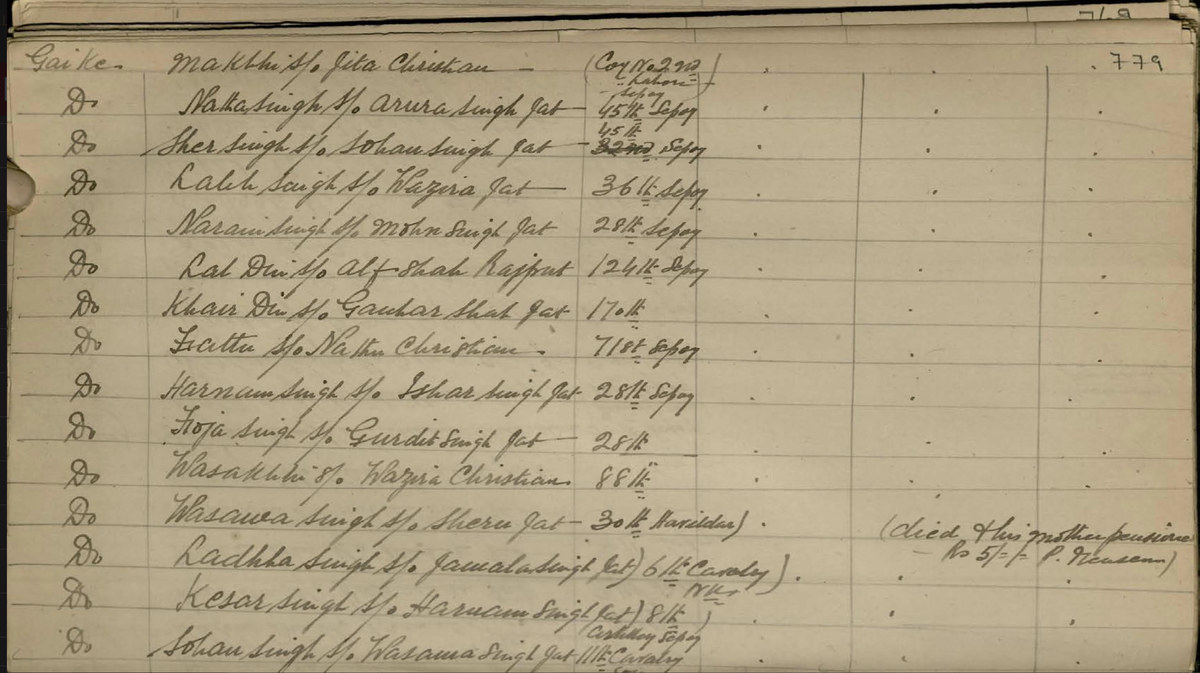
LONDON: The beautifully handwritten note on the yellowing service record, compiled by the Punjab government in 1919 and now over a century old, is as brief as it is poignant.
In faded ink, the entry for Wasawa Singh, the son of Shera, a Jat from the village of Gaike in northeast Punjab, tells the story of a young life cut short in the service of an alien empire.
There are no dates, merely a rank — havildar, equivalent to sergeant — and the name of a unit, the 30th Punjabis.
Paperwork documenting the military service of more than 300,000 men from Punjab was recently unearthed in the Lahore Museum in Pakistan. (Supplied)
An infantry regiment first raised by the British Indian Army in 1857, the 30th saw action in the Indian mutiny (1857-58), the Bhutan War (1864-66), the Second Afghan War (1878-80) and, finally, the First World War.
It was in this last conflict, in which over 1 million Indian soldiers fought in almost every theater of the war for the British Empire, that Singh died, along with more than 70,000 of his countrymen.
The surviving paperwork documenting his service, and that of more than 300,000 other men from Punjab, has been unearthed in the depths of Lahore Museum in Pakistan. Discovered after languishing forgotten for over 100 years, all 26,000 pages have been digitized and can now be searched online, by the name of the soldier, his father, or their village.
Although a priceless treasure trove for both historians and descendants of the old warriors, the documents contain only limited information. They do not reveal, for example, how old Singh was when he was killed, how he met his end, or even when and where he died.
A terse entry in the neat handwriting of some forgotten civil servant does, however, record that after his death, Singh’s nameless and doubtless grief-stricken mother was awarded a small pension.
For four long years, British and Indian soldiers fought side by side to oust the Ottoman Empire from what is now modern-day Iraq. (Alamy)
According to the records of the Commonwealth War Graves Commission, 153 men called Singh died while serving with the 30th Punjabis. Wasawa, service number 3902, fell on Jan. 15, 1917, while fighting the Germans in East Africa. Although fated to perish 5,000 km from his Punjab home, he was, at least, spared the horrors of Gallipoli or the western front in France, where so many Indians fought and suffered in horrendous conditions.
Death was to be his lot, however. He was killed in fierce fighting which saw the Germans finally defeated at Mahenge, near the Rufiji river in modern-day Tanzania.
Wasawa Singh’s final resting place is unknown. His name, and those of more than 1,200 British and Indian officers and men “to whom the fortune of war denied the known and honored burial given to their comrades in death,” is recorded on the British and Indian Memorial wall at Nairobi South Cemetery in Kenya.
FASTFACTS
* The siege of Kut Al-Amara, a town 160 km southeast of Baghdad, lasted four months, ending on April 29, 1916.
* Around 4,000 men died in the siege, while 23,000 more were killed or wounded attempting to relieve the besieged force.
For the hundreds of thousands of families in India and Pakistan today whose grandfathers and great-grandfathers took up arms for the British cause in the 1914-1918 war, the emergence of the Lahore Museum papers is one more step toward a long-overdue recognition of the sacrifices made by so many from the subcontinent.
In Britain, every year, the nation still observes a minute’s silence on Armistice Day: At the 11th hour of the 11th day of the 11th month, the time and date the guns fell silent on the western front in France in 1918.
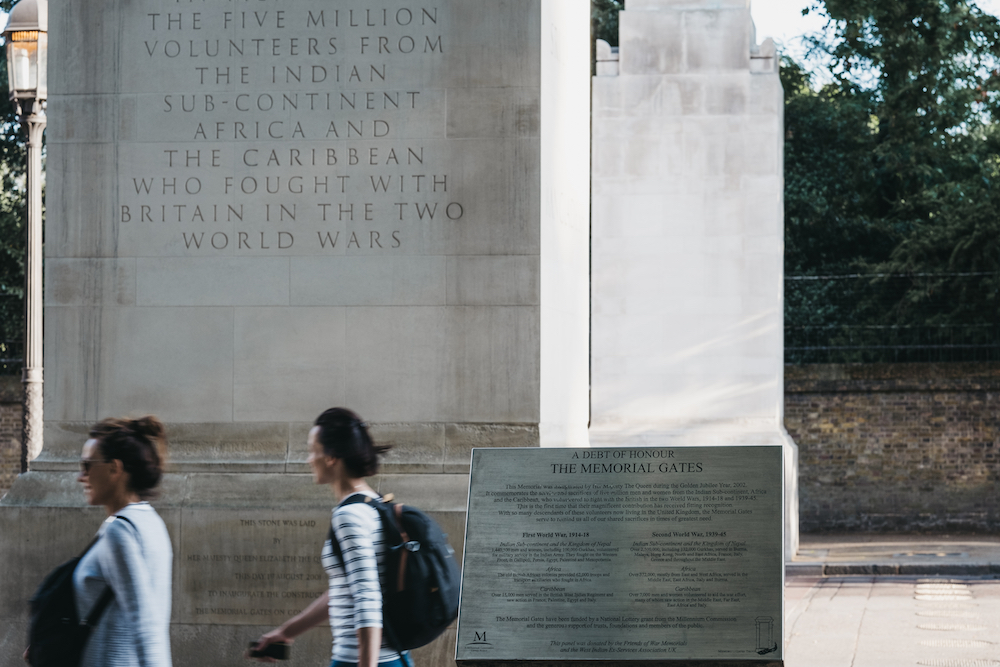
But although in recent years efforts have been made to ensure that the Armistice Day commemorations are inclusive of all the nations of the British Empire whose young men lost their lives, it was not until 2002 — 84 years after the end of the war — that a solemn memorial dedicated “In memory of the 5 million volunteers from the Indian subcontinent, Africa and the Caribbean who fought with Britain in the two world wars” was unveiled on Constitution Hill in London.
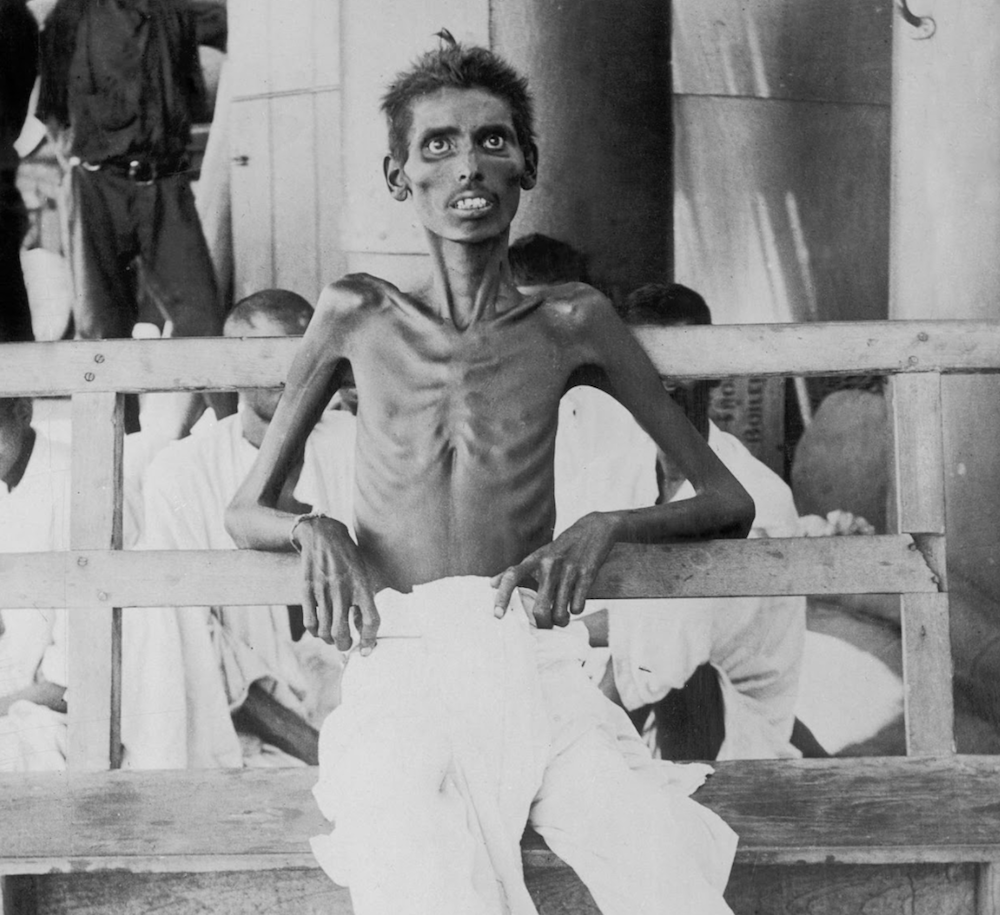
One of the Indian soldiers after being held by the Turks in a Mesopotamian prison following the fall of Kut. June 28, 1917. (Daily Mirror/Mirrorpix/Mirrorpix via Getty Images)
It was almost as if, for all those years, the sacrifices made by the subcontinent’s soldiers on behalf of the empire had been taken for granted.
That, certainly, was the only conclusion that could be drawn from a report by the Commonwealth War Graves Commission, which in 2019 set up a committee “to probe the early history of the Imperial War Graves Commission to identify inequalities in the way the organization commemorated the dead of the British Empire.”
Founded over a century ago as the Imperial War Graves Commission, initially to commemorate the empire’s First World War dead, the organization was charged at the outset with treating all the fallen with equal dignity. In a paper prepared for the commission in 1918, Lt. Col. Sir Frederic Kenyon, director of the British Museum, wrote that “no less honor should be paid to the last resting places of Indian and other non-Christian members of the empire than to those of our British soldiers.”
In its report, published earlier this year, the committee concluded that, “although the organization upheld its promise of equality of treatment in Europe, this was not always the case for certain ethnic groups elsewhere.”
It found that, “in conflict with the organization’s founding principles,” between 45,000 and 54,000 casualties — predominantly Indian, East African, West African, Egyptian and Somali — “were commemorated unequally.”
Memorial Gates at the end of Constitution Hill in London. (Shutterstock)
Even more shocking, as many as 350,000 others “were not commemorated by name or possibly not commemorated at all.”
In all the conflicts in which Indian troops fought and died with barely any recognition, few are as little known, certainly in Britain, as the Mesopotamian campaign, to which India made its greatest contribution in the First World War. As British Col. Patrick Cowley, a veteran of a later conflict in Iraq, wrote in his 2009 book “Kut 1916: Courage and Failure,” the “campaign in Mesopotamia is a ‘forgotten war’ and the Kut story was overshadowed by events elsewhere.”
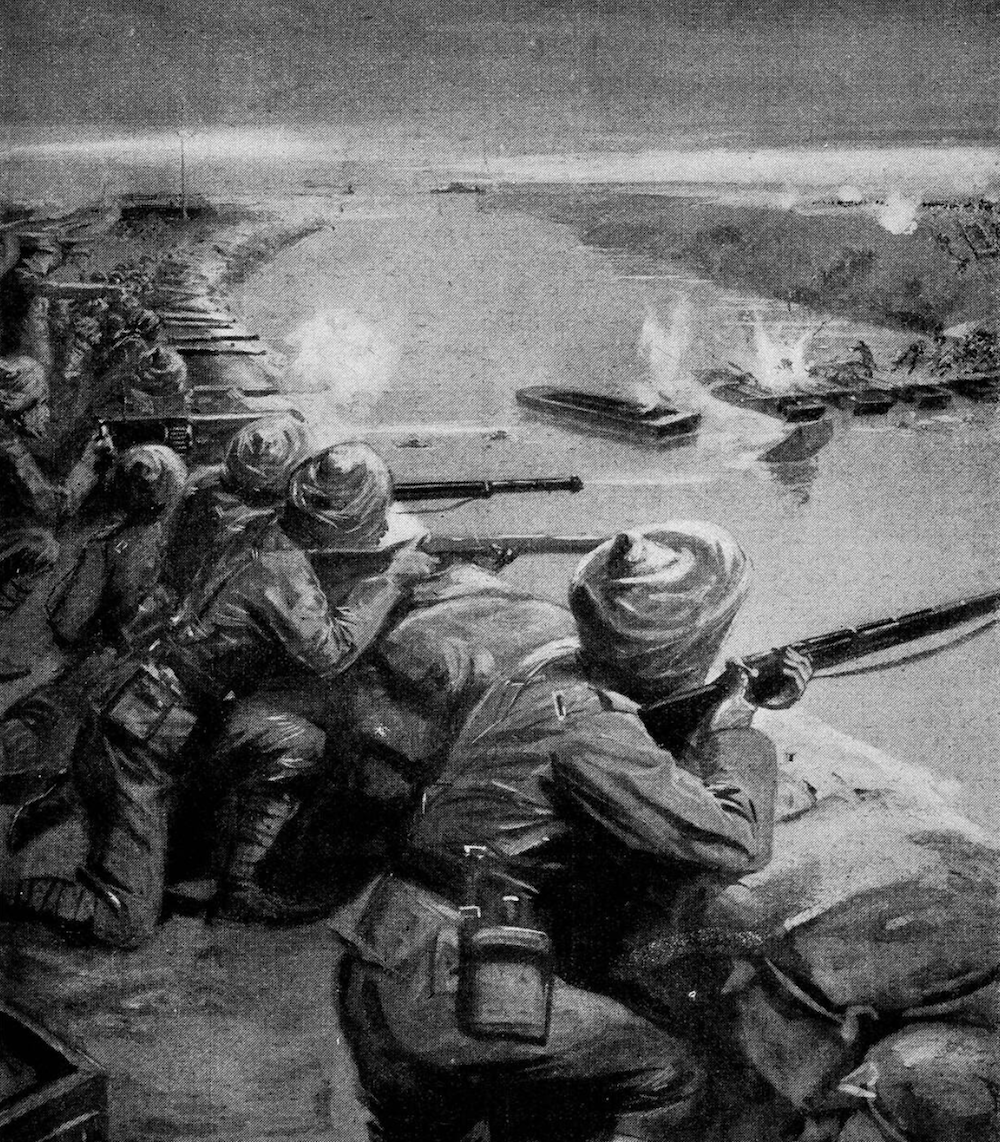
For four long years, British and Indian soldiers fought side by side to oust the Ottoman Empire from what is now Iraq. It was a brutal, bloody affair, ultimately successful, but marred by the disaster of the siege of Kut Al-Amara, a town nestled in a bend in the Tigris, 160 km southeast of Baghdad.
The siege lasted four months. It ended on April 29, 1916, with the surrender of 12,000 mainly Indian troops. Outnumbered, outgunned and poorly led, after four desperate months they were starving, weakened by illness and cut off from any hope of relief.
The day before the surrender, one British officer wrote in his journal: “We are a sick army, a skeleton army rocking with cholera and disease.”
In all, about 4,000 men were killed during the siege. Astonishingly, 23,000 more soldiers — again, mainly Indian — were killed or wounded during attempts to relieve the besieged force.
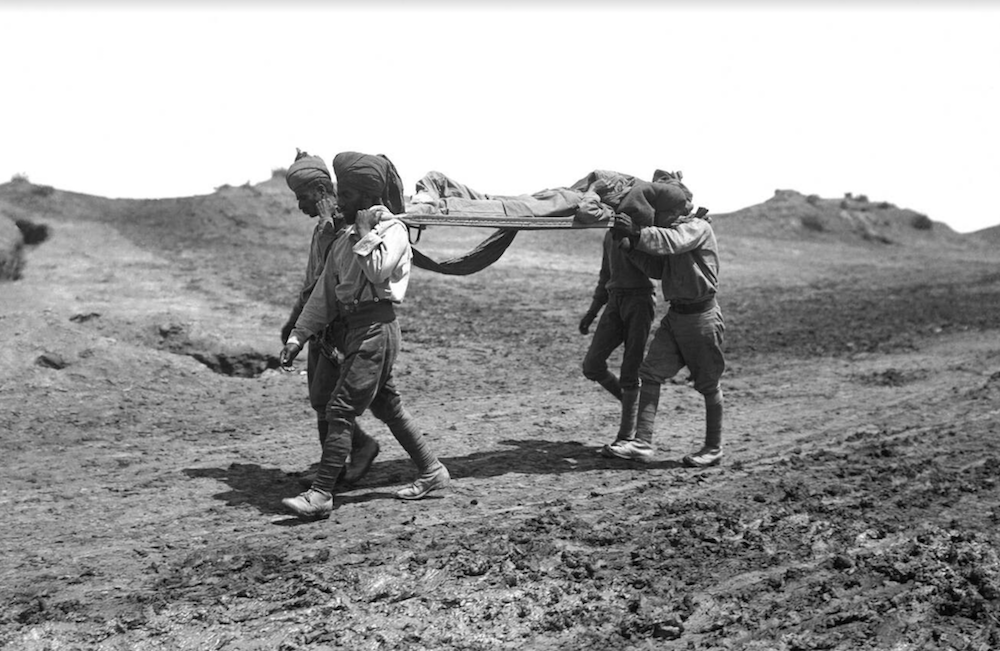
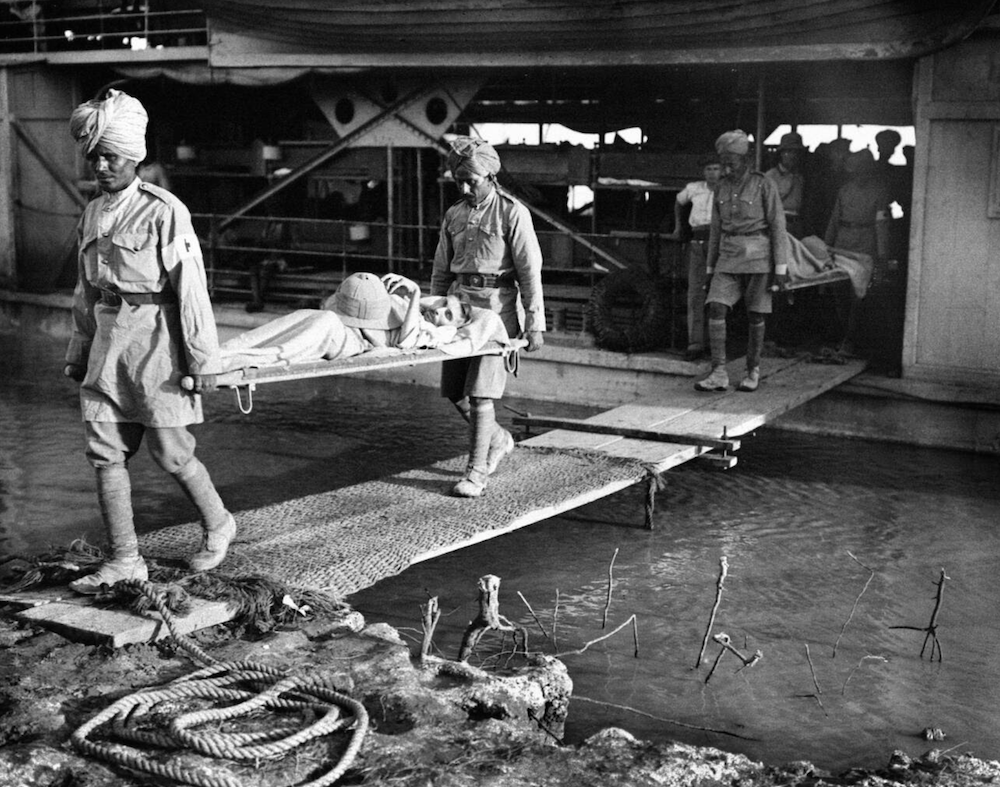
British casualty being brought down the gangway from a steamer by Indian Army orderlies at Falariyeh, Mesopotamia. The Indian Expeditionary Force, consisting of both British and Indian units, advanced along the Tigris towards Baghdad in Summer 1915. (Alamy)
Among the defenders were men of the 22nd, 24th, 66th, 67th and 76th Punjabis. Several other Indian units suffered alongside them, including the 117th Mahrattas, the 103rd Mahratta Light Infantry, the 120th Rajputana Infantry and a squadron of the 7th Hariana Lancers.
More Punjabi regiments, including the 28th and 92nd, were part of the relief force that failed to fight its way through to Kut in time, suffering a high percentage of casualties, alongside other Indian units, including the 51st and 53rd Sikhs and the 9th Bhopal Infantry.
Of the 12,000 men marched into captivity in Anatolia, Turkey, at least one-third died. Some succumbed to disease and starvation, while others were shot or beaten to death for falling behind on the march, or simply left to die where they fell after collapsing, exhausted, by the roadside. At one point on the march, bodies were thrown into a ravine, where skulls were found later in the war.
Ottoman cruelty extended to the local Arabs who had helped the British. About 250 were shot after the surrender, while a number of interpreters were hanged in Kut’s town square.
Today, the siege remains virtually unknown, certainly in Britain. It is, however, acknowledged as one of the greatest catastrophes ever to befall a British army. To this day Kut is studied by military strategists around the world as an example of the danger to an invading army of overstretching its supply lines.
According to the records of the Commonwealth War Graves Commission, 153 men called Singh died while serving with the 30th Punjabis. (Alamy)
Most of the Indians who fell at Kut or died in captivity have no known grave. Many are recorded on the Basra Memorial, which was constructed in 1929 and originally was located at Maqil, on the west bank of the Shatt-al-Arab. In 1997, by order of Saddam Hussein, it was taken apart and reconstructed 32 km along the road to Nasiriyah, in the middle of what was a major battleground during the First Gulf War.
Today, the memorial is in poor repair. The Commonwealth War Graves Commission said that “while the current climate of political instability persists, it is extremely challenging for it to manage or maintain its cemeteries and memorials located within Iraq.”
But when it does finally feel able to renovate the Basra Memorial, the CWGC will have more than mere masonry and marble to repair.
As the report of the Special Committee to Review Historical Inequalities in Commemoration noted, “known issues with memorials to the missing include 38,696 Indian casualties who were or are still commemorated (only) numerically on memorials,” with their names missing.
Subsequently, names have been added to the Port Tewfik memorial in Egypt and the combined British and Indian memorials at Nairobi and Dar es Salaam. But “a decision is yet to be made regarding the Basra Memorial, primarily due to ongoing instability in Iraq.”
On the panels of the memorial can be found the names of the 7,385 British personnel and the Indian officers who lost their lives in Mesopotamia.
But for the 33,256 noncommissioned officers and other ranks of the British Indian army who remain numbered but unnamed on the Basra Memorial, the insult of anonymity has yet to be expunged.
Unearthed records disclose records of allied Punjabi fighters in First World War WWI graffiti sheds light on soldiers’ experience
Cyprus, Jordan sign bilateral agreements
Author:
AFP
ID:
1639767039908702600
Fri, 2021-12-17 21:52
NICOSIA: Jordan’s King Abdullah II paid an official visit to Cyprus on Friday for talks with President Nicos Anastasiades, during which several bilateral accords were signed, officials said.
The agreements covered issues including double taxation and the extradition of fugitives.
Following a military guard of honor, Anastasiades and Abdullah held a private meeting and exchanged gifts.
“President Anastasiades bestowed upon the king of Jordan the highest honor of the Republic of Cyprus… and King Abdullah II bestowed upon the president the highest honor of Jordan,” the presidency said.
The two leaders discussed bilateral relations and regional developments, as well as climate change and efforts to combat Covid-19.
Abdullah was also briefed on efforts to resume United Nations-backed Cyprus reunification talks and Turkish warnings against Nicosia over oil and gas exploration in the region.
Jordan has joined a burgeoning regional alliance that includes Egypt, Greece and Israel, based on shared energy interests.