Permanent ‘Year Zero:’ Red Cross chief paints bleak picture of Mid-East conflict zones

Author: 
Wed, 2021-12-22 01:40

NEW YORK: Although to outside observers the Middle East might appear to be experiencing a period of renewed, active diplomacy, including a host of new peace initiatives, “our teams on the ground see no difference,” according to Fabrizio Carboni, regional director of the International Committee of the Red Cross for Near and Middle East.

During a virtual briefing in New York, he painted a bleak picture of a region that continues to struggle with protracted conflicts, collapsing economies and dire financial predicaments, on top of efforts to battle a COVID-19 pandemic that continues to rage amid vaccine scarcity in many countries. Only 5 percent of Syrians have had their first dose of a vaccine, and 2 percent of Yemenis, for example.

This amid “donor fatigue,” said Carboni, as conflicts proliferate elsewhere in the world, including Afghanistan and Ethiopia, and donor nations divert resources that would previously have gone to help people in the Middle East.

“For the time being, we are $8 million short of what we need for a full slate of humanitarian activities in Israel and the Occupied Palestinian Territories,” Carboni said, by way of an example.

“In Iraq, we are short of $20 million. And even if these countries are not in the top headlines on a daily basis, the families (there) continue to suffer and need massive help.”

Adding to the difficulty of funding humanitarian work in some parts of the region is the fact that “we are moving from true emergency, like distributing food, to another phase — let’s call it ‘early recovery’ — where we need to work on systems to allow people to be autonomous and get back on their feet. And this is a more complex activity to finance and it costs a lot because of the size of the destruction.”

The destruction caused by a decade of conflict in Syria is reminiscent of that caused in Europe during the Second World War, according to Carboni.

“Every time I go back to Syria I always have the feeling that the conflict ended the day before,” he said. “There is this permanent state of ‘Year Zero’ and it’s really heartbreaking.

“And the financial crisis hitting Syria today is an additional layer of vulnerability and complexity, and it is hitting very, very hard the average Syrian.”

Warning that the freezing winter temperatures are making conditions even harsher for displaced Syrians, both internally and as refugees, Carboni in particular highlighted the plight of children as the worst-affected by the crisis. The situation in northeast Syria represents “one of the largest child-protection crises in the world today,” he said.

At the Al-Hol camp, for example, which the official recently visited, he said the vast majority of residents are children under the age of 12. Many of them were separated from their families during transfers to other camps. These children need to be reunited with their families, repatriated alongside them, or have alternative care provided for them, Carboni added.

The packed Al-Hol camp is home to more than 60,000 women and children, many of them the wives and children of defeated Daesh fighters. The majority of states where they originally came from, including the UK, refuse to repatriate them.

Carboni called for “collective action to have a long-term view for those populations who are still stranded in northeast Syria in a legal limbo.” He encouraged all states to repatriate their citizens and “do it lawfully, according to standards and principles, including support to returning children and their families.”

He added: “Family unity should be the norm during repatriation. Keeping families together is usually in the child’s best interest and it’s what international law requires, unless otherwise justified by a rigorous assessment.”

Referring to the political process, Carboni lamented the lack of will to make sacrifices for the sake of peace.

“Peace agreements are about compromise,” he said. “My fear around Syria, but also generally speaking, is that parties to the conflict try to find a painless solution.

“Oftentimes, there is a political price to pay when you decide to make peace. You always need a form of political courage; giving in on something. What we see in Syria (is) there is no will to make this compromise. That’s why the situation is frozen, rotting, and the ones who are paying the price are Syrians.”

In Yemen, where “all basic services are down,” seven years of conflict have come on top of other chronic challenges facing the nation that have nothing to do with war, such as climate change and an education crisis, Carboni said.

In the absence of basic healthcare, with 24 million people in need of assistance and three-quarters of the population living in near-famine conditions, what is needed is for “states with influence to help reach an agreement to shut down this conflict and to allow the people of Yemen to focus on rehabilitating their country and the existential challenges it is facing,” he added.

Turning to the COVID-19 crisis, Carboni said that while the pandemic is the major threat facing the West, it is just one additional layer of vulnerability in places such as Syria, Iraq and Lebanon, where people are trying to cope simultaneously with multiple crises.

Preventive measures such as social distancing become an absurd demand at overcrowded refugee camps and shelters, he pointed out. Sheltering at home is out of the question for Yemenis, who have to venture out every day to find food for their families. Frequently washing hands might sound a simple precaution for people in Western nations, but for those in Tikrit, Mosul, Hodeida or Aden, water is often not so readily available, he said.

Reaching vulnerable populations with vaccines remains an “an absolute necessity” in efforts to end the global pandemic, Carboni added.

An Iraqi boy who lost a leg during a rocket attack in Mosul in 2017 gets prosthetics services from the Red Cross. (ICRC.org photo)
Main category: 

ICRC urges countries to reclaim citizens from Syria campsRed Crescent says bodies of 17 people washed ashore in Libya



Palestinian tries to ram Israel soldiers in West Bank, shot dead

Author: 
AFP
ID: 
1640120712837396100
Tue, 2021-12-21 00:07

JERUSALEM: A Palestinian who tried to ram Israeli soldiers with his car in the Israeli-occupied West Bank late Tuesday was shot dead by the soldiers, the army and Palestinian sources said.
The man crashed his car into a military jeep after being shot, causing both vehicles to burst into flames, a statement from the military said of the incident near the northern West Bank city of Jenin.
The Palestinian health ministry later announced the death of a “citizen.”
The army said “a terrorist accelerated his car toward a manned military post adjacent to the community of Mevo Dotan” in the West Bank.
“IDF troops who were at the point operated to stop the assailant by firing toward the vehicle,” the statement said.
“The vehicle crashed into a military vehicle that was in close proximity to the post. As a result, the vehicles caught on fire,” it added.
An army spokesman told AFP the military believed the assailant had died as a result of gunshot wounds, but was unable to confirm this.

Main category: 


Sudan’s PM Hamdok intends to resign within hours, say sources

Author: 
Reuters
ID: 
1640119216007047900
Tue, 2021-12-21 23:43

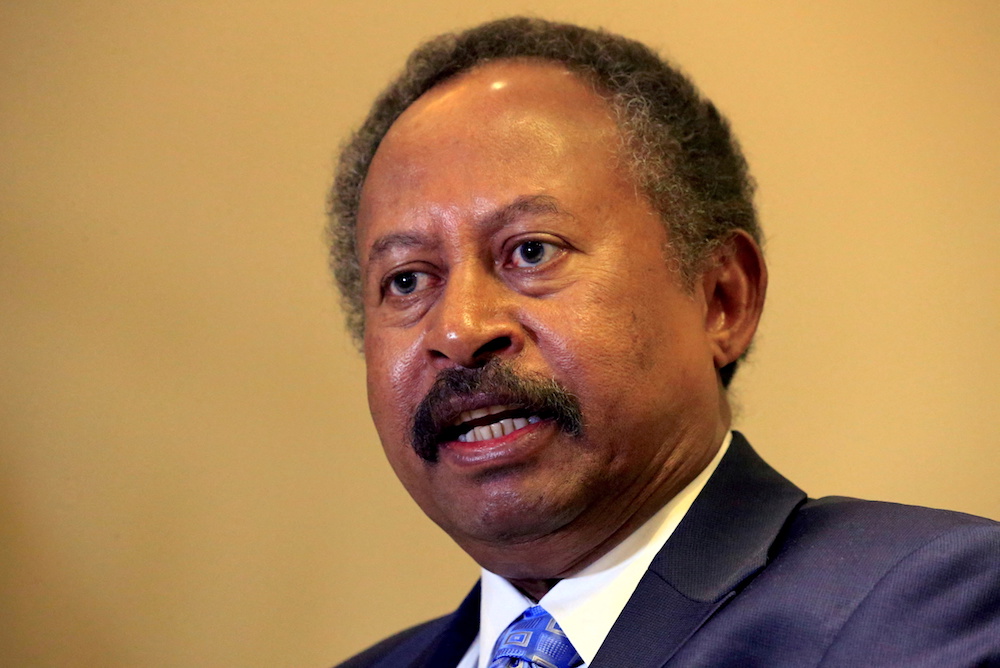
KHARTOUM: Sudan Prime Minister Abdalla Hamdok has told a group of national political and intellectual figures that he intends to resign in the coming hours, two sources close to Hamdok told Reuters on Tuesday.

Hamdok was reinstated on Nov. 21 following a coup a month earlier that saw the military take power and end a transitional partnership with political parties.

While several political forces took part in drafting the agreement, according to the sources, it has faced widespread criticism from parties and the general public.

On Saturday, hundreds of thousands of people marched on the presidential palace rejecting both military rule and Hamdok’s decision to return, which he had said he took to preserve gains made during the transition and to end bloodshed.

Some 47 people have died in crackdowns on protests against military rule, including two as a result of Saturday’s protest. The United Nations said on Tuesday that it had received reports of rape or gang rape of 13 women and girls.

Sources close to Hamdok had said previously he would only remain in office if he had political support and if the agreement was enforced. It called on the military to release political detainees, protect freedom of expression and allow Hamdok to independently appoint a new cabinet.

In a statement over the weekend, Hamdok said Sudan was inching toward “the abyss,” blaming political intransigence and lack of consensus on a new political agreement.

The group Hamdok spoke to on Tuesday called on him to stay in his position but he insisted he would leave, the sources added.

Hamdok was reinstated on Nov. 21 following a coup a month earlier that saw the military take power and end a transitional partnership with political parties. (Reuters/File Photo)
Main category: 

Thousands of Sudanese protest against deal between PM Hamdok and militarySudan’s Hamdok says investigation launched into violations against protesters


Iran, unlike West, upbeat about nuclear talks, say experts

Author: 
Tue, 2021-12-21 23:27

TEHRAN: Iran believes it has scored points in the Vienna talks meant to revive its tattered 2015 nuclear deal by managing to include sanctions relief in discussion documents for the next round, experts say.

The lifting of the punishing sanctions regime then-US President Donald Trump imposed when he pulled Washington out of the agreement in 2018 has been Tehran’s top priority.

European powers have voiced frustration at a lack of progress so far in the Vienna talks, which their diplomats warned Friday are “rapidly reaching the end of the road.”

But from Tehran’s perspective, there has been progress, say Iranian officials and political analysts from the Islamic republic and abroad.

“The parties have agreed on two new texts, the result of intense discussions in recent days in Vienna,” Iranian Foreign Ministry spokesman Saeed Khatibzadeh said Monday.

“These are documents in which Iran’s position has been taken into account … and on the basis of which we can continue future discussions.”

Bernard Hourcade, a French expert on Iran, said Tehran had “succeeded in this session in convincing their interlocutors that the sanctions must be settled as a priority, because this will pave the way for technical settlement of the nuclear component.”

He said Iran regularly stresses that it has “always respected” the original 2015 deal, called the Joint Comprehensive Plan of Action (JCPOA), and “that it is up to the United States, which has flouted its honor, to repair the damage.”

Iran, Hourcade added, “knows the balance of power is to its advantage because it is now at the threshold, that it is able in the short term, like about 30 other countries in the world, to manufacture an atomic bomb if it wishes. It can enrich uranium whenever it wants.”

The parties to the 2015 deal with Iran — Britain, China, France, Germany, Russia and the United States — saw it as the best way to stop it developing a nuclear weapons capability, a goal Tehran has always denied pursuing.

Iran pledged to reduce its nuclear activities, which are monitored by the International Atomic Energy Agency, in exchange for relief from sanctions then in force against it.

FASTFACT

European powers have voiced frustration at a lack of progress so far in the Vienna talks, which their diplomats warned Friday are ‘rapidly reaching the end of the road.’

When Trump pulled out of the deal, he imposed an even more painful and sweeping sanctions regime, including a unilateral US ban on Iran’s crucial oil sales, leading Iran to step up its nuclear activities again. After US President Joe Biden replaced Trump, talks to revive the accord resumed. They stopped before Iran’s June presidential election, then resumed on Nov. 29.

Tehran’s new ultraconservative government has said agreement could be reached “quickly” if the West is serious about lifting sanctions and stops making “threats.”

Iran refuses to engage directly with the US, so Washington is participating indirectly.

Iran’s arch foe Israel is not a party to the talks but has threatened force if diplomacy fails, and the US has also said it is preparing “alternatives.”

Biden’s national security adviser, Jake Sullivan, has voiced frustration with the talks, saying days ago that “it’s not going well in the sense that we do not yet have a pathway back into the JCPOA.”

Sullivan was due to arrive in Israel later Tuesday for talks, which White House officials said would focus partly on Iran and the “very serious situation” around the nuclear talks, which they described as “fluid.”

In the ongoing talks, say observers, Iran has sought to rely on its allies China and Russia, and also hoped to benefit from the goodwill gesture of recently agreeing to replace IAEA monitoring cameras at one nuclear site.

Iranian political scientist Hossein Kanani-Moghaddam said Tehran saw as an “important step” the fact that there are now two texts — one on lifting sanctions, the other on Iran’s nuclear activities.

Tehran’s chief negotiator Ali Bagheri presented the two documents as “supplementary points” to what had been negotiated by his reformist predecessors.

Bagheri — an ultraconservative, and a harsh critic of the original deal — has insisted the main priority is “the complete lifting of unjust and inhumane sanctions.”

He now sees things going Iran’s way, Kanani-Moghaddam believes.

“It appears that the Islamic republic wants to reach a definitive conclusion, whether it be final withdrawal or total membership of the JCPOA,” he said.

“In any case, the objective is to get out of this uncertain situation.”

Main category: 
Tags: 

Mystery of blast at Iran nuclear power plantIran’s Guard fires cruise missiles in military exercise


Lebanese Constitutional Council fails to accept Aoun’s appeal

Tue, 2021-12-21 23:17

BEIRUT: The Lebanese Constitutional Council was unable to take a decision on Tuesday regarding the appeal submitted by President Michel Aoun’s team against the amendments introduced by Parliament to the electoral law, because it “failed to secure a majority of seven members,” according to spokesman Judge Tannous Meshleb.

The amended electoral law is thus effective, and the parliamentary elections shall be held in accordance with the law after it is published in the Official Gazette.

Meshleb denied “any political deal being proposed to the Constitutional Council in return for accepting the appeal.” Following the council meeting, he stressed: “The discussion was legal, and after seven sessions, we were unable to reach a unanimous decision. There was no sectarian division, but members had different opinions regarding expatriate voting. I regret not being able to reach a decision, but there wasn’t much else we could do. This is a failure on the Constitutional Council’s part. I don’t know if any of my colleagues interfered, but I don’t doubt anyone.”

Aoun and the Free Patriotic Movement (FPM) had objected to the amendments made to the electoral law in terms of changing the expatriate voting formula by canceling the six allocated seats and allowing expatriates to vote for the electoral lists, as well as canceling mega voting centers.

Baabda Palace sources described was happened in the Constitutional Council as a “fail,” accusing “certain forces of disrupting the judiciary, the Constitutional Council, the procedural authority and the criminal auditing.”

On Monday, the Lebanese heard rumors about a barter deal between Hezbollah, the FPM and Parliament Speaker Nabih Berri; the Constitutional Council would approve Aoun’s appeal in exchange for stopping Tarek Bitar, the judge leading the probe into the Beirut port explosion, from questioning the politicians he accused of being involved in the crime. The deal also includes making new judicial appointments and appointing a new Central Bank governor.

FASTFACT

Aoun and the Free Patriotic Movement (FPM) had objected to the amendments made to the electoral law in terms of changing the expatriate voting formula by canceling the six allocated seats and allowing expatriates to vote for the electoral lists, as well as canceling mega voting centers.

The FPM hoped the Constitutional Council would accept the appeal so expatriates would not be able to vote in all electoral districts. This is because about 225,000 expatriates will have a very big influence in districts considered essential to the FPM, especially since a good majority of expatriates who registered to vote from abroad in the upcoming parliamentary elections are Christians.

The rumored barter was then negotiated in the open and the political dispute over it happened before the eyes of UN Secretary-General Antonio Guterres during his official visit to Lebanon.

After meeting with Guterres on Monday afternoon, Prime Minister Najib Mikati met with Berri and left the meeting angry. “I have nothing to do with any of this,” Mikati commented, prompting many to assume he would soon resign, but his media office later ruled out such intentions.

A source close to Mikati noted that he does not accept interference in judicial or banking affairs and that his government refuses to be part of such a sin.

After meeting with Mikati on Tuesday, MP Mohammed Al-Hajjar, from the Future Bloc, told Arab News: “Mikati insists that institutions assume their role. He refuses to allow any institution to step on another’s toes. The issue of interfering with the judiciary is out of the question, and any type of deal is unacceptable.”

Al-Hajjar added: “The Future Movement stood with Mikati, despite our comments on Bitar’s performance. We did not demand that he be removed, but we said that the judiciary must stop violating the Constitution. If he had taken our suggestion to lift immunity for everyone, we would not have reached this point.”

Meanwhile, Guterres visited the UNIFIL headquarters in Naqoura on the southern Lebanese border where he toured the Blue Line with Maj. Gen. Stefano Del Col and discussed UNIFIL’s role there with senior international officers.

Guterres also held a closed meeting in Tyre with civil society representatives, amid tight security measures by the Lebanese army.

Main category: 

Lebanon needs $12-15 bn to kickstart recovery: central bank chiefRequest to silence Lebanese alternative media fails