Tunisian court issues verdict to prison former President Marzouki for four years

Author: 
Reuters
ID: 
1640200379373552700
Wed, 2021-12-22 22:15

TUNIS: A Tunisian court issued on Wednesday a verdict to prison former President Moncef Marzouki for four years on charges of “assaulting the external security of the state,” TAP state news agency said after he called on France this year to end support for the current administration.
Marzouki, who resides in Paris, had criticized President Kais Saied, saying he staged a coup.
Saied suspended parliament and dismissed the government in July, before later appointing a government and announcing a plan for a referendum and elections next year.

Main category: 

Obligatory vaccination passes are introduced in TunisiaTunisia to cut subsidies, raise taxes and freeze pay in 2022


Al-Menfi, El-Sisi discuss political situation in Libya

Wed, 2021-12-22 20:53

CAIRO: Egyptian President Abdel Fattah El-Sisi has pledged his country’s continued backing to Libya during a meeting with Presidential Council of Libya Chairman Mohammed Al-Menfi.

Also in attendance during the Federal Palace talks were Egyptian Minister of Foreign Affairs Sameh Shoukry, head of the General Intelligence Directorate Abbas Kamel, and Ambassador Abdel Muttalib Idris, Libya’s permanent representative to the Arab League.

Presidential spokesman, Bassam Radi, said El-Sisi had affirmed Egypt’s support for bringing about the free will of the Libyan people and preserving the unity and sovereignty of its lands.

Al-Menfi thanked Egypt for its leading role in helping to restore security and stability to Libya and unify state institutions, especially military bodies represented by the Libyan National Army. He also briefed the Egyptians on the current internal political situation in Libya, and both sides agreed to further coordination of transitional plans for Libya’s future.

Main category: 

Italy working with Libya to get presidential elections back on trackArmed groups deploy in Tripoli amid Libyan election postponement decision


Higher Defense Council extends general mobilization period in Lebanon

Wed, 2021-12-22 20:36

BEIRUT: Following a meeting chaired by President Michel Aoun on Wednesday, Lebanon’s Supreme Defense Council has decided to extend the current general mobilization period until the end of March 2022. It also announced measures to open the borders with Syria for vaccinated residents or those testing negative for COVID-19.

The council asked all military and security services to “ensure security over the holidays, so the Lebanese can enjoy some stability despite the difficult circumstances.”

It added: “We have taken security decisions related to smuggling operations at the legitimate and illegal crossings, as well as drug production and trafficking, exchange-rate platforms, and we will be monitoring consumer prices.”

During the meeting, council members discussed “the Syrian authorities opening the borders for vaccinated Lebanese, or those with a negative PCR test,” and the council asked the Lebanese General Security to take similar measures in coordination with the Ministry of Health.

The Secretary-General of the Supreme Defense Council Maj. Gen. Mahmoud Al-Asmar said the council had discussed the situation of the wheat silos at the Beirut port, which were severely damaged during the explosion on Aug. 4, 2020. He explained that the council had insisted on the need to expedite measures to prevent the silos from completely falling apart.

“The council requested the ministries of economy and public works and the council for development and reconstruction to address the issue,” he said.

Statements by the Lebanese army commander Gen. Joseph Aoun published on Wednesday by the army’s National Defense Magazine revealed the difficult conditions the country’s military is facing.

Gen. Aoun warned that “sedition is just around the corner, but we will nip it in the bud.”

“Soldiers need to realize that they are facing a sacred mission; the civil war in 1975 was a bitter experience and we will not allow history to repeat itself. Never again shall we allow militias to take over nor will we live under the mercy of armed gangs and terrorism,” he stated.

Addressing his soldiers directly in the article, Aoun said: “In whose hands are we leaving our homeland? Chaos? Civil war? The sacrifices and efforts you are making have prevented Lebanon from collapsing, despite the many developments since October 2019. We faced protests, the pandemic, the Beirut port blast, and devastating economic conditions. But we managed to preserve civil peace thanks to the confidence of our people and the international community, and this encouraged many to help us.”

The general also addressed reports about the number of soldiers deserting and others applying for resignation. “The rumors exaggerate the numbers,” he said. “Many soldiers who left have rejoined the army’s ranks after they discovered that the benefits provided by the army could not be found in any other job.”

He called on officers “to educate the soldiers so that they do not rush into making decisions they will regret.”

Gen. Aoun touched on the repercussions of Lebanon’s financial collapse on the armed forces, saying: “The major concern has become transportation. I am well aware of all the pressures and challenges you are experiencing, including the protest movements, the fuel and medicine crises, raids, clashes and many others, and you have wisely and patiently taken on every one of these challenges.

“I do not expect the economic crisis to end soon and we could be facing worse scenarios,” he added. “We are not the reason behind the crisis, nor are we the solution. We are simply doing our duty toward our homeland, and we will be present wherever we are needed. Our duty is to help the state find solutions by providing security and stability. We have overcome many difficulties in the past and we will overcome this crisis as well. We will weather this storm until it ends.”

Gen. Aoun noted: “The army has bought buses and vans, and they will be in service soon, which will solve the problem of transportation for many soldiers.”

He revealed that 68 percent of soldiers have received two vaccine doses so far, and stressed “the need to vaccinate the rest. Soldiers who refused to take the vaccine would have to cover their own medical costs should they contract COVID-19, he added.

Gen. Aoun also commented on the rumors about “discrimination in the distribution of aid within the military institution,” calling on soldiers “not to pay any attention to such claims, for the army is for everyone and against all those who violate security.”

The army has requested food aid from Arab and foreign armies.

“Donors are facing legal and constitutional obstacles, but efforts are being exerted to find solutions to secure this aid for the army,” the general stressed.

Main category: 

As economic crisis bites, Lebanese army withdraws soldiers from Beirut suburbsLebanon to set up more checkpoints to clamp down on thefts


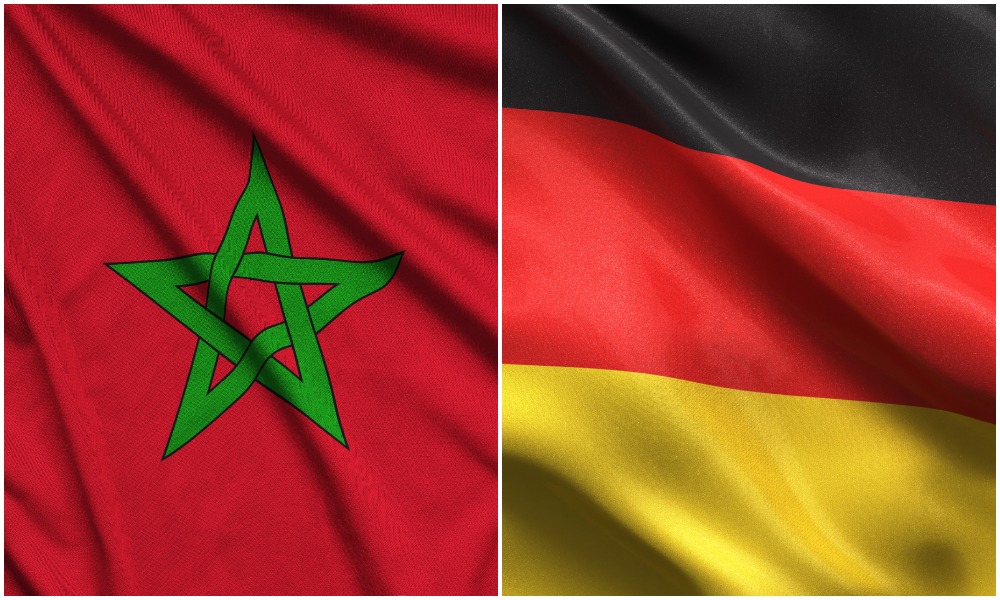
Morocco sees return to normal diplomatic ties with Germany

Author: 
Reuters
ID: 
1640188782471952100
Wed, 2021-12-22 19:01

RABAT: Morocco said on Wednesday it expected a return to normal cooperation and diplomatic ties with Germany after Berlin expressed support for Rabat’s autonomy plan for the disputed Western Sahara territory.
Morocco had recalled its ambassador to Germany in May in protest over what it described as Berlin’s “antagonistic activism” after the United States in December 2020 recognized Moroccan sovereignty over the territory, which is also claimed by the Algeria-backed Polisario Front movement.
In March, Morocco ordered all governmental departments and bodies to abstain from any cooperation and contacts with the German embassy and German political organizations.
But last week, the diplomatic situation improved after the German foreign ministry issued a statement describing Morocco’s autonomy plan as an “important contribution” to finding a political solution to the Western Sahara conflict, in line with United Nations Security Council resolutions.
The Moroccan foreign ministry said in a statement that it welcomed the “positive statements…which bode well for a resumption of bilateral cooperation and a return to normalcy in the work of diplomatic representations of the two countries in Berlin and Rabat.”
Morocco has been assertive in pushing European countries and the European Union to follow the United States on its Western Sahara stance. King Mohammed last month said Morocco would not agree “any economic or commercial step that excludes the Moroccan Sahara.”

Main category: 

Sahara tension: Moroccan row deepens with Germany Morocco cuts contacts with German embassy in WSahara spat


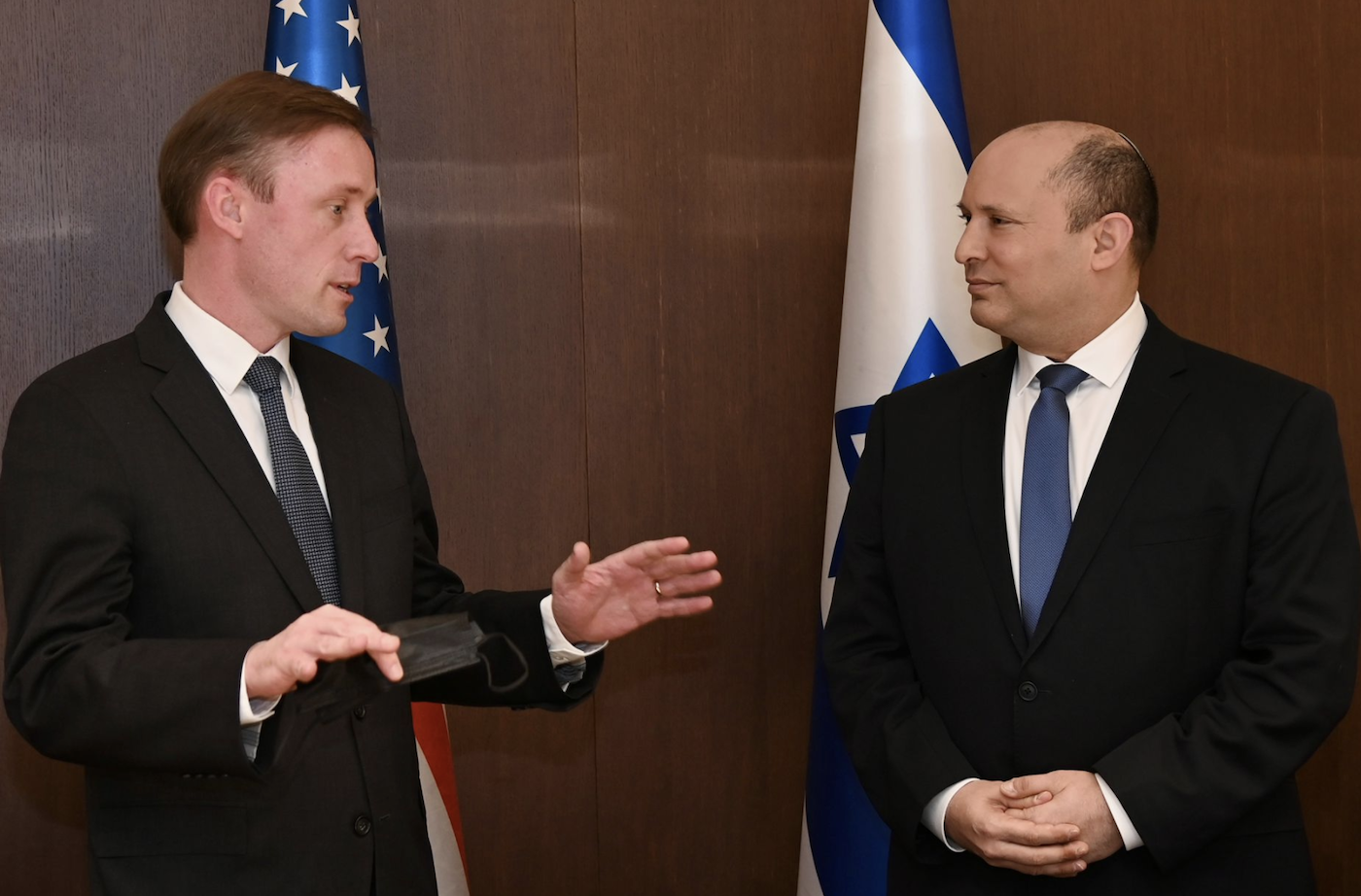
Israel PM meets US national security adviser on Iran

Wed, 2021-12-22 18:53

JERUSALEM: The US national security adviser held talks Wednesday with Israeli Prime Minister Naftali Bennett, who warned that negotiations in Vienna on Iran’s nuclear program had “profound ramifications” for Israeli security.
Bennett’s government has remained firmly opposed to ongoing international efforts to revive a 2015 accord that saw Iran agree to curbs on its nuclear activities in exchange for sanctions relief.
Jake Sullivan, national security adviser to President Joe Biden, said his visit to Israel had come at “a critical juncture.”
“It’s important that we sit together and develop a common strategy, a common outlook, and find a way forward that fundamentally secures your country’s interests and mine,” Sullivan said, according to an Israeli government statement.
He did not directly mention Iran but the Israeli statement said the meeting focused on the Vienna talks.

Later, Sullivan and his Israeli counterpart Eyal Hulata led a meeting of delegations from both countries, a joint statement said.
They discussed the need to confront “all aspects of the threat posed by Iran, including its nuclear program, destabilising activities in the region, and support for terrorist proxy groups,” the statement added.
The US and Israel “are aligned in their determination to ensure that Iran never gets a nuclear weapon,” it said.
Bennett has called for the nuclear deal negotiations to be halted, accusing Iran of “nuclear blackmail” and charging that revenue it gained from sanctions relief would be used to acquire weapons to harm Israelis.
Lead US Iran negotiator Rob Malley told CNN Tuesday that there are only “some weeks” left to revive the deal if Tehran continues its nuclear activities at the current pace.
Negotiations to restore the pact known as the Joint Collective Plan of Action resumed in November.
Washington was a party to the original agreement, but withdrew under president Donald Trump in 2018.
The Biden administration has warned it may soon be too late to revive the JCPOA.
“It really depends on the pace of their nuclear process,” said Malley, the US special envoy for Iran.
“If they halt the nuclear advances, we have more time.
“If they continue at their current pace, we have some weeks left but not much more than that, at which point the conclusion will be there’s no deal to be revived,” he said.
Iran says it only wants to develop a civil nuclear program.
Sullivan is also scheduled to meet Palestinian president Mahmud Abbas in Ramallah, in the Israeli-occupied West Bank.

Main category: 

Arab coalition denies Iranian claims on evacuation of diplomat from Yemen 2021 in Review: Yet another year of disease, drought, privation and repression for Iranians