Clashes in southeast Iran kill 3 troops, 5 bandits: Report
Author:
Associated Press
ID:
1641056495941560000
Sat, 2022-01-01 16:43
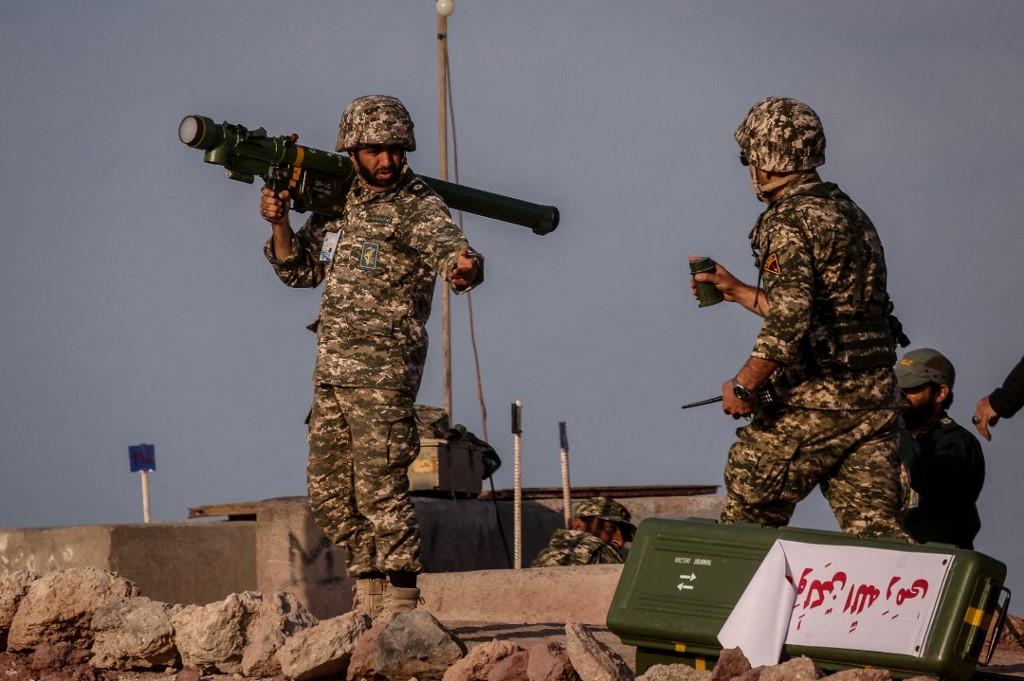
TEHRAN: Iran’s paramilitary Revolutionary Guard and an armed criminal gang clashed on Saturday in a restive southeastern province, leaving three Guard members and “at least five bandits” dead, the state-run IRNA news agency reported.
The report said the fighting took place late Saturday evening in the district of Kourin, about 1,120 kilometers (700miles) southeast of the capital, Tehran, and near the Pakistani border. It also said that at least five other bandits were wounded. There were no further details.
The area is in Sistan and Baluchistan province, has been the scene of occasional clashes between Iranian government forces and various militant groups. The province, bordering Pakistan and Afghanistan, is also where a Sunni separatist group affiliated with Al-Qaeda and known as Jeish Al-Adl, or Army of Justice, operates.
Security forces have also clashed with drug traffickers in the province, located along a major smuggling route for Afghan opium and heroin.
Last July, armed bandits shot and killed four Guard members in the province.
Iraq vote victor Moqtada Sadr meets pro-Iran rivalsIran federation defends footballer in row over ‘Israel flag’ jersey
2022 Look Ahead: No end to suffering in sight for war-weary Syrians
Sat, 2022-01-01 20:02
MISSOURI / WASHINGTON: If 2020 was the year when fissures began to appear within the ranks of Syria’s ruling Assad clan, then 2021 was the year of determined attempts by the leadership to tighten its grip and reclaim its legitimacy.
Although several states lately have tried to bring the regime back into the Arab fold, even opting to reopen their embassies in Damascus, Syrian President Bashar Assad’s dependence on his Russian and Iranian benefactors has only continued to grow.
Indeed, Russian President Vladimir Putin received Assad in Moscow in September for the first time since 2018, no doubt to assist his Syrian counterpart’s rehabilitation but also to rebuke Turkey and the US for their ongoing involvement in Syria.
Assad’s reliance on Russia and Iran is owed in large part to the parlous state of Syria’s economy, the crippling effects of Western sanctions, the country’s diplomatic isolation, its military vulnerabilities, de facto partition, and the lack of popular support.
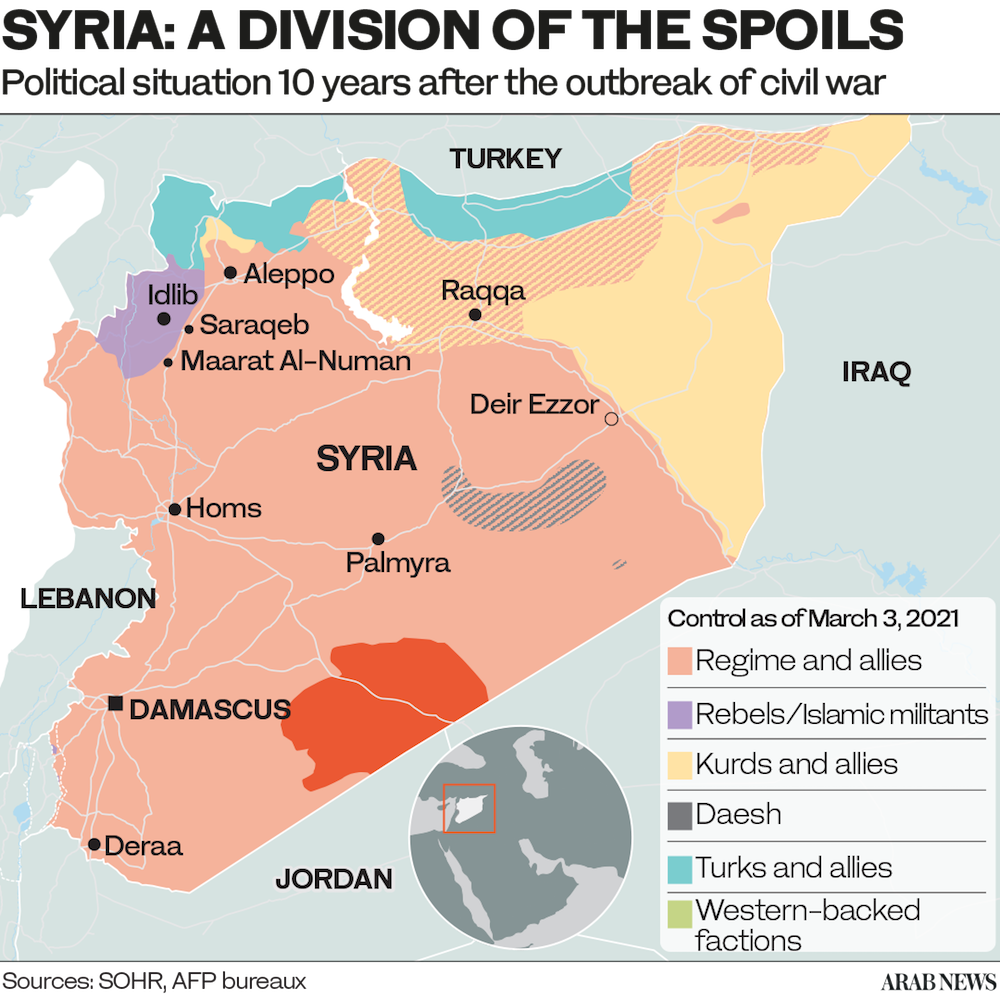
Syria is geographically fractured between regime-held areas, rebel holdouts in the northwest, and Kurdish self-administration in the northeast, making the distribution of aid — particularly COVID-19 vaccines — all the more difficult.
Russian, Turkish and American forces stationed in Syria have maintained an uneasy standoff, with the cracks between their respective spheres of influence filled by mercenaries, traffickers and the increasingly emboldened remnants of Daesh.
Many Syrian cities still lie in ruins and millions of citizens remain displaced, internally and externally, often in precarious circumstances, too terrified to return home and face the regime’s retribution.
A report published in September by Amnesty International, titled “You’re Going to your Death,” documented a catalog of horrific violations committed by the regime against Syrians who were forced to return after seeking refuge in Europe.
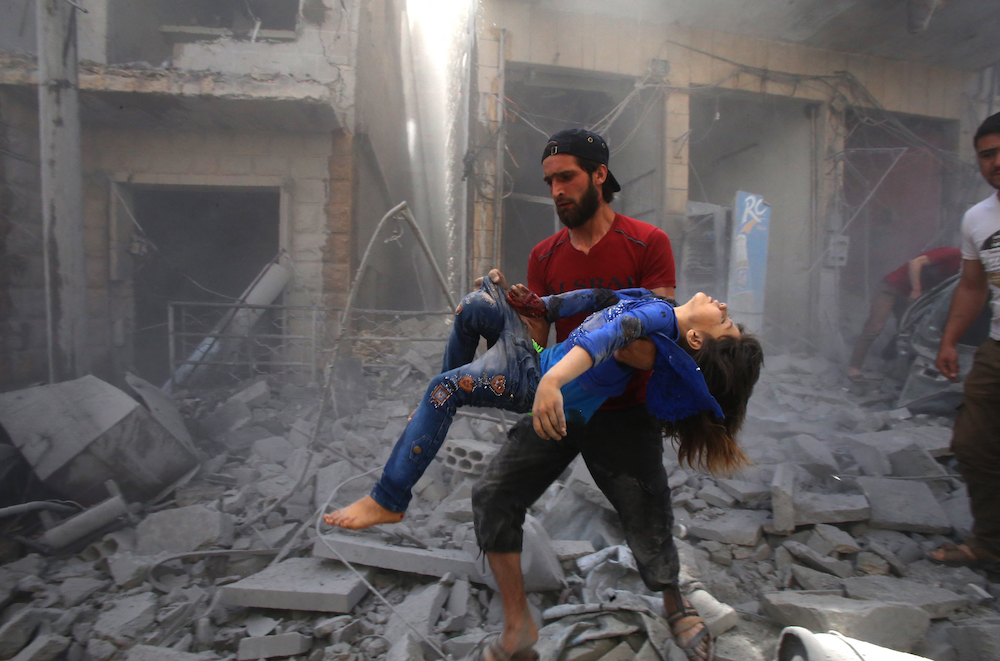
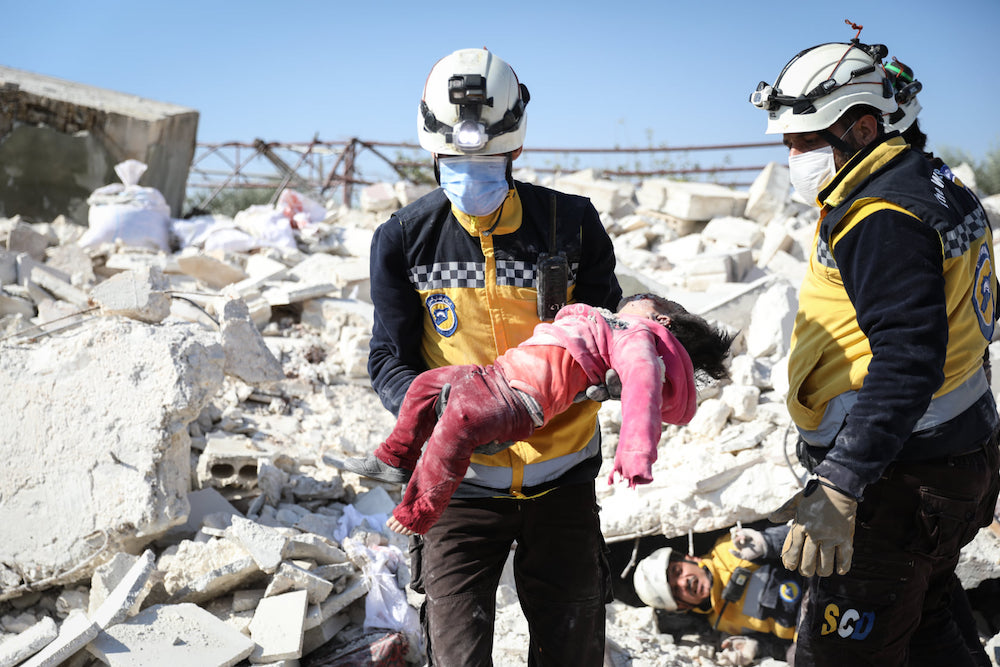
A man evacuates a young bombing casualty after a reported air strike by regime forces and their allies in the extremist-held Syrian town of Maaret Al-Numan. (AFP/File Photo)
The scale of the regime’s crimes was hammered home in November when Omar Alshogre, a 25-year-old former regime detainee and torture survivor, addressed a UN Security Council meeting on the prevailing impunity in Syria and the need to ensure accountability.
“We have stronger evidence today than what we had against the Nazis at Nuremberg,” said Alshogre. “(We) even know where the mass graves are located. But still no international court and no end to the ongoing slaughter for the civilians in Syria.”
A report in September by the UN’s Independent International Commission of Inquiry on the Syrian Arab Republic concluded that thousands of detainees have been subjected to “unimaginable suffering” during the war, including torture, death and sexual violence against women, girls and boys.
The sentencing by a German court in Koblenz in February of former Syrian intelligence agent Eyad Al-Gharib to four and a half years in prison on charges of aiding and abetting crimes against humanity has been hailed as historic.
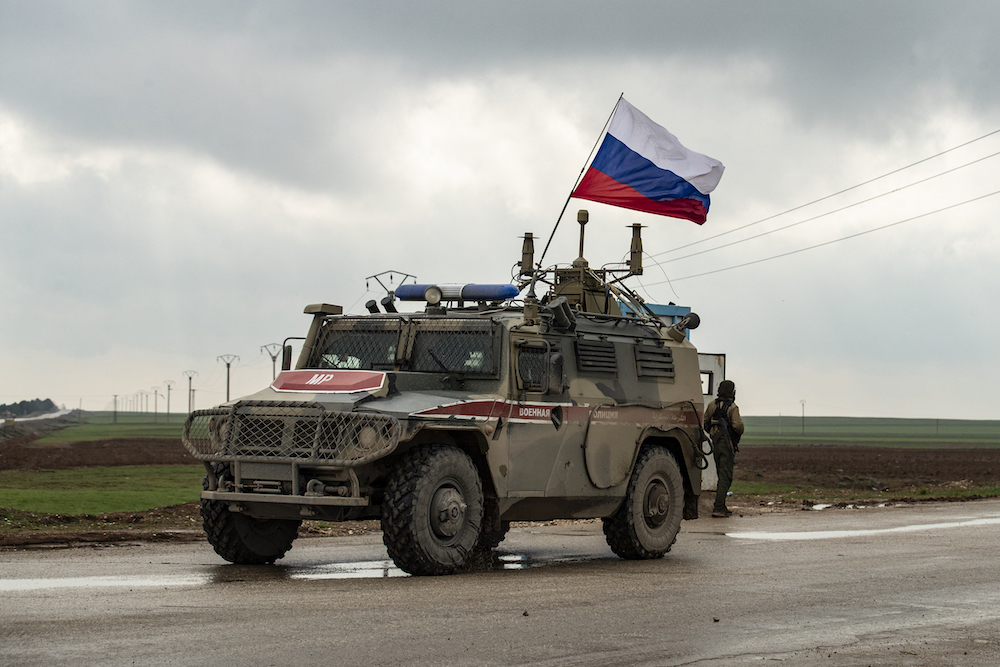
A Russian military police vehicle patrols the M4 highway in the northeastern Syrian Hasakeh province on the border with Turkey, on February 22, 2020. (AFP/File Photo)
Nevertheless, few Syrians believe they will ever obtain justice for the abuses of the past decade, nor do they hold out much hope of an improvement in the humanitarian situation.
Indeed, during the closing months of 2021 thousands of Syrians lined up at Damascus airport having paid thousands of dollars to a Belorussian travel agency to fly them to a remote wilderness on the border with the EU in the desperate hope of starting a new life.
“The situation in Syria is quieter now but that doesn’t mean it is better,” Asaad Hanna, a Syrian activist and refugee, told Arab News. “In the regime-held areas, people are living from one day to the next. They can’t meet their basic needs. The economy is collapsing and the currency is losing its value
“The Assad regime is still arresting anyone who complains, so people who are suffering are leaving the country. Imagine: since 2011, those finishing their studies have either been drafted into the army or have left the country.”
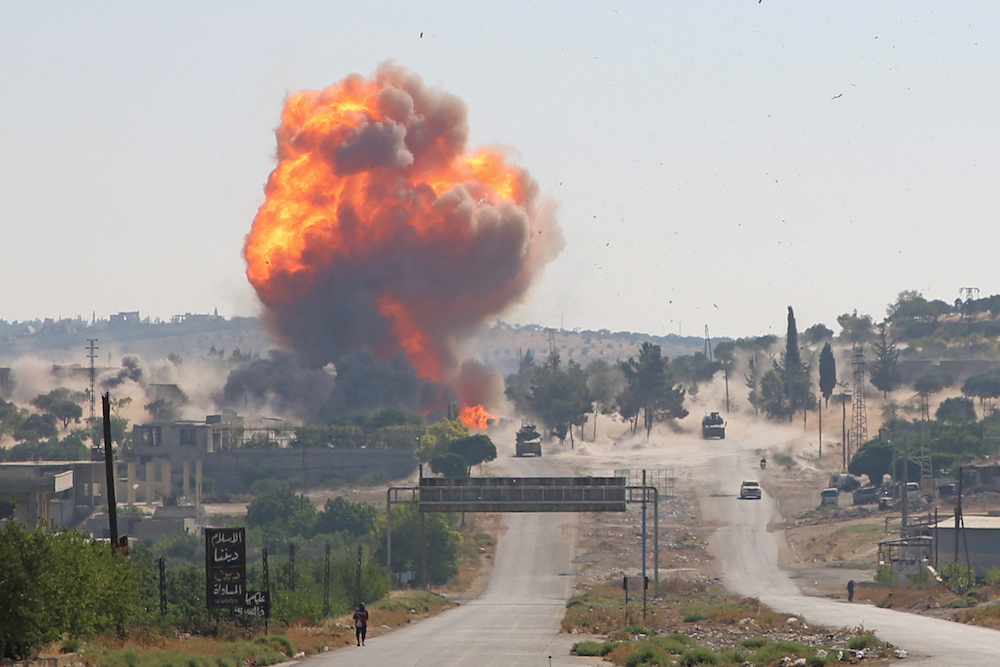
A fireball erupts from the site of an explosion reportedly targeting a joint Turkish-Russian patrol on the strategic M4 highway, near the Syrian town of Ariha. (AFP/File Photo)
In Hanna’s view, the country is going the way of other international pariahs.
“With the increase in poverty, 10 years of destruction, Syria is getting the kind of stability of North Korea,” he added.
In northwest Syria, on the other side of the dividing line between the Assad regime and the last remaining rebel holdouts, 2021 was yet another year filled with tragedy, as schools, hospitals and even displacement camps were targeted in air and artillery attacks.
Mousa Zidane, who works for the rebel-affiliated Syrian Civil Defense, also known as the White Helmets, said 2021 was a difficult year for first responders.
“The bombing and deaths continued despite the ceasefire decision,” he told Arab News. “The coronavirus invaded the IDP (internally displaced persons) camps and cities of Syria. The burden on us was great.
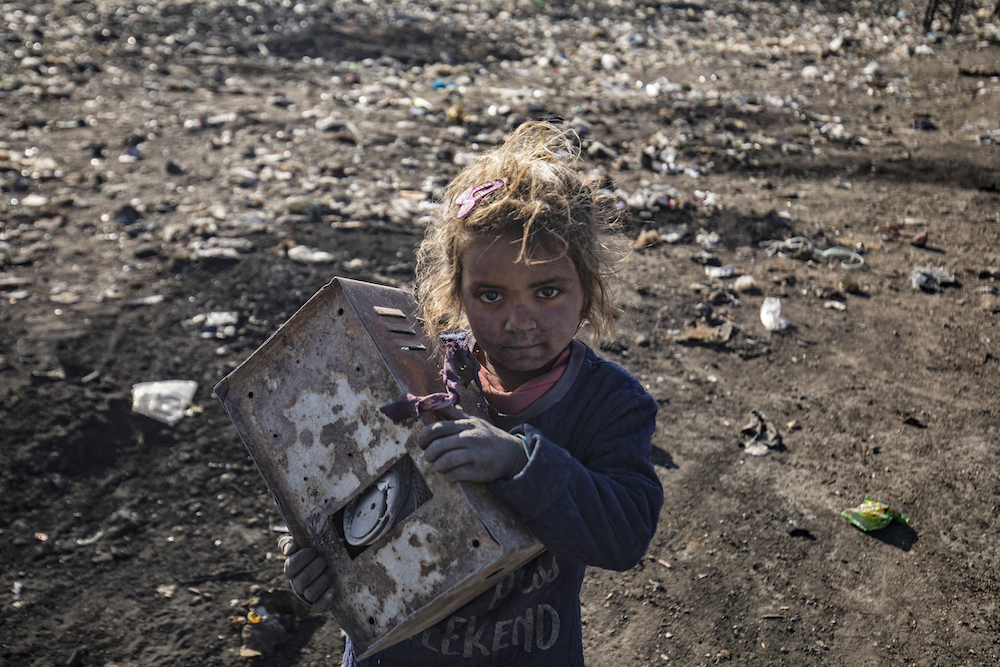
A displaced Syrian child, one of thousands who fled their homes in the countrysides of Raqa and Deir Ezzor, carries a bag of recyclable garbage. (AFP/File Photo)
“In addition to all of that, the regime and Russia’s attacks on us continued. Three of my colleagues in the White Helmets died as a result of direct attacks targeting our teams while performing their humanitarian missions, and more than 14 other volunteers were injured.”
The near-daily bombardment of rebel-held areas has drained the public’s morale, Zidane said, leaving people with little hope of change this year.
“Although we have always searched for hope, we doubt the coming year will be better for the Syrians,” he said. “But we do not lose hope in ourselves and we do not lose hope in the true friends of Syria and the Syrians. We will continue our work and our rightful demands.”
Like many Syrians, Hanna believes the Assad regime is unlikely to ever face justice for the killing of protesters, the bombardment of civilian areas, the torture and killing of opponents, or the alleged use of chemical weapons.
White helmets in Idlib. (Twitter: @syriacivildef)
“Obviously, the international community is not interested in starting an accountability track right now but that doesn’t mean we should stop. It gives us more responsibility to keep pushing for justice and accountability for the Syrian people.”
Hanna fears the Biden administration’s openness to easing sanctions against the regime, and the recent diplomatic overtures by Arab countries, mean international pressure for regime change in Syria is all but finished. Indeed, Damascus might very well regain its seat in the Arab League.
“I only see that as a result of the new Democratic administration in the US,” Hanna said. “The previous one was clear about no relations with the Assad regime. But now we see Biden’s administration softening their position on everything Iran-related.”
Of course, almost everything in Syria remains Iran-related. Militias armed and funded by the Islamic Revolutionary Guard Corps continue to solidify their hold over wide swaths of the country.
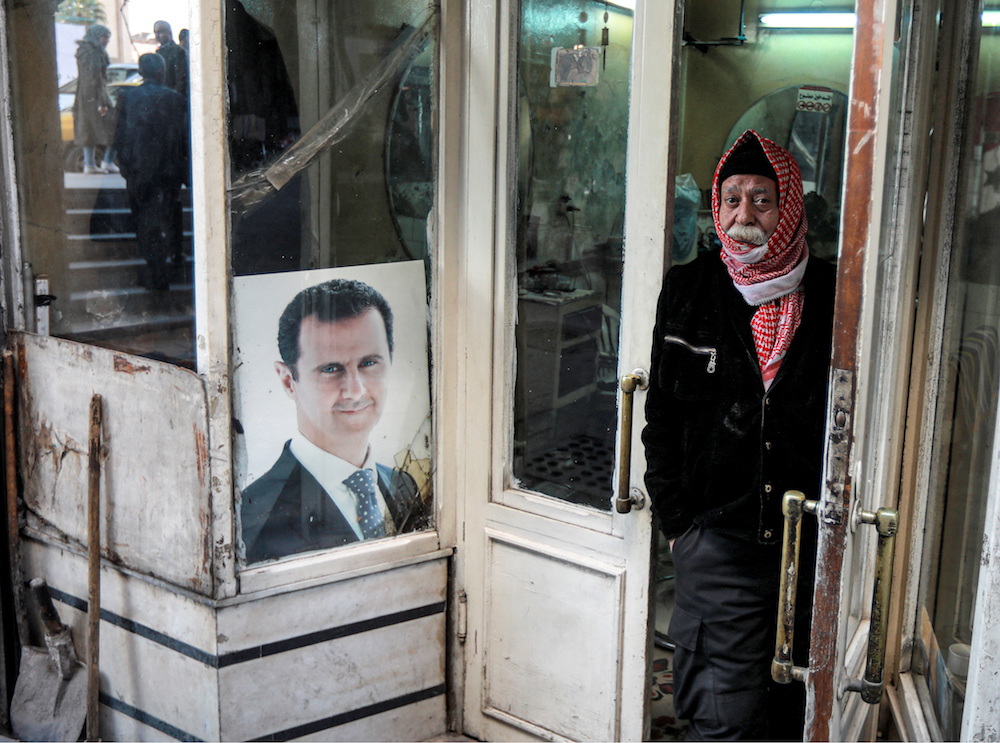
A man stands at the entrance of a barber shop next to a portrait of Syria’s president Bashar Assad in the capital Damascus on December 15, 2021. (AFP)
A long-standing alliance between Tehran and Damascus has allowed Iran to use Syria to expand its regional influence and smuggle advanced munitions. Lebanese Hezbollah, another Iranian proxy, has likewise played a decisive role in staving off a rebel victory over the embattled Assad regime.
Iran’s exploitation of Syria has drawn the attention of Israel, which is increasingly at odds with Washington’s more conciliatory approach to Tehran.
In December, Israel twice attacked suspected Iranian weapons shipments at the Syrian regime’s Latakia port. The coming months could see many more unilateral Israeli strikes targeting Iran’s regional interests.
Despite the suffering, setbacks and grim expectations for 2022, activists such as Hanna remain defiant.
“For me, personally, I don’t consider this a job; it has become a way of life,” he said. “As long as it goes on, we will keep supporting what we went into the streets for in 2011.”
———
* David Romano is the Thomas G. Strong professor of Middle East politics at Missouri State University
* Oubai Shahbandar is a former defense intelligence officer and Middle East analyst with the Pentagon
Life in ruins: Ancient sites shelter Syria’s displacedYouth exodus takes joy out of festivities in Syria
Egypt brings temperature down after malfunctioning Hamas rockets fall into Med
Author:
Sat, 2022-01-01 19:43
GAZA CITY: Two rockets fired from Gaza early Saturday fell into the Mediterranean Sea off the coast of Tel Aviv, the Israeli army said, with no injuries reported.
Hamas and Israel exchanged indirect messages through Egypt to prevent the situation from deteriorating.
Hamas military sources said the launch was not deliberate and was caused by a malfunction due to bad weather.
The Israeli army said that two rockets were launched from Gaza toward the sea off Tel Aviv, but the sirens did not go off, nor did the Iron Dome system launch missiles to intercept the rockets.
Israeli police received reports from citizens about hearing an explosion but no damage or injuries were reported, according to the Israeli army statement.
Palestinian and Israeli media said that Egypt immediately rushed to mediate between the two parties in order to prevent an escalation in Gaza.
A website close to the Ezz El Din Al-Qassam Brigades, the military wing of Hamas, quoted an unnamed source as saying that the two missiles were fired due to weather conditions, and that there were no missile tests.
The past few days have witnessed an intensification of Hamas firing experimental rockets toward the sea.
The Egyptian mediator conveyed to Hamas that “Israel is not convinced by these old arguments. They provided evidence that the rockets came out due to the weather,” Israel’s Channel 13 reported.
It was the first time that Israel announced the detection of rockets from Gaza off the coast of Tel Aviv since the last war in May 2021.
In the winter of last year, a similar incident occurred when rockets were launched from Gaza, which Hamas also explained as being the result of bad weather.
The security situation became tense last Wednesday after Israeli tanks bombed Hamas posts in northern Gaza, against the backdrop of Israel’s announcement that an Israeli had been wounded by gunfire from Gaza.
Following the fall of the two missiles, Israel’s security and military level sectors held a “security assessment session” and, according to the military correspondent for Israel’s Walla website Amir Bukhbut, “some Israeli security authorities believe Hamas’s narrative, but the weak response from Israel will show its weakness, and a strong response may lead to another response.”
No Palestinian faction has claimed responsibility for firing the two rockets.
Israel’s Channel 14 said: “This is a test for the (Israeli Prime Minister Naftali) Bennett government. Either it responds, or it continues to ignore, as was the case in the sniper incident last week.”
Palestinian observers said that if Israel decided to respond, its response would be limited.
Ibrahim Abrash, a professor of political science at Al-Azhar University in Gaza, said it would be difficult for the Israeli government to give a “big response” in light of the continuation of talks to reach a truce and in light of no approval from Washington for any escalation in Gaza.
He said Israel would find in the failure of any Palestinian faction to take responsibility for the rockets a convincing justification before its people for not responding strongly. On the other hand, the factions in Gaza realized that “the cost of a new war will be very high.”
This incident coincides with the anger of Hamas and its ally Islamic Jihad over issues related to the siege and the reconstruction process, and the prisoners in Israeli prisons.
Since the end of the last war, the process of rebuilding the Gaza Strip has been faltering, which has increased the frequency of threats by Hamas and Islamic Jihad in an attempt to pressure Israel and donor countries to speed up the reconstruction process.
Hamas cordons off explosion site in Lebanon camp, says oxygen bottles explodedUK bans Hamas in its entirety as ‘terrorist group’
Jailed Palestinians boycott ‘political weapon’ of detention without charge
Author:
Sat, 2022-01-01 18:14
AMMAN: Hundreds of Palestinians held without charge in Israeli jails are boycotting court hearings over the practice of administrative detention.
Administrative detention orders can last for a maximum of six months, but are often renewed, effectively keeping prisoners in indefinite detention.
The boycott began after Hisham Abu Hawash, a father of five jailed without charge or trial under administrative detention, reached the 138th day of a hunger strike. His family and friends say that “his life and health are at risk” and that “the Israeli occupation bears full responsibility for his survival.”
A statement issued by the prisoners’ leadership committee said an agreement was reached to initiate the boycott of Israeli courts from Jan. 1.
Hind Shraydeh, whose husband Obay Aboudi was detained two years ago, told Arab News of the pain of raising three children without their father.
“Administrative detention has nothing to do with law or justice. Your family, your life, your children and your work are affected by the mood of the Israeli military commander who signs the administrative detention order,” she said.
Shraydeh supports the boycott, saying that it “is the only option left.”
She added: “Prisoners have tried hunger strikes, which changed nothing. There is no other option left with the prisoners and their families because we all know the results of the court cases anyway, so why should we give them the facade of claiming to be a democracy when they are not.”
Rami Fadayel’s case is another example of arbitrary detention. He has been administratively detained seven times, his mother, Muna Fadayel, told Arab News.
“With the last arrest, however, they decided to charge him. They confiscated his printing press after finding a receipt at the medical relief committee. They charged him — without proof — with supporting terror,” she said.
The evidence against her son, she added, “is so flimsy” that the Israelis will most likely fail to convict him, but will use administrate detention to keep him behind bars.
“He is 42 and his 14-year-old daughter has barely seen him out of jail due to the successive administrative detention orders that are regularly slapped on Palestinians,” she told Arab News.
Fadayal is “praying that the boycott works,” but is doubtful due to previous unsuccessful attempts. “It is a good idea. although nothing happened in the past. We are all frustrated and feel that no one is standing with us.”
Palestinian member of the Israeli Knesset Sami Abu Shehadeh told Arab News that the Joint Arab List believes that the practice of administrative detention is “simply the kidnapping of Palestinians by Israel.”
He said: “By not arresting them for a particular act and not charging them, the Israeli government is putting them in jail without any legal basis. Israel has inherited this act from the British Mandate, which enacted emergency regulations during the Second World War.
“The war is long over, but Israel is still using these war-related laws against Palestinians.”
He added that administrative detention is “an immoral and illegal crime used by Israel to increase the oppression of the Palestinians, with the silence of all the countries that claim to be democratic.”
Shahwan Jabarin, director of the Al-Haq human rights organization, told Arab News that Israel has transformed the procedure, which was previously limited to “extremely exceptional cases,” into “punishment, a political weapon and a method of political intervention into Palestinian lives.”
Palestinians raise alarm over Facebook content ‘suppression’Popular Palestinian protest succeeds in stopping settler march
Bahrain authorizes use of anti-coronavirus drug Paxlovid for emergency use
Sat, 2022-01-01 18:25
MANAMA: Bahrain’s health authorities authorized Pfizer’s Paxlovid COVID-19 drug for emergency use in adults aged 18 and over on Saturday.
It will be used to treat adults suffering from mild to moderate symptoms who are at an increased risk of developing severe COVID-19 that may lead to death, Bahrain News Agency said.
The decision by the National Health Regulatory Authority was based on the review and evaluation of data provided by Pfizer.
The NHRA said the Health Ministry has begun importing procedures in accordance with the relevant standards and requirements, and that the medication was expected to arrive in January.
Meanwhile, new figures from Britain’s official statistics body estimate that about 1 in 25 people in private households in England had COVID-19 in the week before Christmas, as the highly transmissible omicron variant spread rapidly across the country.
The number jumped from 1 in 45 in the previous week, the Office for National Statistics said on Friday. One in 25 is the equivalent of about 2 million people with coronavirus in England, the highest number since the statistics body began estimating infection levels in May 2020.
BACKGROUND
It will be used to treat adults suffering from mild to moderate symptoms who are at an increased risk of developing severe COVID-19 that may lead to death, Bahrain News Agency said.
The figure was even higher in London, the British capital, where officials said around 1 in 15 people was likely to test positive for the coronavirus in the week to Dec. 23.
In another development, Turkey’s Health Ministry is allowing a fifth dose as a booster for people who’ve received two doses each of Sinovac and BioNTech vaccines.
Healthcare workers and people above 65 started off their inoculation early this year with China’s Sinovac’s inactivated vaccine. They became eligible for a third and fourth doses with Pfizer-BioNTech’s mRNA vaccine in response to the highly contagious delta variant.
The fifth “reminder” dose would be available for people who had their fourth shot three months prior and appointments were opened on Friday.