Kuwait suspends indoor activities until Feb. 28 to limit spread of COVID-19

Author: 
Tue, 2022-01-04 00:14

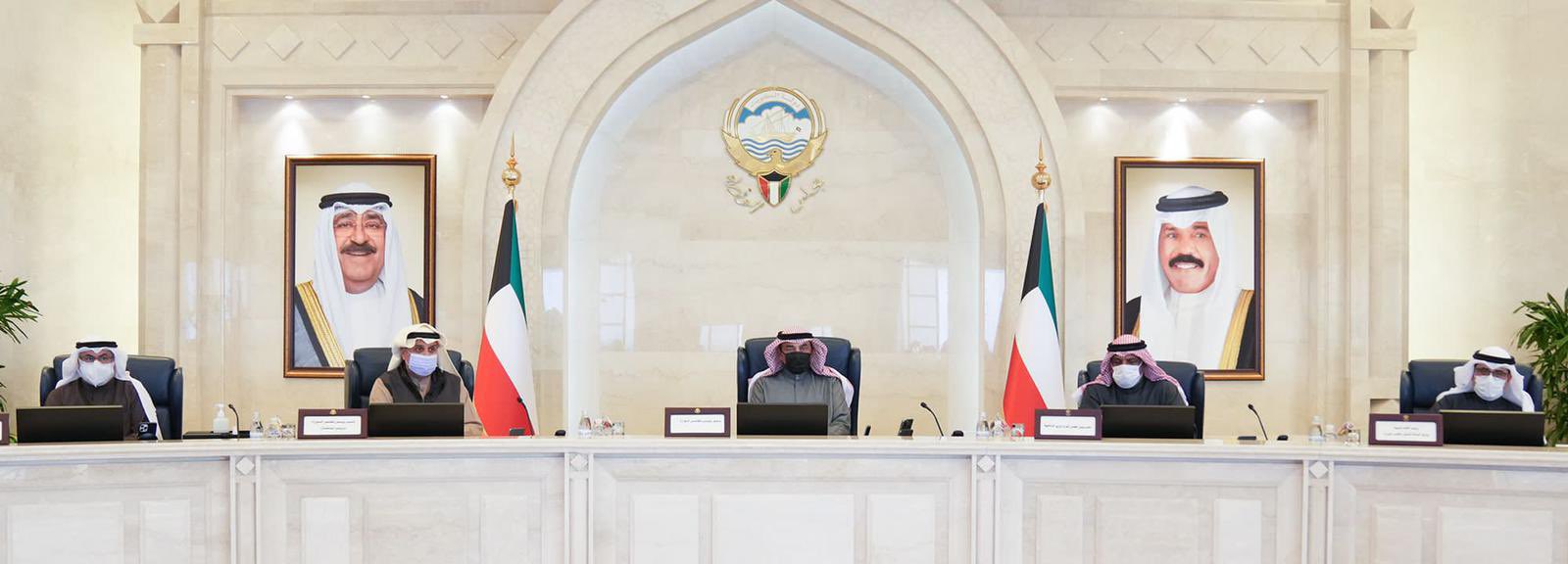
LONDON: Authorities in Kuwait on Monday announced a decision to temporarily suspend all types of social events, which are held in closed places, from Sunday until Feb. 28, in an effort to control the spread of COVID-19.
The Kuwaiti Cabinet made the decision during its weekly meeting and said it would continue to review the epidemiological situation in the country throughout the period.
The Cabinet also announced that all travelers are obligated to take a PCR test 72 hours before arriving in the country as of Tuesday.
Meanwhile, the health ministry registered 982 new coronavirus cases on Monday, raising the total to 419,314. It also said 171 patients had recovered from the virus in the past 24 hours, while no deaths were reported. 

Kuwait’s Cabinet holds it weekly meeting on Monday, Jan. 4, 2022. (Twitter/@KuwaitiCM)
People are directed towards vaccination booths as they arrive to receive COVID-19 coronavirus vaccine booster doses at the vaccination centre at the Kuwait International Fairground in Kuwait City on Jan. 3, 2022. (AFP)
Main category: 

Kuwait airport activates emergency plan amid heavy rainfall


Two killed in flash flooding in Iran’s southern province of Fars

Author: 
Mon, 2022-01-03 23:57

TEHRAN: At least two people were killed in flash flooding in Iran’s southern province of Fars, a local official said on Monday.

“Two people from this province were trapped by water and lost their lives,” Mehdi Khoobyar, deputy head of the Iranian Red Crescent in Fars, told the Young Journalists Club, a news agency affiliated with state television.

One of the victims died in the city of Darab, he added, without giving details on the second.

Relief teams “who were already on full alert, were dispatched to the flood-affected areas” in at least five cities in the province, he said.

The Red Crescent had “provided relief aid or rescued” hundreds of people, Khoobyar was quoted as saying by Tasnim news agency.

Meteorological authorities had warned on Sunday of heavy rain and floods in southern provinces including Kerman and Hormozgan, local media reported. Heavy rains caused damage to agricultural lands and blocked roads in Hormozgan province, and damaged some infrastructure in the southeastern province of Sistan-Balushistan, state news agency IRNA said Sunday.

A weather system causing heavy rain is covering Iran’s south and several Arab countries of the Gulf.

Torrential rainfall has hit the UAE, where its official news agency WAM said bad weather is expected to last until Thursday.

Oman was also impacted by the dense weather system, and Kuwait suspended school classes and exams on Monday.

Largely arid, Iran has been suffering chronic dry spells for years.

In 2019, heavy floods in the south left at least 76 people dead and caused damages estimated at more than $2 billion.

Main category: 
Tags: 

Iran: Biden White House also ‘responsible’ for Qassem Soleimani killing


Israel begins fourth COVID-19 jab for over 60s, health workers

Author: 
Mon, 2022-01-03 23:36

TEL AVIV: Israel began on Monday administering fourth Covid vaccine shots to people over 60 and health workers amid a surge driven by the omicron variant.

Health workers at Ichilov Hospital in Tel Aviv lined up for the shot and over-60s received it at the nearby branch of Clalit, Israel’s largest health fund.

The shot was given to those who received their third inoculation at least four months ago.

The Health Ministry on Sunday approved the fourth shot for the over-60s and medical staff, two days after those with weakened immunity started to take the shot, making Israel one of the first countries to do so.

The Health Ministry on Monday reported 6,562 new COVID-19 infections over the previous day, nearly double the daily average of last week.

In an address late on Sunday, Prime Minister Naftali Bennett warned that cases could soon surge to around “50,000 cases per day.”

More than 4 million people out of Israel’s population of 9.2 million have received three shots of coronavirus vaccine.

A total of almost 1.4 million cases of COVID-19 infection, including 8,244 deaths, have been officially recorded in Israel.

Also on Monday, the Health Ministry said it will admit foreigners with presumed COVID-19 immunity from countries deemed medium-risk as of Jan. 9, partially reversing a ban on entry by foreigners imposed in late November in response to the fast-spreading omicron variant.

FASTFACT

Israel’s Prime Minister Naftali Bennett warned that COVID-19 cases could soon surge to around ‘50,000 cases per day.’

The ministry said on Monday that travelers from 199 countries Israel has designated “orange” would have to prove in advance they are vaccinated or have recovered from COVID-19 and would be subject to PCR testing before and after arrival.

They include Australia, Italy and Ireland.

The ministry has also recommended that South Africa, Nigeria, Spain, Portugal, France and Canada, currently among 16 countries listed as “red” or high COVID-19 risk, be changed to “orange.”

Bennett said in the televised address that Israel would this week begin loosening curbs on international travel even as omicron-fueled cases spiral.

The US, Britain, UAE, Ethiopia, Tanzania, Mexico, Switzerland and Turkey remain on Israel’s red list, the ministry said.

Visitors from those countries require advance special permission from an Israeli committee to enter the country. Israel banned most travel to and from red-listed countries — initially all in southern Africa — on Nov. 25 after the omicron variant was first detected.

Main category: 
Tags: 

Israel to admit some foreigners with presumed COVID-19 immunity as of Jan. 9Omicron could lead Israel to herd immunity: health official


Lebanese president criticized over ‘marketing and populist’ motives

Author: 
Mon, 2022-01-03 23:06

BEIRUT: The political aide of Lebanon’s parliament speaker on Monday attacked President Michel Aoun and the head of the Free Patriotic Movement, MP Gibran Bassil.

MP Ali Hassan Khalil made the remarks in response to Sunday’s speech from Bassil, who threatened to break off the partnership with Hezbollah and asked the party to choose between an understanding with him or an alliance with Parliament Speaker Nabih Berri.

Berri’s move embarrassed FPM ally Hezbollah a few hours before the Monday evening speech from its secretary-general, Hassan Nasrallah

Hezbollah was keen to avoid commenting on Bassil’s press conference.

Political observers were expecting that Nasrallah would not cut ties with Bassil as he was the “only Christian ally of Hezbollah” in Lebanon.

Khalil said at a surprise press conference at the Amal Movement headquarters that the presidency and its movement were “detached from reality” and trying to blame their failure and crises on others.

He said Aoun’s and Bassil’s invitations to a national dialogue had “marketing and populist reasons” and accused the president’s political team of “disrupting” the state and decisions in the Cabinet in order to pass deals and decisions.

Khalil said Aoun was the one who had turned the “principle of participation into a confiscation under the sectarian title and slogans of the movement.”

He expressed his surprise at Bassil’s adherence to the “financial decentralization” proposal, saying the proposal “blasts the basis of the unified state, its responsibility for all its people and regions, and the principle of balanced development.”

He further accused FPM ministers, who held the Ministry of Energy, of having ignored the law of the authority regulating the electricity sector for 12 years in order to remain in control of power and decisions, away from any oversight.

Khalil considered that Aoun and Bassil’s demand for a financial criminal audit was “a slogan to delude public opinion that you are not corrupt in the Ministry of Energy and the Ministry of Communications during the era of your ministers and other ministries.”

He added that the “lie of the attack on the governor of the Central Bank, Riad Salameh, will not deceive public opinion and absolve you from the fact that you were the ones who initiated the renewal of his mandate, after you made a deal for banks affiliated with you to benefit from Salameh’s financial engineering, and any denial (of this fact) is refuted by published documents.”

He said the Amal Movement’s relationship with Hezbollah would not be shaken by “inciting words because it is built on foundations of frankness, trust and respect for the privacy of the other, and we are sure that the party and its leadership know that.”

The president’s team stepped up its attack on Hezbollah and Berri against the backdrop of the Constitutional Council’s failure to accept an appeal from Aoun’s team against parliamentary amendments to the electoral law.

The dispute expanded to include criticism of Hezbollah and Berri for paralyzing the work of the Council of Ministers over the investigation into the Beirut Port explosion.

Khalil has been accused by Judge Tarek Bitar of being connected to the explosion, with a warrant issued for his arrest. The warrant has yet to be executed.

While Nasrallah was commemorating the third anniversary of the killing of Iranian military officer Qassem Soleimani in his speech on Monday evening, the Ain Al-Hilweh camp for Palestinian refugees witnessed some tension.

It was caused by a protest from a group inside the camp loyal to Hezbollah against people who were tearing up a picture of Soleimani that had been raised inside the camp.

Contacts were made between leaders inside the camp to calm the situation.

The protest extended to the area separating Ain Al-Hilweh camp and Haret Saida, which is dominated by Shiites, against the backdrop of raising the Soleimani picture, with young men placing red crosses on it to express their rejection.

The leaders in Palestinian refugee camps in Lebanon decided to neutralize the camps from any events taking place in the country.

Main category: 

Lebanon’s Bassil hits out at Hezbollah amid country’s political paralysisAs the crises in Lebanon continue into 2022 so does the suffering of its people


Palestinian parties urged to remove obstacles for local elections in Gaza and West Bank

Author: 
Mon, 2022-01-03 22:32

GAZA CITY: Hamas has rejeced plans to hold municipal polls in the Gaza Strip — as is the case in the West Bank — where the Palestinian Authority was preparing for the second phase of elections in March.

More than 100 Palestinian NGOs issued a petition calling on Hamas and Fatah to remove any administrative, technical, or legal obstacles, and to ensure that local elections are held in Gaza and the West Bank.

The director of the NGOs Network in Gaza, Amjad Al-Shawa, said that the consensus on holding local elections will restore hope to the Palestinian people in the possibility of achieving internal reconciliation.

Hamas and Fatah have failed to achieve internal Palestinian reconciliation after several attempts.

The NGOs said that holding local elections would push the process towards completing the rest of the legislative and presidential elections.

Hamas has made three demands of the Palestinian Authority to participate and allow the second phase of local elections to take place in the Gaza Strip.

In a letter sent to the Palestinian Central Elections Commission, Hamas demanded that comprehensive elections should be held simultaneously or consecutively, in which local elections are a part and not a substitute for them.

Hamas sought a written pledge from President Mahmoud Abbas to ensure that the elections will not be canceled at the last minute, and also wants the amendments he made to the municipal elections law to be cancelled.

Hamas spokesman Hazim Qasem said that the movement does not want partial elections.

He said that the movement’s demands match national aspirations and that they must be discussed within the framework of a “serious national dialogue to discuss the elections at all levels, setting specific timetables, with written guarantees that they will be respected.”

Hamas wants to hold comprehensive Palestinian elections for the Legislative Council, the presidency, and the National Council, as agreed upon nationally — either simultaneously or consecutively.

Abbas indefinitely postponed the legislative elections that were scheduled for last May, citing Israel’s refusal to hold them in Jerusalem.

The Central Elections Commission announced that it had received an official letter from Hamas including its position on the second phase of the local elections scheduled to be held on March 26.

This stage of the elections will not be held in Gaza, according to the letter from Hamas, confirmed the director of the Regional Office of the Elections Commission in Gaza, Jamil Al-Khalidi.

He said that the letter included “political demands,” which Hamas set as a basis for agreeing to participate and hold elections in Gaza.

The demands related to the elections law, such as canceling the formation of the electoral court, and returning the jurisdiction to decide on appeals to the courts of first instance in the West Bank and Gaza Strip.

Hanna Nasser, the chair of the commission, responded to Hamas with a written letter.

He stressed that Hamas’s demands “are political, and require addressing the political level about them.”

The chairman said that the commission has an executive mission and it was not within its competence to decide on those political issues.

The commission believes that it is currently impossible to hold local elections in Gaza due to limited time ahead of the voter registration process for local elections, which is expected to begin within a few days.

The first phase of local elections were partially held in early December in 154 local councils in villages and towns in the West Bank, but not in the Gaza Strip.

Hamas has controlled the situation in the coastal strip since the split occurred in mid-2007.

The Palestinian Local Elections Law stipulates that “elections shall be held every four years by a decision of the council of ministers, provided that the term of office of the council shall be four years, and it shall continue to conduct business until the elections are held.”

The last local elections were held in 2017 in the West Bank, when Hamas also refused to hold them in Gaza.

 

Police officers stand guard as Palestinians begin registering party lists for May parliamentary election, at the Central Elections Commission's office in Gaza City March 20, 2021. (Reuters)
Main category: 
Tags: 

Economy, security meetings will not settle Palestine-Israel conflict: AnalystsEgypt pushes for calm after flare-up in Gaza hostilities