Libya’s peace remains fragile as election disputes defy resolution

Sun, 2022-01-09 23:27

DUBAI: Libya occupies a sensitive position for the security of Arab and European countries and in managing the Mediterranean region’s migration flows. Yet a road map for the restoration of the oil-rich nation’s security and stability continues to elude the international community. 

Libya’s first presidential election since the overthrow of dictator Muammar Qaddafi in 2011 was due to take place on Dec. 24, amid hopes of finally unifying the war-torn North African country after years of bitter upheaval.

However, just two days before the UN-sponsored polls were due to open, the vote was postponed amid logistical hurdles and ongoing legal wrangling over election rules and who is permitted to stand.

Libya’s electoral board called for the election to be postponed for a month, until Jan. 24, after a parliamentary committee tasked with overseeing the process said it would be “impossible” to hold the vote as originally scheduled.

Even now, 10 days into the new year, it is unclear whether the election will go ahead at all. Many fear that the fragile peace in the country could collapse if disputes over the election are not resolved quickly. 

Any further delay would deal a significant blow to the international community’s hopes of reunifying the country.

“This is a critical moment for Libya and the indications are increasing, day by day, that we are running out of time to have a free and fair election,” Ben Fishman, a senior fellow at the Washington Institute for Near East Policy, told Arab News.

“The multiple court cases against leading candidates has limited the campaign season. This all shows that these elections are not being run on an agreed constitutional basis. More time is needed to resolve fundamental issues, not just on who is able to run but also on what the powers of the president will be.”


Without an agreement concerning those powers, Fishman said, the election could result in an “increasing recipe for more polarization, as well as an increasing potential for more violence and not less.”

One particularly controversial candidate to emerge ahead of the vote is Saif Al-Islam Qaddafi, the son of Muammar Qaddafi and a strong contender for the presidency.

On Nov. 24, a court ruled him ineligible to run. His appeal against the decision was delayed for several days when armed militiamen blocked the court. On Dec. 2, the ruling was overturned, clearing the way for him to stand.
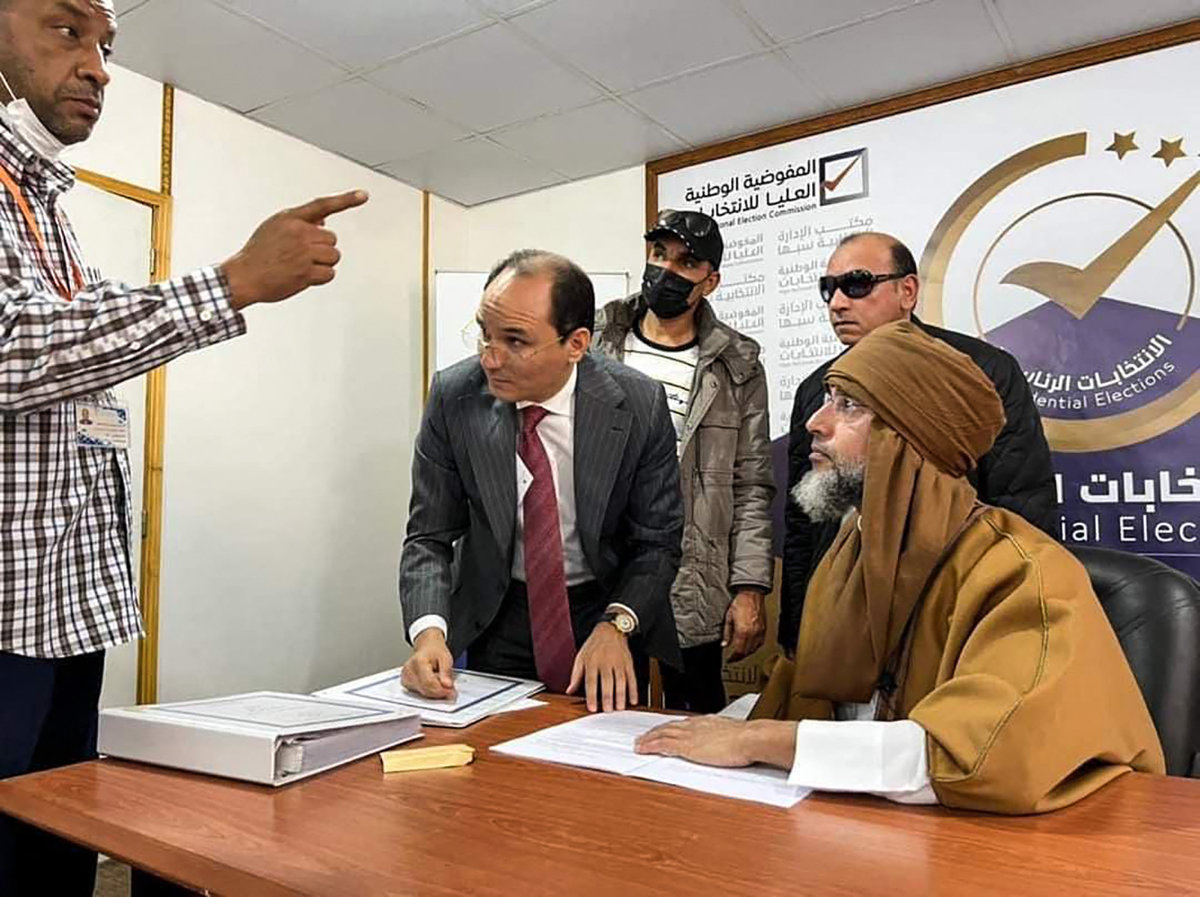

A handout picture released by the Libyan High National Commission on Nov. 14, 2021, shows Seif Al-Islam Kadhafi (right) registering as presidential candidate. (AFP/Libyan High National Electoral Comission)

A Tripoli court sentenced Qaddafi to death in 2015 for war crimes committed during the battle to prolong his father’s 40-year rule in the face of the 2011 NATO-backed uprising. However, he was granted an amnesty and released the following year by the UN-backed government. He remains a figurehead for Libyans still loyal to the government of his father.

Qaddafi is not the only divisive candidate. Field Marshal Khalifa Haftar, who in September temporarily suspended his command of the Tobruk-based Libyan National Army to run for office, also faces legal proceedings for alleged war crimes.
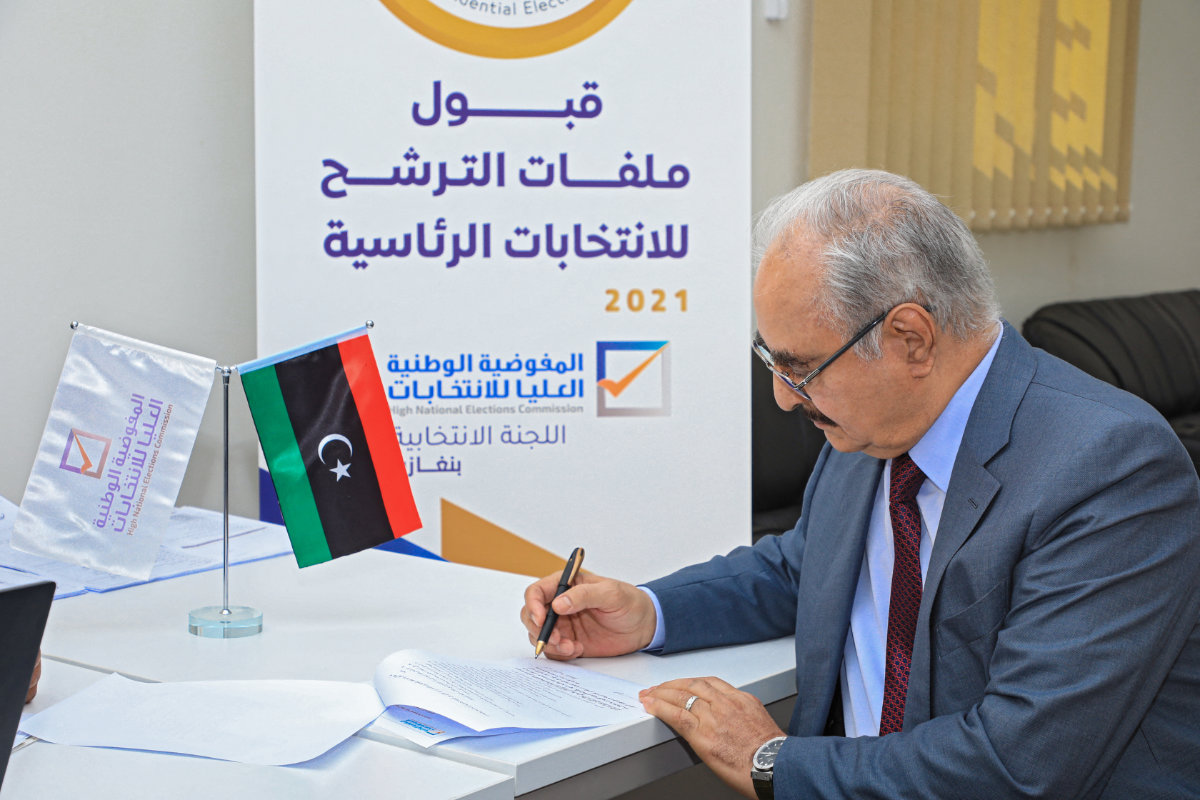

Khalifa Haftar submits documents for his candidacy for the Libyan presidential election at the High National Election Commission in Benghazi on Nov. 16, 2021. (AFP)

According to Jonathan Winer, a scholar at the Middle East Institute and a former US special envoy for Libya, the chances of success for the election were seriously undermined from the beginning when the Libyan House of Representatives devised the rules.

“These elections have become increasingly chaotic,” he said. “The process over who gets disqualified and who doesn’t is, at least, somewhat flawed, imperfect, and with so many candidates the idea that anyone would get a majority is ludicrous — no one will get a majority.”

Given the ongoing disputes, Dalia Al-Aqidi, a senior fellow at the Center for Security Policy, believes even Jan. 24 is overambitious for a rescheduled vote. 

“Despite all the continuous calls for the importance of holding the Libyan presidential elections to help the country to cross to safety and prevent a new wave of violence, the possibility of this happening is slim due to the lack of agreement between the major key players, divisions on the ground, and foreign interference,” Al-Aqidi said.

“Holding elections in January is a difficult task since none of the obstacles that led to postponing the electoral process were addressed or dealt with by local leaders nor the international community.

“Less than one month is not enough time to solve all the issues that prevented the Libyans from casting their votes and that includes the conflict over the nomination of candidates.”

FASTFACTS

Factions continue to disagree over basic electoral rules and who can run for office.

Parliamentary committee said it would be “impossible” to hold the vote as scheduled.

Al-Aqidi is concerned that factional fighting could resume if foreign interference continues. “The likelihood of violence and chaos is very high, especially with the increase of the Muslim Brotherhood’s efforts in the country due to its loss everywhere else in the region,” she said. 

“The group, which is supported by Turkey, is looking at Libya as an alternative to Tunisia, which was its last stronghold.”

The Washington Institute’s Fishman also doubts the election will take place later this month, but remains cautiously optimistic that a serious uptick in violence can be avoided if dialogue continues.

“It appears now that an immediate threat of violence is less likely as different actors are talking about next steps,” he said. “Because of these talks, the date is likely to be extended beyond late January, or even several months after.

“The international community should support these internal Libyan talks and UN-brokered conversation and not take a specific position right now on the timing of elections until a better consensus is more clear.”

The appointment on Dec. 7 of Stephanie Williams as UN special adviser on Libya offers some hope of getting the process back on track. Williams led the talks that resulted in the October 2020 ceasefire in Libya.

“She’s deeply immersed in the issues and knows all the parties, and can hopefully pull a rabbit out of a hat and do what her predecessor was not able to do and come up with a game plan and a timeline,” said Fishman.

The road to the presidential election in Libya was never going to be easy. In August 2012, after the fall of Muammar Qaddafi, the rebel-led National Transitional Council handed power to an authority known as the General National Congress, which was given an 18-month mandate to establish a democratic constitution.

Instability persisted, however, including a string of major terrorist attacks targeting foreign diplomatic missions. In September 2012, an assault on the US consulate in Libya’s eastern city of Benghazi left US ambassador Chris Stevens and three other Americans dead.

Responding to the threat, Haftar launched an offensive against armed groups in Benghazi in May 2014. He named his forces the Libyan National Army.

Elections were held in June 2014, resulting in the eastern-based parliament, the House of Representatives, which was dominated by anti-Islamists. In August that year, however, Islamist militias responded by storming Tripoli and restoring the GNC to power.

The Haftar-affiliated House of Representatives took refuge in the city of Tobruk. As a result, Libya was divided, left with two governments and two parliaments.

In December 2015, after months of talks and international pressure, the rival parliaments signed an agreement in Morocco establishing a Government of National Accord. In March 2016, GNA chief Fayez Al-Sarraj arrived in Tripoli to install the new administration. However, the House of Representatives did not hold a vote of confidence in the new government and Haftar refused to recognize it.

In January 2019, Haftar launched an offensive in oil-rich southern Libya, seizing the capital of the region, Sabha, and one of the country’s main oilfields. In April that year he ordered his forces to advance on Tripoli.

By the summer, however, after Turkey deployed troops to defend the administration in Tripoli, the two sides had reached a stalemate.

A UN-brokered ceasefire was finally agreed in Geneva on Oct. 23, 2020. It was followed by an agreement in Tunis to hold elections in December 2021.
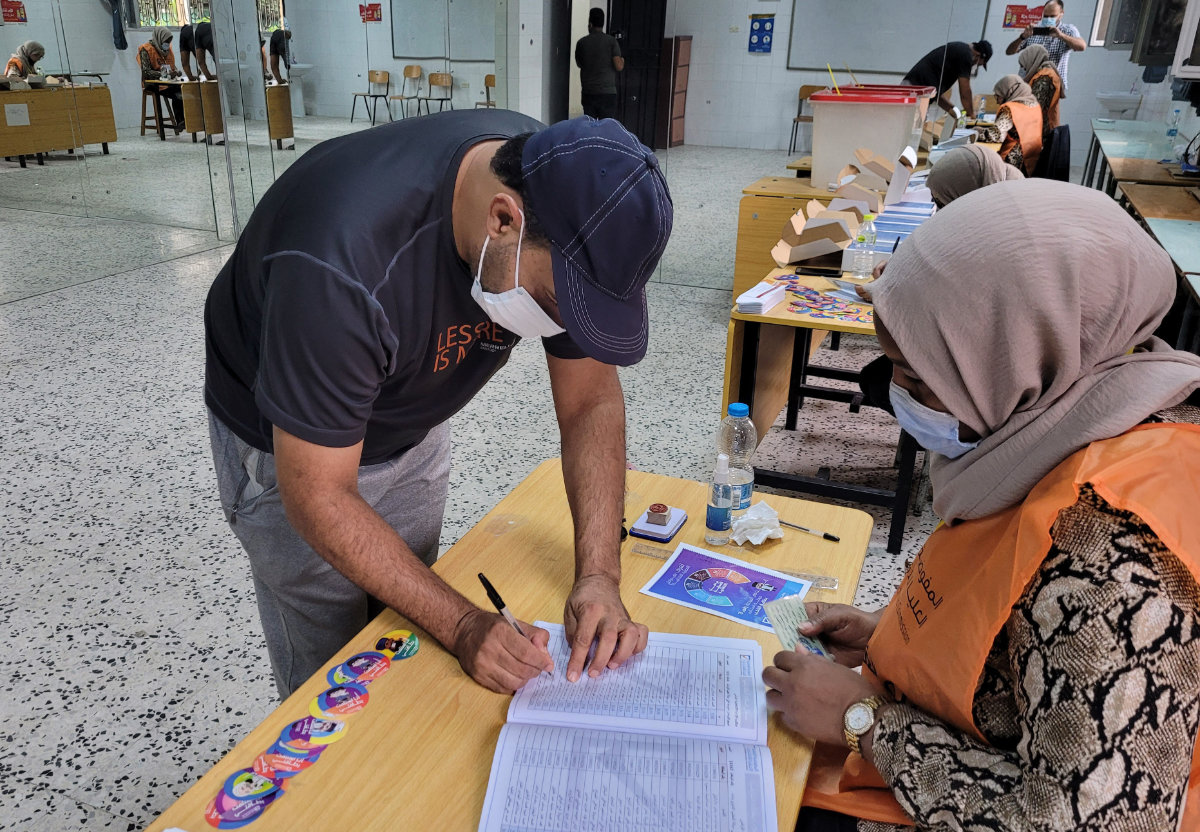

A Libyan man registers to vote inside a polling station in Tripoli on November 8, 2021. (AFP)

A provisional Government of National Unity, headed by Abdul Hamid Dbeibah, was approved by lawmakers on March 10, 2021. On September 9, however, Aguila Saleh, the speaker of Libya’s parliament, ratified a law governing the presidential election that was seen as bypassing due process and favoring Haftar.

Subsequently, the parliament passed a vote of no-confidence in the unity government, casting the election and the hard-won peace into doubt.

Even if an election does take place in January, Libya still has a long way to go before a stable administration is formed and a sustainable peace is achieved.

___________________

Twitter: @rebeccaaproctor

Libyans protest at Martyrs’ Square in the capital Tripoli after Saif Al-Islam Qaddafi, son of former dictator Muammar Qaddafi, announced his candidacy in the upcoming presidential election. (AFP)
Main category: 

Libya parliament debates election chaos, refuses to fix date for delayed pollsUN calls on Libyan authorities to honor millions who registered to voteArab League urges Libyan parties to uphold national interestLibya urged to reschedule presidential vote ‘swiftly’


Relying on more home COVID tests, Israel looks to lower costs

Author: 
Sun, 2022-01-09 23:38

JERUSALEM: Israel sought on Sunday to ease access to home COVID-19 tests after a decision to allow most vaccinated people to use the kits to decide whether or not to quarantine led to shortages in shops and complaints about high prices.

“We are mindful of the public’s distress,” Prime Minister Naftali Bennett said at the weekly Cabinet meeting, announcing that every child in kindergarten or elementary school in Israel would be issued three free kits in the coming days.

The government was also negotiating price reductions with major pharmacy chains, Bennett said, adding: “In any event, costs will come down in the near future because the market will be flooded with millions of kits that will arrive in Israel.”

The kits cost around 25 shekels to 35 shekels ($8 and $11) in Israeli stores, many of which have reported running out.

Nachman Ash, director-general of the Health Ministry, told 103 FM radio that unit price should be no more than 10 shekels ($3).

With a surge in COVID-19 infections and hours-long queues at mandatory testing stations, Israel last week said PCR and professionally administered antigen tests would only be required for people over the age of 60 or with weak immune systems. Other vaccinated people could now rely on home tests. But there was some skepticism about efficacy.

Israel’s Channel 12 TV news reported that a Defense Ministry technology team had found that the kits missed 47 percent of confirmed COVID-19 carriers and had a false-positive rate of 37 percent. A ministry spokeswoman declined comment.

Salman Zarka, Israel’s pandemic-response coordinator, said self-testing and self-reporting would compromise efforts to track cases.

“We will not know the scale of morbidity with the home antigen kits,” he told Kan radio.

Israel hopes new antiviral COVID-19 medications will help keep hospital admissions and severe cases down, even as daily cases are expected to rise to record highs in the coming weeks.

About 60 percent of its 9.4 million population is fully vaccinated, according to the Health Ministry.

Main category: 
Tags: 

Israeli MP faces heat for remarks on settlersIsrael to start reopening to foreigners even as omicron surges


Kuwait, Qatar COVID-19 daily cases soar past previous highs

Author: 
Sun, 2022-01-09 23:32

DOHA: Daily coronavirus infection rates reported by Kuwait and Qatar have soared past previous peaks recorded in the summers of 2021 and 2020 respectively, as cases rise across all Gulf states.
Kuwait on Sunday reported 2,999 new cases of COVID-19, its fourth day of case numbers exceeding a high of 1,993 seen in July last year.
Kuwait had seen below 50 daily cases during the last quarter of 2021.


Qatar, with a population of around 2.8 million, on Saturday reported 3,487 new cases — almost 10 percent of those tested — outpacing a previous high of 2,355 seen in May 2020.
On Saturday, Qatar reintroduced a set of rules limiting home gatherings to 10 vaccinated people, barring unvaccinated people from entering malls and restaurants and reducing capacity limits for some commercial establishments. Schools in Qatar have reintroduced distance learning until at least January 27.
To relieve pressure on Qatar’s testing infrastructure authorities on Wednesday urged travelers and some symptomatic people to take rapid antigen tests, which don’t need to be processed in a laboratory, rather than PCR tests.

It also opened a new 10-lane drive-through PCR testing station to sample up to 5,000 people a day.
Saudi Arabia, the largest Gulf state with a population of some 30 million, has also seen a rapid increase in cases since the start of the year. The Kingdom registered 3,460 new infections on Sunday, still below a peak of more than 4,700 in June 2020.
In the UAE, the Gulf’s tourism and commercial hub, the past three weeks also brought a surge in cases as the country hosts a world fair during its peak tourist season.
Authorities on Sunday reported 2,759 new infections, as it hosts a world fair during its peak tourist season.

A Kuwaiti medical worker walks at a Covid-19 vaccination center in Kuwait City on Oct. 25, 2021. (AFP)
Main category: 

Saudi Arabia records 3,460 new COVID-19 cases, 1 deathKuwait reimposes social distancing measures for mass events, mosque prayers


Lebanon goes dark after bungling protesters disable key power plant

Sun, 2022-01-09 22:35

BEIRUT: The Lebanese population was subjected to collective punishment on Saturday night after protesters stormed a key power station and tampered with the electrical equipment, inflicting power cuts on the whole country for hours.

Protesters stormed the main power station in the Aramoun area, 22 km from Beirut, and tampered with its contents to secure electricity for their neighborhoods, causing a problem that affected all power generation plants.

They claimed that that there is discrimination in the distribution of electricity. They said that “the electric current is available to areas under the authority of the Free Patriotic Movement, while it is totally absent from areas that are considered an incubator environment for the movement’s opponents.”

The owner of a private electric generator in the Choueifat area near Aramoun said that as electricity supplies on Sunday morning returned to the same rationing levels in the Lebanese regions, resentment over what is happening could break out at any time.

Nabih Al-Durra told Arab News that “one hour in the morning and another hour at night is the total electrical energy provided by Electricite du Liban (Lebanon’s state electricity company) to people.”

The rest is provided by private generators, which are too expensive for many people and are also facing difficulties.

Al-Durra said that the number of subscribers had fallen by 25 percent because people are unable to pay LBP 7,100 ($ 4.72) for a kilowatt of electricity.

Electricite du Liban said in its statement that some protesters had broken into its Aramoun power station — “endangering their personal safety and the safety of the station’s workers.”

Their activities in the power station led to disturbances in the electrical network, which in turn disconnected all power production plants around the country, leading to a national blackout,  Electricite du Liban said.

The company renewed its appeal to “all authorities and security forces about the necessity of protecting all the establishment’s facilities from any other attacks and restoring control over the substations outside its control.”

The forgotten Arabs of Iran
A century ago, the autonomous sheikhdom of Arabistan was absorbed by force into the Persian state. Today the Arabs of Ahwaz are Iran’s most persecuted minority

Enter

keywords

It pointed out the strategic importance of the main Aramoun station. This station is the main linking station between Al-Zahrani power plant and the rest of the electrical network.

Meanwhile Patriarch Bechara Boutros Al-Rahi reiterated his concern on Sunday over the current political and economic crisis.

“It is unacceptable for the Cabinet to remain suspended, especially since any agreement with the International Monetary Fund requires the approval of the Council of Ministers as a whole,” he said in his Sunday sermon.

He stressed that “Lebanon’s Arab affiliation is in harmony with its natural surroundings and the interaction of the Lebanese and Arab civilizations throughout history. This is what determines its existence, not the regional conflicts, nor any sectarian project.”

He spoke as the official dollar exchange rate broke the LBP 30,000 barrier on Sunday. The Lebanese pound lost about 95 percent of its value against the dollar since November.


A picture taken on July 27, 2020 shows part of Lebanon’s capital Beirut in the dark caused by fuel shortages. (AFP)
Main category: 

Lebanon power company says protesters behind national blackoutGeneral Labor Union president warns against ‘certain catastrophe’ in Lebanon amid economic crises


Taliban FM visits Iran for talks on trade, border and refugees

Sun, 2022-01-09 21:19

ISLAMABAD: A delegation led by the Taliban foreign minister is in Iran to discuss border, economic and refugee issues, a senior foreign ministry official in Kabul said on Sunday.

It is the first time that a high-profile delegation from Kabul is visiting the neighboring country after the Taliban took control of Afghanistan in August last year.

Taliban Foreign Minister Amir Khan Muttaqi is accompanied by the ministers of economy and commerce, as well as the governor of Afghanistan’s central bank.

The delegation arrived in Tehran on Saturday, on the invitation of the Iranian government.

“During this visit, very important issues, including the border and crossing points, refugees, the economy and strengthening political relations with Iran will be discussed,” Waliullah Shaheen, director of the Institute of Strategic Studies at the Ministry of Foreign Affairs in Kabul, told Arab News.

“We at the Ministry of Foreign Affairs of Afghanistan believe that Iran is an important neighbor for Afghanistan, especially at this time.”

Iran, like other nations, has so far not recognized the interim government of Afghanistan, formed by the Taliban in September last year.

Since the fall of Kabul’s Western-backed administration on Aug. 15, billions of dollars in foreign assistance to Afghanistan’s aid-dependent economy have been suspended and some $9.5 billion of Afghan Central Bank assets parked overseas have been frozen.

With aid suspended, its new rulers unrecognized, and the financial system paralyzed, Afghanistan is facing a looming humanitarian crisis.

Iran is a key trade partner to Afghanistan and host to millions of Afghan refugees.

Tensions on its 900-kilometer border with Afghanistan, an active smuggling and human trafficking route, have been a long-standing issue.

In December, Taliban authorities reported the killing of several Iranian border guards following fuel smuggling attempts from the Iranian side to Nimroz Province in southwestern Afghanistan.

The forgotten Arabs of Iran
A century ago, the autonomous sheikhdom of Arabistan was absorbed by force into the Persian state. Today the Arabs of Ahwaz are Iran’s most persecuted minority

Enter

keywords

Main category: