Desert tree planting sows discord within Israel’s coalition
Author:
Thu, 2022-01-13 00:15
SAWE AL-ATRASH, Israel: Government-sponsored tree planting in an Israeli desert has set off violent protests by Bedouin Arabs who see the forestation as discriminatory encroachment by the state, sowing discord within Prime Minister Naftali Bennett’s ethnically mixed coalition.
Coming days before the Jewish arbor festival of Tu Bishvat, the drive to turn the sandy expanses of the southern Negev green hails back to Israel’s founding pioneer narratives.
But the nomadic Bedouin claim private ownership over nationalized land being zoned and accuse Israeli courts of enabling expropriations as part of a campaign of disenfranchisement that has kept many of their community in off-the-grid breeze-block encampments.
The diggers rolled this year despite an appeal by Mansour Abbas, a Bennett coalition partner from Israel’s Arab minority, for a deferral “while we work on a decent plan that would grant Bedouin citizens honorable lives and livelihoods.”
“A tree is not more important than a person,” he tweeted.
Authorities have said the flattening of the dunes and planting of trees is necessary for conservation and modernization.
At the Negev village of Sawe Al-Atrash, Bedouin scuffled with riot police on Wednesday after a night in which authorities said protesters blocked roads, stoned motorists and forced a train to halt by piling rocks on its tracks.
Mansour’s United Arab List party was boycotting parliamentary votes, a coalition spokesman said.
If sustained, that could deny Bennett his razor-thin majority and bolster the Jewish-nationalist opposition.
Asked how far UAL was willing to go, party lawmaker Iman Khatib Yassin said: “All the way.”
“We came into this partnership hoping to find partners who understand that Arab citizens of the country have a basic right and deserve basic rights on their lands,” she told Kan radio, while stopping short of any threat to quit the coalition.
Foreign Minister Yair Lapid, a centrist, urged a halt to the contested forestation.
Despite successive governments’ pledges of equitable Negev investment, “the Bedouin problem has been forsaken,” he said in a statement.
The religious-rightist Bennett did not comment. His ideologically kindred housing minister, Zev Elkin, saw no need to heed such calls. “These are state lands,” Elkin told 103 FM radio.
Some protesters on Tuesday evening hurled stones at vehicles on a highway near Beersheba, blocked the railway line and torched a vehicle. Police said two officers were wounded in the violence and local media reported at least 18 people arrested.
The government announced a compromise in which it would complete the day’s planting and launch negotiations on Thursday. Authorities withdrew heavy machinery from the area as the tensions appeared to ease.
The Bedouin are part of Israel’s Arab minority, which makes up some 20 percent of the country’s population.
They have citizenship, including the right to vote, but face discrimination. Arab citizens of Israel have close family ties to the Palestinians and largely identify with their cause.
Israeli MP faces heat for remarks on settlersIn Israel, omicron, confusion drive ‘real panic’ for tests
European archaeologists back in Iraq after years of war
Wed, 2022-01-12 23:43
NASIRIYAH, Iraq: After war and insurgency kept them away from Iraq for decades, European archaeologists are making an enthusiastic return in search of millennia-old cultural treasures.
“Come and see!” shouted an overjoyed French researcher recently at a desert dig in Larsa, southern Iraq, where the team had unearthed a 4,000-year-old cuneiform inscription.
“When you find inscriptions like that, in situ, it’s moving,” said Dominique Charpin, professor of Mesopotamian civilization at the College de France in Paris.
The inscription in Sumerian was engraved on a brick fired in the 19th century B.C.
“To the god Shamash, his king Sin-iddinam, king of Larsa, king of Sumer and Akkad,” Charpin translated with ease.
Behind him, a dozen other European and Iraqi archaeologists kept at work in a cordoned-off area where they were digging.
They brushed off bricks and removed earth to clear what appeared to be the pier of a bridge spanning an urban canal of Larsa, which was the capital of Mesopotamia just before Babylon, at the start of the second millennium B.C.
“Larsa is one of the largest sites in Iraq; it covers more than 200 hectares,” said Regis Vallet, researcher at France’s National Center for Scientific Research, heading the Franco-Iraqi mission.
The team of 20 people has made “major discoveries,” he said, including the residence of a ruler identified by about 60 cuneiform tablets that have been transferred to the national museum in Baghdad.
Vallet said Larsa is like an archaeological playground and a “paradise” for exploring ancient Mesopotamia, which hosted through the ages the empire of Akkad, the Babylonians, Alexander the Great, the Christians, the Persians and Islamic rulers.
However, the modern history of Iraq — with its succession of conflicts, especially since the 2003 US-led invasion and its bloody aftermath — has kept foreign researchers at bay.
Only since Baghdad declared victory in territorial battles against the Daesh group in 2017 has Iraq “largely stabilized and it has become possible again” to visit, said Vallet.
“The French came back in 2019 and the British a little earlier,” he said. “The Italians came back as early as 2011.”
In late 2021, said Vallet, 10 foreign missions were at work in the Dhi Qar province, where Larsa is located.
Iraq’s Council of Antiquities and Heritage director Laith Majid Hussein said he is delighted to play host, and is happy that his country is back on the map for foreign expeditions.
“This benefits us scientifically,” he told AFP in Baghdad, adding that he welcomes the “opportunity to train our staff after such a long interruption.”
Near Najaf in central Iraq, Ibrahim Salman of the German Institute of Archaeology is focused on the site of the city of Al-Hira.
Germany had previously carried out excavations here that ground to a halt with the 2003 US-led invasion that toppled Saddam Hussein.
Equipped with a geomagnetic measuring device, Salman’s team has been at work in the one-time Christian city that had its heyday under the Lakhmids, a pre-Islamic tribal dynasty of the 5th and 6th centuries.
“Some clues lead us to believe that a church may have been located here,” he explained.
He pointed to traces on the ground left by moisture which is retained by buried structures and rises to the surface.
“The moistened earth on a strip several meters long leads us to conclude that under the feet of the archaeologist are probably the walls of an ancient church,” he said.
Al-Hira is far less ancient than other sites, but it is part of the diverse history of the country that serves as a reminder, according to Salman, that “Iraq, or Mesopotamia, is the cradle of civilizations. It is as simple as that!”
New archeological finds made in EgyptSaudi Arabia with a rich history and home to archeological treasures
UN green light for aid to Idlib puts miseries of Syria’s war into stark relief
Wed, 2022-01-12 23:02
WASHINGTON D.C.: Airstrikes targeting civilian infrastructure in the rebel-held enclave of Idlib in Syria have become so common in recent months, they have ceased to be considered news by many Western media outlets, human-rights campaigners say.
According to Syrian Civil Defense, the rebel-affiliated first responders also known as the White Helmets, attacks by the Bashar Assad regime and its foreign military backers have intensified, maiming and killing scores of children.
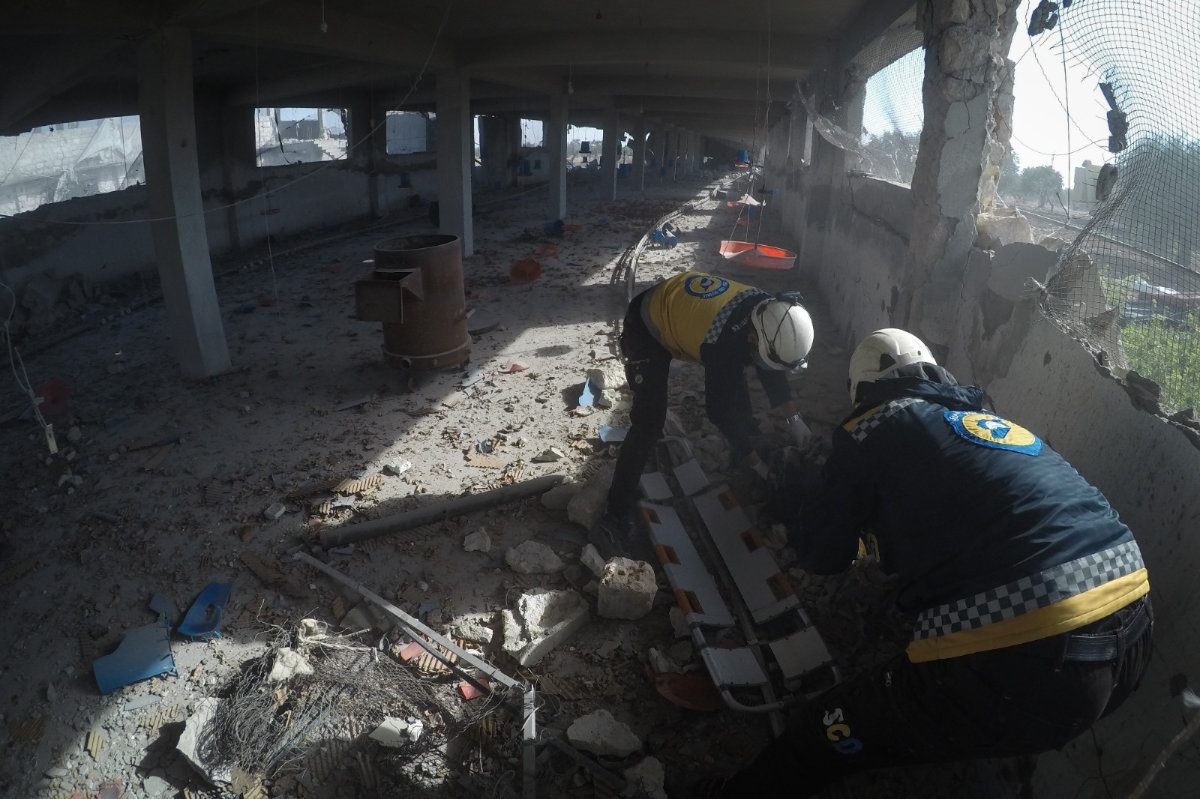
One photograph released by the White Helmets in mid-November shows first responders lifting the lifeless body of a little girl from the rubble of what used to be her home. Such images were once front-page news. Now they barely register on the news media’s radar.
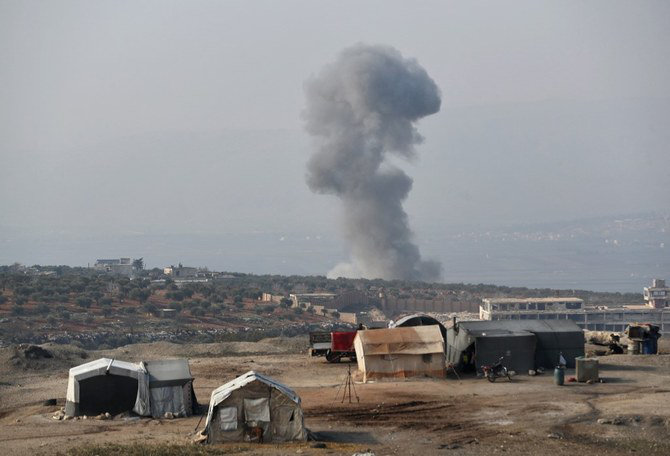
Syria’s White Helmets volunteers search through the rubble of a building destroyed by an exploding bomb in Idlib. (AFP file photo)
Since June this year, the White Helmets have documented the deaths of 63 children in air and artillery attacks on rebel-held northwest Syria. To highlight the issue, the group has launched a social media hashtag campaign, #ChildrenUnderAttack.
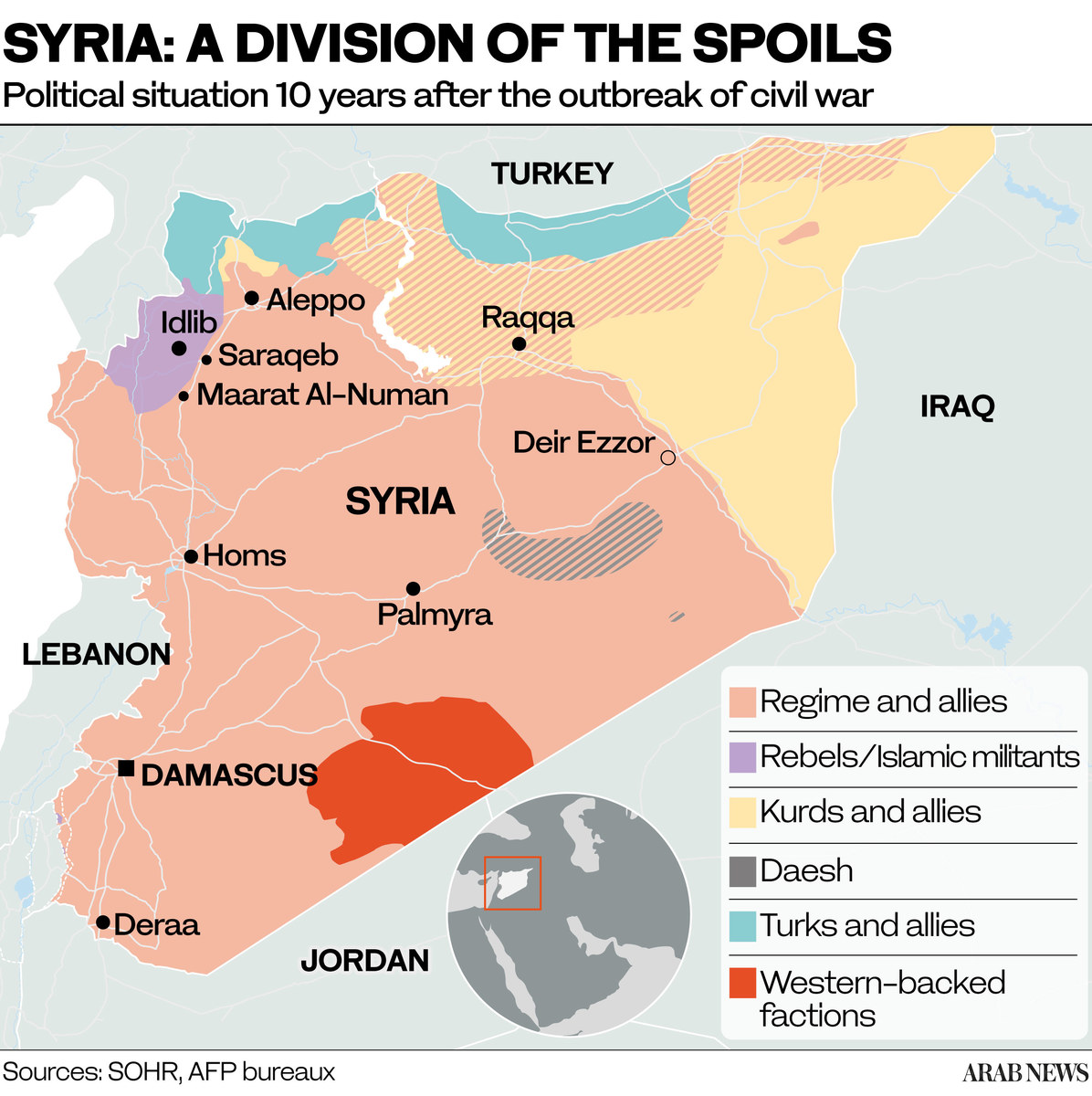
Northwest Syria does receive a modicum of media attention every time the UN extends a measure that allows cross-border aid into the region for a period of six months, as happened on Monday. Roughly three million people live in Idlib, which remains outside the Assad regime’s control.
The green light for continued passage of humanitarian supplies through the crossing at Bab Al-Hawa, on the Syrian-Turkey border, was given even though the Assad government did not approve the move and the Security Council did not vote on the matter.
Many analysts argue that Assad has “won” the Syrian civil war and therefore the international community ought to accept the new status quo. However, teachers in rebel-held areas have said it is wrong for the world to simply turn a blind eye to the regime’s crimes.
School staff in Idlib recently published an open letter with the help of a UK-based charity, The Syria Campaign, urging world leaders not to forget the region’s children who live under almost daily bombardment.
“We are the teachers of students in northwest Syria who are deliberately targeted in their homes, classrooms and as they walk to school,” the letter states. “We go to work afraid of another attack, and of another traumatizing day, which we know will affect our pupils for the rest of their lives.
“Our letter could not be more urgent. Early on Wednesday, October 20, four students and our colleague, Arabic teacher Qamar Hafez, were tragically killed on their way to school when Syrian government forces attacked the town of Ariha in southern Idlib with artillery shells.
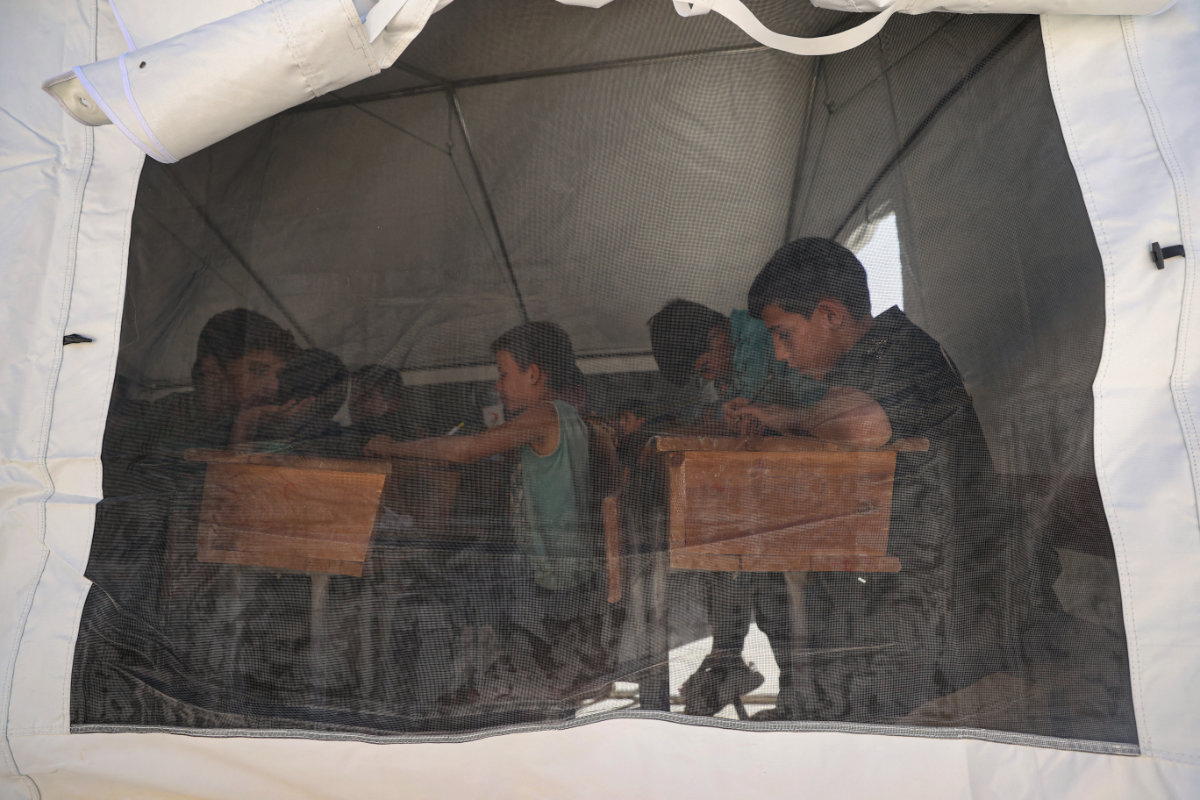
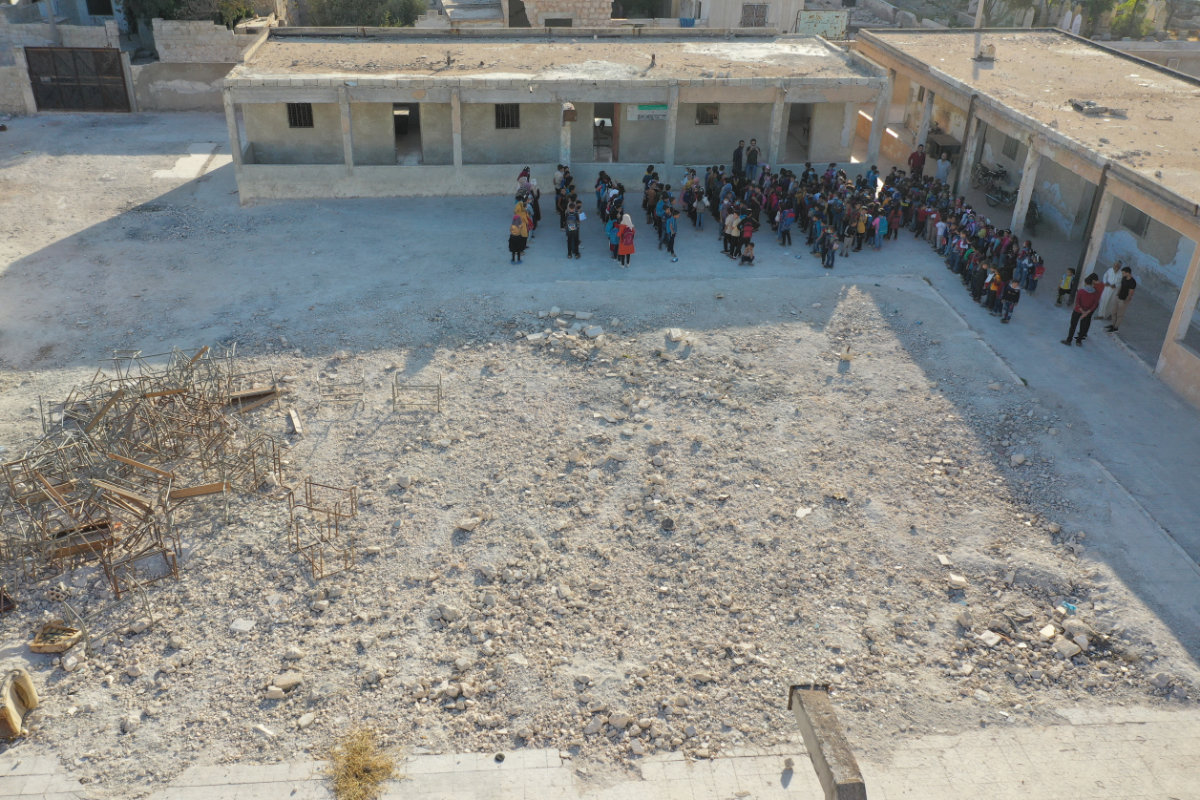
Children attend the first day of school in a village in the countryside of Syria’s northwestern Idlib province on Oct. 9, 2021. (Omar Haj Kadour / AFP)
“One million children in Idlib are terrified they might be next or they might lose their best friend at any moment. Like teachers everywhere, we are deeply committed to the children we teach, and we do all we can to try to protect them, but it is not enough. We need world leaders to stop the attacks, and ensure that children are safe and able to continue their education.”
Children have suffered the brunt of the Syrian conflict, which began more than a decade ago when anti-government protests met with violent repression, sparking a civil war.
According to the Syrian Network for Human Rights, another UK-based monitor, at least 29,661 children have been killed in Syria since March 2011 — 22,930 of them at the hands of regime forces.
In its latest report, published on Nov. 20 to coincide with World Children’s Day, the network said at least 1,197 schools and 29 kindergartens had been completely or partially destroyed across Syria since March 2011.
Opinion
This section contains relevant reference points, placed in (Opinion field)
An estimated 2.5 million children in Syria are out of school, with another 1.6 million at risk of dropping out, according to UNICEF, which estimates that nine in 10 children in Syria live in poverty and more than 5,700 children — some as young as seven — have been recruited to fight.
According to UNICEF, 512 children were killed in attacks last year, most of them in northwest Syria. Around 1.7 million vulnerable children reside in the rebel-held areas, most of whom have been displaced multiple times by successive regime offensives. There are currently at least 2.5 million displaced children in Syria.
First responders have catalogued the impact of the war on the mental health of children living in the region’s displacement camps. Humanitarian aid workers have referred to the trend as a “psychological disaster that threatens this generation, and future generations of Syria.”
Speaking to Arab News, Layla Hasso, a Syrian advocacy director for the Hurras Network, a child protection NGO, said: “The goal is to terrify the half million children who live in Idlib province and to send a clear message to their families that there is no future for their children here. It’s why civilians are being targeted at their homes, schools, hospitals.
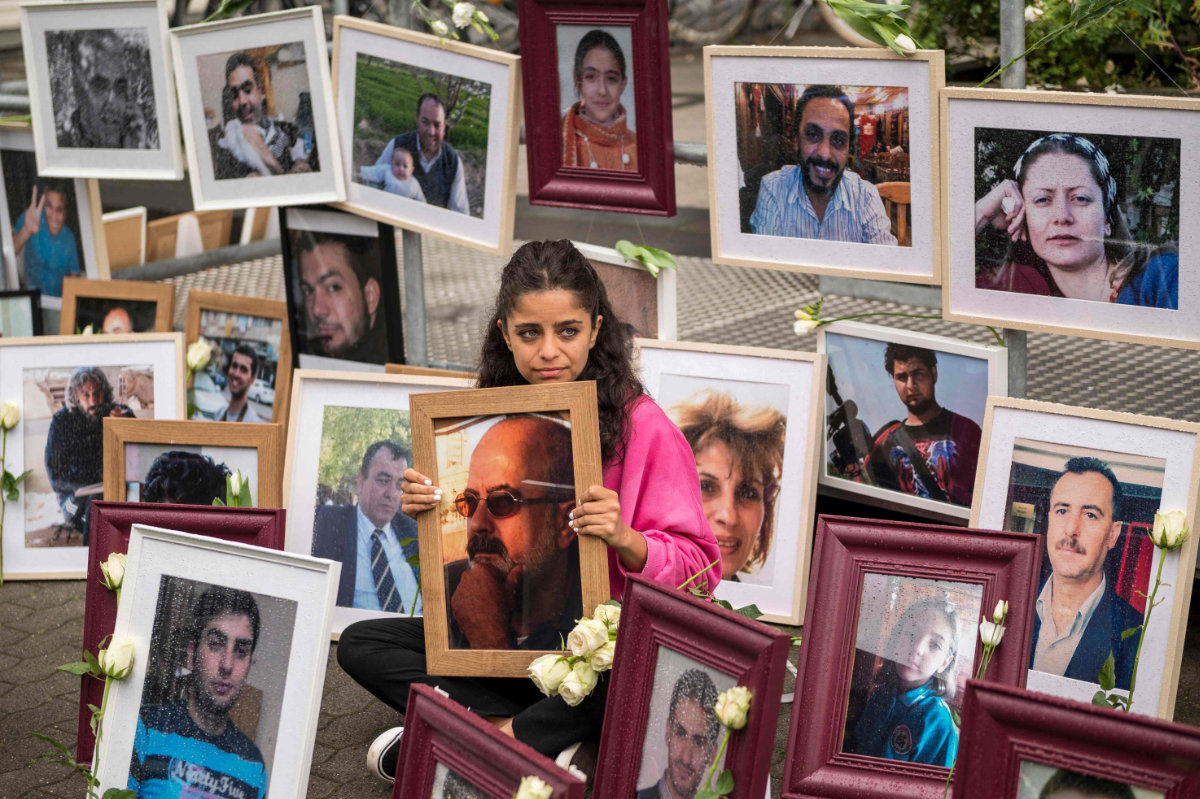
Pictures of Syrian regime victims are displayed during a protest in Koblenz, Germany, during the trial of two former Syrian officials accused for crimes against humanity. (AFP file)
“This is what I call terrorism and it has to stop. The international community cannot continue to turn a blind eye to this horror.”
However, anecdotal evidence suggests news consumers across the world are fatigued by the unending stream of images of devastation emanating from the region. As a result, global concern over Syria and its people has declined noticeably in recent years.
Analysts say this indifference, coupled with the inaction of the UN Security Council, has emboldened the regime to continue its bombing campaign. By giving the Syrian crisis a human face, The Syria Campaign hopes to revive international interest in the plight of Idlib’s children.
“Teachers joined together to write this letter to remind world leaders that Syrian and Russian forces continue to bomb civilians, including children, in northwest Syria with zero accountability,” Sara Hashash, communications director at The Syria Campaign, told Arab News.
Children in northwest Syria are unable to go to school due to constant bombing and displacement. (AFP photo)
“Children in northwest Syria are traumatized and unable to go to school due to constant bombing and displacement. A child has been killed almost every other day for the past four months.
“On Nov. 15, two children were killed by Syrian regime artillery shelling on Kafr Nouran in the Aleppo countryside. It’s frustrating that many of these attacks no longer get widespread media coverage.”
The result of the media silence on the issue has been political inaction. Already the Assad regime is being welcomed back into the regional fold. Many feel it is perhaps only a matter of time before Western and moderate Arab powers accept that Assad is here to stay.
In remarks to reporters on Nov. 11, Ned Price, the US State Department spokesperson, said: “This (Biden) administration will not express any support for efforts to normalize or rehabilitate Bashar Assad, who is a brutal dictator.”
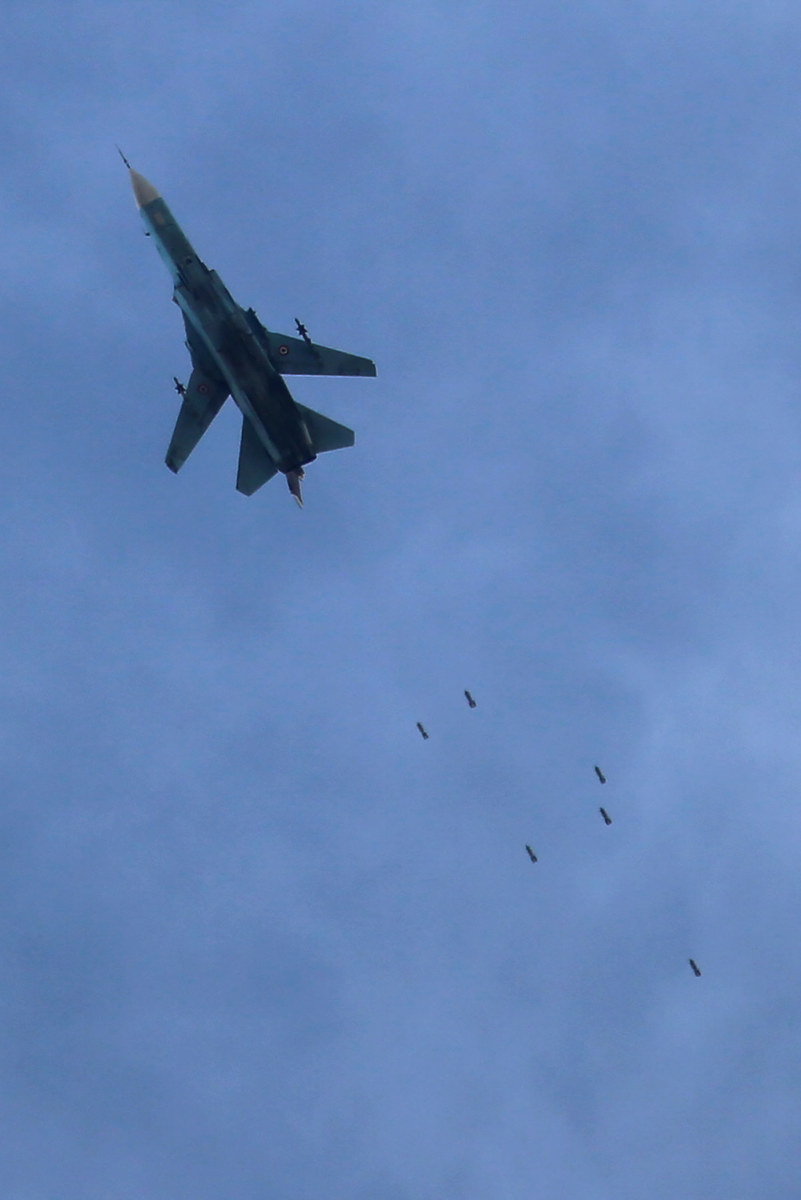
A Syrian air force MiG-23 jet drops a payload during an air strike in the rebel-held town of Arbin in Eastern Ghouta region, outskirts of the Damascus, on Feb. 7, 2018. (AFP)
He said: “There has been no change in our position and Bashar Assad certainly has not said anything that would rehabilitate his image or that would suggest that he or his regime is changing its ways.”
In his column in Asharq Al-Awsat, the Syrian commentator Ibrahim Hamidi recently wrote: “As it stands, the room for confrontation is now limited to two options: The first is engaging Assad and ending Damascus’ isolation with the hope of easing Iran’s influence. Some Arab countries have indeed forged ahead with normalization, demanding that Damascus begin reining in Iran in Syria and the region.
“The second option lies in banking on the leadership of Russian President Vladimir Putin and his ability to rein in Iran. This option stems from the position that the war had brought together Putin and Iran’s supreme leader Ali Khamenei in Syria, but peace and normalization will pull them apart.”
INNUMBERS
2.5 million Children out of school in Syria.
9/10 Living in poverty.
5,700 Recruited to fight.
(Source: UNICEF)
For better or worse, according to Sara Hashash, the normalization effort is still limited to regional leaders. “On an international level, Assad is still largely isolated and dependent on the backing of Russia and Iran, and heavily sanctioned by the US and EU,” she told Arab News.
“Regional leaders who seem to be ready to move on from Assad’s crimes must be reminded that there can be no real peace in Syria without justice and accountability.”
According to the White Helmets, the number of civilian casualties has increased dramatically since the regime and Russia began using Krasnopol laser-guided artillery. The group says several members of the same family are often killed in such strikes.
The White Helmets allege that regime artillery and Russian jets have deliberately targeted schools and deprived children of an education.
In many cases, entire families are killed in indiscrimate shellings and bombings by the Assad regime. (AFP file photo)
Reports from the UN Independent International Commission of Inquiry on the Syrian Arab Republic corroborate many of their claims that residential areas, markets and medical facilities have been deliberately targeted, often indiscriminately.
With the Russian military in control over Idlib’s airspace and operating an airbase in neighboring Lattakia province, local medical and aid workers are unequivocal in pointing the finger of blame.
The Russian government has consistently and strenuously denied responsibility for the airstrikes, as well as accusations that its forces indiscriminately attack civilians.
Against this backdrop of conflicting accounts, Hashash has a message for the international media: It must speak to Syrians to amplify their voices and ensure their narrative is highlighted when reporting on the war-torn country.
“When stories are told, the world will listen,” she said.
Cross-border Syria aid gets 6-month extension sans new UN voteSyria’s Assad regime on trial in Europe
Iranian weapons shipments prolonging the war in Yemen, US envoy says
Author:
Wed, 2022-01-12 23:37
NEW YORK: The Houthi offensive in Marib is fueled by “the illegal flow of weapons” to the group from Iran, Linda Thomas-Greenfield, the US ambassador to the UN, said on Wednesday.
She told fellow members of the Security Council that “while we encourage peace, we must not be afraid to call out actions that obstruct it,” and that the escalation of violence by the Houthis “undermines the cause of peace.”
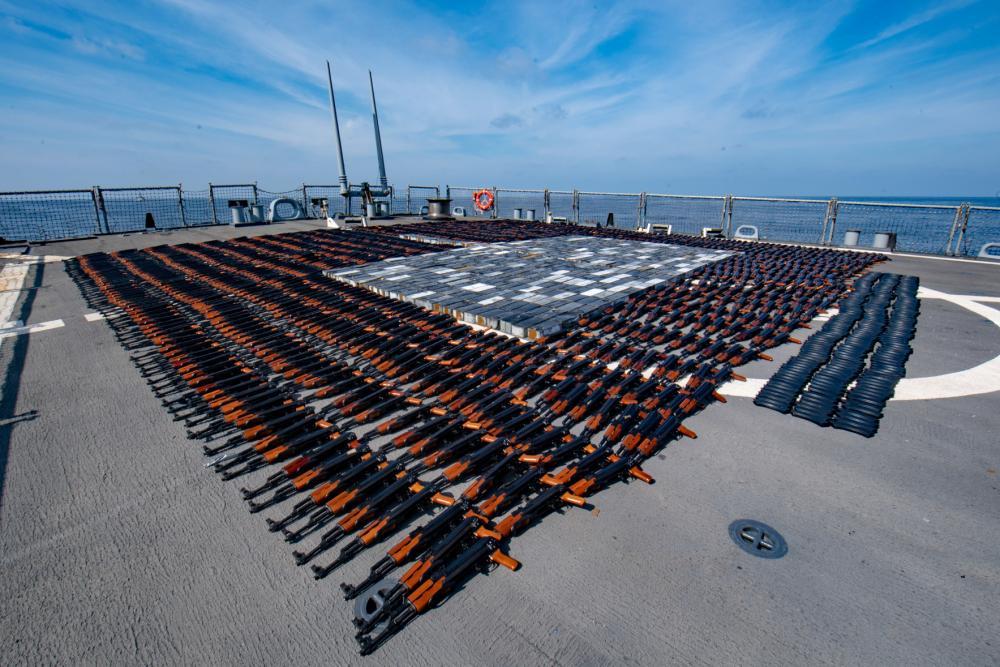
She added: “Just last month, the US Navy seized upwards of 1,400 assault rifles (and) 226,000 rounds of ammunition from a vessel originating from Iran.
“This ship was on a route historically used to illegally smuggle weapons to the Houthis. The smuggling of arms from Iran to the Houthis represents a flagrant violation of the UN’s targeted arms embargo and is yet another example of how Iran’s destabilizing activity is prolonging the war in Yemen.”
Her comments came as council members condemned the continued Houthi aggression, the resultant deaths and displacements, the militia’s attacks on targets in Saudi Arabia, and its ongoing “acts of piracy” that endanger maritime security.
In his briefing to the council on the latest developments in the conflict Hans Grundberg, the UN’s special envoy for Yemen, reiterated that no long-term solution is “to be found on the battlefield,” and that the “warring parties can, should and, indeed, must talk even if they are not ready to put down their arms.”
He described the recent military escalations as being “among the worst we have seen in Yemen for years, and which are taking an increasing toll on civilian lives.”
He said the Houthis remain determined to continue their assault on Marib and that attacks on Saudi Arabia have also increased. He called on all parties involved in the conflict to “respect and uphold their obligations under international humanitarian law, which include protecting civilians and preserving the civilian character of public infrastructure.”
As he lamented what appears to be a new cycle of escalation of violence, “with predictable, devastating implications for civilians and for the immediate prospects of peace,” Grundberg also expressed concern “that battles could intensify along other fronts.”
In particular he highlighted the recent seizure by the Houthis of a UAE-registered cargo ship, and the continued detention of UN staff members in Sanaa and Marib, and called on the Houthis to grant the UN immediate access to its detained staff.
The increase in the tempo of the war has also tightened already severe restrictions on the movement of people and goods within the country, Grundberg said. The use of Hodeidah port for military purposes is “worrying,” he added, given that it is a lifeline for many Yemenis.
Despite these challenging developments on the ground, the envoy said that peace efforts continue and spoke of plans to enhance his consultations with all parties.
“Yemen’s war, like many, is littered with missed opportunities driven in part by combatants oscillating between feeling too weak to accept or too strong to settle for compromise.
“Genuine political will, responsible leadership and adherence to the interests of the entire population is needed to sustainably put Yemen on a different trajectory.”
Ramesh Rajasingham, the UN’s deputy emergency relief coordinator, told the Security Council that 15,000 people were displaced in the past month during fierce clashes in Al-Jawf, Marib and Shabwah. He said that 358 civilians were killed or injured, “a figure that is tied for the highest in three years.”
He reiterated the importance of “safe, predictable passage into and out of Yemen,” and pointed to the suspension by the Houthis in December of humanitarian flights through Sanaa airport as the kind of disruption that “risks undermining the aid operation and staff safety.” He called on the Houthis to avoid unilateral flight cancellations.
Lana Nusseibeh, the permanent representative of the UAE to the UN, said progress in Yemen will not be possible until the Houthis cease hostilities and end their repeated violations carried out against the Yemeni people.
“The Houthis must understand that the only solution is a political (one), free of any hegemonic aspirations,” she said as she condemned the group’s drone and ballistic missile attacks against targets in Saudi Arabia as a “flagrant violation of international law.”
In addition to condemning Iran for supplying weapons to the Houthis, Thomas-Greenfield, the US ambassador, told her fellow council members: “The Houthis’ pattern is punctuated by their continued engagement in violence, rape and other forms of sexual violence, arbitrary detentions (and) targeted killings, including female politicians and professionals. This is unconscionable.
“We unequivocally condemn all human rights abuses and violations, by all parties. We remain strongly committed to promoting accountability for human rights violations and abuses in Yemen.”
She added that despite repeated condemnation by the Security Council the Houthis continue to occupy the shuttered US embassy compound, and to detain and harass the Yemeni staff who work there.
“The Houthis must immediately release, unharmed, all of our Yemeni employees, vacate the former US embassy compound, return seized US property and cease their threats against our employees and their families,” Thomas-Greenfield said.
She also condemned the seizure by the Houthis of the civilian Emirati ship Rwabee and called for the immediate release of the ship and its crew.
UN envoy to Yemen: Militarization of Hodeidah ports worrying KSrelief chief: Saudi Arabia ranks third globally in providing humanitarian assistance around the world
US asks Israel for clarification over death of citizen in West Bank
Wed, 2022-01-12 23:09
LONDON: The US State Department confirmed on Wednesday that an 80-year-old Palestinian-American man found dead in the West Bank was a US citizen.
Omar Abdalmajeed As’ad was found earlier on Wednesday after being detained and handcuffed during an Israeli raid on an occupied West Bank village, Palestinian officials and relatives said.
The State Department said had been in touch with the Israeli government for clarification over the death.
His body was found in Jiljilya in the early morning with a plastic zip-tie still around one wrist.
The Israeli military said it had carried out an overnight operation in the village, and that a Palestinian was “apprehended after resisting a check.” It said he was alive when the soldiers released him.
“The Military Police Criminal Investigation Division is reviewing the incident, at the end of which the findings will be transferred to the Military General Advocate Corps,” it said in a statement.
As’ad was a former Milwaukee, Wisconsin, resident who lived in the United States for decades and returned to the West Bank 10 years ago, his brother told Reuters.
State Department spokesperson Ned Price told reporters: “We support a thorough investigation into the circumstances.” He said the State Department had expressed its condolences to the family and offered to provide consular assistance.