Turkey lifts PCR requirement for unvaccinated in some areas
Author:
Sun, 2022-01-16 02:06
ISTANBUL: Turkey will no longer require unvaccinated individuals to take a PCR test for COVID-19 before using planes, buses or other transportation, or before attending events such as concerts, plays or movies, the state-owned Anadolu Agency said on Saturday.
Citing the Interior Ministry, Anadolu said unvaccinated civil servants, private sector employees and school personnel will also not be required to take a PCR test.
Turkish Airlines CEO Bilal Eksi said separately on Twitter that the carrier will not require PCR tests on domestic flights.
Meanwhile, scientists have warned that omicron’s whirlwind advance practically ensures it won’t be the last version of the coronavirus to worry the world.
Every infection provides a chance for the virus to mutate, and omicron has an edge over its predecessors: It spreads way faster despite emerging on a planet with a stronger patchwork of immunity from vaccines and prior illness.
That means more people in whom the virus can further evolve. Experts don’t know what the next variants will look like or how they might shape the pandemic, but they say there’s no guarantee the sequels of omicron will cause milder illness or that existing vaccines will work against them. It’s why they urge wider vaccination now, while today’s shots still work. “The faster omicron spreads, the more opportunities there are for mutation, potentially leading to more variants,” Leonardo Martinez, an infectious disease epidemiologist at Boston University, said. Since it emerged in mid-November, omicron has raced across the globe like fire through dry grass.
Research shows the variant is at least twice as contagious as delta and at least four times as contagious as the original version of the virus.
Omicron is more likely than delta to reinfect individuals who previously had COVID-19 and to cause “breakthrough infections” in vaccinated people while also attacking the unvaccinated.
The WHO reported a record 15 million new COVID-19 cases for the week of Jan. 3-9, a 55 percent increase from the previous week.
Along with keeping comparatively healthy people out of work and school, the ease with which the variant spreads increases the odds the virus will infect and linger inside people with weakened immune systems — giving it more time to develop potent mutations.
“It’s the longer, persistent infections that seem to be the most likely breeding grounds for new variants,” said Dr. Stuart Campbell Ray, an infectious disease expert at Johns Hopkins University.
BEIRUT: A Lebanese Shiite scholar has denounced Hezbollah, as well as its leader Hassan Nasrallah and his deputy Sheikh Naim Qassem, in a sermon published on his Facebook page and shared across social media.
Sheikh Abdul Salam Dandach, from the Baalbek–Hermel region, said in the video: “Our resistance is different from theirs (Hezbollah’s). We are not the rulers of this land and we are not new parties that came to Lebanon. Our parents and ancestors are deeply rooted in this land.”
The party is referred to as the “resistance” in Lebanon.
He addressed Nasrallah, saying: “You resist using deception and encroachment. You live off your resistance, based on the bliss of the US dollar, whereas our resistance comes from hunger and poverty. You resist through surfeit and ingratitude. We resist your lies. We resist the illness and ignorance that you caused in the region. We resist the destruction and havoc that you created.”
FASTFACT
The Shiites in Baalbek–Hermel constitute 60 percent of the population.
Since the beginning of the economic and social crisis that has hit Lebanon, many in the Shiite community of Baalbek–Hermel have complained about the rampant insecurity that the region is witnessing due to the emergence of a de facto power that controls people’s lives with its weapons and allows the formation of gangs involved in smuggling, kidnapping and extortion.
An activist from the region, who did not reveal his identity, told Arab News: “Baalbek–Hermel doesn’t have any patron. The government has been neglecting it for years and Hezbollah tries to avoid it, turning its back on the complicated social and economic crises.”
The Shiites in Baalbek–Hermel constitute 60 percent of the population, whereas the Sunnis and Christians represent 20 percent apiece.
Fewer than 30 percent of the Shiites belong to political parties, mostly the Amal Movement and Hezbollah, whereas the rest belong to a clan.
On Oct. 17, 2019, massive protests swept across Lebanon in an unprecedented movement against government failures, poor living standards, rampant corruption, the lack of basic services, overwhelming sectarian rule, and the imploding economy.
One of the Oct. 17 activists said: “Sheikh Dandach is not the first opposition voice to rise in the region against Hezbollah. People were previously silent because the economic situation was acceptable. But when everything collapsed, there were no more reservations, the pain became bigger and the voice louder.
“The dominant mindset in the region is a clan mindset ruled by the logic of dignity that refuses to be dictated as to what to do and what not to do.”
The activist said the people of Baalbek–Hermel drew comparisons between the situation in their neglected areas and in the prosperous areas of southern Lebanon.
“They feel that the south is receiving greater attention from Hezbollah and enjoys many benefits and economic projects that aren’t provided to the Baalbek–Hermel region. They refer to Hezbollah’s chief Hassan Nasrallah and Parliament Speaker Nabih Berri as the ‘Southern Duo.’”
According to a political activist in the region, Dandach derived his power from his family in Hermel, the biggest city in the Baalbek–Hermel governorate. “This family is linked to those involved in murders and smuggling. So, Hezbollah may not pay attention to what Dandach says.”
But this did not mean that Dandach’s words would not harm Hezbollah and allow other voices to be raised, including those of opponents active in the revolution, he added, demanding that all those in power, including Hezbollah, changed their primary decision-making partners in the country.
“Dandach’s words reflect a situation of great malaise within the Shiite community in the region, which may be reflected in the upcoming parliamentary elections, but the problem lies in the counter-fight against Hezbollah, which may be in the interest of the party itself.
“Terming Hezbollah as an Iranian occupation force is an uncomfortable expression in the region and may cause people to gravitate back toward Hezbollah.”
Hezbollah, Amal end boycott of Lebanon’s cabinet amid economic crisisConcern as mental health patients in Lebanon struggle to obtain medications
Northeast Syria’s experience signifies challenge of ending use of children in conflicts
Sat, 2022-01-15 22:13
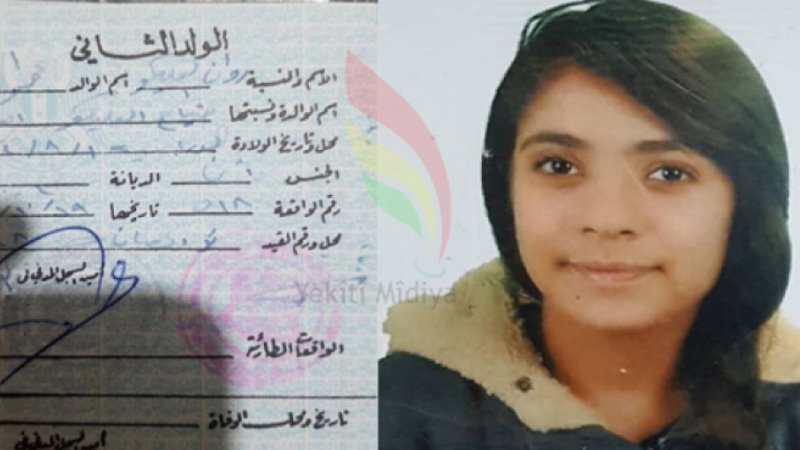
DUBAI: Rawan Al-Aleku was visiting a friend in Debrassiye, northeast Syria, in the summer of 2020 when she was conscripted by the Syrian Democratic Forces, an alliance of Kurdish and Arab militias raised in 2014 to fight Daesh. She was just 16 years old.
Narrating Al-Aleku’s story, her Iraqi Kurdistan-based relative Farhad Osso, a human rights activist, told Arab News that the schoolgirl had effectively been kidnapped after her friend’s mother took her to the local Kurdish security office.
Al-Aleku found herself whisked away to a boot camp for young conscripts, where she underwent months of grueling military drills and political indoctrination. All the while, according to Osso, she had no contact with her family.
Rawan Al-Aleku, who was returned to her family one year after her recruitment at age 16. (Supplied)
As the weeks turned into months, Al-Aleku’s father Omran made increasingly angry demands for her release, eventually resulting in his arrest.
When he was released, he published an open letter on Facebook demanding his daughter’s freedom.
“My case is that of kidnapping, the kidnap of a child from her home, her school and her friends and her childhood,” Omran wrote, appealing directly to the SDF’s Commander-in-Chief Mazloum Abdi, who had one year earlier pledged to end the practice of child recruitment.
“These traitors kidnapped my daughter. I have been told you are following through with your pledge, so why is it you apply the rules only where you deem fit? You stole my past, present and future.”
Al-Aleku’s story is not an isolated one in northeast Syria. When Daesh began seizing territory in the summer of 2014, the SDF raised a multi-ethnic alliance that teamed up with the US-led coalition to retake territory from the extremists. In the process, scores of under-aged fighters were swept into its ranks.
Before the Syrian uprising of 2011, Kurdish language and culture were suppressed by the regime of President Bashar Assad.
But when regime troops were withdrawn from Syria’s multi-ethnic north to quell the uprising elsewhere, the Kurds began to manage their own affairs.
It was in 2014, with the emergence of Daesh, that the Kurds mobilized to defend their newfound freedoms.
Syria’s Kurds won global praise for their sacrifices, which resulted in the final territorial defeat of Daesh in the town of Baghuz in March 2019.
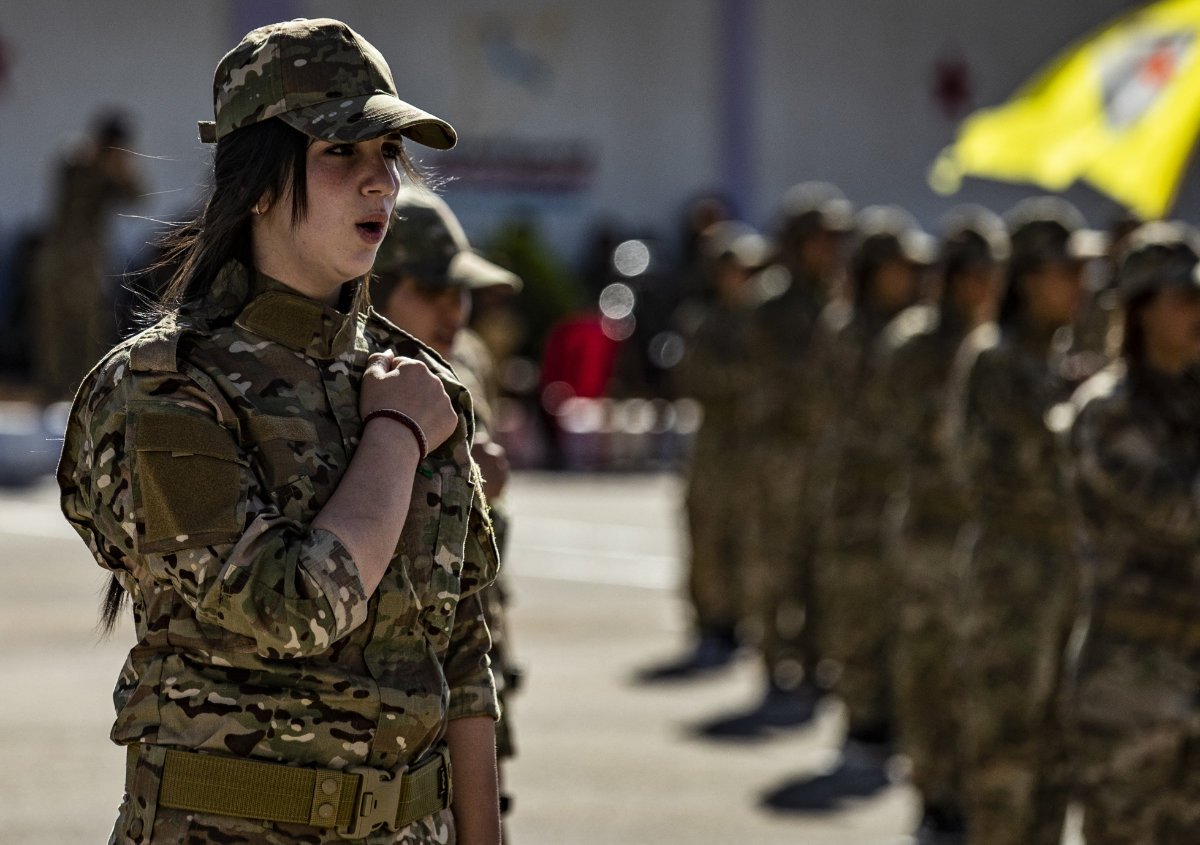
The women in the SDF’s ranks were a particular source of inspiration, later depicted as fearsome heroines in movies and even video games.
The women in the SDF’s ranks were a particular source of inspiration. (AFP file photo)
Rojava, the Kurdish-led autonomous region of northeast Syria, quickly became an epicenter for the broader Kurdish cause, wrapped in the revolutionary socialist zeal of the Kurdistan Workers’ Party, or PKK, of neighboring Turkey.
Once the Daesh threat had receded in Syria, many living in Rojava began to express reservations about the political aims of the main force within the SDF: The People’s Protection Units, or YPG.
The YPG is the militia of the Democratic Union Party, or PYD, a Syrian-Kurdish nationalist group linked to the PKK, which has waged a decades-old guerrilla war against the Turkish state in pursuit of greater political and cultural rights for Kurds in the country’s southeast.
According to a report by the Atlantic Council, to support the PYD’s political and military efforts in Syria, Kurds from Turkey, Iran and Iraq have traveled to Syria to join with the YPG.
FASTFACTS
The recruitment and use of children by armed forces or groups is a grave violation of child rights and international humanitarian law.
Sources told Arab News that while some Syrian Kurds were drawn to the PKK’s ideals, others viewed them as foreign and subversive.
As the SDF’s demand for troops increased to fend off militant attacks and later Turkish cross-border incursions — first in Afrin in 2018, then in northeast Syria in 2019 — SDF conscription quotas began to taken in more and more under-aged fighters, according to the sources.
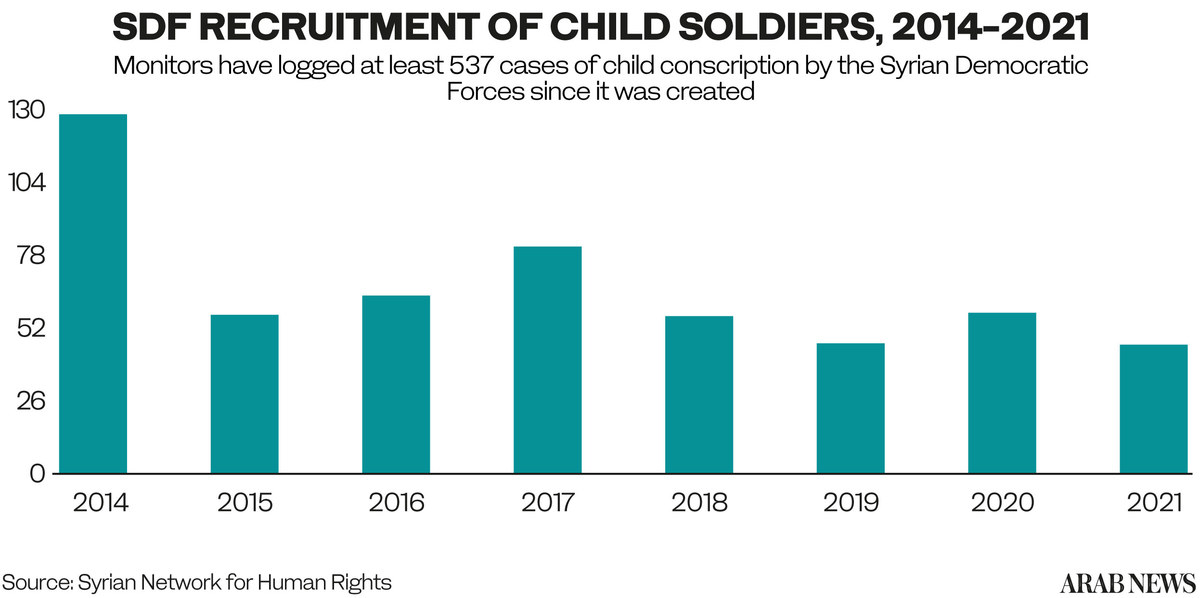
Osso says he and fellow human rights activists have documented more than 80 similar cases of minors being forcibly conscripted by the SDF.
Among the female fighters in the SDF, human rights activists have found cases of teenage girls being forcibly conscripted. (AFP)
Among them was a 15-year-old girl who disappeared in December 2021 in the border town of Kobane.
“Her parents received confirmation she was there, but the Revolutionary Youth Movement refuses to give her back,” Osso said, referring to the PKK-affiliated group that conscripted her.
“Generally, all kids who were kidnapped in northern Syria received military and combat training and, most importantly and most dangerously, the kids are subjected to an intense brainwashing, to an extent where they’re told to forget their parents and where they came from,” he added.
“PKK ideals are all that matters. Parents aren’t allowed to have any contact with their children during the time of training.”
As the SDF’s power and influence grew over the course of the war against Daesh, analysts say, so too did the influence of the PKK, which had established a presence in Syria’s northeast at around the same time.
Syrian Kurdish troops march in a procession ahead of the body of their fallen comrade Khalid Hajji in Syria’s northeastern city of Qamishli on April 22, 2021. (AFP)
Thousands of its fighters moved in from the Qandil Mountains of Iraq’s northern Kurdistan region to take advantage of the strategic opportunities opening up on the southern flank of their mortal foe Turkey.
The comrades from the mountains were often received with open arms, with local groups deferring to their discipline and battlefield experience.
Posters plastered throughout Rojava towns depicting the “martyrs” of recent battles were always topped with the PKK’s fallen, while the SDF’s and YPG’s dead appeared below. Many of the casualties were not old enough to be carrying weapons.
The recruitment and use of children by armed groups is considered a grave violation of child rights and international humanitarian law.
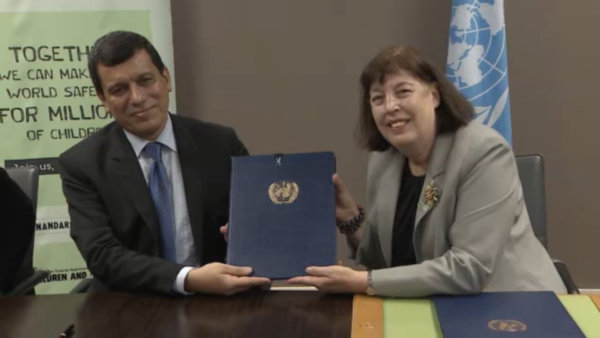
In 2019, having faced criticism for the continued recruitment of children by SDF factions, Abdi — himself a Syrian-Kurdish veteran of the PKK — signed a UN-supervised pledge on behalf of the Rojava administration to end the practice.
Mazloum signed a pledge against child recruitment in 2019. (Supplied)
To enforce this commitment, the SDF established the Office of Child Protection from Armed Conflict, which has been credited with demobilizing and returning more than 200 children to their families.
But in November 2021, dozens of Kurdish families gathered outside the UN compound in the city of Qamishli, northern Syria, accusing the SDF of breaking its pledge.
Responding to the allegations, Farhad Shami, head of the SDF’s media center, said reports of ongoing child recruitment are inaccurate and exaggerated.
“There are no conscripted individuals under the age of 18 years old in the SDF,” he told Arab News. “Conscription abides by the written laws and rules, which clearly state no minors are allowed to join.”
Shami concedes that the Revolutionary Youth Movement, an unarmed faction, does recruit minors, but only with parental consent.
Among the female fighters in the SDF, human rights activists have found cases of teenage girls being forcibly conscripted. (AFP)
“We, in the SDF, confirm the implementation of all the conditions in the event that anyone wishes to join our forces, the most important of which is the appropriate age requirement,” he said.
However, Bassam Alahmad, co-founder and executive director of Syrians for Truth and Justice, told Arab News that “all armed forces from all factions in Syria are guilty” of recruiting child soldiers.
“The only difference is that the SDF signed a pledge with the UN in 2019 to stop the practice, unlike the Syrian regime forces and the rebels,” he said.
“While children were returned to their parents after that, this phenomenon is far from over. There should be zero cases of child recruitment.”
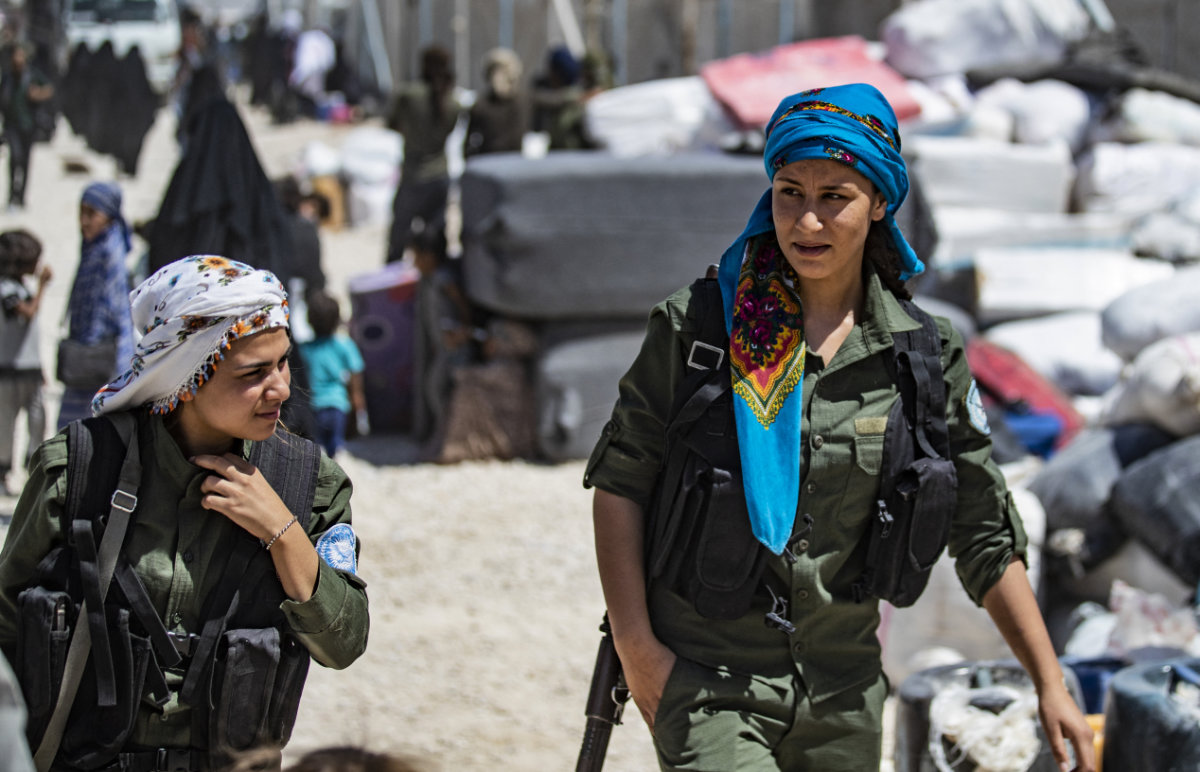
SDF fighters stand guard as displaced people prepare to board a bus on their way home at the Al-Hol camp in northeastern Syria’s Al-Hasakeh governorate on June 3, 2019. (AFP file)
A report prepared by Syrians for Truth and Justice cites at least 17 cases of boys and girls being recruited during the last three months of 2021, only one of whom has been returned home. The fate of the others remains unknown.
A report by the Syrian Network for Human Rights said at least 156 fighters conscripted as children remain in SDF ranks, and 19 were conscripted in November 2021 alone.
Wherever children have served in combat zones, the lasting damage to cognitive development and emotional wellbeing is well documented.
The lasting damage to cognitive development and emotional wellbeing of children who have served in combat zones is well documented. (AFP file photo)
“This is a heavy subject to tackle,” said Alahmad. “Unfortunately, the kids who spent months in training camps are in dire need of psychological support — a service rarely provided at the moment.”
When Al-Aleku was finally returned to her family one year later, her character had changed dramatically, remolded to fit the intense demands of soldiering and the duties of a loyal revolutionary.
“She was brainwashed with the communist ideals of the PKK and she was trained in weaponry,” Osso said. “Her parents were distraught.”
Yemen calls for international pressure against Houthi recruitment of child soldiersWest Africa has highest numbers of child soldiers, says UN
Hezbollah, Amal end boycott of Lebanon’s cabinet amid economic crisis
Author:
Reuters
ID:
1642271736499098000
Sat, 2022-01-15 21:39
BEIRUT: Powerful Lebanese groups Hezbollah and Amal said on Saturday they would end a boycott of cabinet sessions, opening the way for ministers to meet after a three-month gap that has seen the economic crisis deepen and currency collapse further.
The groups, which back several ministers in a government made up of members from across the political and sectarian spectrum, said the decision was driven by a desire to approve the 2022 budget and to discuss an economic recovery.
The groups had been refusing to attend cabinet sessions in a dispute over the handling of an investigation into the huge Beirut port blast in 2020.
The failure to hold cabinet meetings has delayed talks on a recovery plan with the International Monetary Fund, seen as vital to unlocking international support to lift the country out of a crisis that has driven swathes of the nation into poverty.
Hezbollah, an Iran-backed group that has a well-armed militia, and Amal, another Muslim Shiite group, have sought the removal of a judge who has been overseeing the blast probe.
They have accused Judge Tarek Bitar of bias after he sought to question two senior Amal figures charged over the blast.
Bitar, who does not make public statements, has been quoted by the families of blast victims as saying he would press on with his investigation that has repeatedly been stalled by a slew of lawsuits filed by powerful suspects in the case.
Prime Minister Najib Mikati, whose post is held by a Sunni Muslim under Lebanon’s sectarian political system, said in a statement he welcomed the decision to end the boycott and would call for a cabinet meeting as soon as he received a draft 2022 budget from the Finance Ministry.
A government source told Reuters there was not expected to be cabinet session in the coming week as budget preparations were still under way and figures for a financial recovery plan were being drawn up.
Mikati has said his government was seeking to sign a preliminary agreement for an IMF support program in February.
An IMF spokesperson told Reuters that virtual talks would be held with Lebanese authorities in the last week of January.
US has told Lebanon not to fear sanction law over energy supply plans, says PM’s officeFounder of Lebanon’s canoe-kayaking federation found dead after suspected burglary
Negotiators head home as Iran talks hit critical stage
Sat, 2022-01-15 19:14
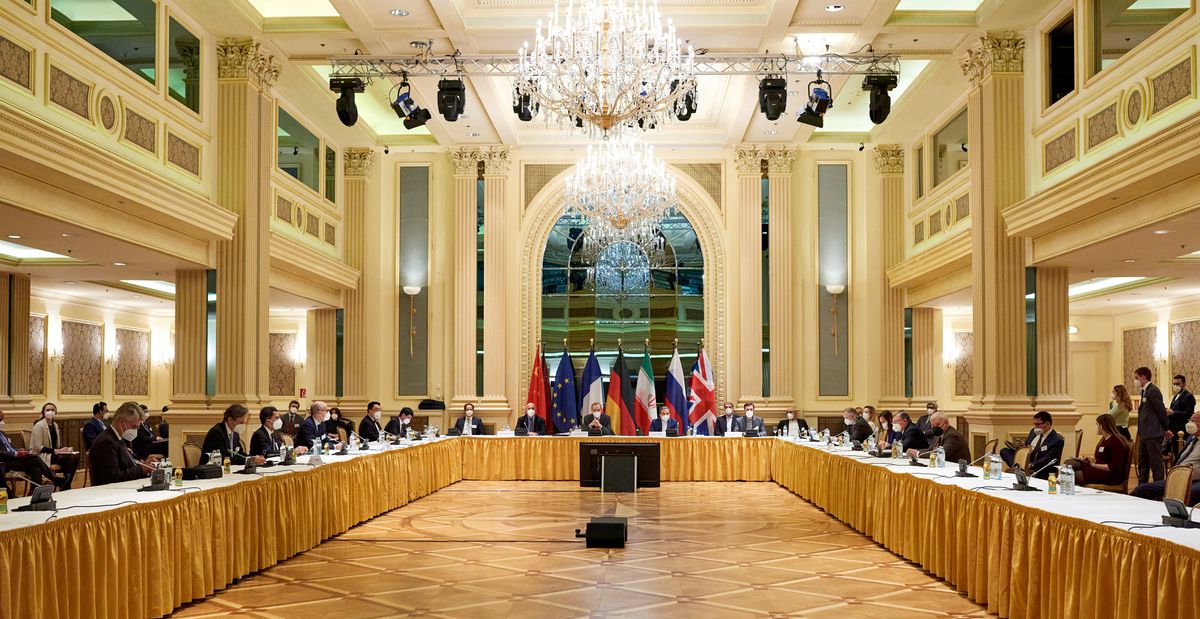
VIENNA: Chief negotiators from Iran and Europe returned home for consultations as talks to revive the 2015 nuclear deal reached a critical stage, state media in the Islamic republic said Saturday.
“The negotiators will return to Vienna in two days” but expert-level discussions at the eighth round of talks would continue on Saturday and Sunday, IRNA news agency said.
The talks between Tehran and world powers resumed in late November after they were suspended for around five months as Iran elected a new, ultraconservative government.
Iran agreed the nuclear deal, formally known as the Joint Comprehensive Plan of Action (JCPOA), with Britain, China, France, Germany, Russia and the United States.
It offered the Islamic republic sanctions relief in exchange for curbs on its nuclear program.
But former US president Donald Trump unilaterally withdrew from the agreement in 2018 and imposed crippling sanctions, prompting Iran to begin rolling back its commitments.
“We are now at a stage of the negotiations where we are discussing difficult issues and how we can translate the subjects that we agreed upon in principle into words and enter them into a document,” IRNA quoted an anonymous source as saying.
“We are discussing the details,” the source said, adding that “this is one of the most tedious, long and difficult parts of the negotiations, but is absolutely essential for achieving our goal.”
The main aims of the negotiations are to get the US to return to the deal and lift sanctions, and for Iran to resume full compliance with the accord.
Tehran is seeking verification of the sanctions easing, as well as guarantees that Washington will not withdraw from the deal again.
“Regarding the three subjects (lifting of sanctions, nuclear commitments and implementation, sequencing and verification), there are still open issues and some of them are tough,” the source said.
The return of the negotiators to their capitals came as EU foreign policy chief Josep Borrell said on Friday that a deal with Iran remained “possible,” and that the talks were advancing in a “better atmosphere” than before Christmas.
Iran’s foreign ministry spokesman Saeed Khatibzadeh on Monday said the efforts by “all parties” to revive the nuclear agreement had resulted in “good progress.”
French Foreign Minister Jean-Yves Le Drian recently noted progress in the talks, but said it was “too slow.”
US Secretary of State Antony Blinken said on Thursday that only “a few weeks” were left to save the 2015 deal, and that Washington would consider “other options” if the negotiations fail.