Iran regime condemns attack on Baghdad airport as ‘destabilizing’

Author: 
Sun, 2022-01-30 01:38

TRIPOLI: Iran’s Foreign Ministry on Saturday condemned a rocket attack against Baghdad airport that took place the previous day as an act that seeks to “destabilize” Iraq.
Six rockets were fired on Friday at the Iraqi capital’s airport, causing damage to one runway and two civilian planes but no casualties. It was the latest in a string of attacks that the US blames on Iran-linked armed groups. The attack was not immediately claimed.
Iran condemns “the targeting of Baghdad airport” in an attack that aims to “destabilize” Iraq, Foreign Ministry spokesman Saeed Khatibzadeh said in a statement.
“Such suspicious actions have created insecurity and unrest in Iraq, paving the way for the ill-wishers and the insurgents, and affecting the government’s services to the Iraqi citizens,” he added.
The rockets fell around civil installations at the airport, damaging an out-of-service Boeing 767 belonging to state-owned Iraqi Airways.
The attack prompted Kuwait Airways to suspend its flights to Iraq, the airline said on Twitter.
Recent months have seen rocket and drone attacks target the US Embassy in Baghdad’s high-security Green Zone, a US diplomatic facility at the airport and troops belonging to a US-led coalition stationed at Iraqi bases.
Such attacks mounted after the US assassinated the commander of the Quds Force of the Iranian Revolutionary Guards, Maj. Gen. Qassem Soleimani, and his Iraqi lieutenant Abu Mahdi Al-Muhandis, in a January 2020 drone strike near Baghdad airport.
The attacks are rarely claimed but they are routinely pinned on pro-Iran factions, who demand that US troops deployed to help Iraqi forces fight Daesh leave the country.
The US-led coalition ended its combat mission in Iraq in December, but has kept roughly 3,500 of its soldiers in the country to offer training, advice and assistance to national forces. Recent attacks in Iraq have also come amid a tense domestic political situation there.
Violence has lately targeted Iraqi politicians and parties, mainly consisting of grenade attacks, but also extending to one rocket assault near the home of a key politician, amid tensions surrounding the formation of a new government.
“The Islamic republic of Iran has always supported the establishment and maintenance of security in Iraq … and supports the actions of the Iraqi government in ensuring stability,” Khatibzadeh added.

Members of Iraqi security forces gather on the Iraqi side of Iraq-Syria border, January 27, 2022. (REUTERS)
Main category: 
Tags: 

Iraqi ‘super app’ Baly raises $10.5m in funding round


Erdogan threatens media with reprisals over ‘harmful’ content

Sun, 2022-01-30 01:31

ANKARA: President Recep Tayyip Erdogan on Saturday threatened Turkish media with reprisals if they disseminated content that damaged the country’s core values, in a move that might be a prelude to further censorship in the sector.

In a notice published in the Official Gazette, he said measures were needed to protect Turkey’s “national culture” and prevent its children’s development “from being adversely affected as a result of exposure to harmful content on all written, verbal and visual media.”
Erdogan did not specify what such content was, but said legal action would be taken against “overt or covert activities through the media aimed at undermining our national and moral values ​​and disrupting our family and social structure.”
Erdogan has been in power for nearly 20 years and has often criticized media content that is out of step with the Islamic values espoused by his AK Party.
Turkey has in recent years also moved to increase media oversight, with around 90 percent of major media now owned by the state or close to the government.

BACKGROUND

Erdogan has been in power for nearly 20 years and has often criticized media content that is out of step with the values espoused by his AK Party.

Its Western allies and critics have said Erdogan has been using a 2016 failed coup attempt to muzzle dissent and erode social rights and tolerance.
The government has denied this, saying the measures are necessary due to the gravity of the threats Turkey faces and that freedom of religious expression has been restored in a once strongly secular republic.
The RTUK radio and television watchdog has sweeping oversight over all online content, which it also has the power to remove.
It has fined TV stations over footage it says violates Turkish values, such as music videos it has labeled “erotic” or content it deems to have insulted the president.
Tens of thousands have been prosecuted under the latter law including Sedef Kabas, a well-known journalist jailed last week pending trial after posting a proverb about Erdogan’s palace on her Twitter account and repeating it on  an opposition television channel.
In another development, Erdogan has sacked the head of the state statistics agency, according to a decree published on Saturday, after releasing data showing last year’s inflation rate hit a 19-year high of 36.1 percent.
Sait Erdal Dincer was just the latest in a series of economic dismissals by Erdogan, who has sacked three central bank governors since July 2019.
Erdogan has railed against high interest rates, which he believes cause inflation — the exact opposition of conventional economic thinking. The 2021 inflation figure released by Dincer angered both the pro-government and opposition camps.
The opposition said it was underreported, claiming that the real cost of living increases was at least twice as high.
Erdogan meanwhile reportedly criticized the statistics agency in private for publishing data that he felt overstated the scale of Turkey’s economic malaise. Dincer seemed to sense his impending fate.
“I sit in this office now, tomorrow it will be someone else,” he said in an interview with the business newspaper Dunya earlier this month.
“Never mind who is the chairman. Can you imagine that hundreds of my colleagues could stomach or remain quiet about publishing an inflation rate very different from what they had established?”
“I have a responsibility to 84 million people,” he added.
Erdogan did not explain his decision to appoint Erhan Cetinkaya, who had served as vice-chair of Turkey’s banking regulator, as the new state statistics chief.
“This will just increase concern about the reliability of the data, in addition to major concerns about economic policy settings,” Timothy Ash of BlueBay Asset Management said in a note to clients.
The agency is due to publish January’s inflation data on Feb. 3. In December, opposition leader Kemal Kilicdaroglu was refused an appointment with Dincer and turned away by security guards when he sought to enter the statistic agency’s headquarters in Ankara.
He had accused the agency of “fabricating” the numbers to hide the true impact of the government’s policies and slammed it as “no longer a state institution but a palace institution,” in reference to Erdogan’s presidential complex.
Also on Saturday, Erdogan appointed a new justice minister, naming former Deputy Prime Minister Bekir Bozdag to replace veteran ruling party member Abdulhamit Gul.
“I have resigned from my duties at the Ministry of Justice, which I have been serving since July 19, 2017,” Gul wrote on Twitter.
“I would like to express my gratitude … for accepting my request,” he added, without explaining his decision.
Ali Babacan, former deputy prime minister who left the ruling AKP party and founded the Deva Party, took to Twitter to vent fury over the changes.
“The justice minister is being replaced, (statistics agency) TUIK chairman is being dismissed before the inflation data is published. Nobody knows why,” he said.

Turkey's President Recep Tayyip Erdogan speaks during a media conference at the G20 summit in Rome, Oct. 31, 2021. (AP)
Main category: 
Tags: 

Presidential visit to Ankara could start ‘new period’ in Israel-Turkey relations: ErdoganTurkish court orders imprisonment of journalist Sadaf Kabas for ‘insulting’ Erdogan


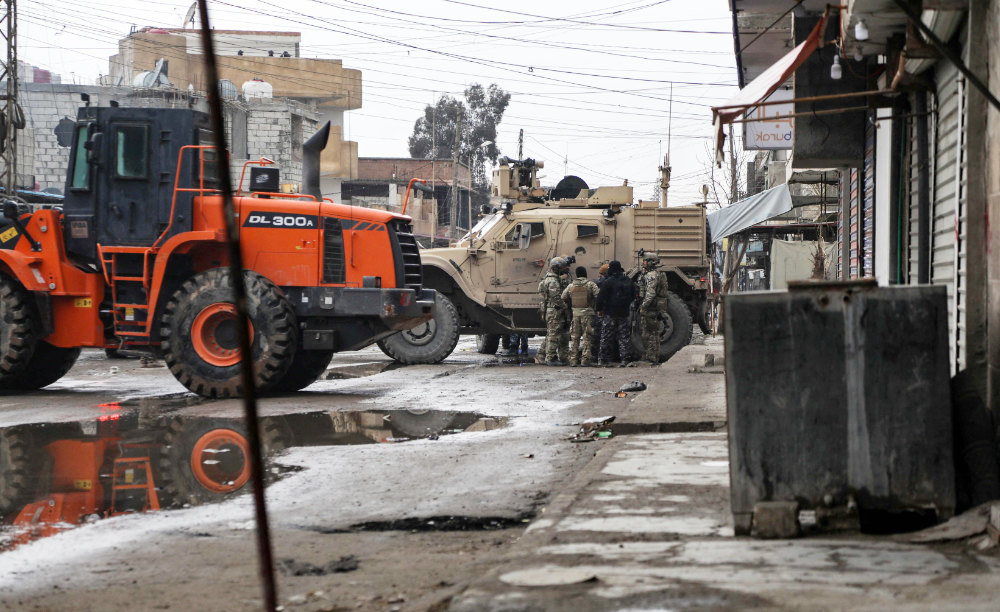
Clashes near Syria prison attacked by Daesh

Author: 
Sun, 2022-01-30 01:11

HASSAKAH: Clashes broke out Saturday between Kurdish forces and Daesh group fighters near a Syrian prison where dozens of jihadists are still holed up, a war monitor said.
A Daesh assault on the sprawling Ghwayran Prison complex near the northeastern Syrian city of Hassakah on Jan. 20 sparked days of heavy fighting that has left some 260 people dead.
The US-backed Syrian Democratic Forces announced they had recaptured the prison on Wednesday, but that mop-up operations continued.
On Saturday, there were “clashes in the vicinity of the prison between the Syrian Democratic Forces and Kurdish security forces on the one hand, and members of IS (Daesh) who are hiding in the area,” the Syrian Observatory for Human Rights said.
The war monitor, which relies on a network of sources inside Syria, said that four Daesh fighters are holding a local official and three civilians hostage in a residential building near the prison.
The SDF said on Wednesday some 3,500 Daesh members had surrendered, but that holdout Daesh fighters had barricaded themselves inside the prison facility. The Daesh gunmen are in “cellars that are difficult to target with airstrikes or infiltrate” the observatory said.
SDF officials estimate that between 60 and 90 Daesh fighters were still in the basement and the ground floor above it.
An AFP correspondent reported that US troops and Kurdish-led forces have surrounded the building and deployed snipers on nearby rooftops, reporting there was intermittent shooting.
Kurdish forces have repeatedly called for Daesh gunmen to surrender. “Our forces have not used force with them so far,” Farhad Shami, who heads the SDF’s media office, said on Saturday.
Kurdish-led forces have banned journalists from accessing the Ghwayran neighborhood or approaching the prison since the start of the attack.
The fighting has killed more than 260 people, including around 180 jihadists, 73 Kurdish-led fighters and seven civilians, the observatory said, adding that the death toll is likely to increase.

US soldiers accompanied by members of the Syrian Democratic Forces (SDF) gather in the neighbourhood of Ghwayran in the northeastern Syrian city of Hasakeh, on January 29, 2022. (AFP)
Main category: 
Tags: 

Syrian fighters search for Daesh sleeper cells near prisonJordan troops kill 27 drug smugglers in Syrian border shootout


Loyalists drive Houthis from swaths of Yemen

Author: 
Sun, 2022-01-30 00:38

AL-MUKALLA: Loyalist fighters from the Giants Brigades drove the Houthis out of swaths of central Yemen on Saturday as the Iran-backed militia suffered more military defeats.

“The national army and the Giants Brigades are inflicting heavy blows on the Houthis,” army spokesman Gen. Abdu Abdullah Majili told Arab News.

Government troops recaptured Najed and Al-Hajela in Juba district and made gains in Abedia district, both south of Marib, Majili said.

The Giants Brigades stormed Houthi locations on the Malla’a mountain range as they sought to join up with army troops outside the Houthi-controlled Um Resh military base in Juba. They also resumed their push inside the Houthi-controlled Al-Bayda province, retaking the Gharaba area in Natea district, east of Al-Bayda.

The Houthis have suffered a string of military defeats since the beginning of this year, when the Giants Brigades began an offensive that led to the recapture of the oil-rich province of Shabwa, and seized control of large amounts of lands from the Houthis in the bat- tleground Marib province.

Their successes have alleviated pressure on government troops who have been defending the central city of Marib since February last year.

Hundreds of Houthis have been killed in Marib, Shabwa and Al-Bayda since earlier this year when the Coalition to Restore Legitimacy in Yemen intensified airstrikes against the militia’s military targets.

The Giants Brigades have now redeployed some of their fighters, and thanked the coalition for military support to their forces since the first day of their offensive.

“The forces completed their mission in liberating the district of Shabwa and securing it, and pushed the Houthis out of the district of Harib, south of Marib,” a Giants Brigades official said.

“The force that was repositioned did not leave the front lines, but rather began putting up defensive measures to repel any military attacks by the Houthis.

“What is not yet liberated in Marib province is left up to the government, which has hundreds of thousands of soldiers, and it is their turn to kick the Houthis out of Marib.”

Yemen’s Defense Ministry said on Saturday that a coalition airstrike had killed nine Houthis and destroyed a cannon after targeting their location in Jabal Habashy district, west of Taiz.

Fighting between government troops and the Houthis has intensified in Jabal Habashy since last week, when government troops mounted a new offensive to liberate the district and break the Houthi siege on Taiz.

Earlier, five Giants Brigades fighters were killed and several more injured when a missile fired by the Houthis hit their location in Al-Safha in Shabwa’s Bayhan district.


Yemeni pro-government fighters man a position on the outskirts of al-Jawba in Marib on Jan. 27, 2022. (Photo by Saleh Al-Obeidi / AFP)
Main category: 

Coalition says target in Saada airstrike was a Houthi special security campCoalition: Nearly 200 Houthis killed in airstrikes on Marib, Al-Bayda, and Taiz


Aoun stresses Sunnis’ role in preserving Lebanon unity

Sat, 2022-01-29 22:07

BEIRUT: Lebanese President Michel Aoun made a surprise visit to Dar Al-Fatwa on Saturday, where he met with Lebanon’s Grand Mufti Sheikh Abdel Latif Derian, the highest authority in Sunni Islam in the country, amid fears of a Sunni boycott of Lebanon’s political process.

Aoun stressed the role “that the Sunni community plays in preserving Lebanon’s unity and political diversity, and the importance of participating alongside all other components in national and political life, as well as all elections that define the future of Lebanon and its people.

“Arrangements are underway so that the parliamentary elections are held as scheduled, and there is no reason to postpone them,” he added, stressing that “the Sunni community is an essential component, and we do not support its boycott of the elections.”

Aoun’s visit to Dar Al-Fatwa was described by political observers as “an attempt to remedy what can no longer be remedied; too little, too late.”

A source close to the former prime minister of Lebanon, Fouad Siniora, told Arab News: “The damage was done to the Sunni community when Aoun obstructed all attempts made by PM-designate Saad Hariri to form his government. Aoun went further by insulting Hariri, calling him a liar.

“Lebanon’s relationship with the Gulf states was also damaged as a result of the positions of Aoun and Hezbollah regarding the abuse committed against Saudi Arabia. It’s pointless to resort to Dar Al-Fatwa now.”

Prime Minister Najib Mikati announced on Friday that “there will be no Sunni boycott of the parliamentary elections in May. Our main concern is for the state and its institutions to remain active and effective, and for elections to be held on time.”

It comes days after Hariri, who leads the Future Movement that represents the majority of the Sunni community in Parliament, announced “the suspension of political work and the suspension of any direct role or responsibility in the ruling authority, Parliament and politics in its traditional sense.”

Mikati said: “It is true that Hariri announced his reluctance to run in the elections, but we will definitely not call for a Sunni boycott, and whoever wants to run should run. The sect holds great potential to participate in the elections.”

Hariri’s Future Movement has a major influence in 10 of the 15 electoral districts in Lebanon. He had attributed the suspension of political action to his conviction that “there is no room for any positive opportunity for Lebanon in light of Iranian influence, international uncertainty and national division.”

A source in Dar Al-Fatwa said: “Derian, along with prominent Sunni figures, decided to move toward unifying the ranks to absorb the turmoil before it was too late and to confront the Iranian control that Hezbollah relies upon on the national scene.”

The source close to Siniora noted: “The Sunni sect’s boycott of political action leads nowhere because Hezbollah can then take the decisions it wants without anyone objecting to it. It can also nominate whoever it wants for Sunni seats in the elections and ensure their victory to serve its interests.”

On Friday evening, three days after Hariri’s speech, his older brother Bahaa Hariri announced that he would “continue his father’s journey, the late Prime Minister Rafik Hariri.”

Bahaa, 55, who had kept away from politics after the assassination of his father in 2005, making room for his brother Saad, said: “First of all, it must be emphasized that neither our religion, nor our morals, nor our upbringing … allow us, the sons of martyr Prime Minister Rafik Hariri, to abandon our responsibility, and we put (forward) all our capabilities for the sake of Lebanon’s renaissance.”

He added: “The family of the martyr Rafik Hariri … will not disintegrate. In partnership and solidarity, we will fight the battle to restore the homeland and restore the sovereignty of the homeland from its occupiers.”

Bahaa stressed that any misinformation alluding to a power vacuum among Lebanon’s Sunni community serves only the enemies of the country, adding: “Who dares warn of a vacuum within the largest sect in Lebanon to which I have the honor to belong?”

Lebanese President Michel Aoun made a surprise visit to Dar Al-Fatwa on Saturday, where he met with Lebanon’s Grand Mufti Sheikh Abdel Latif Derian. (Reuters/File Photo)
Main category: 

Lebanon highlights drug seizures as PM ‘smooths rough edges’ of response to Kuwaiti initiativeLebanon’s Bahaa Rafik Al-Hariri says he will continue his father’s journey