Israeli treatment of Palestinians termed study in the mechanics of apartheid

Author: 
Christopher Hamill-Stewart
ID: 
1643751189728008600
Wed, 2022-02-02 00:32

LONDON: Israel’s treatment of the Palestinian people is a study in the mechanisms and policies by which apartheid systems operate and reproduce oppression, according to a new report by Amnesty International.
In its report, published on Tuesday, the human rights monitor says there is a growing body of evidence to suggest these legal, technical and militaristic mechanisms are crimes worthy of prosecution in the International Criminal Court.
An apartheid regime by definition systematically empowers, enrichens and emboldens one ethnic group to the direct detriment of another. In South Africa, from 1948 until the early 1990s, it was white people advancing at the cost of black people. In Israel and Palestine, according to Amnesty, it is Jewish Israelis benefitting from the systemic oppression of Arabs.
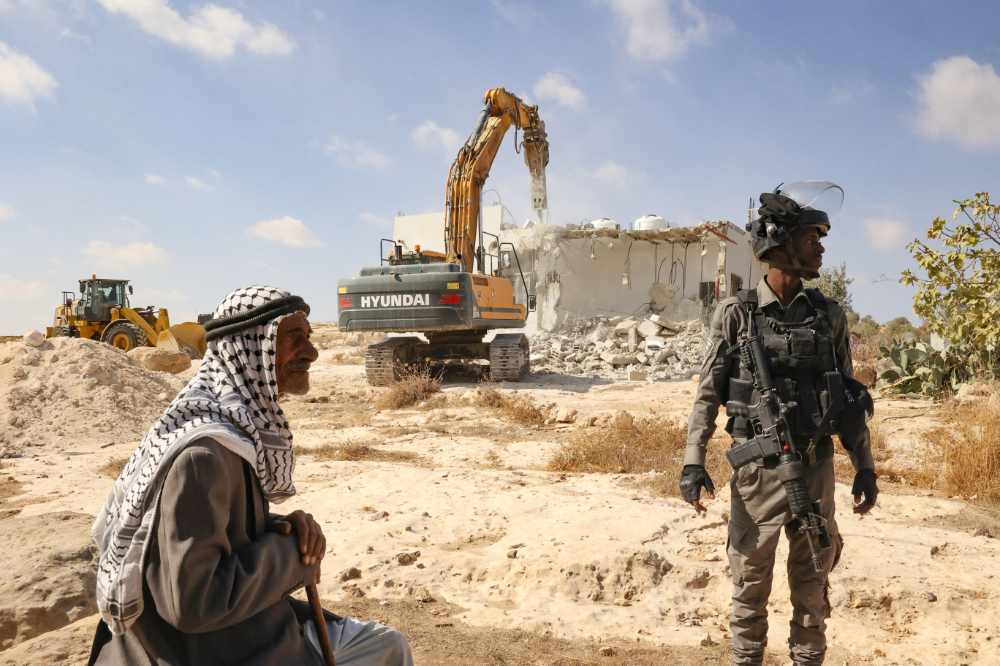

Amnesty’s 280-page report features a slew of allegations against Israel. (AFP)

Amnesty’s report found that “massive seizures of Palestinian land and property, unlawful killings, forcible transfer, drastic movement restrictions, and the denial of nationality and citizenship to Palestinians are all components of a system which amounts to apartheid under international law.”
As a legal term, the word apartheid is defined as “an institutionalized regime of oppression and domination by one racial group over another.” It was deemed a crime against humanity under the 1973 International Convention on the Suppression and Punishment of the Crime of Apartheid — the “Apartheid Convention” — and then later the 1998 Rome Statute of the International Criminal Court.
Despite Israel signing up to the 1998 Rome Statute — though never ratifying it — Amnesty has documented extensive evidence that the Israeli state now engages in apartheid in the legal sense, potentially opening the door to prosecution in the ICC.
Amnesty’s 280-page report features a slew of allegations against Israel. One of the most egregious and widespread is the forcible displacement of the Palestinian people, whether through home demolitions, intimidation, legal mechanisms or by the creation of adverse living conditions.

Opinion

This section contains relevant reference points, placed in (Opinion field)

“Across Israel and the OPT (Occupied Palestinian Territories), Israel’s destruction of Palestinian homes, agricultural land and other property is intricately linked with Israel’s long-standing policy of land appropriation for the benefit of its Jewish population,” the report said.
“Since 1948, Israel has demolished tens of thousands of Palestinian homes and other properties across all areas under its jurisdiction and effective control.”
These demolitions separate the Palestinians from their ancestral homes, opening the door to further Israeli demographic domination over the native Palestinians.
“Israel has pursued an explicit policy of establishing and maintaining a Jewish demographic hegemony and maximizing its control over land to benefit Jewish Israelis while minimizing the number of Palestinians,” Amnesty said.
And this dominant demographic — Jewish Israelis — are “unified by a privileged legal status embedded in Israeli law, which extends to them through state services and protections regardless of where they reside in the territories under Israel’s effective control.”
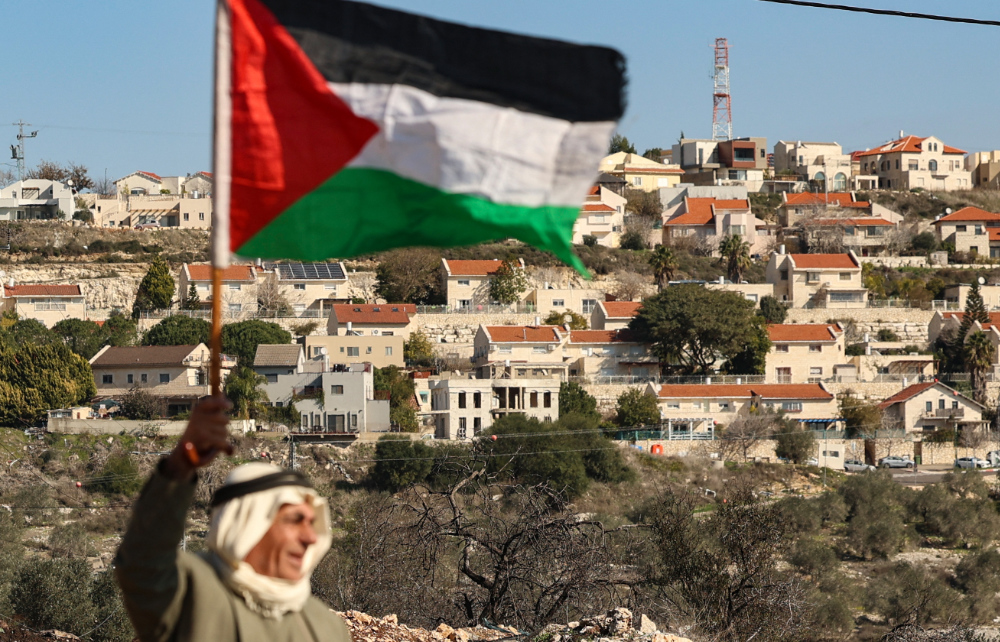

Movement restrictions described as “draconian” by Amnesty also provide a visceral reminder of the oppression that Arabs face daily. (AFP)

These legal mechanisms, the report added, “systemically privilege Jewish citizens in law and in practice through the distribution of land and resources, resulting in their relative wealth and well-being at the expense of Palestinians.”
Movement restrictions described as “draconian” by Amnesty also provide a visceral reminder of the oppression that Arabs face daily.
The internet is awash with images of heavily armed Israeli soldiers and police interrogating and herding huddled masses of Palestinians through checkpoints, many of them hoping only to reach work or school unimpeded and on time.
Israel’s web of checkpoints, roadblocks, fences and other structures control the movement of Palestinians within the occupied territories and restrict their travel into Israel or abroad, Amnesty said, adding that these restrictions serve “as a means of control over land and people.”
And for Palestinians in Gaza, the situation is even worse. For them, “travel abroad is nearly impossible under Israel’s illegal blockade, which Israel imposes on Gaza’s entire population as a form of collective punishment.”
But despite the oppression they face at the hands of the Israeli state, the Palestinian people have “never stopped resisting,” Saleh Higazi, Amnesty International’s head of office in East Jerusalem, told Arab News.
Despite the odds being stacked against them, Palestinians have found new and creative ways to resist apartheid, he said.
Higazi highlighted the solidarity expressed within Palestine and globally when authorities tried to evict Palestinians from their homes in Sheikh Jarrah, East Jerusalem.
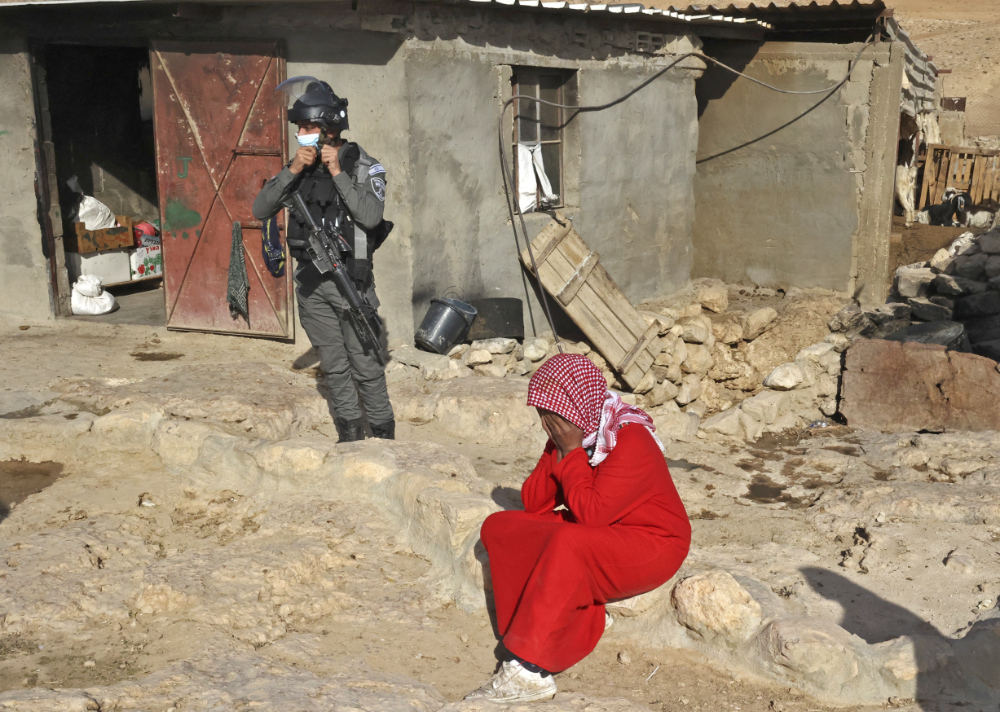

Amnesty has documented extensive evidence that the Israeli state now engages in apartheid in the legal sense. (AFP)

Further, a general strike among Palestinians across all territories — intentionally divided from each other by Israel — was convened “to show that they are one people, one group, that stands against the policies and practices of fragmentation that Israel has been imposing on them since its establishment.”
He added: “Palestinians have not stopped resisting. This is why reality has unfortunately become more brutal.”
Amnesty’s report received a furious reaction from Israel. Senior officials obtained the report ahead of its release and leaked it ahead of its scheduled publication date.
The Israeli Embassy in London wrote on Twitter: “Amnesty International’s report is a shameful misrepresentation of Israel’s diverse and dynamic society. As a proud democracy, we looked for nuance but found only falsehood and distortion.
“This antisemitic report recycles lies instead of seeking truth and consolidates bad-faith attacks from those who seek to demonize the state of Israel.
“Our citizens can speak from lived experience about the challenges we face as we try to create a better society, the goal of every democracy. We need to amplify these voices. We should center people who passionately and openly reflect the complexity and nuance of Israeli society, as opposed to focusing on erroneous and damaging reports that attempt to delegitimize Israel.
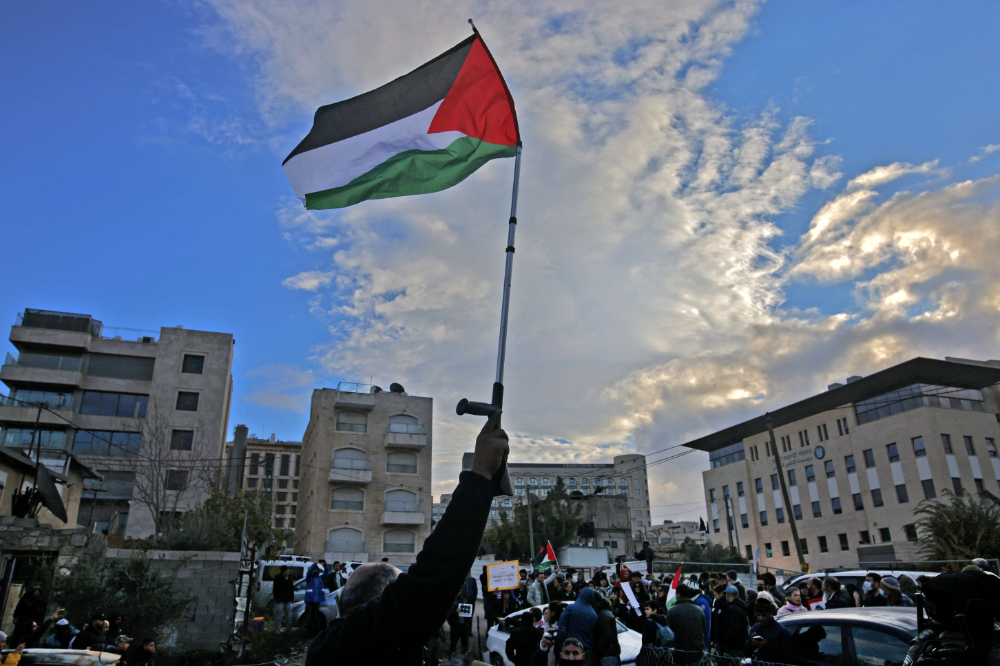

“Palestinians have not stopped resisting. This is why reality has unfortunately become more brutal.” (AFP)

“It’s a sad truth that if Israel were not a Jewish state, Amnesty would not employ such vicious smears against us,” the statement added.
Higazi vehemently rejected the claim that his organization is antisemitic. Accusations like this, he said, are “not new” and have long been “weaponized by Israel.”
“They have used such baseless and false accusations to divert attention from what really needs to be the focus: the crime against humanity of apartheid.”
Higazi continued: “Any state or authority that carries out systematic human rights violations or states that impose systems of oppression amounting to the crime against humanity of apartheid will be worried about the truth, this truth, being exposed.”
Israel is “worried and scared,” Higazi added. “I hope that they are scared because we will be campaigning along with our partners to dismantle the system, which means holding those responsible accountable.”

Main category: 

Israel demolishes east Jerusalem home of Palestinian gunmanIsrael to remove two commanders over death of Palestinian-American


Frenchman jailed in Iran halts hunger strike: family

Author: 
AFP
ID: 
1643747919677528300
Tue, 2022-02-01 16:29

PARIS: A Frenchman convicted in Iran on spying charges he denies has ended a hunger strike in prison after refusing food for more than a month, his family said Tuesday.
Benjamin Briere, 36, was sentenced by an Iranian court last week to eight years in jail.
He had begun the hunger strike at Christmas to protest the conditions of his detainment and the lack of any progress in his legal proceedings after he was arrested in 2020.
“He has stopped his hunger strike, I asked him to, given how it was developing. And he knows he needs strength to continue his struggle,” his sister Blandine told AFP.
Briere, who is being held at the Vakilabad jail in the eastern city of Mashhad, was arrested in May 2020, after taking pictures in a national park with a recreational drone.
The French foreign ministry has described the verdict as “unacceptable,” saying Briere was a “tourist.”
Briere’s Iranian lawyer Saeid Dehghan wrote on Twitter that his hunger strike had lasted 35 days and that he had lost 13 kilos.
He is one of more than a dozen Western citizens held in Iran described as hostages by activists, who say they are innocent of any crime and detained by the powerful Revolutionary Guards to extract concessions from the West.
The verdict against Briere came as Iran and world powers are seeking to reach an agreement at talks in Vienna on reviving a 2015 deal to curb the Iranian nuclear program in exchange for a lifting of sanctions.
Blandine Briere said her brother was keeping up hope after his situation — along with that of French academic Fariba Adelkhah, who is also detained in Iran — was raised by President Emmanuel Macron in telephone talks with his Iranian counterpart Ebrahim Raisi on Saturday.
Macron urged the “immediate release” of both French citizens, the French presidency said.
“It gives (us) hope, but we will continue to fight until he is on a plane for France,” Blandine Briere said.

Main category: 

Frenchman gets long jail term in Iran; denies spy chargesFrenchman held in Iran begins hunger strike


Saving Lebanon can help prevent Iran’s web of terror from spreading in region, activists argue

Tue, 2022-02-01 22:55

CHICAGO: Lebanon will be “another Iran-dominated, corruption-riddled failed state” if critical steps are not taken soon to end government corruption in the country, tackle the economic challenges it is facing and address the “crippling” issue of Hezbollah’s violence.

This is the conclusion of a report published on Tuesday by two leading Middle East think tanks based in Washington, the American Task Force on Lebanon and the Middle East Institute. To mark the occasion they hosted a webinar during which panelists discussed ways in which the report’s powerful conclusions might be implemented and order restored to Lebanon.

A major part of the discussion focused on the role of Hezbollah, and participants noted that the outcome of the ongoing US negotiations with Iran over its nuclear program could have significant ramifications for Lebanon.

Paul Salem, the president of the Middle East Institute, said Lebanon faces many challenges, including the failure to eliminate sectarianism over the past 31 years, but that a greater challenge is the continuing presence and power of Hezbollah as a non-state actor with allegiance to Iran.

“(A) crippling issue is the presence of Hezbollah,” he said. “This (Lebanese) government, no matter how they reform their government system, and no matter how much they are able to fight corruption or take some good decisions, the fact of the matter is the Lebanese state is not sovereign.

“It doesn’t control its border. It doesn’t control its territory. It doesn’t control the decisions of war and peace. There is a full-fledged army that is in complete allegiance to a foreign country — which is the Islamic Republic of Iran, which they proudly say so — that does not answer to the Lebanese people, does not answer to the Lebanese government or the Lebanese parliament or the Lebanese state. That is also a crippling problem.”

Salem said he does not see Hezbollah’s power in Lebanon changing, even if the US and Iran reach an agreement in Vienna.

“With or without a return to the nuclear deal, Iran remains committed to an advanced defense strategy, remains committed to standing up militias in other countries,” he said. “(In the past) it was Lebanon, and now it is Lebanon, Iraq, Syria and Yemen.”

In his introductory remarks, congressman Darrell Issa gave an assurance that the US remains committed to Lebanon and to the staging of “free and fair elections” scheduled for May for the parliament and later in the year for the presidency.

The participants in the discussion also included Edward M. Gabriel, president of the ATFL and a former ambassador; Brian Katulis, the MEI’s vice president of policy; and journalist Joyce Karam. It was moderated by Jean AbiNader, the ATFL’s vice president for policy.

“If we don’t get the Iran deal correct, we have missed our best chance of dealing with this outside pressure on the country of Lebanon,” said Gabriel, referring to Hezbollah’s ties with Iran.

Opinion

This section contains relevant reference points, placed in (Opinion field)

“The United States should realize they are in for some tough times by the Gulf, by Israel, by the Lebanese Americans if, in fact, they don’t deal with terrorism proxies in the region.”

Katulis said that the world must get past the idea that “Lebanon is lost.” He added that he hopes US President Joe Biden, who began his term in office by placing much focus on Iran and Yemen, will see that the future of Lebanon “is directly linked to the issue of Iran.”

AbiNader said that saving Lebanon is “critical to America.”

He added: “Without strong support from the United States and its friends, Iran and Syria would dominate Lebanon and likely pose increased terror threats to the United States. This does not serve American interests.”

The ATFL/MEI report highlights a number of hurdles that need to be cleared to improve the situation in Lebanon and end the crises it faces, and calls on Biden and the US to lead a “diplomatic coalition” to encourage the implementation of political and economic reforms.

All of the panelists agreed on the need to “significantly reduce corruption at all levels of government” in Lebanon.

Main category: 
Tags: 

Gulf states review Lebanon’s response to proposal to ease rowVatican envoy accuses Lebanese politicians of profiting from country’s suffering 


63 migrants rescued off Morocco: activists

Author: 
AFP
ID: 
1643741669736856900
Tue, 2022-02-01 21:59

RABAT: The Moroccan navy on Tuesday rescued 63 migrants including 15 women and three children after their vessel started to sink as they tried to reach the Canary Islands, activists said.
Alarm Phone, which provides an emergency hotline for migrants in trouble at sea, said on Twitter that “63 people in severe distress close to the Moroccan coast were found by the Moroccan navy and safely brought to shore.”
The Moroccan authorities did not immediately confirm the operation.
Helena Maleno Garzon of rights group Caminando Fronteras had earlier warned that dozens of people were sinking in an inflatable boat off Tarfaya, on Morocco’s southern coast, and would “die if they are not rescued soon.”
Migrants, mostly from sub-Saharan Africa, regularly use Morocco as a launchpad for attempts to reach European shores.
Last year more than 4,000 migrants died or went missing in such attempts, mostly as they tried to reach the Canary Islands, according to Caminando Fronteras.
Many choose to head for the Spanish territory in the Atlantic as shorter routes across calmer Mediterranean waters are more closely monitored, the group says.

Main category: 

Six migrants drown off Tunisia, 30 missingAt least 11 migrants drown off Tunisia in shipwreck


Iranian teachers in new day of protests over pay

Author: 
Wed, 2022-02-02 00:41

TEHRAN: Thousands of Iranian school teachers have protested and staged a one-day strike over the slow implementation of salary and pension reforms, local media reported on Tuesday.

Reformist newspaper Arman Melli said the teachers demonstrated outside parliament in Tehran and Education Ministry offices in provincial cities including Isfahan and Shiraz.

The paper said it was the third day of protests by teachers in recent weeks.

Iran’s ILNA news agency reported that striking teachers in Alborz province, west of the capital, carried placards demanding “Free the imprisoned teachers.”

It was an apparent reference to colleagues detained at previous rallies.

Protesters called for the alignment of teachers’ salaries with those of other public sector employees among other demands, ILNA said.

“Unfortunately, our salary with a master’s degree and sometimes a doctorate is about 4.5 million tomans ($160) per month,” it quoted a protesting teacher in the city of Yazd as saying.

Main category: 
Tags: 

Frenchman jailed in Iran halts hunger strike: familyUS officials say negotiations on Iran nuclear program at crossroads