Washington threatens Houthi terror militia with new sanctions

Thu, 2022-02-03 02:43

WASHINGTON: The US on Wednesday threatened Yemen’s Houthi rebels with new sanctions after a series of drone and missile attacks on the United Arab Emirates.
“We’ve taken a number of such actions, including in recent weeks and months alone, and I suspect we will be in a position to take additional action given the reprehensible attacks that we’ve seen emanate from Yemen from the Houthis in recent days and weeks,” said State Department Spokesperson Ned Price.
President Joe Biden’s administration is under increasing pressure to again formally designate the Houthis as a “foreign terrorist organization,” a label withdrawn from the group one year ago after Biden became president, to engender peace negotiations in the war-torn country.
But the war between the Iran-backed Houthis and the government, backed by the multination Coalition to Restore Legitimacy in Yemen, has continued to rage.
“You heard from the president last month that this is a decision that is under review,” Price told reporters.
“We will not relent in designating Houthi leaders and entities involved in military offensives that are threatening civilians and regional stability,” he said.
fff/pmh/sst

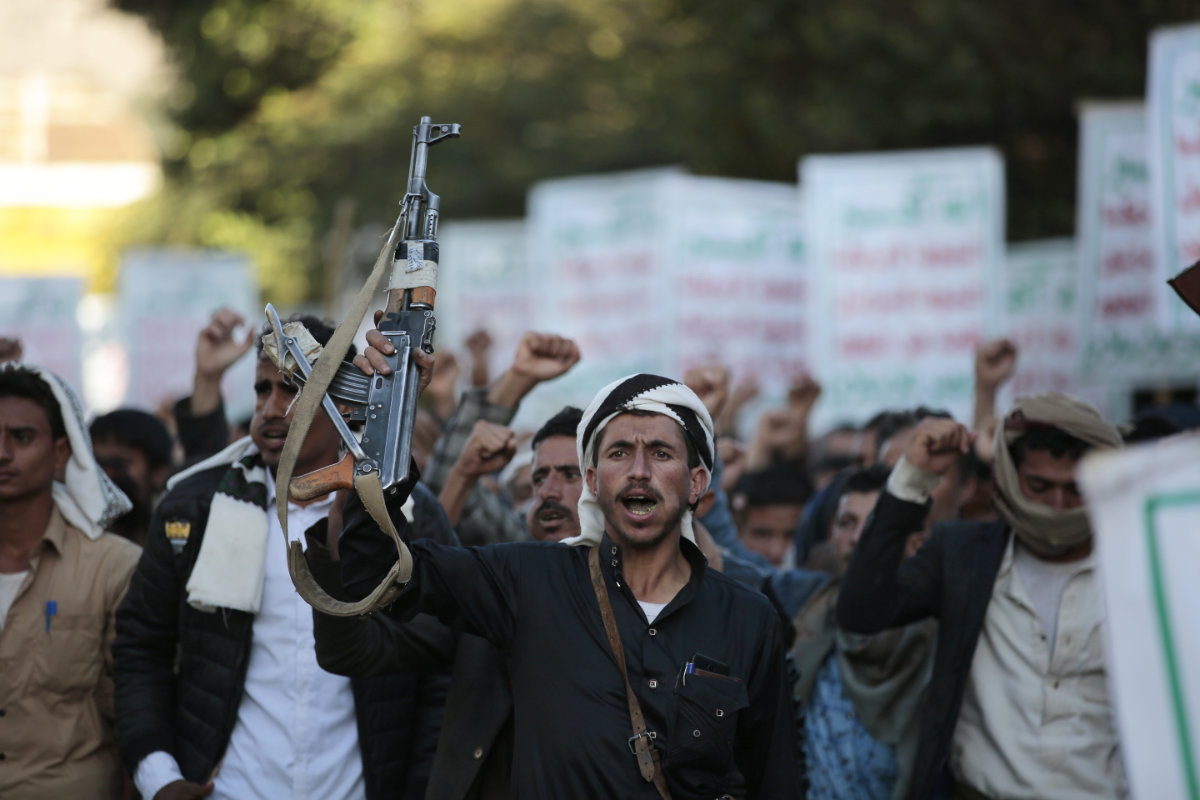
Houthi supporters demonstrate in Sanaa against US support to the Yemeni government on Nov. 22, 2021. (AP Photo/ File)
Main category: 

US Navy forces seize arms from Iran likely bound for YemenTourists in UAE shrug off Houthi missile attacks


Turkish strikes Kurd targets in Iraq, Syria

Author: 
AFP
ID: 
1643834532195987600
Wed, 2022-02-02 18:08

JEDDAH/BEIRUT: Turkey launched a wave of airstrikes by 60 warplanes early on Wednesday targeting Kurdish militia positions in northern areas of Iraq and Syria.

The Turkish military said the airstrikes hit Derik in northern Syria, and Sinjar and Karacak in northern Iraq. The targets were outlawed PKK militants, who have bases in Iraq, and the Syrian Kurdish YPG militia. Turkey regards both groups as terrorists.

Defense Minister Hulusi Akar said “many terrorists” were killed. 

The Syrian Observatory for Human Rights, a monitor based in Britain, said four security staff died in an airstrike on a Kurdish-run power station near Al-Malikiyah in Hassakeh province.

Iraq’s military condemned what it called a Turkish infiltration into Iraqi air space as a violation of its sovereignty, although Baghdad is widely thought to be giving Ankara free rein to attack the militants.

It called on Ankara “to put an end to these violations,” and said “Iraq is fully prepared to cooperate (with Ankara) to stabilize the situation on the border.”

The US-backed Syrian Democratic Forces (SDF), the semi-autonomous Kurdish administration’s de facto army, said four of its fighters died in the attack and vowed vengeance against Turkey.

The YPG — which forms the backbone of the SDF fighting IS in Syria — also condemned the Turkish airstrikes, which followed an attack by Daesh on a prison in Hassakeh province last month in an attempt to free their fighters. 

“Turkey tries to continue what Daesh started,” the YPG said. “Everyone has to take action against this attack now.”

The YPG is viewed by Ankara as the PKK’s Syria offshoot.

On Wednesday, shelling on the Turkish-held city of Al-Bab in northern Syria killed eight people, including five civilians, according to the Observatory which relies on a network of sources inside Syria.

It didn’t specify who was responsible but Kurdish forces and Syrian regime troops are both deployed in the region.

Turkish forces escalated attacks in northeastern Syria on Wednesday evening, shelling “about 20 villages and sites… in the Hasakah countryside and north of Raqqa governorate,” the Observatory added later.

It said the attacks targeted residential areas and displaced a large number of people.

The Turkish strike came hours after hundreds of mourners gathered in Al-Malikiyah for mass funerals honoring Kurdish fighters killed in a week of battles with Daesh extremists who had attacked the Ghwayran jail on January 20.

Since the start of its military intervention in Syria in 2016, Ankara has sporadically bombed the YPG and carried out military operations targeting Daesh and Kurdish forces.

Turkey also routinely carries out attacks in Iraq, where the PKK has bases and training camps in the Sinjar region and on the mountainous border with Turkey.

Turkish President Recep Tayyip Erdogan, who has threatened to “clean up” parts of northern Iraq, accuses the PKK of using the border area as a springboard for its insurgency.

In December, Turkey carried out retaliatory air strikes in northern Iraq after three Turkish soldiers died in a PKK attack.

(With AFP)

Main category: 

Clashes near Syria prison leaves 332 dead, war monitor reportsDaesh-Kurds battle after Syria prison attack kills over 120 in 4 days


Power cuts help Syrian tradition of public bathhouses pick up steam

Author: 
Wed, 2022-02-02 23:29

DAMASCUS: At Hammam Bakri in Damascus’ Old City, Syrian men wrapped in towels from the waist down lie down on a scalding marble floor. Masseurs vigorously scrub their skin with a soap-soaked loofah and wash them down with hot water.

Around a hexagonal fountain outside — traditionally found in old Damascene houses — patrons sip an infusion of herbs and dried flowers known as zhourat. The soothing smell fills the air around the domed roof.

After having fallen victim to modernization, Syria’s ancient public bathhouses, known as Hammamat, are picking up steam again, largely due to prolonged electricity cuts during a particularly cold winter in this war-scarred country.

With soaring fuel prices and barely enough power to heat water at home, many are turning to the few remaining Hammams in cities like Damascus, Homs and Aleppo more to the north.

Damascus, along with major Arab cities like Baghdad, Mosul and Cairo, is home to some of the country’s oldest and best bathhouses, some of them over a thousand years old. Many of them have closed due to modernization, lack of business and the war that left much of the country in ruins, crippled the economy and shrunk wages.

Now, officials at Damascus’ remaining public baths say they are doing brisk business again but it’s mostly due to residents who come for the hot water — a luxury they no longer find at home. Power outages often run for more than 20 hours a day in Damascus. Few can afford to have a private generator or pay the price of fuel.

The difficult times, say owners of public bathhouses, are in a way helping keep the tradition alive.

For 10,000 lira (less than $3), the customers at Hammam Bakri located within the old city are given towels, a loofah and a piece of traditional olive oil soap. They are then scrubbed in a steamy room, often with Arabic music in the background. “Having a hot shower is very different than having cold showers especially in these temperatures,” said Husam Hamami, the manager.

“We are now going through a difficult time. There is little electricity and the water is little so people are not even getting a chance to heat their water so we are finding that many people are coming in once a week.”

Bakri is one of the oldest bathhouses in Damascus, established in 1069. Instead of tourists, it is now residents who come in more frequently. On a recent day, a group of men sauntered in elevated clogs made from wood, known as qabqab, as they patted themselves dry with towels, emerging from a fog.

Main category: 
Tags: 

Aleppo bathhouse boom as Syria crisis turns showers coldSyrian fighters search for Daesh sleeper cells near prison


Opposition says Iran created mercenary naval unit for attacks

Author: 
Wed, 2022-02-02 23:22

PARIS: Iran has created a new naval militia made up of mercenaries from around the region to attack enemies in its neighborhood and particularly off Yemen, the exiled opposition alleged on Wednesday.

The National Council of Resistance of Iran said the unit had been created as part of the Quds Force, the arm of the Revolutionary Guards responsible for extra-territorial operations.

“The Quds Force has been recruiting mercenaries for newly created, armed and trained terrorist units to attack ships and maritime targets in the region,” it said in a report based on information received from Iran.

The NCRI, which is outlawed in Iran and is the political wing of the People’s Mujahedin, said the mercenaries were being hired from Iraq, Lebanon, Syria, Yemen and Africa.

The fighters are brought to Iran for training and then sent back to their home countries to conduct the operations, it said.

“The strategy affords the politically weakened and vulnerable Iranian regime a veneer of plausible deniability for its proxy war in the region, as it seeks to augment the export of terrorism on which it depends,” the group added.

It said the primary location for naval commando training is at a naval academy in Ziba Kenar on the Caspian Sea in Gilan Province.

The militia troops are then organized in naval commando battalions, which are deployed in the Arabian Sea, the Bab Al-Mandab Strait between Yemen and the Horn of Africa and the Red Sea.

The aim is to “disrupt maritime navigation of commercial ships, to attack ports, conduct ship hijackings and plant mines.”

It detailed examples where such operations had already been carried out including suicide and bomb attacks using small boats off Yemen’s Red Sea port of Hodeidah.

Iran is deeply implicated in Yemen’s seven-year war, where it backs Houthi rebels in their fight against the government. Tensions have soared after the rebels launched missile attacks on UAE.

“No rockets are fired, no attacks on ships take place, and no suicide speed boats target the shores, unless the order has come from Tehran,” said Soona Samsami, the NCRI’s representative in the US.

Main category: 

Iranian teachers in new day of protests over payUS officials say negotiations on Iran nuclear program at crossroads


Tourists in UAE shrug off Houthi missile attacks

Author: 
Wed, 2022-02-02 22:59

DUBAI: Tourists who flock to the UAE in search of winter sun appear undeterred by recent missile attacks on the Gulf State by Yemen’s Houthi group.

Data suggests the tourism industry, centered in Dubai, is booming, with hoteliers and reservation agents reporting high demand despite the renewal of COVID-19 travel restrictions in many countries late last year.

Beaches are thronged and restaurants thriving, with the Expo world fair bringing more visitors to the Middle East’s trade, finance and tourism hub.

“I feel super-safe,” said Daniel Rivlin, 22, speaking at Expo hours after the UAE said on Monday it had intercepted a ballistic missile fired by the Houthis on the same day Israeli President Isaac Herzog was visiting.

“I feel safe as an Israeli being in Dubai. I feel safe being a foreigner in Dubai,” he added.

October to March, when many Europeans swap freezing winters for the sunny Arabian Peninsula, is the peak season for the tourist industry, which according to ratings agency S&P accounted for 13 percent of Dubai’s gross domestic product in 2020.

According to Hopper, a travel search engine that uses historical data to predict and analyze flight prices, searches for the UAE were stable in the first half of January and trended up 22 percent later in the month.

Hospitality data company STR said in December that Dubai’s hotel industry was reporting room occupancy of 78.2 percent.

Monday’s attack followed a Jan. 17 strike on a fuel depot in Abu Dhabi, that killed three people. It marked a dangerous new phase in the conflict for the UAE as previous cross-border strikes had mostly targeted Saudi Arabia.

The Houthis have said they also launched drones at Dubai, home to the world’s tallest building and Ferris wheel, whose glitzy shopping malls are a magnet for tourists.

At Habtoor Grand Resort, popular among British, Russians, Kazakhs, Ukrainians, Germans and French, guests were relaxed, lying in the sun by the pool or playing tennis.

General manager Karolina Paliszewska said there had been no cancellations due to the Houthi attacks, instead forecasting a bumper end to a season she said had already been better than in years just before the pandemic.

“It’s looking much better than last year. The first quarter is far beyond last year, so we are very positive and obviously the Expo is still going on so it brings additional attention,” she said.

Vinayak Mahtani, CEO of bnbme holiday homes, said he expected strong demand until the blistering summer months start.

“The UAE thanks to its leadership is such a safe place that it’s not even mentioning what may have been. There is zero sense of insecurity or fear among us or tourists,” he said, adding that the attacks have had “no impact whatsoever.”

Anastasia Nikitina, who studies in Moscow, was enjoying the sunshine. “The weather is so nice compared to Russia,” she said. “We feel really safe here and nothing bothers us at all.”
Main category: 

Most popular US horse set for Dubai World Cup Carnival runLouis Vuitton brings its traveling exhibition SEE LV to Dubai