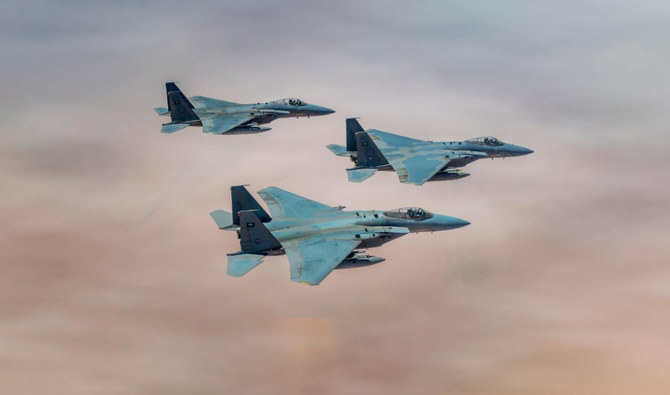
RIYADH: The Coalition to Restore Legitimacy in Yemen has struck targets in Yemen’s capital, Al Ekhbariya reported on Saturday.
The coalition said it had hit Sanaa and a number of other provinces.
The operation had been taken to safeguard against threats to civilian lives, the coalition said.
The Iran-backed Houthi militia often use drones to attack the southern regions of the Kingdom.
The Houthis have also been condemned for attacking the UAE in recent weeks.
Three expatriate workers, two from India and one from Pakistan, were killed in a Houthi drone and missile attack on Abu Dhabi’s oil storage facilities and airport on Jan. 17, triggering a salvo of deadly air- strikes in retaliation.
Palestine’s Expo 2020 Dubai pavilion takes visitors on a multi-sensory tour of Jerusalem
Author:
Alexandra Draycott
ID:
1644011342415965700
Sat, 2022-02-05 00:48
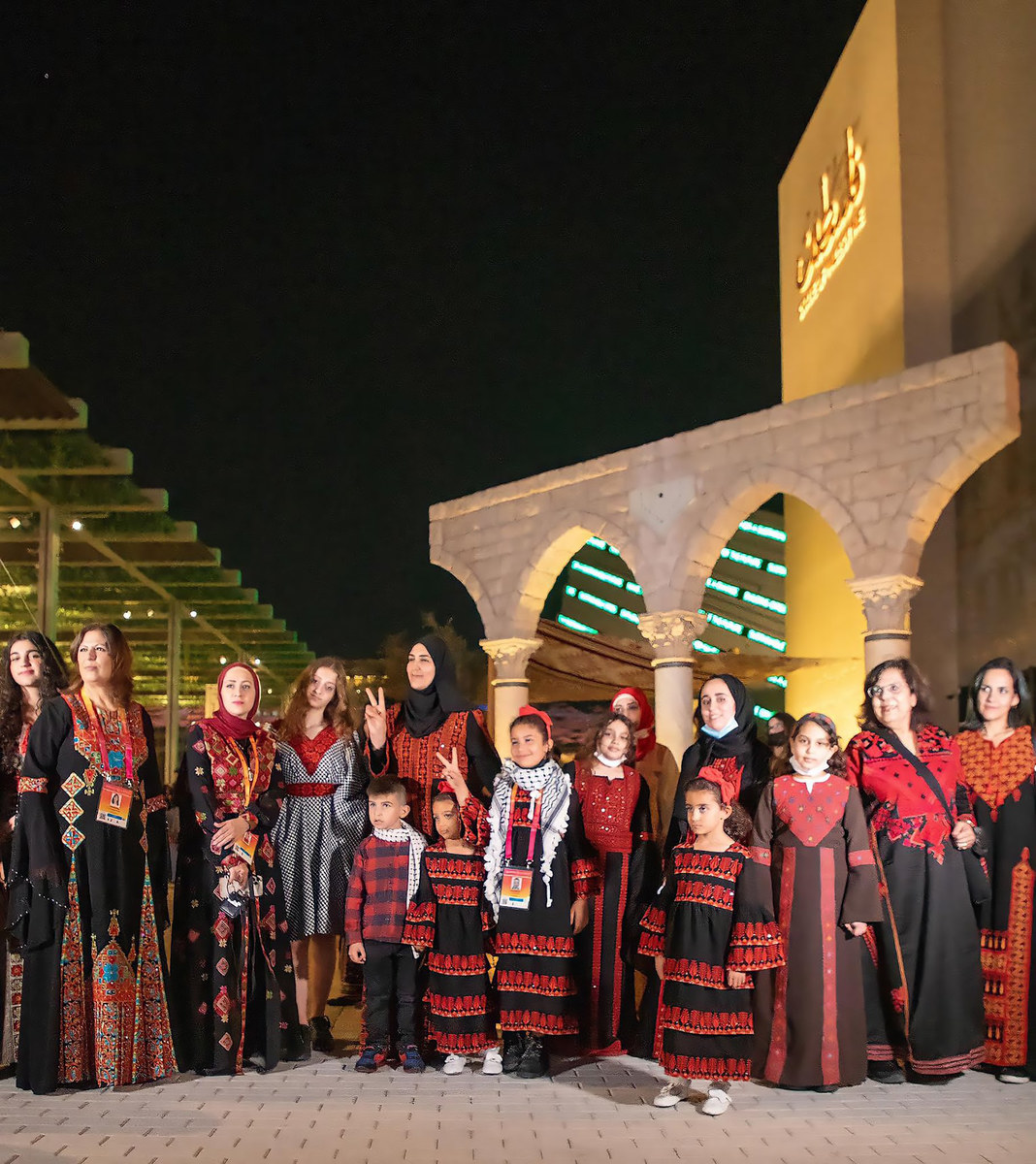
DUBAI: Palestine’s pavilion at Expo 2020 Dubai is as eye-catching as it is groundbreaking.
The pavilion, situated in a prime location along the main concourse of the Opportunity District, may not have an ornate exterior, but its simple, yet dignified, design stands out easily, especially when one considers Palestine’s geographical size and diplomatic status.
With some of the expo’s biggest pavilions nearby, including those of Saudi Arabia, Morocco and Egypt, the Palestinian pavilion gives off an air of understated grandeur and is close to the Al-Wasl dome, giving it enviable visibility in the Arab world’s first world expo.
The sand-colored stones are the same that pave the streets of Jerusalem’s Old City and were brought from Palestine to adorn the pavilion. (Twitter)
On entering the pavilion, visitors are transported to an authentic Jerusalem street scene. Most guests experience the pavilion in small, guided groups of about 20 people, who are offered an informative, albeit occasionally crowded, tour of the pavilion’s displays.
Its stone-tiled floors are an immediate focal point. The sand-colored stones are the same that pave the streets of Jerusalem’s Old City and were brought from Palestine to adorn the pavilion.
According to pavilion staff, some visitors remove their shoes and kneel on the stones to be as close as possible to a land considered sacred by many.
Also paying homage to the city’s ancient architecture are modern replicas of its famous archways, floor-to-ceiling photos of the picturesque alleyways that snake through the Old City, and atmospheric audio of the city’s soundscape.
The overall sensation is immersive and hints at the pavilion’s theme — See, Hear, Touch, Smell and Taste — creating an experience of Palestine that employs all five senses.
From the entrance, visitors follow a path lined with the same latticework and mashrabiya designs that call to mind the balconies and doors of houses in Jerusalem.
The back wall features an elevator and a remarkable panoramic image of the city, looking out over the buildings and surrounding landscape.
Some visitors remove their shoes and kneel on the stones to be as close as possible to a land considered sacred by many. (Supplied)
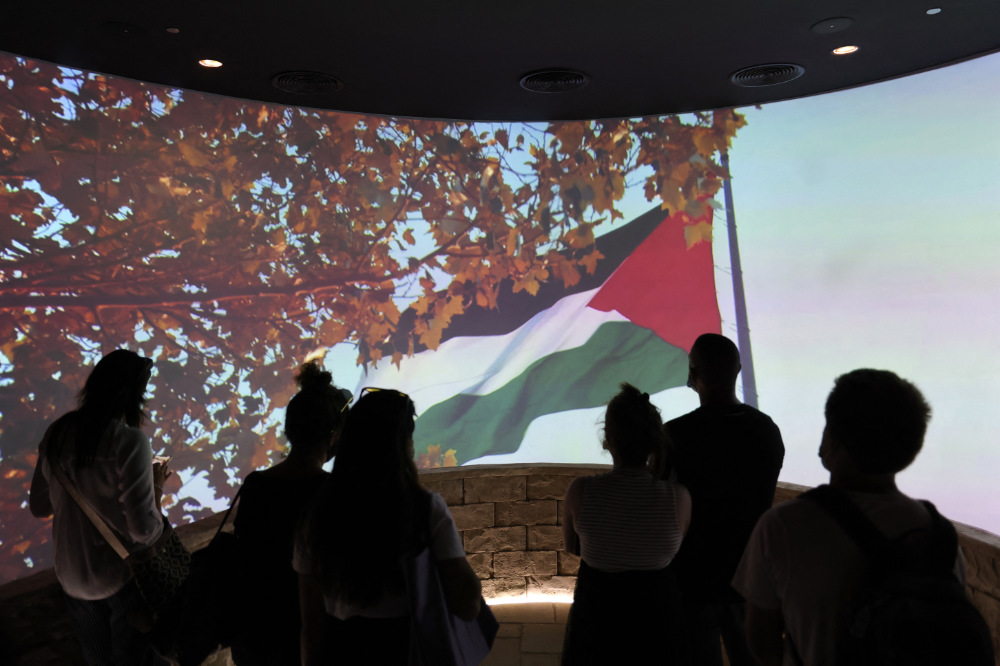
From here, visitors enter the first exhibit: “See.” A brief video plays, highlighting the natural beauty of rural Palestine, its industry, economy and welcoming culture. The video ends with an exhortation to create a “new perception of Palestine.”
From “See,” visitors move on to “Hear.” To amplify sensory perception, the “Hear” corridor is cast into darkness, with nothing on the walls but a few minimalist light drawings that help identify the sounds emanating from the speakers.
Along the corridor are different sound bubbles. In one, there is a call to prayer, followed by ringing church bells, evoking the proximity of the major religions in Jerusalem. In another, a poem about Palestine is recited in English and Arabic.
In a third, street sounds predominate, with cars and people speaking, bringing to life a typical Jerusalem street. In the last area, the sounds are of traditional Palestinian musical instruments, including the oud.
Hopes for statehood recognition. (AFP)
Walking through the next corridor, visitors arrive at “Touch.” Again, as with “Hear,” perceptions beyond the focal sense are limited. In this case, mysterious objects are placed in hidden compartments within white columns, stretching from floor to ceiling. Screens guide visitors through the process of feeling inside the column and guessing what the items are inside.
In some cases, the objects are emotionally charged. One is a large metal key, easily recognizable by touch. A screen informs the visitor that the key is a symbol of the dream to return to homes left behind in 1948, when nearly half the Arab Palestinian population was exiled in an event known as the Nakba, or catastrophe. Many displaced families have preserved the keys to their homes in Palestine.
Another easily discernible shape is a many-pointed star, symbolizing the star of nativity. This star was found in 1717 in Bethlehem, and is said to mark the place of Jesus Christ’s birth. A screen informs visitors that the Church of the Nativity was the first UNESCO World Heritage site to be listed under the name of “Palestine.”
Moving on through another corridor filled with mashrabiya shadows, visitors arrive at “Smell.” The smell of Palestine is represented through roses, sage, guava, oranges and olive oil soap. Each has a clay pot, which emits the scent, followed by a description of its significance.
Roses, for instance, represent the rose of Jericho, which wilts in the desert heat, but springs back to life with the first sign of moisture — a resilience believed to be synonymous with the people of Palestine.
Next is sage, or maramiya, a popular tea ingredient in Palestine, consumed after meals as a digestive aid. In the pavilion’s words, it is “a quintessentially Palestinian pleasure.”
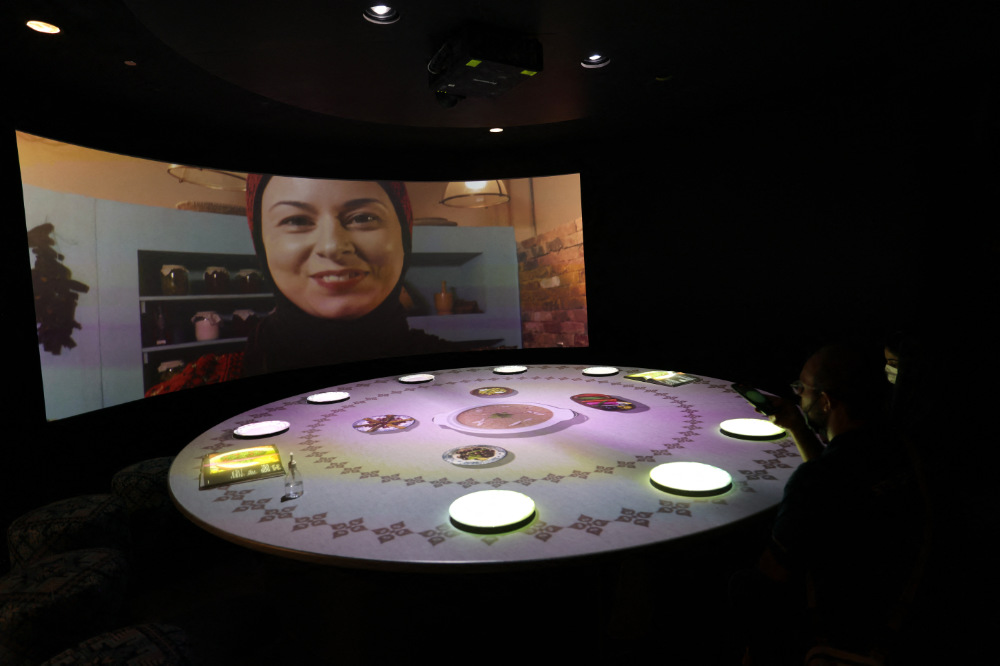
Images of luscious olives, lemons, rice, meat and spices are projected from above on to empty white plates. (Supplied)
Olive oil soap, which has been used in the region for millennia, is also featured, its strong and refreshing fragrance lingering on the nostrils as visitors move on to the next exhibit: “Taste.”
Somewhat surprisingly, there is nothing to eat in the Taste exhibit, although the pavilion’s cafe, Mamaesh, is nearby. Instead, images of luscious olives, lemons, rice, meat and spices are projected from above on to empty white plates set on a table in the center of the room, while a short film about Palestinian cuisine is projected on an adjacent wall.
The film features tantalizing close-up shots of zaatar, falafel and kunafa, while also lingering on the people preparing these dishes. Rather than simply focusing on the cuisine, the exhibit leaves visitors with a taste of Palestine’s warmth and hospitality.
Once visitors have experienced all five senses, they are brought to a room and handed virtual reality headsets. In this immersive experience, the full sensory experience is brought together on a journey through Jerusalem’s top historical sites, from the Dome of the Rock to the Church of the Holy Sepulcher.
Palestinian pavilion does not focus solely on the future, nor does it dwell excessively on the past. (Supplied)
Unlike many other Arab offerings at Expo 2020 Dubai, the Palestinian pavilion does not focus solely on the future, nor does it dwell excessively on the past. Rather, everything about the pavilion, not least the channeling of perception through the five senses, creates a feeling of immediacy and connection.
Indeed, in the video from the pavilion’s “See” exhibit, a line references the “pulsation of the present.” A visit to the Palestinian pavilion creates a shared moment in the here and now, which is both unique and irreplaceable, much like Palestine itself.
Saudi pavilion launches Coffee Week at Dubai’s Expo 2020Saudi pavilion at Expo 2020 Dubai receives 2 million visitors
Stress laid on interfaith cooperation at Expo 2020 Dubai event to mark Human Fraternity Day
Sat, 2022-02-05 00:37
DUBAI: The Document for Human Fraternity was “a milestone on the path of interreligious dialogue,” Cardinal Miguel Angel Ayuso told Arab News on the sidelines of an event at Expo 2020 Dubai marking the International Day of Human Fraternity.
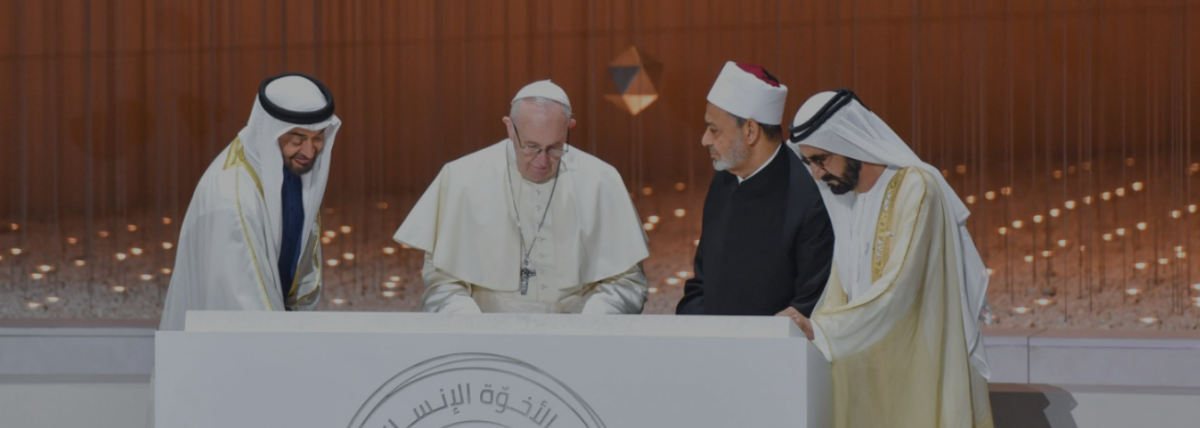
He was one of several faith leaders who gathered at the Expo’s Sustainability Pavilion on Friday to mark the third anniversary of the signing — by Pope Francis of the Catholic Church and Sheikh Ahmed El-Tayeb, grand imam of Al-Azhar — of the document in Abu Dhabi on Feb. 4, 2019.
The joint declaration called for peace among all peoples, while setting out a blueprint for a culture of dialogue and collaboration between all faiths.
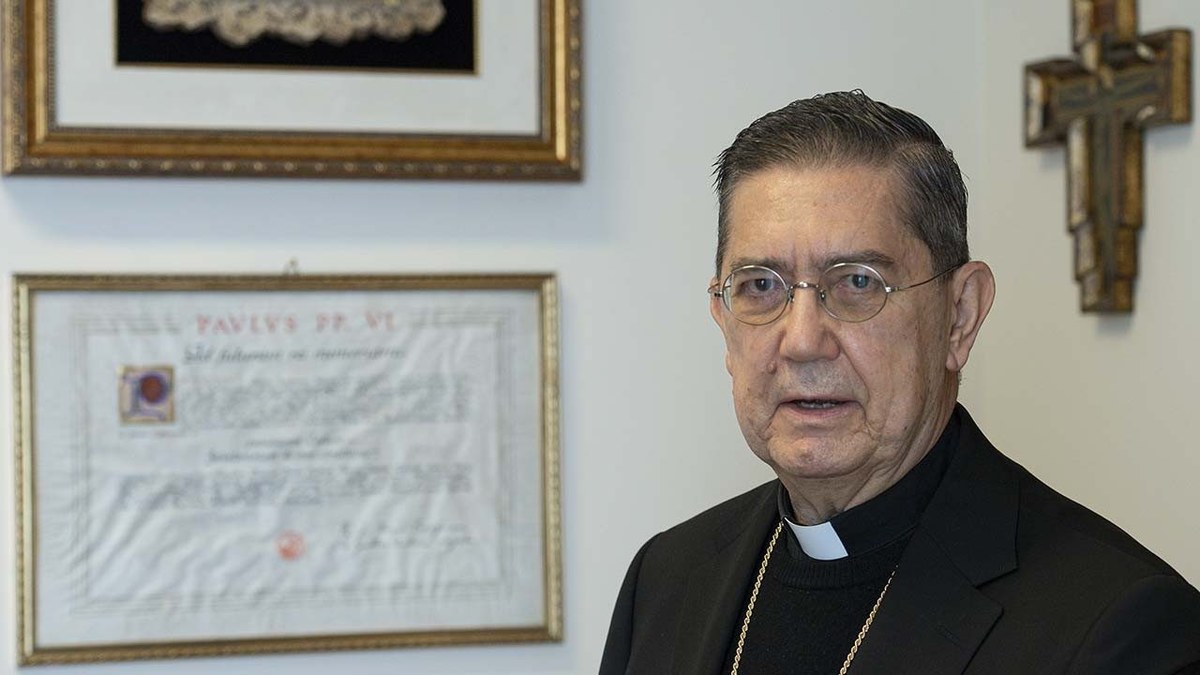
Cardinal Miguel Angel Ayuso, the President of the Pontical Council for Interreligious Dialogue Human Fraternity for the joint Initiatives and peaceful Coexistence. (Supplied)
“We are citizens of the world,” said Ayuso, from Spain, who is the president of the Pontifical Council for Interreligious Dialogue and a renowned historian of Islam.
“All believers of God must work together to counter the problems we are facing today. It is important to cultivate values and to maintain a relationship with religion, whether it’s in church, a mosque or a synagogue.”
To mark the anniversary, Pope Francis and Sheikh El-Tayeb sent video messages in which they called for continued interfaith understanding.
“Now is not a time for indifference,” Pope Francis said. “Either we are brothers and sisters or everything falls apart.”
Sheikh El-Tayeb said: “This celebration means a quest for a better world where the spirit of tolerance, fraternity, solidarity and collaboration prevails. It also indicates a hope for providing effective tools to face the crises and challenges of contemporary humanity.
It is three years since Pope Francis of the Catholic Church and Sheikh Ahmed El-Tayeb, Grand Imam of Al-Azhar, co-signed the document in Abu Dhabi on Feb. 4, 2019. (Supplied)
“We have embarked on this path in the hope for a new world that is free of wars and conflicts, where the fearful are reassured, the poor sustained, the vulnerable protected and justice administered.”
Opening the celebrations, Judge Mohammed Abdelsalam, secretary-general of the Higher Committee of Human Fraternity, emphasized the ways in which the Document for Human Fraternity has empowered people to fight prejudice and increase accountability, offering protection for “the haves and have-nots, the rich and the poor, and both genders.”
The Higher Committee of Human Fraternity was founded by authorities in the UAE to determine the recipients of the Zayed Award, which is awarded each year to people or organizations “who embody through their work this lifelong commitment to human fraternity.”
Last year’s recipients were UN Secretary-General Antonio Guterres and Latifa Ibn Ziaten, a Moroccan-French activist who has campaigned tirelessly against radicalization since losing her son in a terrorist attack 10 years ago.
Speaking during Friday’s event in Dubai, Mohammed Al-Diwaini, Al-Azhar deputy director of the grand imam, said it is imperative to “drop any sicknesses” of hatred and discrimination in favor of religious tolerance.
“If we follow our religion in its right form and without misinterpretation, we would be living in the best condition possible,” he told attendees.
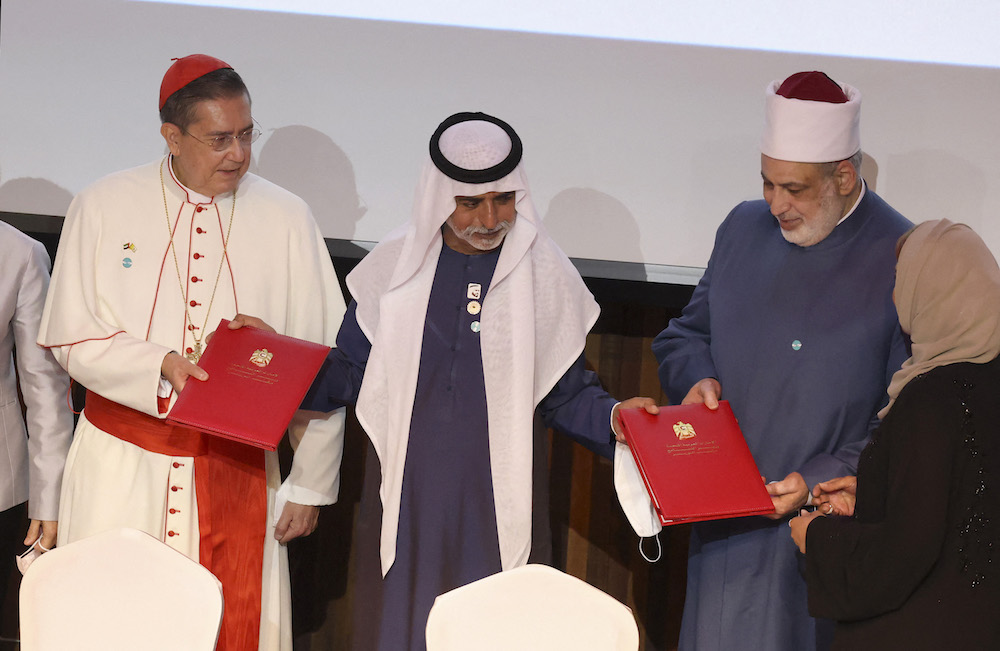
Cardinal Miguel Angel Ayuso, the President of the Pontical Council for Interreligious Dialogue Human Fraternity for the joint Initiatives and peaceful Coexistence (L), Sheikh Nahyan Mabarak Al-Nahyan (C), the UAE’s Minister of Tolerance and Coexistence and Dr Muhammad Al-Duwaini Al-Azhar, the Deputy of the Grand Imam in Dubai, on February 4, 2022. (AFP)
The opening ceremony included a short video highlighting leaders who had served the cause of coexistence, including Mahatma Gandhi, Mother Teresa, Martin Luther King Jr. and Sheikh Zayed, who was the driving force behind the formation of the UAE and championed plurality throughout his life.
To mark the International Day of Human Fraternity, US President Joe Biden sent a letter to the Higher Committee calling for global solidarity to meet the challenges of the day.
“From the ongoing threat of the COVID-19 pandemic and the existential climate crisis to the rise of violence around the world, these challenges require global cooperation from people of all backgrounds, cultures, faiths and beliefs,” Biden wrote.
He added that these challenges “require us to speak with one another in open dialogue, to promote tolerance, inclusion and understanding. Above all, they require us to be open minded, cooperative and empathetic and to ensure that all people are treated with dignity and as full participants in society.”
Echoing these sentiments, Cardinal Ayuso said the pandemic has been a challenge for people of all religious backgrounds, but added that faith has helped to guide communities through the crisis and would help them recover.
“In light of today’s pandemic that pushed people to lockdown, numbers of believers at houses of worship went down but I believe their faith grew stronger in their hearts,” he told Arab News.
“Some complain religion should not be active in society but religion is not a problem; rather it is a part of a solution.”
Grand Imam of Al-Azhar in Vatican meeting to discuss Document on Human FraternityPope Francis and Grand Imam of Al-Azhar Ahmed Al-Tayeb receive trophies for Zayed Award for Human Fraternity
US grants sanctions relief to Iran as nuclear talks remain in balance
Sat, 2022-02-05 00:34
WASHINGTON D.C.: The Biden administration on Friday restored some sanctions relief to Iran’s atomic program as talks aimed at salvaging the languishing 2015 nuclear deal enter a critical phase.
As US negotiators head back to Vienna for what could be a make-or-break session, Secretary of State Antony Blinken signed several sanctions waivers related to Iran’s civilian nuclear activities. The move reverses the Trump administration’s decision to rescind them.
The waivers are intended to entice Iran to return to compliance with the 2015 deal that it has been violating since former President Donald Trump withdrew from the agreement in 2018 and re-imposed US sanctions.
Iran says it is not respecting the terms of the deal because the US pulled out of it first. Iran has demanded the restoration of all sanctions relief it was promised under the deal to return to compliance.
Friday’s move lifts the sanctions threat against foreign countries and companies from Russia, China and Europe that had been cooperating with non-military parts of Iran’s nuclear program under the terms of the 2015 deal, known as the Joint Comprehensive Plan of Action, or JCPOA.
The Trump administration had ended the so-called “civ-nuke” waivers in May 2020 as part of its “maximum pressure” campaign against Iran that began when Trump withdrew the US from the deal in 2018, complaining that it was the worst diplomatic agreement ever negotiated and gave Iran a pathway to developing the bomb.
As a presidential candidate, Joe Biden made a US return to the nuclear deal a priority, and his administration has pursued that goal but there has been little progress toward that end since he took office a year ago. Administration officials said the waivers were being restored to help push the Vienna negotiations forward.
“The waiver with respect to these activities is designed to facilitate discussions that would help to close a deal on a mutual return to full implementation of the JCPOA and lay the groundwork for Iran’s return to performance of its JCPOA commitments,” the State Department said in a notice to Congress that announced the move.
“It is also designed to serve U.S. nonproliferation and nuclear safety interests and constrain Iran’s nuclear activities,” the department said. “It is being issued as a matter of policy discretion with these objectives in mind, and not pursuant to a commitment or as part of a quid pro quo. We are focused on working with partners and allies to counter the full range of threats that Iran poses.”
A copy of the State Department notice and the actual waivers signed by Blinken were obtained by The Associated Press.
The waivers permit foreign countries and companies to work on civilian projects at Iran’s Bushehr nuclear power station, its Arak heavy water plant and the Tehran Research Reactor. Former Secretary of State Mike Pompeo had revoked the waivers in May, 2020, accusing Iran of “nuclear extortion” for continuing and expanding work at the sites.
Critics of the nuclear deal who lobbied Trump to withdraw from it protested, arguing that even if the Biden administration wants to return to the 2015 deal it should at least demand some concessions from Iran before up front granting it sanctions relief.
“From a negotiating perspective, they look desperate: we’ll waive sanctions before we even have a deal, just say yes to anything!” said Rich Goldberg, a vocal deal opponent who is a senior adviser to the hawkish Foundation for Defense of Democracies.
One senior State Department official familiar with the waivers maintained that the move is not a “concession” to Iran and was being taken “in our vital national interest as well as the interest of the region and the world.” The official was not authorized to discuss the matter publicly and spoke on condition of anonymity.
US imposes new Iran sanctions over human rights violationsUS renews waiver for Iraq to import Iranian energy for 60 days
UK accused of neglecting Briton held in Yemen since 2017
Author:
AFP
ID:
1644005068895348300
Fri, 2022-02-04 23:17
LONDON: The family of a British man held since 2017 and allegedly tortured in Yemen on Friday accused the UK government of apathy about his fate.
Luke Symons, 29, was detained by Houthi militia in southwest Yemen along with his Yemeni wife on suspicion of espionage, which his family strongly denies.
They say his arm was broken during one interrogation in a bid to force a confession, and that his physical and mental health has degenerated during solitary confinement in the Yemeni capital Sanaa.
His wife was released and has been able to visit him periodically in the prison, and is alarmed at his condition, according to Symons’ grandfather Robert Cummings.
“Luke’s going through hell. He’s getting no medical attention, and we’ve been going backwards, not forward, with this (UK) government,” Cummings told AFP by phone from the family’s home in Cardiff.
“The government should ask the question, ‘what do the Houthis want to get Luke released?’,” he said, accusing the militia of holding his grandson as a “bargaining chip” for unspecified aims.
“But they just won’t ask the question,” Cummings said, alleging inaction both by the Foreign Office in London and by Saudi-based British diplomats responsible for Yemen.
Amnesty International, which this week launched a fresh appeal for UK intervention, demanded that Foreign Secretary Liz Truss meet the family.
“It’s long overdue that the government properly engaged with his family and exerted sustained pressure on the Houthis to get him out of jail and back home to Cardiff,” Amnesty’s UK chief Sacha Deshmukh said.
Symons was arrested in April 2017, when Prime Minister Boris Johnson was foreign secretary, and has never been charged.
The detainee’s MP in the Welsh capital, Kevin Brennan of the opposition Labour party, pressed his case to Johnson in parliament a month ago.
The prime minister replied that the case was “a very sad one.”
“I know that our staff in the (Foreign Office) work very, very hard to try to release people from the positions they find themselves in,” Johnson said.
“Luke Symons is no exception to that,” he said, promising Brennan a meeting with a Foreign Office minister.
But there has still been no meeting, according to the family and Amnesty.
Britain says it has been regularly raising Symons’ plight with the Houthi leadership, and insists it has kept his family informed.
“We know this is a difficult time for Luke Symons and his family. Our staff have been working intensively to secure Luke’s release,” a Foreign Office spokesperson said after the latest appeals.