Coalition destroys Houthi ballistic missile launch pad in Yemen
Author:
Mon, 2022-02-07 03:39
RIYADH: A Houthi launch pad for ballistic missiles has been destroyed in Yemen’s Al-Jouf province, the Coalition to Restore Legitimacy in Yemen said on Monday.
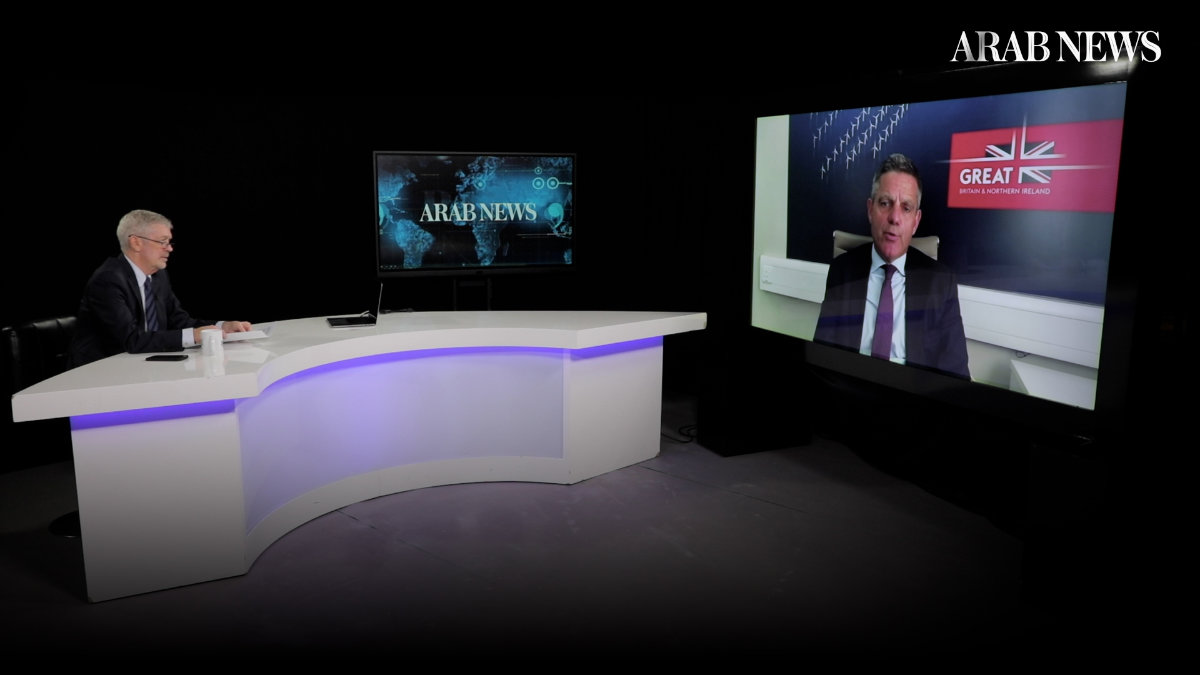
Frankly Speaking: Terror threat won’t deter British investment expansion in the Middle East, UK trade official says
Sun, 2022-02-06 23:35
DUBAI: Escalating terror attacks by Iran-backed Houthis will not deter British businesses from expanding investment in the Middle East, the UK official responsible for his country’s trade with the region told Arab News.
“The GCC, and within that the UAE, have been very popular destinations for both UK exporters and tourists over many years, and we certainly don’t see any drop-off in that interest,” Simon Penney, UK trade commissioner for the Middle East, said.
“In fact, the Gulf more broadly is the UK’s third-largest export market globally, outside of the EU. We are highly confident and have every reason to believe that our position as an exporting nation to the Gulf will improve even further in the years ahead.”
He was speaking after a spate of air strikes on the UAE, claimed by backers of Yemen’s Houthi militia, in an escalation of the terror campaign that has seen drones and missiles aimed at population centers and civilian infrastructure in Saudi Arabia.
The UK authorities warned British citizens of an increased threat and urged them to be vigilant, ahead of a visit by Prince William, the Duke of Cambridge, to the UAE this week. But Penney insisted that such threats would not dent the enthusiasm of British business for investment in the region.
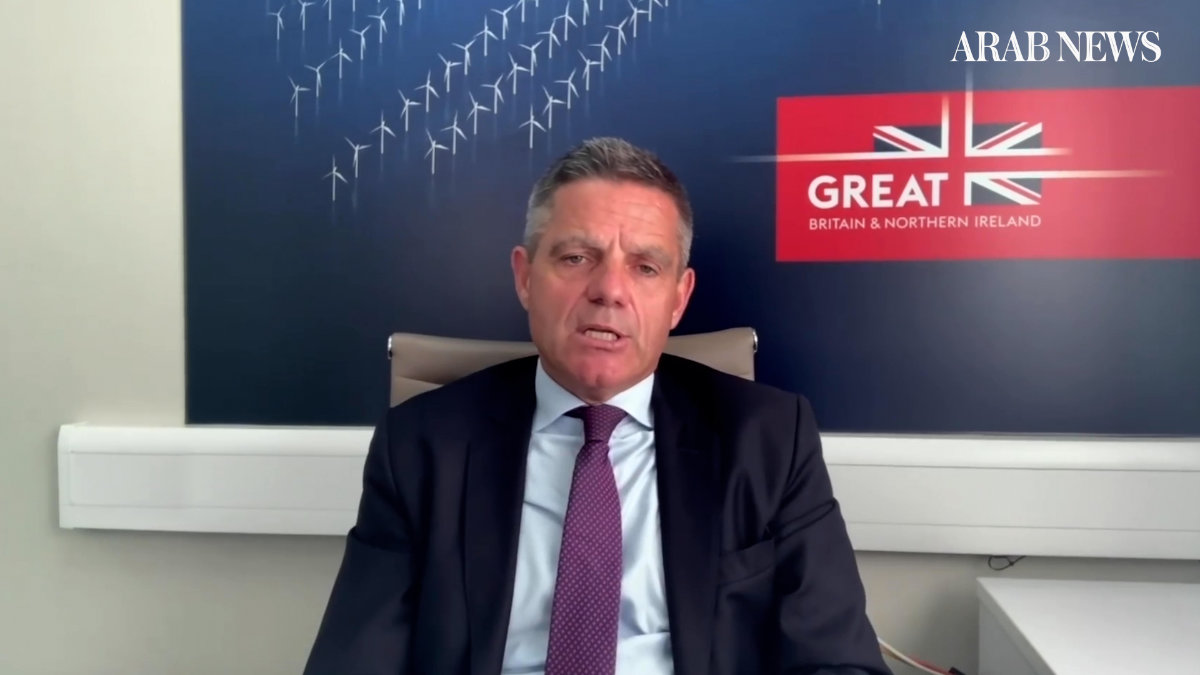
Simon Penney, a veteran banker, highlighted the attractions of Saudi Arabia as a trade partner for the UK. (Screen grab from Frankly Speaking video)
“We continue to see a very strong and healthy pipeline of companies doing business here,” he said.
“In fact, only last week we had (in Dubai) the Arab Health (trade fair). More than 140 UK companies made the trip out here, which was fantastic to see, not only in light of the events that you highlighted but also off the back of two years of COVID-19.”
In a wide-ranging interview on “Frankly Speaking,” the series of video conversations with leading policymakers and business people in the region, Penney — who is also the British consul in Dubai — spoke of the “passionate” interest of UK business in many sectors of Saudi Arabia’s Vision 2030 economic transformation strategy, the imminent prospects for a UK-GCC free trade agreement, and the potential for the Middle East to help compensate for some of the trade forgone by the UK in the post-Brexit world.
Penney, a banker in the Middle East before he took up his current role in 2018, highlighted the attractions of Saudi Arabia as a trade partner for the UK.
“I have to say I’m very passionate about the Kingdom. I’ve been working there in my various different jobs for more than a decade now and I’m as enthusiastic if not more today than I’ve ever been about the opportunities that exist in the Kingdom and across the whole of the Kingdom.”
“It’s not just about Saudi Arabia. We see a lot of activity in Qatar, obviously, with the FIFA World Cup coming up later this year, but also beyond that, in Oman, Bahrain and Kuwait. There really is a lot of interest in this region both ways.”
He added: “In fact, only the week before last I had the opportunity to visit NEOM and I was absolutely blown away by the sheer scale of the project, by the ambition of the project, from what can only be described, really, as a blank sheet of paper today.”
UK interest in Saudi Arabia was strong across all sectors that have been energized by the Vision 2030 strategy, he said, including healthcare, education, food and drink, and leisure and entertainment.
“And energy, of course. You know, as the Kingdom and the world embarks on this journey of energy transformation toward ‘clean growth,’ we’re seeing increasing interest around ‘clean growth’ and how we can work with the Kingdom to develop the technologies of the future,” Penney said, referring to the goal of simultaneously increasing national income and cutting greenhouse gas emissions.
British companies in the region were looking increasingly at Saudi Arabia rather than other GCC countries.
“In the UAE alone, we have 5,000 UK companies that call the UAE their home but, interestingly, as those companies look increasingly across the region for future business opportunities, it really is clear that Saudi Arabia, in particular, is going to be a major source of opportunity for those businesses,” he said.
Penney touched on the reaction in the UK to the recent proposals by the government of Saudi Arabia, which will require multinational companies to have their headquarters in Riyadh in order to conduct official business in the Kingdom.
“I think it’s varied. I know a lot of large British businesses that have been working in the Kingdom for quite some time that are actually embracing that because it makes good business sense — it’s where the majority of the business that companies are starting to do is, and you know it makes sense to be located in the Kingdom,” he said.
“I know other companies have a slightly longer-term watching brief on that. But I think companies will make decisions around what makes commercial sense. Certainly, in a lot of the companies that I’ve spoken to, based on what I said around the scale of opportunity that Saudi presents, that actually it will make good business sense to do so.”
Penney said: “It’s not just about Saudi Arabia. We see a lot of activity in Qatar, obviously, with the FIFA World Cup coming up later this year, but also beyond that, in Oman, Bahrain and Kuwait. There really is a lot of interest in this region both ways.”
Simon Penny says the GCC is the UK’s third-largest export market, outside of the EU, third behind the US and China. (Screen grab from Frankly Speaking video)
As someone who has been closely involved in preparations for a free trade agreement between the UK and the GCC, Penney outlined the next steps of that negotiations process.
“We will be launching negotiations for a GCC free trade agreement in the spring of this year,” he said.
“We have just concluded a parliamentary process, which is a uniquely UK process we need to go through before we can launch FTA negotiations. That 14-week consultation closed in mid-January.”
He added: “We’re now going through a process of assimilating and capturing all the feedback that we received from businesses and stakeholders during that consultation period. We’re factoring that into the negotiating strategy and approach the UK will adopt as we commence those FTA negotiations with the GCC.”
Since the decision to leave the EU, the UK has been seeking to put in place trade alliances with other major economic blocs as part of the “Global Britain” strategy. However, Penney insisted a UK-GCC agreement was not just a way of compensating for business lost with Europe in the wake of Brexit.
“On the contrary, I think, if anything, it’s going to spur business further. The GCC already is the UK’s third-largest export market, outside of the EU, third behind the US and China,” he said.
“So, already today the Gulf features very highly in the minds of UK exporters. We’re highly confident that by putting in place a free trade agreement, we’ll be able to reduce even further some of the barriers and impediments that businesses face in doing business here, which are not unique to the Gulf.”
Penney insisted that political uncertainty in the UK, where Prime Minister Boris Johnson is increasingly beleaguered after a series of scandals, would not deter Middle East investors from doing business with the UK.
“We don’t see any let-up in investor interest in the UK,” he said.
“In fact, since we’ve left the EU and the referendum in 2016, in particular, we’ve seen investor interest increase exponentially. Confidence in the UK, I would say, is probably the highest we have seen for a very long time.”
Frankly Speaking: ‘Houthi terror attacks will not deter American investments in the region, says Hall Delano RooseveltFrankly Speaking: Saudi Arabia can be a leading oil exporter while also fighting climate change, says deputy minister for environment
Survey shows negative attitudes among Turks towards Syrians on the rise
Sun, 2022-02-06 21:25
ANKARA: A new survey published by Turkey’s Social Democracy Foundation, known as SODEV, reveals negative feelings toward Syrian refugees in Turkey are on the rise.
Turkey, home to 3.7 million registered refugees from war-torn Syria, the world’s largest refugee population, has seen tensions in recent months between locals and Syrians, mostly driven by domestic politics and economic difficulties.
According to the SODEV survey, 66 percent of respondents think Syrians should return to their homeland, with this sentiment higher among voters of opposition parties.
More than half of those voters prefer the repatriation of Syrians, with this rate at about 42 percent among voters of the ruling Justice and Development Party.
Turkish respondents broadly describe Syrians negatively, with 45 percent thinking that Syrian refugees are dangerous people who could pose challenges in the future.
Forty-one percent of respondents consider them as a burden on society, and more than 70 percent of respondents said they were not “clean, trustworthy and polite,” while 57 percent believe that Syrians are not hardworking.
Across the country, 55 percent of people preferred not to have a Syrian neighbor, and about 65 percent said they would not marry, or allow their children to marry, a Syrian.
Half of respondents said they would be disturbed if Syrians went to the same school as their children, with 70 percent adding they only communicate with Syrians when they are obliged to.
However, half of the respondents said they have not faced any concrete problems with Syrians in their daily lives, and 77 percent said Syrian refugees had not harmed them in the past five years.
Omar Kadkoy, a migration policy analyst at Ankara-based think tank TEPAV, told Arab News: “In the last 11 years, and especially after 2016, the (Turkish) government prioritized project-based activities to induce and safeguard social cohesion over a strategy of integration.”
According to Kadkoy, the majority of Syrians and Turks live in parallel worlds, and populist politicians exploit this gap and enlarge it with misinformation and hate speech.
The survey also sheds light on the public perception about the ongoing financial help that has been extended to the refugee community in Turkey.
Half of the respondents think the Turkish state should provide humanitarian assistance only to Syrians in urgent need, while 70 percent think that Turkey has already helped Syrians more than enough.
With a debit card practice in force over the past six years, the EU supports one third of the vulnerable refugee population in Turkey to cover their basic needs each month.
So far, Brussels distributed over €4 billion ($4.579 billion) to NGOs and international aid groups working to improve the situation of refugees in Turkey.
Last year, the EU contributed an additional €3 billion to be used in refugee-focused projects until 2023.
Having repeatedly called on the EU share the burden, Turkey has spent more than €40 billion on refugees.
It has not solely been a story of deprivation, however; Syrians have established more than 10,000 companies in Turkey, some with the knowhow provided by EU-funded projects.
The companies are mostly active in the wholesale, real estate, hospitality, construction and manufacturing sectors.
Although these initiatives help sustain them and avoid being dependent on state aid, 67 percent of respondents are against the opening of Syrian businesses in Turkey, claiming that these companies do not pay taxes or trigger more unemployment in Turkey.
“This is largely driven by refusing (to accept) Syrians as members of the overall community,” Kadkoy said.
“Although there are informal businesses and the ones who run (them) are both Turks and Syrians, there are close to 10,000 companies registered with the Turkish chambers whose owners invested 2.1 billion lira ($154 million) to set up companies across Turkey, and they have created inclusive job opportunities,” he added.
However, about half of respondents said they would avoid shopping from a Syrian company; 82 percent of Turks think Syrians do not contribute to the Turkish economy, and 85 percent say they do not add to Turkey’s social fabric. Eighty percent think it would be impossible to live with Syrians peacefully.
Respondents expect that crime rates will increase, internal conflicts be exacerbated, that the economy will be weakened, and moral values will be harmed if Syrians stay longer in Turkey.
Ertan Aksoy, president of SODEV, said Turks consider the increased number of Syrian companies as a sign of permanence.
“They consider the presence of Syrians as a moral obligation, and accept the humanitarian assistance as long as they need it and in a restricted way,” he told Arab News.
According to Aksoy, ongoing prejudice against Syrian refugees is mainly motivated by the decreased purchasing power among Turkish citizens due to high inflation rates.
“As long as people struggle to earn a living, they start considering refugees as a scapegoat to blame (for) their daily economic problems,” he said.
“In addition to this, the influx of Afghan refugees following the Taliban takeover escalated social frustration,” added Aksoy.
“Rather than using the refugee card for domestic consumption and translating it into vote potential, opposition parties are mainly using a responsible rhetoric these days, apart from some breakaway figures.”
Experts also note that Turks from a lower socio-economic status are much more tolerant of Syrian refugees, though they have to share the job market with them.
“However, those who benefit from cheap labor of refugees, for instance the owners of factories, take a critical stance … when we survey them,” Aksoy said.
In the meantime, Turkish authorities recently found the bodies of 12 migrants who froze to death near Greece, blaming the tragedy on Greek guards sending them back across the border without shoes and clothes — allegations that were dismissed by Athens as “false propaganda.”
According to the official statistics on the readmission of migrants, Turkey took back 2,300 Syrians from the Greek islands as part of the readmission agreement.
Turkey to open $45m hospital for Syrian refugees with help from EUSyrian refugees stranded in Gaza ‘prison’ for a decade
Israeli leader talks to Biden about Daesh, Iran
Sun, 2022-02-06 21:23
JERUSALEM: Israel’s prime minister on Sunday congratulated President Joe Biden for last week’s deadly raid in Syria that killed the leader of Daesh, the Israeli premier’s office announced.
In a phone call with the president, Naftali Bennett told Biden that “the world is now a safer place thanks to the courageous operation of the US forces,” his office said.
Bennett and Biden also discussed Iranian military activity across the Middle East and efforts to block Iran’s nuclear program, it said.
Israel and Iran are arch-enemies, and Israel has raised vocal concerns about US-led efforts to revive the 2015 international nuclear deal between Iran and world powers.
The deal unraveled after President Donald Trump withdrew from it in 2018.
Israel objected to the initial deal and believes any attempts to restore it will not include sufficient safeguards to prevent Iran from developing a nuclear weapons capability.
Israel also says any deal should address Iranian military activity across the region as well as its development of long-range missiles capable of striking Israel.
Earlier Sunday, Bennett said Israel is closely watching world powers’ negotiations with Iran in Vienna, but reiterated his position that Israel is not bound by any agreement reached by them.
Israel has repeatedly threatened to strike Iran if it believes it is necessary to halt the country’s nuclear program.
Iran says its nuclear program is for peaceful purposes only.
“Anyone who thinks such an agreement will increase stability is wrong,” Bennett told his Cabinet early Sunday. “Israel reserves its right to act in any case, with or without an agreement.”
US grants sanctions relief to Iran as nuclear talks remain in balanceIran: US sanctions move ‘good but not enough’
Iraq receives hundreds of trafficked antiquities from Lebanon
Author:
Sun, 2022-02-06 21:16
BEIRUT: Iraq on Sunday received hundreds of trafficked antiquities from Lebanon.
The artifacts had been in Nabu Museum, a private institution in Lebanon’s Byblos region, and the handover took place at the National Museum, with the items given to Iraq’s embassy in Lebanon.
“A total of 337 artifacts were handed over, 331 of which are cuneiform and six others that were among 32 disputed pieces,” said Lebanese Culture Minister Mohammed Wissam Al-Murtada. “Iraqi, Syrian and Lebanese committees verified that the six pieces belong to Iraq, so it was decided that they should be handed over as well.”
Al-Murtada described the handover as “a gesture embodying cooperation between Lebanon and Iraq in the cultural field.”
Speaking about whether or not these disputed artifacts had been smuggled from Iraq, he said: “Lebanon’s General Directorate of Antiquities had previously revealed in a 2018 report that some pieces may have Iraqi origins.”
He added that the ministry “consequently assigned a committee of technical specialists to look into these disputed pieces.”
Archeology expert Dr. Jaafar Fadlalah told Arab News: “The owner of the Nabu Museum, who is a well-known businessman, obtained the antiquities displayed in his museum either by buying them from markets specialized in antiques or from auctions. When they were displayed in the museum, some of these pieces were found to belong to either Syria or Iraq.
“These artifacts should thus be returned to their rightful owners, while the disputed pieces remain in place until their ownership is proven. This is a rule followed in all museums around the world.
“During the wars in Lebanon, Iraq and Syria, a large number of antiquities were lost, and some of them were seized later, either during smuggling operations or found in antique shops.
“However, several artifacts may still be stored by those who acquired them but never displayed them, so it is impossible to know where they are and who their rightful owners are.
“The ceremony that was held at the National Museum to hand over the pieces to the Iraqi authorities is to encourage collectors to preserve the antiquities.”
He said that Lebanon had previously returned many pieces “without any celebrations” because they had been seized either during smuggling operations or found in local markets.
Nabu Museum owner Jawad Adra emphasized the “ongoing communication” with countries of the region to revive and preserve heritage, and that this understanding “annoys smugglers because we embarrass them.”
The General Directorate of the Internal Security Forces announced on Sunday the recovery of 300-year-old antiquities belonging to the ancient Saint John Church in Byblos, after they were stolen in late January.
It said that three people had been arrested. One was Lebanese, another was Syrian, and the third was Egyptian.