Former US Yemen envoy calls for Houthi terrorist listing

Author: 
Thu, 2022-02-17 00:10

AL-MUKALLA, Yemen: A former US ambassador to Yemen and veteran analyst has urged the Biden administration to redesignate the Houthi militia as a terrorist organization for resisting peace efforts to end the war and staging attacks on neighboring countries.

Writing for the US-based War on the Rocks platform on Tuesday, Gerald Feierstein said that the Biden’s administration should consider redesignating the Houthis as a Foreign Terrorist Organization since it is the only option available to pressure the Houthis to stop hostilities on the ground and comply with peace initiatives.

The former ambassador, who until now had opposed the proposed designation, added: “But, in the absence of other viable options to pressure the Houthis to abandon their military campaign and seek a peaceful political outcome to the war, it would be foolhardy not to consider the possible use of a terrorist designation as a tool in America’s kit.”

The senior vice president and senior fellow at the Middle East Institute in Washington, DC was among 100 former US diplomats and military officials who signed a letter in 2020 to the then US secretary of state Mike Pompeo arguing against adding the Houthis to the terror list.

Feierstein also opposed the designation in an interview with Arab News in March 2020, arguing that the militia should be treated and “defeated as an anti-Yemeni movement.”

But after a surge in fighting over the past year and renewed Houthi missile attacks on neighboring countries, Feierstein has argued that the US has little choice but to reclassify the militia.

“While the designation would still lack tangible, immediate effects on Houthi leadership, it would nevertheless send a powerful, symbolic message that delegitimizes the Houthi movement as a participant in Yemen’s political future,” he said, adding: “The past year has demonstrated that the Houthis will not return to the negotiating table until they accept that there is no alternative to a political resolution.”

FASTFACT

Gerald Feierstein said that the Biden administration should consider redesignating the Houthis as a Foreign Terrorist Organization since it is the only option available to pressure the Houthis to stop hostilities on the ground and comply with peace initiatives.

Feierstein is among many experts and Yemeni government officials who have warned against tolerating the powerful and radical Iran-backed Houthi movement. The militia’s arsenal of advanced ballistic missiles and long-range drones are being used to kill Yemeni civilians and target neighbouring countries, analysts have warned.

“As a member of Iran’s ‘axis of resistance,’ uncontested Houthi control of Yemen would pose an enduring challenge not only to the well-being of the Yemeni people but also to vital US interests, including stability in the Arabian Peninsula, freedom of navigation in the Red Sea and Bab Al-Mandeb, and even to Israeli security as the Houthis expand their missile and drone capabilities to reach as far as southern Israel,” Feierstein said.

To address the possible repercussions of designating the Houthis, the US should talk to international aid organizations that operate in Yemen, international monetary institutes, companies and other parties who might be impacted by the decision, Feierstein added.

“If the administration decides to pursue the option, it should discuss the terms of the designation with international humanitarian organizations, banks, commercial enterprises and others who might be affected by it to ensure that it’s crafted in a way to minimize unintended consequences,” he said.

The former US ambassador weighed in as the Houthis on Wednesday demanded that the Arab coalition end military operations and “the blockade and aggression” in order for peace talks to begin.

Responding to the UN Yemen envoy’s call for all factions in Yemen to accept UN-brokered peace efforts, Hussein Al-Azi, a Houthi official, said that the Arab coalition should lift restrictions on airports and seaports, and stop airstrikes on Houthi territory.

“Yes, addressing the humanitarian and economic aspect represents the only gateway to serious and real peace in Yemen,” Al-Azi said on Twitter.

Briefing the UN Security Council on Tuesday night, Special Envoy for Yemen Hans Grundberg said that he is working on a plan to revive peace efforts with the aim of reaching a political settlement in Yemen that would address the interests and concerns of the country’s warring parties.

“I count on the support of this Council to encourage all actors to participate constructively without delay. This is a real opportunity for Yemeni parties to shift gear and charter a peaceful way forward,” he said.

Main category: 

Coalition carries out strikes on Houthis in Marib and HajjahUAE envoy criticizes UN for failing to stem Houthi escalation



Lebanese judge sues police chief over central bank governor

Author: 
Associated Press
ID: 
1645043518165058100
Wed, 2022-02-16 23:38

BEIRUT: An investigative judge on Wednesday sued Lebanon’s police chief after accusing him of preventing security forces from bringing in for questioning the central bank governor, who is accused of corruption.
The move by Judge Ghada Aoun came a day after she said that a police force prevented members of State Security, an intelligence agency, from bringing central bank governor Riad Salameh from his home for questioning.
Aoun said Tuesday that she has sent a formal letter to Internal Security Force chief Maj. Gen. Imad Osman, asking for an explanation regarding the incident. She said fighting authorities and preventing the implementation of a judicial order as Osman did, is an offense.
It was not immediately clear if Osman will show up for questioning by a Lebanese judge next week.
Salameh, who is accused of corruption and dereliction of duty during Lebanon’s historic economic meltdown, is being sued by a Lebanese anti-corruption group. The value of the national currency has plunged, foreign reserves are running low and the highly indebted government has been unable to agree on an economic recovery plan.
Salameh is also being investigated in several countries including Switzerland, Luxembourg and France for potential money laundering and embezzlement.
The division between Internal Security Forces and State Security mirrors the rivalry between the country’s politicians. Osman is considered close to former Lebanese Prime Minister Saad Hariri, who quit politics last month, and was a main opponent of President Michel Aoun, who backs the head of State Security.
The judge has been also been blamed of being close to the president. They are both from the same family but not related.

Main category: 

Lebanese judge issues subpoena for cenbank governor Riad SalamehSaad Hariri expects the worse for Lebanon


Lebanese trust army — not Hezbollah — to secure stability, poll shows

Author: 
Wed, 2022-02-16 22:56

BEIRUT: Eighty-nine percent of respondents in a recent poll said they trusted the Lebanese Armed Forces to ensure the country’s stability, while 80 percent felt the same way about the religious leadership and 75 percent about the judiciary.

In contrast, just 19 percent of those polled — regardless of their religious beliefs — thought political parties could be trusted to ensure stability.

On Hezbollah, opinions were divided. The poll, conducted by Zogby Research Services, found that 48 percent of respondents had confidence in it to secure Lebanon’s stability, while 52 percent did not.

Almost two-thirds of those polled expressed the belief that the “weapons and forces of the resistance should be under the control of the LAF and this includes a majority of respondents in every sectarian community.”

The poll was carried out in September, 10 days after the formation of Najib Mikati’s government. The respondents were adults from various Lebanese regions and sects, and all said they were optimistic about the future despite the current situation being worse than it was five years ago.

A total of 869 people were asked their opinions on the economic crisis in Lebanon, how it has affected citizens and how far they trust state institutions. They also gave their views on Lebanon’s relations with other countries, the political regime and their hopes for the upcoming legislative elections.

Speaking at an event organized by the AUB Issam Fares Institute for Public Policy and International Affairs, also attended by Arab News, James Zogby, who owns the polling company, said: “The developments Lebanon has faced of late led to breaking the existing regime which needs reform, but the ruling political elite does not want to admit that.”

Zogby, who is also the founder and president of the Arab American Institute, said the poll showed that respondents had been seriously affected by shortages of fuel (97 percent), electricity (89 percent) and drinking water (74 percent). More than a third of people reported having to go without food on some occasions, with one in five from poor backgrounds saying they or members of their families had “very often gone without meals because of a lack of money or available food.”

“Almost two-thirds said they don’t have enough income to make ends meet. And when asked to identify the most pressing economic problems facing the country, far and away the two issues they pointed to were the collapse of the lira (Lebanese pound) and corruption. Given this dire situation, almost two-thirds of all respondents said they would emigrate if given the opportunity,” Zogby said.

He added that about 65 percent of respondents thought the “Oct. 17 revolution was beneficial for the country’s stability, while 29 percent said parliament does not ensure stability.”

Seventy-six percent of respondents under the age of 30 were more confident in the revolution ensuring Lebanon’s stability.

When asked whether Lebanon should strengthen or weaken its ties with other countries, only France scored well, with respondents supporting strengthening ties with Paris by a ratio of two to one.

On the US and Iran, a third of people said ties should be strengthened, a third said they should be weakened and a third said they should remain as they were.

Zogby said that respondents, “seemed optimistic of change in the next legislative elections,” with almost 60 percent expressing some confidence that they would “bring the political change Lebanon needs.”

That attitude may be due to the fact that two-thirds of respondents said they would be voting for the “new alternative parties, with this holding true for all demographic groups. Only one in five said they will vote for the traditional parties.”

This rejection extends to the Taif agreement, with almost 60 percent saying Lebanon should dispose of the Taif formula and “adopt a new constitutional model of governance.”

The results of the poll — which Dr. Fadlo Khoury, president of the American University of Beirut, said was based on reliable sources, and which was praised by Dr. Joseph Bahout, director of the Issam Fares Center for Public Policy and International Affairs at AUB — also raised a number of questions.

Dr. Brigitte Khoury, founding director of the clinical psychology training program at AUH, said: “People need food and health security, in addition to security itself. Every day brings new challenges to the Lebanese, which prevents them from planning for the future or from dreaming of a better future.”

She added that after the explosion of the port of Beirut, “people became more desperate and depressed, while the level of tension rose and people lost their power and control, and this is the hardest thing that a human being could face, and it could acquire a violent tendency especially among people who live through shocking events.”

Khoury said that if the “elections do not take place then I fear that people will further lose their power and control especially if there is no justice or a sound judiciary.”

Dr. Jamil Mouawad, a political scientist, expressed his fear that the “institutions which the Lebanese still trust might be a target for the untrustworthy political powers. We see how the judiciary and the military institutions are getting besieged by the politicians.”

He was skeptical about the “possibility of the next parliamentary elections producing promising changes if the parties in power revert to confessional polarization and to using money.”

The Lebanese “should agree on a political plan to get out of the crisis and this is something that is not clear. And the question that needs an answer is what is the political regime that the Lebanese want, and what are we protesting against?”

Mouawad said that “the ones who participated in the Oct. 17 revolution lack experience and should have history lessons to see what has happened.”

Despite being underfunded amid the country's economic crisis, Lebanon's Armed Forces command great trust among the citizenry to ensure the nation's stability. (AFP file photo)
Main category: 

Lebanese officials busy themselves with border dispute discussions against backdrop of port blast angerUS Treasury imposes more sanctions on Hezbollah-linked Lebanese individuals


Russia’s defense chief arrives in Syria to review naval drills

Author: 
Wed, 2022-02-16 00:51

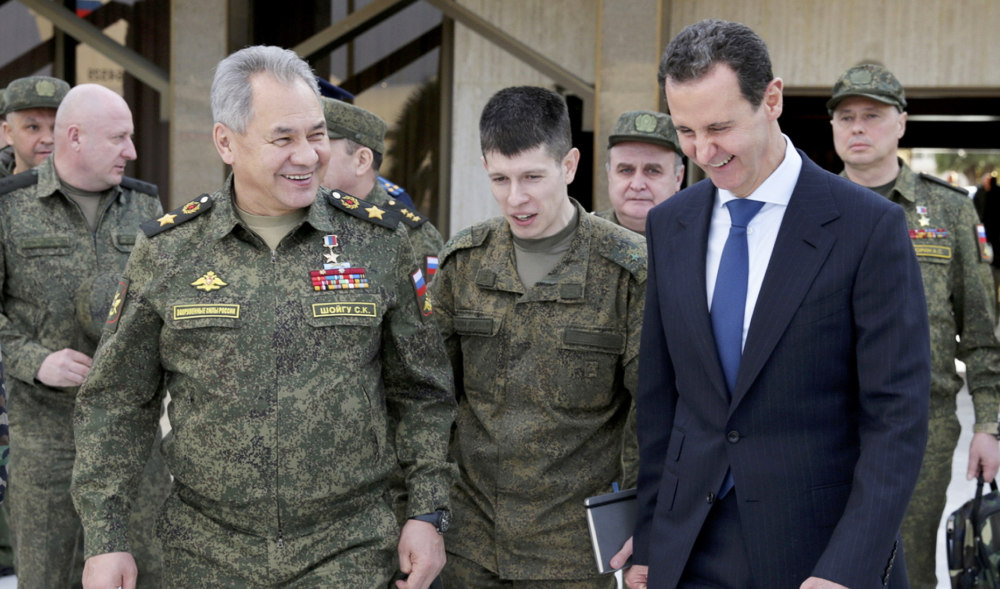
MOSCOW/DAMASCUS: Russian Defense Minister Sergei Shoigu traveled to Syria to inspect naval drills involving 15 warships and 30 aircraft in the eastern Mediterranean on Tuesday, the RIA news agency cited his ministry as saying.
The drills are part of a surge of Russian military activity amid a standoff with the West over security in Europe. Russia said earlier it had deployed fighter jets with hypersonic missiles to its Syrian air base for the naval exercises.
Moscow announced on Jan. 20 that its navy would stage an array of exercises involving all its fleets from the Pacific to the Atlantic, drawing on 10,000 servicemen, 140 warships and dozens of planes.
Meanwhile, a bomb attached to a bus carrying Syrian troops in Damascus exploded on Tuesday morning, killing one soldier and wounding 11, state TV reported.
The blast occurred during rush hour at a customs roundabout near the capital’s landmark Omayyad Square, according to the report. There was no immediate claim of responsibility.
Such attacks have occurred in Damascus in recent months amid an otherwise calm period in the capital. Regime forces captured rebel-held eastern neighborhoods of the city in 2018.
Regime forces now control much of Syria with the help of President Bashar Assad’s allies Russia and Iran, while rebels are mostly cornered in the country’s northwestern province of Idlib. US and Turkish troops, meanwhile, are deployed in parts of the country’s north and east.
In October, two bombs attached to a bus carrying Syrian troops exploded in Damascus, killing 14. It was one of the deadliest bombings in the capital in years.
A little-known group calling itself the Qasioun Brigades claimed responsibility for the attack at the time.
In recent years, attacks in Damascus have been rare. One of the last major explosions to take place was in 2017 — when bombers hit a judicial office building and a restaurant, killing nearly 60 people.

In this photo taken on Tuesday, Feb. 15, 2022, Russian Defense Minister Sergei Shoigu, left, and Syrian President Bashar Assad, right, smile during their meeting in Damascus, Syria. (AP)
Main category: 
Tags: 

Two women, two children among six killed in Syria regime shelling on Idlib


Israeli premier meets Bahrain crown prince in push to tighten ties

Wed, 2022-02-16 00:37

MANAMA: Israel’s prime minister met Bahrain’s crown prince on Tuesday as the new allies sought to nurture closer cooperation and present a united front to their shared nemesis Iran.

Prime Minister Naftali Bennett was making a one-day visit to the Gulf island kingdom, the first by an Israeli leader, less than two years after the countries established formal diplomatic relations as part of the US-brokered “Abraham Accords.”
Bennett was greeted by Crown Prince Salman bin Hamad Al-Khalifa, who also serves as the kingdom’s prime minister, and a military color guard at Manama’s Gudaibiya Palace. He told the crown prince that he came “with a spirit of goodwill, of cooperation, of standing together against mutual challenges.”
Bennett also met several government ministers and discussed the need for greater economic cooperation.
“We must do more to get to know one another and build upon the Abraham Accords, which have been such a historic agreement,” the crown prince said.

HIGHLIGHT

Israel has stepped up its naval presence in the Red Sea after a series of attacks on commercial ships with links to Israel, which it blamed on Iran.

In recent months, as tensions with Iran have soared, the two countries have intensified military cooperation.
Early this month, they signed a defense pact, and last week, Bahrain announced that an Israeli naval officer would be stationed in Manama, which is also home to the US Navy’s 5th Fleet.
The Israeli military confirmed it will have a naval representative attached to the 5th fleet.
Bennett met with the fleet commander, Vice Adm. Brad Cooper, during his stop in Manama. Bennett’s office said the fleet “is a significant element in maintaining regional stability in the face of various security threats.”
It did not mention Iran specifically. But Israel has made no secret of its concerns about Iranian naval activities across the region.
Israel has stepped up its naval presence in the Red Sea after a series of attacks on commercial ships with links to Israel, which it blamed on Iran.
Earlier this month Israeli ships took part in a massive naval exercise in the Gulf. Israeli warships also participated in US-led naval drills with the UAE and Bahrain in the Red Sea in November.
Israel and Bahrain established formal diplomatic ties after years of clandestine security cooperation over their shared enmity of Bahrain’s neighbor, Iran.
Israel and Bahrain have exchanged ambassadors and signed trade and defense agreements since they signed a normalization agreement on the White House lawn, alongside the UAE, Sudan and Morocco, in September 2020.
Bennett’s visit came as negotiations between world powers and Iran to reach an international agreement to curb Tehran’s nuclear program continued in Vienna.
Israel has said it would not be bound by any such agreement and that it would take whatever action necessary, including a military strike, to prevent Iran from obtaining nuclear arms.


Bahrain Crown Prince and Prime Minister, Prince Salman bin Hamad Al Khalifa receives Israeli Prime Minister Naftali Bennett at Gudaibiya Palace, Manama, Bahrain, February, 15, 2022. (Reuters)
Main category: 
Tags: 

Israeli prime minister lands in Bahrain in first visitIsraeli forces kill Palestinian teen in West Bank clashes