Early marriage blights lives of young girls in Lebanon’s marginalized communities

Wed, 2022-02-23 23:09

DUBAI: Nadia, 14, should be in school in her native Syria. Instead she is married to someone 13 years her senior in neighboring Lebanon.

She was married off by her father, Yasser, a Syrian refugee, on the promise of $8,000, half upfront and the rest when the marriage contract was signed.

“Her suitor approached me when she was studying,” Yasser told Arab News. “He promised he would treat her right and help me open a minimarket to better my finances. But he turned out to be a liar and an abuser.”

Among refugees in Lebanon, Nadia’s plight is not uncommon. Grinding poverty and a dearth of opportunities have forced many families to make similarly desperate decisions — in effect selling their daughters to secure a semblance of financial security.

Yasser regrets his decision. “Her husband won’t let her talk to me,” he said. “I called once. He overheard her saying baba (father) and then snatched the phone away. I felt like my heart was set on fire.”


A campaign to highlight the plight of child brides went viral on social media thanks to a powerful image showing a middle-aged man posing with a 12-year-old girl on their wedding day. (Supplied)

In addition to the perils of poverty in exile, the estimated 1.5 million Syrian refugees in Lebanon must also endure the myriad of challenges facing their host country amid its crippling economic crisis.

Add to that the effects of the COVID-19 pandemic, political paralysis and the ongoing violence in Syria that militate against the return of displaced families, and the options for many appear bleak.

Against such a backdrop, marrying off children is seen by some communities — including impoverished Lebanese — as one of the few avenues available to them.

Reem, who is Lebanese, was only 16 when she consented to an arranged marriage. She did not object to the idea because several of her friends and neighbors were also tying the knot at around the same time.

One of the main factors in her decision — which in reality was only partly her own to make — was a desire to ease the financial burden on her parents. Now, three years into her marriage, she feels trapped.


A Lebanese woman holds a placard as she participates in a march against marriage before the age of 18, in the capital Beirut. (AFP/File Photo)

“I wish I never went through it,” she told Arab News. “What did I know? I have a daughter. Where will I go with her? I thought I was helping my parents to have one less mouth to feed. Now it seems I added one.”

In Lebanon and Syria, children continue to be married off, with neither government paying much heed. Under Lebanon’s constitution, personal-status laws are decreed by each individual sect, combining common law with religious doctrine.

As a result, matters such as marriage, divorce, custody and inheritance are often governed by religious courts. Each of the major sects has a different legal age for marriage; for Catholics it is 14, Sunnis have raised it to 18, and Shiites have set it at 15.

According to the constitution: “The state guarantees that the personal status and religious interests of the population, to whatever religious sect they belong, shall be respected.”


Aya Majzoub, a researcher for Human Rights Watch, says the impact of child marriage on young girls is “devastating.” (Supplied)

Civil society groups in Lebanon have long urged the government to introduce an all-encompassing personal-status law.

A report published by Human Rights Watch in 2017 said it would be a “common sense measure” to raise, without delay, the minimum age of marriage to 18 without any exceptions. Such a law was drafted that same year but never passed.

“The impact on girls is devastating,” Aya Majzoub, a researcher for HRW, told Arab News. “They are at heightened risk of marital rape, domestic violence and a range of health problems due to early childbearing.

“Lebanon’s parliament can help end this practice. The Lebanese government and local authorities should develop programs to prevent child marriages, such as empowering girls with information and support networks, as well as engaging parents and community members about the negative effects of child marriage.”

INNUMBERS

* 12 million girls under the age of 18 married off worldwide every year. (HRW)

* 13 million additional child marriages estimated to occur in next 10 years due to the pandemic. (UN)

* 2030 is UN’s Sustainable Development Goal target year for eliminating marriage before age of 18

The high number of children who have missed out on an education in Lebanon over the past two years, because of the pandemic and the economic crisis, has increased the likelihood of premature marriage, particularly among vulnerable refugee communities.

A recent report titled Searching For Hope published by UNICEF, the UN’s children’s agency, revealed that 31 percent of children in Lebanon are out of school and that enrollment in classes had dropped to 43 percent in the current academic year.

The figures are thought to be much worse among refugee communities, where in many cases children have little access to any education at all.

Aid agencies have made efforts to end the custom of underage marriage by raising awareness of the effects it has on girls’ lives and the potential for traumatic physical damage to pre-teens whose bodies are not sufficiently developed to endure the rigors of childbirth.

KAFA, which translates as “enough” in Arabic, is a Lebanese nongovernmental organization that was established in 2005 with the aim of eliminating all forms of gender-based violence and exploitation.


Besides legal reforms and active public-awareness campaigns, aid agencies believe the key to ending child marriage is poverty reduction and providing vulnerable communities with economic security. (AFP/File Photo)

In 2016, it launched a campaign to highlight the plight of child brides. It also provides psychosocial support to survivors.

The campaign went viral on social media thanks to an extremely powerful image that showed a middle-aged man posing with a 12-year-old girl on their wedding day.

“Based on the abused women who come to our center, our statistics show that 20 percent of them were actually child brides,” Celine Al-Kik, supervisor of the KAFA support center, told Arab News.

“There is a link between violence and child marriages. We are permitted by law to intervene and provide legal assistance when the underage girl is kidnapped, and when her parents oppose her marriage when her suitor has her convinced.”

Besides legal reforms and active public-awareness campaigns, aid agencies believe the key to ending child marriage is poverty reduction and providing vulnerable communities with economic security.

“Families experiencing the economic crisis in Lebanon are increasingly resorting to marrying off young girls as a coping strategy for the deepening crisis,” Nana Ndeda, policy director with Save the Children, told Arab News.

“It is important that the economic drivers of child marriage are urgently addressed. Girls who marry are most likely to drop out of school and have limited access to decent work. Child marriage is a violation of human rights.”


Young Lebanese girls disguised as brides hold a placard as they participate in a march against marriage before the age of 18, in the capital Beirut on March 2, 2019. (AFP/ANWAR AMRO/File Photo)

Rawda Mazloum, a Syrian refugee, campaigns on the issues of women’s rights and gender-based violence in the camps of eastern Lebanon’s Bekaa Valley.

She organizes community workshops and partners with local nongovernmental organizations, such as KAFA, to try to raise awareness about the growing rates of child marriage, divorces and violence within the Syrian refugee community.

“The youngest girl I know of (who got married) was only 13,” Mazloum told Arab News. “Her parents, like the rest, were struggling. These girls often get abused. They are not aware of their rights as they are still children. They are victims of ignorance, poverty and war.”

As the crises on both sides of the Syrian-Lebanese border bleed into one another, the daily fight for survival, and the desperate decisions that come with it, is unlikely to end soon.

A report published in 2019 by Save The Children in Lebanon, titled No I Don’t, lists poverty, conflict and lack of education as the primary factors driving child marriage.
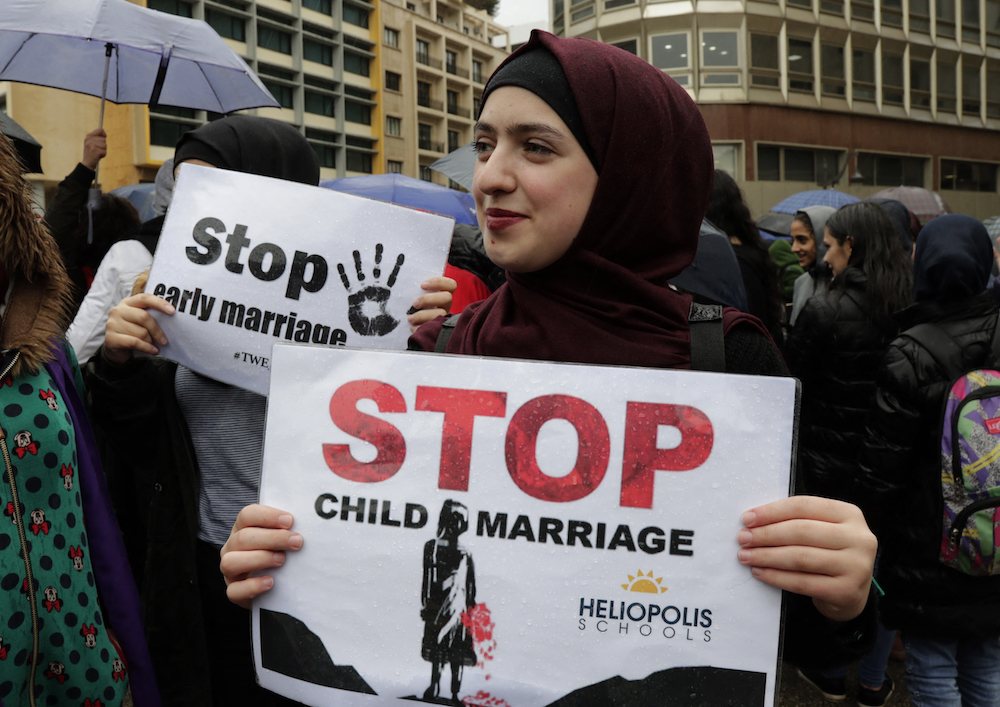

A report published by Human Rights Watch in 2017 said it would be a “common sense measure” to raise, without delay, the minimum age of marriage to 18 without any exceptions. (AFP/File Photo)

However, it notes that child marriage can also be a means by which families try to protect their daughters from sexual harassment.

Parents who have married off young daughters often say security is a key motivation. Indeed, when refugees and impoverished households live in densely populated spaces among many strangers, there is a higher perceived risk of sexual harassment and violence toward girls.

Providing a male figure who can offer protection is often a consideration. In the case of Yasser and his daughter Nadia, however, the opposite proved to be the case.

“I thought I was offering her a better alternative, a better life,” he told Arab News. “But he wasn’t serious about her. He used her for fun.”
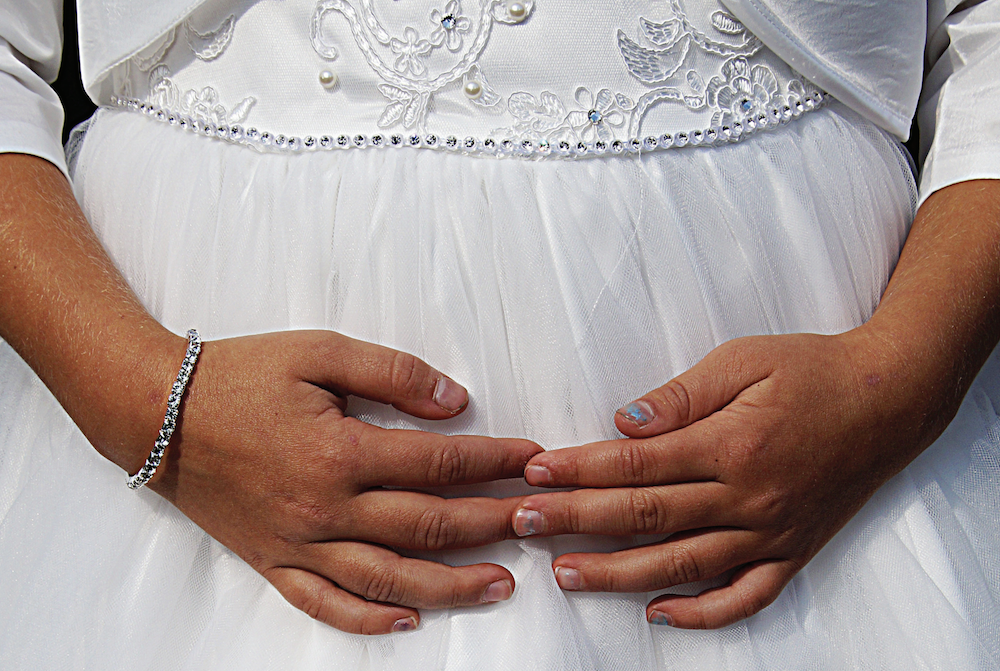
Besides building awareness, aid agencies believe the key to ending child marriage is poverty reduction and providing vulnerable communities with economic security. (Shutterstock)
Main category: 

‘Still a lot to do,’ rights groups say after Philippines bans child marriagePhilippines bans child marriage



Iranian prisoner dies of heart attack after death penalty retracted

Wed, 2022-02-23 23:02

LONDON: A 55-year-old Iranian convict died from a heart attack after being informed that his death penalty sentence was being retracted for a murder he committed 18 years ago because the victim’s family forgave him.

Iranian newspaper Hamshahri said the man, Akbar, had been detained along with four others for premeditated murder.

He was convicted along with another man, Davood, who had reportedly already been executed for his involvement in the murder.

A dispute-resolution board mediated between the victim’s family and Akbar. The family initially resisted granting clemency, but eventually gave their support after hearing of his poor health. 

But as the family experienced a change of heart, Akbar’s failed, with the overjoyed prisoner dying before he could taste freedom.  

Iranian officials prepare a noose in 2017 (file photo). The country is believed to execute most people per capita, with Iran Human Rights Monitor reporting that 365 prisoners were executed in 2021 alone. (AFP/File Photo)
Main category: 

Iran uses death penalty to target protesters, human rights expert tells UNHouthi death penalties condemned by Yemeni government, activists


Houthi death penalties condemned by Yemeni government, activists

Author: 
Wed, 2022-02-23 22:14

AL-MUKALLA: Government officials, human rights activists and journalists on Wednesday strongly condemned the death sentences handed down to Yemenis by the Iran-backed Houthis.

The Specialized Criminal Court in Sanaa, which is controlled by the Houthis, on Tuesday sentenced to death three people, including a school principal, on charges of colluding with the Coalition to Restore Legitimacy in Yemen and the Yemeni government.

Fahed Al-Salami, who runs Al-Nahdah private school in Sanaa, Sadeq Mohammed Al-Majedi and Khaled Ahmed Al-Oulefi were found guilty of forming five military units of hundreds of fighters to undermine security in Houthi-controlled areas, sending the locations of military sites to the coalition, and receiving training and military support from the government in the central city of Marib.

The court also handed down jail terms to 10 other people, including a journalist at Yemen’s official news agency, who were abducted in 2015 and 2016.

Yemeni officials and activists said that all 13 people had been abducted from their homes or offices in Sanaa and tortured by the Houthis.

Majed Fadhail, deputy minister of human rights and part of a government delegation involved in prisoner swap talks with the militia, told Arab News on Wednesday that the abductees were on the government’s list of people who would be swapped with Houthi prisoners.

He accused the Houthis of using judicial bodies in areas under their control to get rid of their opponents.

“Those abducted academics, teachers, journalists and doctors are facing trumped up charges,” Fadhail said. “The judicial system is no longer effective and the Houthis are using it as a tool to silence their challengers.”

Fuad Al-Mansouri, a Yemeni human rights activist, told Arab News that the trials of abducted people and the death sentences handed down to them showed that the Houthis would not tolerate dissent.

“Those are purely politically motivated verdicts, targeting their political opponents,” he said.

Al-Mansouri, his wife and fellow activist Zafaran Zaid were last year sentenced to death in absentia by a Houthi court over allegations that they helped activists to flee Houthi-controlled areas.

“With these verdicts, the militia says you must be a Houthi or loyal to the movement or you will be jailed, displaced, sentenced to death or you will be abducted,” Al-Mansouri said.

Nabil Al-Osaidi, a member of the Yemeni Journalists’ Syndicate, condemned the jail sentence given to Yemeni journalist Nabil Al-Sedawi, and demanded the militia “immediately and unconditionally” free him.

Since the Houthis seized power in Yemen in late 2014, thousands of people, including politicians, activists, journalists and security and military officials have been forced to flee Sanaa and other areas.

The Houthis harassed their families and sentenced them to death, froze their bank accounts and confiscated properties.

Meanwhile, Yemeni activists and local media reports said the Houthi authorities fired the principal of Manarat Sanaa International School in Sanaa for allegedly arranging a cultural activity that “violated Islamic norms.”

A video posted online shows several girls dressed in traditional attire dancing on a stage at their school in front of a jubilant audience.

“Ignorant and clueless outsiders (sometimes elite Yemenis who like to fit in) accuse us Yemenis who stand up to the Houthis of being ‘biased’ when all we are trying to do is defend our country against a supremacist, radical and violent group,” Nadwa Al-Dawsari, a Yemeni conflict analyst, said on Twitter, criticizing the Houthis for harassing the school’s principal and students.

Main category: 
Tags: 

Coalition: Over a dozen Houthi military vehicles destroyed in strikes on Yemen’s HajjahUAE designates 5 entities for Houthi support, US sanctions militia finance network


El-Sisi affirms Egypt’s keenness on Kuwait, Gulf’s stability and security in confronting internal and regional challenges

Author: 
Wed, 2022-02-23 00:49

LONDON: President Abdel-Fattah El-Sisi on Tuesday affirmed Egypt’s keenness on the stability and security of Kuwait and all the Gulf states in the face of internal and regional challenges, as an integral part of the Egyptian national security
Speaking during a meeting with Kuwait’s Emir Sheikh Nawaf Al-Ahmed Al-Jaber Al-Sabah, El-Sisi said his country was also keen to strengthen and diversify the frameworks of joint bilateral cooperation in the political, security, economic and commercial fields, Egyptian Presidency Spokesman Bassam Rady said.
Sheikh Nawaf expressed his appreciation for Egypt’s efforts in support of Kuwaiti affairs at all levels, as well as the Egyptian community’s contribution to the construction and development process in Kuwait in various fields.
He said in the coming period, Kuwait will increase investments in Egypt and exploit the opportunities available there, and praised Cairo’s role in strengthening the mechanisms of joint Arab action in facing the current crises and challenges in the region.
Rady said the meeting discussed a number of Arab and regional issues of common interest, as well as developing Egyptian-Kuwaiti cooperation, especially in light of the upcoming 13th session of the Egyptian-Kuwaiti joint committee in Cairo and the joint consular committee between the two countries.
The spokesman said they also discussed efforts to combat terrorism and extremist ideology and spread a culture of tolerance and moderation in the region and agreed to jointly coordinate to confront challenges to promote peace and stability.
During his official one-day visit to Kuwait, El-Sisi also held talks with Crown Prince Sheikh Meshaal Al-Ahmed Al-Jaber Al-Sabah, and Prime Minister Sheikh Sabah Khaled Al-Sabah.
Kuwaiti Minister of Amiri Diwan Affairs Sheikh Mohammed Abdullah Al-Mubarak Al-Sabah said that the discussions were held in “a cordial atmosphere, reflecting the depth of the strong brotherly relations between Kuwait and Egypt,” Kuwait News Agency reported.

Kuwait’s Crown Prince Sheikh Meshaal Al-Ahmed Al-Jaber Al-Sabah meets Egyptian President Abdel-Fattah El-Sisi. (KUNA)
Egyptian President Abdel-Fattah El-Sisi meets Kuwaiti Prime Minister Sheikh Sabah Khaled Al-Sabah. (KUNA)
Kuwait’s Emir Sheikh Nawaf Al-Ahmed Al-Jaber Al-Sabah meets Egyptian President Abdel-Fattah El-Sisi. (KUNA)
Main category: 

Egypt and UK slam Houthi targeting of Saudi airportEgyptian, French forces launch joint drillGrowth in food, clothing and home maintenance prices drove Kuwait consumer inflation higher in 2021Kuwait Emiri decree accepts resignations of defense, interior ministers -tweet


Archaeologists find 9,000-year-old shrine in Jordan desert

Author: 
By OMAR AKOUR | AP
ID: 
1645560099513398700
Tue, 2022-02-22 23:06

AMMAN, Jordan: A team of Jordanian and French archaeologists said Tuesday that it had found a roughly 9,000-year-old shrine at a remote Neolithic site in Jordan’s eastern desert.
The ritual complex was found in a Neolithic campsite near large structures known as “desert kites,” or mass traps that are believed to have been used to corral wild gazelles for slaughter.
Such traps consist of two or more long stone walls converging toward an enclosure and are found scattered across the deserts of the Middle East.
“The site is unique, first because of its preservation state,” said Jordanian archaeologist Wael Abu-Azziza, co-director of the project. “It’s 9,000 years old and everything was almost intact.”
Within the shrine were two carved standing stones bearing anthropomorphic figures, one accompanied by a representation of the “desert kite,” as well as an altar, hearth, marine shells and miniature model of the gazelle trap.
The researchers said in a statement that the shrine “sheds an entire new light on the symbolism, artistic expression as well as spiritual culture of these hitherto unknown Neolithic populations.”
The proximity of the site to the traps suggests the inhabitants were specialized hunters and that the traps were “the center of their cultural, economic and even symbolic life in this marginal zone,” the statement said.
The team included archaeologists from Jordan’s Al Hussein Bin Talal University and the French Institute of the Near East. The site was excavated during the most recent digging season in 2021.

Main category: 

Archeologists discover pregnant woman with fetus in Ancient Egyptian burial siteSaudi authorities sign deal to preserve heritage sites